Affiliate Marketing Ecommerce Growth Guide
Category: Affiliate marketing ecommerce
Affiliate marketing is a straightforward concept for any online store. You team up with creators, publishers, and influencers—your affiliates—who promote your products. When someone they refer buys something, you pay them a commission. It's a powerful, low-risk way to find new customers and boost sales, all based on actual performance.
Why Affiliate Marketing Is a Game-Changer for Ecommerce
 Every ecommerce brand faces the same puzzle: how to get new customers without draining the marketing budget. Traditional ads can feel like a shot in the dark—you pay upfront and cross your fingers for results. Affiliate marketing flips that script entirely, giving you a cost-effective and scalable growth machine powered by genuine partnerships.
Instead of paying for clicks or views, you only pay for a completed sale. This performance-first model dramatically cuts your financial risk and directly connects your marketing spend to your revenue. If you're new to this, it's worth taking a moment to understand the basics of what is affiliate marketing to see why it's such a big deal for online stores.
The Power of Trusted Recommendations
The magic behind a successful affiliate program comes down to one word: trust. Your affiliates, whether they're niche bloggers, YouTube creators, or Instagram influencers, have already put in the work to build a loyal following. When they recommend your product, it’s not just another ad—it’s a personal endorsement from a source their audience already knows and respects.
This "borrowed trust" is pure gold. A shopper is much more likely to buy something based on a creator's recommendation than from a random pop-up ad. The result? Higher conversion rates and customers who feel good about their purchase.
At its heart, affiliate marketing is about leveraging relationships. You're not just buying ad space; you're partnering with passionate advocates who can authentically integrate your products into their content, reaching engaged audiences ready to buy.
Impressive and Predictable ROI
The numbers don't lie. Over 81% of brands now run affiliate programs, and the reason is clear. The average return on investment (ROI) is a staggering $15 for every $1 spent, a figure that leaves many other marketing channels in the dust. You can dig deeper into this by reading the full research about affiliate marketing ROI.
This kind of return is why we're seeing a major shift. More and more ecommerce businesses are moving bigger chunks of their marketing budgets into building and growing their affiliate channels. It turns marketing from a simple expense into a predictable, profit-driving engine.
Laying the Groundwork for a Winning Affiliate Program
An affiliate program that actually moves the needle doesn't just happen. It’s built on a smart foundation, one that’s designed to attract the right partners and keep things running smoothly right from the get-go. Before you even think about recruiting, you need to get these core pieces in place. For a more detailed look at the initial setup, this guide on how to start an affiliate program is a fantastic resource.
First things first, what does success actually look like for your brand? Without a clear goal, you're just flying blind.
Are you trying to blast your brand name out to as many new audiences as possible for sheer awareness? Or is your focus sharper, zeroing in on acquiring brand-new customers? Maybe you just want to crank up the sales volume, and you don't care if the buyer is new or returning. Nailing down this "north star" early on will guide every other decision you make.
How Will You Pay Your Partners? Crafting a Smart Commission Structure
Your commission structure is the heart of your affiliate program. It has to be tempting enough to attract great partners but also sustainable for your own bottom line. There's no magic bullet here; the best model really depends on your products, your average order value (AOV), and your margins.
Here are a few common ways to structure payouts:
- Percentage of Sale: This is the most common for a reason. You offer affiliates a cut (say, 8-15%) of the sale they drive. It’s simple, fair, and scales perfectly with performance.
- Flat Fee Per Sale: This works great if you have a single-price product or want to push specific items. For example, you could offer a flat $20 for every sale of a high-margin product you want to move.
- Tiered Commissions: A fantastic way to keep your top affiliates motivated. You increase their commission rate as they hit sales goals (e.g., 10% for the first 10 sales, then 12% for sales 11-25).
My advice? Do some recon. See what your direct competitors are offering their affiliates. If their standard rate is 10% and you come to the table with 5%, you’re going to have a tough time recruiting the best talent. You don’t need to start a price war, but you do need to be competitive.
Choosing Your Tech: The Backbone of Your Program
Okay, you've got your goals and your commission plan. Now, you need the technology to power it all. This is a huge decision for any affiliate marketing ecommerce strategy. The global affiliate marketing space is now worth around $18.5 billion, and it's not slowing down. That kind of growth demands solid tech.
You're basically choosing between dedicated software and an established affiliate network.
A platform like Coral lets you build and manage your own program from the ground up, plugging directly into your Amazon store. This route gives you total control—you decide the branding, you approve every partner, and you can even set custom commission rates for different affiliates. If you're a brand that wants that level of customization, it's worth exploring the different ecommerce affiliate programs and the tools they use. Taking this hands-on approach allows you to build a system that’s perfectly scaled to what your brand actually needs.
How to Recruit and Onboard the Right Partners
Now that you've built a solid program foundation, it’s time to find the right people to bring it to life. Let's be clear: a successful affiliate program isn't about getting a flood of sign-ups. It’s about attracting quality partners whose audiences genuinely align with your brand and your customers.
Your ideal partners aren't all the same. In fact, they come in all shapes and sizes, and each type brings something unique to your affiliate marketing ecommerce strategy.
- Niche Bloggers & Content Creators: These folks are masters of trust. A detailed review from a blogger who lives and breathes sustainable home goods will hit home with their audience far better than any generic ad ever could.
- Major Media Publishers: Big publications can send a ton of traffic your way and add a layer of credibility. Just be prepared; they often command higher commission rates or placement fees.
- Coupon & Deal Sites: These affiliates are experts at snagging buyers right at the finish line. They’re fantastic for driving volume, but be mindful that they can sometimes attract one-off bargain hunters.
- Social Media Influencers: If your products are visual, influencers on platforms like Instagram and TikTok are your best friends. They create authentic, engaging content that feels more like a personal recommendation than an advertisement.
Finding and Attracting Your Ideal Affiliates
So, where are these amazing partners hiding? You have to be proactive. Don’t just launch your program and wait for the applications to trickle in.
A great first move is to see what your competitors are up to. Which influencers are shouting them out? What blogs are linking back to their product pages? You can use tools like Ahrefs or Semrush to uncover who's sending them traffic. This gives you a pre-vetted list of potential partners who are already active and trusted in your niche.
Once you know who you want to reach, you need a compelling place for them to land. This is where a dedicated affiliate landing page is non-negotiable. Using a tool like Coral, you can quickly spin up a professional, branded sign-up page that lays out all the benefits of joining your program.
Think of your affiliate landing page as your sales pitch. It needs to convince potential partners why they should choose you. Make sure you highlight your competitive commission rates, the quality of your products, and any unique perks you offer, like early access to new launches.
Setting New Partners Up for Success
Getting a partner to sign up is only half the job. A smooth onboarding process is what transforms an approved applicant into an active, motivated partner who actually drives revenue. The moment you approve a new affiliate, your mission is to give them everything they need to start promoting effectively—right away.
Don't make them hunt for information. Your welcome email is their first step to success and should include:
- A direct link to their new affiliate dashboard.
- Simple instructions on how to generate their unique tracking links.
- Access to a library of creative assets, like high-quality product photos, pre-written copy, and brand-approved banners.
Remember, a well-equipped affiliate is a motivated one. For instance, a fashion blogger can’t create a great post without lifestyle images and specific product details. By providing these resources upfront in a central spot like the Coral dashboard, you remove all the friction. This empowers them to create high-converting content from day one, getting results for your ecommerce affiliate program that much faster.
Proven Tactics to Optimize Your Program for Sales
Getting your program live is a fantastic first step, but the real journey begins now. Consistent, hands-on optimization is what separates a powerhouse affiliate program from one that quietly fades away. This is all about actively managing your partnerships to keep them healthy, motivated, and laser-focused on your sales goals.
The first thing I always do is jump into the performance data. Your Coral dashboard is a goldmine—it shows you exactly which partners are bringing in the clicks and, more importantly, the sales. Pinpoint those top performers. These are your all-stars, the ones sending you high-quality traffic that actually converts.
But don’t just pop the champagne and move on. Dig into why they’re succeeding. Are they masterminds at in-depth product reviews? Do they create killer tutorial videos? Maybe they have a loyal community they share exclusive deals with. When you understand their winning formula, you've found a playbook you can share to help your other affiliates find similar success.
Keeping Your Partners Active and Engaged
Once you know what’s working, your next job is to keep that momentum going. The biggest mistake I see brands make is taking a "set it and forget it" approach to affiliate marketing ecommerce. You have to stay engaged to keep your program top-of-mind.
Regular communication is absolutely essential, but that doesn't mean you should flood their inboxes. A simple monthly newsletter can work wonders. Pack it with updates on new products, a list of your current best-sellers, and a heads-up on any upcoming promotions.
You can also light a fire under your affiliates with targeted campaigns and friendly competitions. Here are a few ideas that have worked well for me:
- Performance Bonuses: Offer a $100 bonus to any partner who drives over $1,000 in sales during a key shopping month, like November or December.
- Tiered Commission Bumps: Create an incentive for new partners by automatically increasing their commission from 10% to 12% after they make their first 50 sales.
- Product-Specific Pushes: Launching something new? Offer a limited-time, higher commission rate specifically for that item to get everyone focused on promoting it.
This flow chart gives you a great visual of how a successful affiliate thinks and operates—moving from brainstorming to promotion and then back to review.
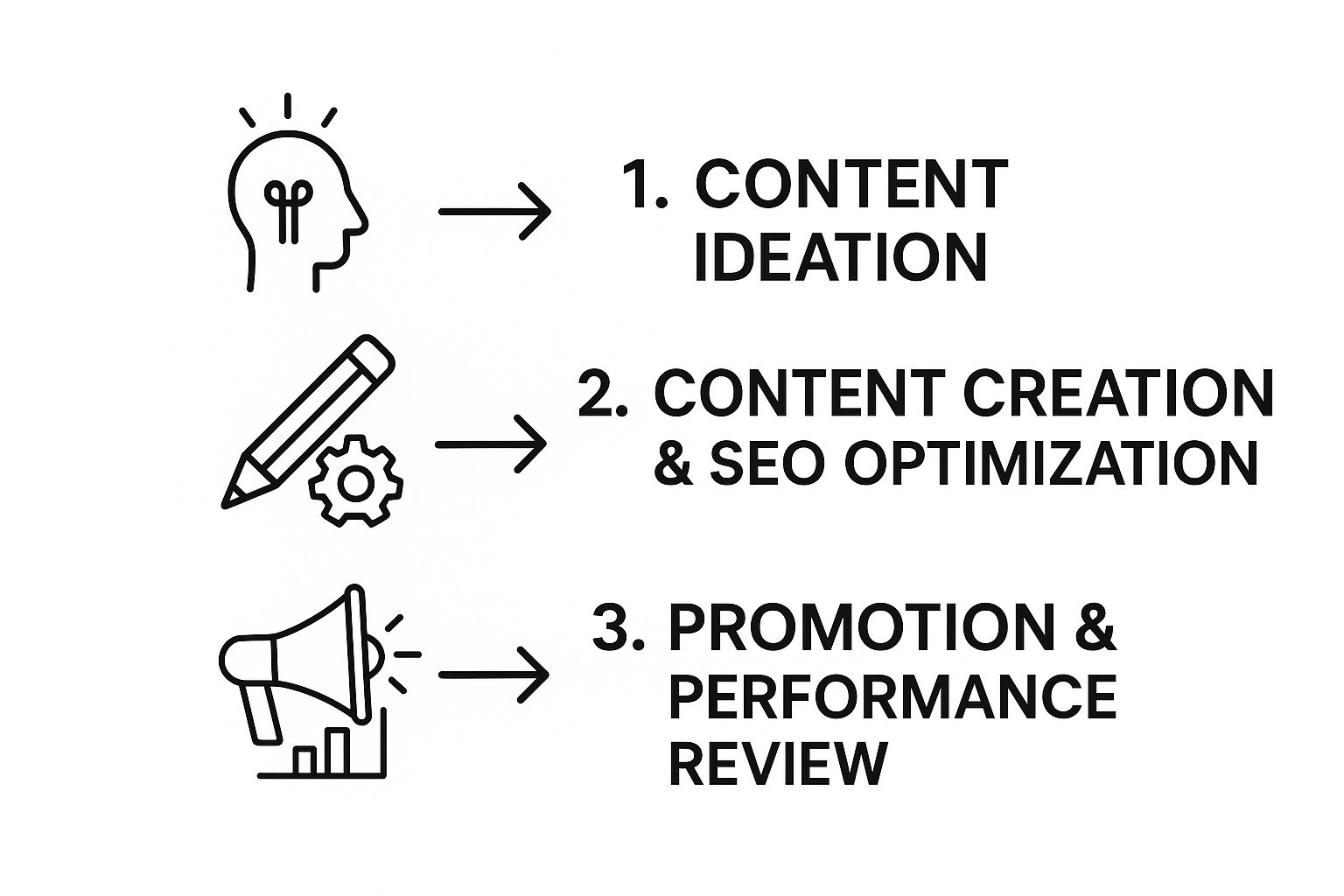
As you can see, reviewing performance isn’t the final step; it’s a crucial part of a loop that feeds right back into creating better, more effective content next time.
To keep your affiliates excited and actively promoting, you need a mix of strategies. Some partners respond well to direct incentives, while others prefer ongoing support and resources.
Here’s a quick comparison of a few common activation tactics:
Affiliate Activation Tactics Comparison
| Tactic | Description | Pros | Cons |
|---|---|---|---|
| Performance Bonuses | Offer one-time cash bonuses for hitting specific sales targets (e.g., $100 for $1,000 in sales). | Highly motivating for short-term pushes; creates excitement and urgency. | Can be costly; may only motivate already high-performing affiliates. |
| Tiered Commissions | Automatically increase an affiliate's commission rate permanently after they reach a milestone. | Rewards loyalty and consistent performance; encourages long-term growth. | Can increase overall program costs permanently; requires careful tracking. |
| Contests & Leaderboards | Run competitions for prizes based on sales, clicks, or new customer acquisition. | Fosters a fun, competitive environment; engages a broad range of affiliates. | May disengage lower-performing affiliates; prizes need to be compelling. |
| Exclusive Content | Provide affiliates with unique articles, banners, or video assets they can use. | Equips affiliates with tools to succeed; strengthens brand messaging. | Requires significant time and creative resources to produce high-quality content. |
Ultimately, the best approach is to use a combination of these tactics. This ensures you're engaging different types of partners and keeping the program dynamic and interesting for everyone involved.
Maintaining Program Health
While you're busy celebrating your top affiliates, you also need to address the other end of the spectrum: the underperformers and the inactives. An affiliate who signed up six months ago but hasn't generated a single click isn't helping your program.
Don't be afraid to do a little spring cleaning. A simple rule I like to use is this: if an affiliate hasn't driven any traffic in 90 days, their account is deactivated. This keeps your program lean, your data clean, and your time focused on partners who are actually committed. To get a better handle on your campaign data, check out these UTM tracking best practices.
Running a great affiliate program is a continuous cycle of analyzing data, talking to your partners, and tweaking your strategy. It’s a living, breathing part of your business that, when managed with care, can become one of your most powerful and predictable sales channels. For a masterclass in how it's done at scale, take a look at our breakdown of the Amazon affiliate marketing program.
Advanced Strategies and Common Mistakes to Avoid
Alright, so your affiliate program is up and running, bringing in consistent sales. That's fantastic. Now it’s time to stop thinking about basic management and start focusing on strategic growth. This is the fun part, where you implement smarter tactics to turn a decent revenue channel into a powerhouse for your brand.
One of the best ways I’ve seen to light a fire under affiliates is by creating a tiered commission structure. Forget the one-size-fits-all flat rate. Instead, you create levels that directly reward your top performers. Imagine a new partner starts at an 8% commission. But once they hit $2,000 in monthly sales, they automatically jump to 12%. It’s a simple, powerful incentive that’s built right into the system, motivating your partners to promote you more.
Another pro-level move is to hand out affiliate-exclusive discount codes. With a platform like Coral, you can generate unique codes for your best partners. Not only does this give their audience a VIP feel, but it’s also a nearly bulletproof way to track sales—even when pesky browser cookies fail.
Elevating Partnerships and Avoiding Pitfalls
As you grow, think beyond just commissions and links. Look for opportunities to create deeper, more meaningful collaborations. This could be a co-branded webinar with a top-tier influencer in your niche or a detailed "how-to" guide you create with a well-respected blogger. These aren't just link drops; they're authentic assets that build credibility and drive sales for both of you for a long time.
Of course, as you scale your affiliate marketing ecommerce program, the risks get bigger, too. Learning to sidestep the common pitfalls is what separates the thriving programs from the ones that fizzle out.
The biggest mistake you can make isn't a lack of sales; it's a breakdown in trust. If you start delaying payments or go silent on your partners, you'll burn bridges that are incredibly hard to rebuild. Word travels fast in the creator community, and a bad reputation can be toxic.
To keep your program healthy and growing, you have to stay on top of a few critical areas:
- Delayed Payments: Nothing sours a partnership faster. Set a reliable payment schedule and treat it as a non-negotiable deadline. Paying on time is a fundamental sign of respect.
- Poor Communication: Don't let your affiliates feel like they're on an island. A simple monthly newsletter with updates on new products, upcoming promotions, or program changes goes a long way. Keep them in the loop.
- Inadequate Fraud Detection: A growing program is a magnet for shady activity, from self-referrals to bot-driven traffic. Make sure you're using your platform's fraud detection tools to spot suspicious activity and protect your investment.
By proactively managing these challenges, you can build a program that's both profitable and resilient. If you want to dive deeper into structuring your program for success, our guide on various affiliate programs for ecommerce has plenty more valuable insights. Steering clear of these mistakes will ensure your affiliate program remains a powerful asset for years to come.
Got Questions About Ecommerce Affiliate Programs? We’ve Got Answers.
Jumping into the world of affiliate marketing for the first time? It's natural to have a few questions. After all, you're busy running an ecommerce store. Let's walk through some of the most common things we hear from brand owners, so you can feel confident launching your own program.
Cost and profitability are always top of mind. And they should be. Let's get right to it.
What Should I Be Paying My Affiliates?
Figuring out the right commission rate is more of an art than a science, and there’s no single number that works for everyone. It really boils down to your specific industry, your product margins, and what your average customer spends.
For most physical products, a commission rate of 5-10% of the sale price is a solid starting point. But if you’re selling digital goods or high-margin items, you have more wiggle room. In those cases, you can offer much more attractive rates, sometimes anywhere from 20-50%.
The best first step? See what your direct competitors are offering. A quick search will tell you if your rates are in the right ballpark to attract the kind of partners you want. Another great strategy is to build a tiered commission structure. For example, you could bump an affiliate’s rate up after they hit a certain number of sales. It’s a fantastic way to keep your top performers motivated.
Here's a pro tip: Don't just set your rates and forget them. Take a look at your commission structure at least once a year. If your margins have improved or you want to get more aggressive for a holiday push, a small rate adjustment can give your entire program a serious lift.
Should I Use an Affiliate Network or In-House Software?
This is another huge question that trips people up. Do you join a big, established network, or do you use dedicated software to run your program yourself?
Affiliate Networks: Think of marketplaces like ShareASale or CJ Affiliate. They offer a pre-made directory of potential partners, which can really speed up recruitment. They also handle all the tracking and payments, but they'll take a network fee or a cut of your sales for the convenience.
In-house Software: This is where a platform like Coral comes in. You get total control over every aspect of your program. While you'll need to recruit your own partners, this approach is often more affordable in the long run and lets you build a program that feels completely integrated with your brand.
Many brands get their feet wet with a network to leverage its existing publisher base. But as they scale, they often find that bringing the program in-house gives them the control, data, and cost-savings they need.
How Long Does It Take to Actually Make Money?
Ah, the million-dollar question. While you might get lucky and see your first affiliate sale within a few days, building a truly profitable channel doesn't happen overnight.
Being realistic, you should plan for it to take about 3-6 months to see consistent, meaningful results from your affiliate marketing efforts. This gives you enough time to find and onboard a good group of partners, for them to create and share content, and for that content to start getting seen by their audience and search engines.
Patience is everything here. Consistent management and relationship-building are what turn an affiliate program from a small experiment into a reliable, long-term revenue engine.
Ready to take the reins of your partnerships and build a powerhouse affiliate program on Amazon? Coral provides all the tools you need to find, track, and pay your affiliates, turning trusted recommendations into predictable revenue. Start building your affiliate army with Coral today!