Boosting Your Amazon Conversion Rate
Category: Amazon conversion rate
So, what’s a "good" Amazon conversion rate?
If you’re looking for a quick answer, the general benchmark hovers between 10% and 15%. That number blows the typical e-commerce site's average of 1-2% out of the water, and it really speaks to the powerful, high-intent mindset of an Amazon shopper.
But let's be real—that's just a starting point.
What a Good Amazon Conversion Rate Actually Looks Like
Every seller I talk to wants to know the magic number, but a truly "good" conversion rate isn't one-size-fits-all. It's more of a health check for your product listing. How well are you convincing people to hit that "Add to Cart" button? That's what it all comes down to.
The reality is that what’s realistic for a $15 kitchen gadget is going to be completely different for a $500 piece of electronics.
Historically, Amazon has always crushed other e-commerce platforms on conversions. As of early 2025, the average rate for all products was sitting around 9-10%. Strong, well-oiled listings often pushed past that, hitting 10% to 15% or even higher. If you want to dive deeper into the advertising stats behind this, the team at AdBadger.com has some great data.
Why the massive gap? People don't just "window shop" on Amazon. They show up ready to buy. They trust the platform, their credit card is already saved, and they're primed for that one-click purchase. Your job is simply to get them across the finish line.
Benchmarks Vary by Category and Price
Expecting a 15% conversion rate on a high-ticket item is probably setting yourself up for disappointment. Customers naturally take longer to mull over a big purchase. On the flip side, a simple, low-cost product could easily blow past that benchmark if the listing is dialed in perfectly.
Several things will move the needle on what a "good" rate looks like for you:
- Product Category: Super competitive niches (think supplements) will almost always have lower conversion rates than a niche hobbyist category with a dedicated audience.
- Price Point: The more expensive the item, the more research a buyer does. This naturally stretches out the buying cycle and lowers the immediate conversion rate.
- Traffic Source: A click from a highly targeted Sponsored Products ad is way more likely to convert than traffic from a broader, top-of-funnel brand awareness campaign.
I see so many sellers make the mistake of chasing a single, universal average. Forget that. Focus on your own historical data. Pushing your conversion rate from 3% to 5% is a huge victory and proves your optimization efforts are paying off.
To give you a clearer picture, here’s a quick reference table to help you see where you might stand.
Amazon Conversion Rate Benchmarks
This table breaks down what different conversion rate levels typically mean for an Amazon listing. Use it as a quick reference to gauge your own performance against industry standards.
| Performance Level | Typical Conversion Rate | What This Indicates |
|---|---|---|
| Needs Work | Below 5% | There are likely significant issues with your listing—think poor images, confusing copy, or negative reviews. |
| Average | 5% - 10% | You're doing okay, but there's plenty of room for improvement. This is a common range for many sellers. |
| Good | 10% - 15% | Your listing is strong and effectively converting shoppers. You're hitting the industry benchmark. |
| Excellent | Above 15% | You have a highly optimized listing that resonates powerfully with your target audience. Keep up the great work! |
This is just a guide, of course. Your own numbers and context are what truly matter.
Moving Beyond Simple Averages
If you really want to understand your performance, you have to set your own baseline.
Hop into Seller Central and start tracking your Unit Session Percentage. Watch it for a few weeks to get a feel for your starting point. From there, the goal isn't to hit some arbitrary number you read online—it's to consistently beat your own average, week after week.
A healthy, growing business is built on continuous improvement, not on chasing a perfect metric that might not even apply to you. This is how you set goals you can actually hit and measure the things that truly matter for your brand's bottom line.
Finding and Understanding Your Conversion Data
Before you can start boosting your Amazon conversion rate, you first have to get your hands on the right data. You need to know exactly where you stand right now. Guessing is a surefire way to waste time and money.
Thankfully, all the key information is waiting for you inside Amazon Seller Central. You just need to know where to click.
Navigating to Your Conversion Metrics
First things first, log into your Seller Central account. From there, you'll want to head straight for the Business Reports dashboard.
Once you're in, look at the menu on the left and find “Detail Page Sales and Traffic.” This report is an absolute goldmine for understanding how customers are interacting with your listings.
Inside this report, pay close attention to two specific columns:
- Sessions: This number tells you how many unique visits your product page received over a certain period. Think of it as the total number of shoppers who walked through your virtual door.
- Unit Session Percentage: This is the magic number—your conversion rate. Amazon does the heavy lifting for you, calculating it by dividing the total units ordered by the total number of sessions.
Getting your hands on this data is the first step. The next is learning how to monitor conversion metrics like an expert so you can spot opportunities.
I see so many sellers get hung up on a single bad day. Don't fall into that trap. Your conversion rate will naturally go up and down. The real insights come from zooming out and looking at trends over weeks or even months. That’s how you’ll see if the changes you're making are actually working.
This simple flow chart breaks down the process of improving your conversion rate, from initial analysis to ongoing optimization.
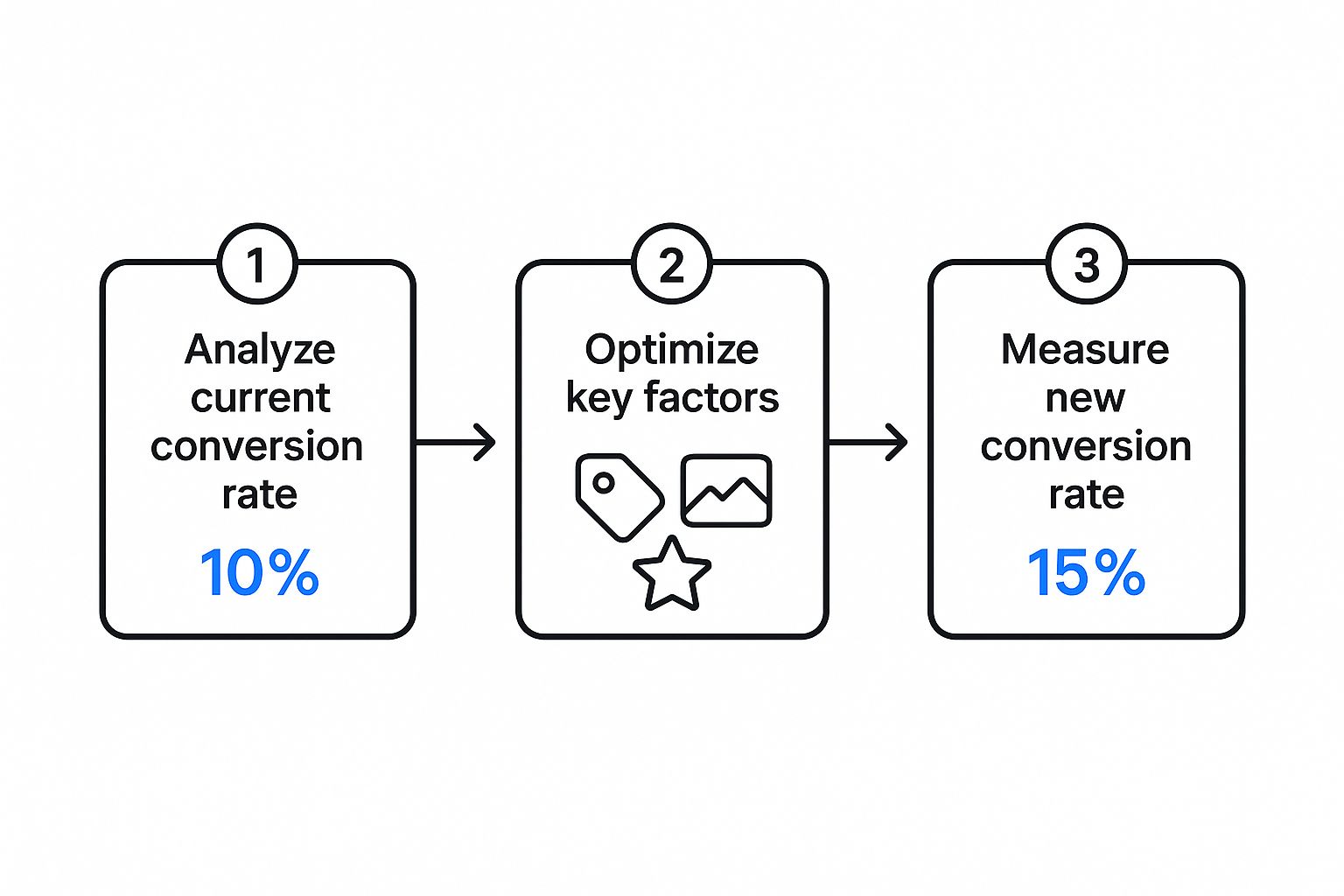
As you can see, it's a continuous cycle. You analyze, you make changes, and then you measure the results to see what worked.
Interpreting the Numbers
While Amazon’s built-in reports are a great starting point, many seasoned sellers pull this data into third-party analytics tools for a deeper dive. These platforms typically use the classic conversion rate formula: (Total Orders ÷ Total Sessions) x 100%.
So, if your product page got 20,000 sessions last month and you landed 800 orders, your conversion rate is a solid 4%.
Getting comfortable with these numbers is what separates the pros from the amateurs. It helps you quickly spot your winners and pinpoint which products are underperforming and need a little love.
If you want to go even deeper, check out our guide on https://coral.ax/blog/how-to-track-amazon-sales. A data-first approach is the bedrock of every smart, profitable decision you’ll make for your business.
The Core Elements That Drive Customer Purchases
A great product is just the starting point. On Amazon, your product listing is your salesperson, and it's responsible for closing every single deal. If you want to see your conversion rate climb, you need to break down your product page piece by piece and figure out what actually convinces a shopper to hit that "Add to Cart" button.
From my experience, it boils down to a few core components that have to work in harmony. When they're all firing on all cylinders, they build trust, answer a customer's unspoken questions, and make buying feel like a no-brainer. But if even one of these elements is weak, the whole listing can fall flat.
Visuals That Sell a Story
The very first thing a potential customer lays eyes on is your main image. Before they even read your title, they're forming an opinion based on that single photo. Let me be clear: professional, high-quality photography isn't a "nice-to-have"—it's an absolute must.
Your image gallery should do more than just show the product; it needs to tell a story. You need shots from multiple angles, close-ups highlighting key features (maybe with some light text overlays), and photos that show the product being used. A good lifestyle shot is incredibly powerful because it helps customers picture your product in their own lives.
I see so many sellers make the mistake of uploading one sterile product photo on a white background and leaving it at that. A winning strategy uses every single image slot to showcase benefits, features, scale, and maybe even a short video of the product in action.
Copywriting That Converts
Once your images have hooked them, your words have to reel them in. The goal here is to stop listing dry, boring features and start selling the benefits that solve your customer's problems.
Think strategically about your text:
- Titles: Your title needs to be crystal clear, packed with relevant keywords, and communicate the main benefit right away. Don't just say "12-Inch Non-Stick Pan." Instead, try something like "12-Inch Non-Stick Skillet for Perfect Omelets and Easy Cleanup." See the difference?
- Bullet Points: Use those five bullet points to really hammer home the benefits. I always recommend starting each bullet with a capitalized, benefit-focused phrase to grab their attention as they skim.
Let's be real, shoppers are scanners. Your copy has to be persuasive at a glance. Adding even Basic A+ Content can give you a sales bump of up to 8% because it gives you more space to tell your brand story with visuals and text.
The Power of Social Proof and Trust
Trust is the currency of Amazon. Shoppers lean heavily on what other people think before they pull out their wallets. This is why your reviews and ratings are arguably your most valuable assets.
A high star rating is obviously important, but the number of reviews is just as critical. A product with 4.8 stars from 2,000 ratings just feels more credible than one with a perfect 5 stars from only three reviews. You have to be proactive about managing customer feedback and encouraging reviews—it’s a non-negotiable part of optimizing for conversions.
Finally, don't overlook basic trust signals like pricing and Prime eligibility. That little Prime badge is a huge shortcut to trust, telling customers they'll get fast, reliable shipping. And if your price is way off from your competitors for no good reason, you’re just inviting shoppers to click away. A fair price combined with the convenience of Prime creates a powerful foundation for a high-converting listing.
Actionable Tactics to Optimize Your Product Listings
Alright, you’ve got the data. Now for the fun part: putting it to work. This is where we roll up our sleeves and turn those insights into real-world changes that move the needle on your Amazon conversion rate. A truly great listing isn't just one thing; it's a collection of well-optimized parts all working together to earn a shopper's trust and, ultimately, their business.

Don't feel like you have to tear everything down and start from scratch. Small, focused changes often yield the biggest results. My advice? Pick one thing, improve it, measure the impact, and then build on that success. That's how you create sustainable growth.
Let's dive into the most impactful tactics you can start with right now to get that Unit Session Percentage climbing.
Master Your Visual Storytelling with A+ Content
The days of a plain text description sealing the deal are long gone. Shoppers today demand a rich, visual journey that tells your brand's story. This is precisely where A+ Content becomes your secret weapon for a higher conversion rate.
A+ Content lets you go way beyond the standard bullet points, giving you space for high-quality images, helpful comparison charts, and modules that bring your brand to life. The data doesn't lie—even Basic A+ Content can bump sales by as much as 8%. It’s your best shot at visually answering customer questions and building a genuine connection.
A huge mistake I see all the time is sellers just rehashing their bullet points in the A+ section. Don't do that. Use this prime real estate to show your product in action, stack it up against competitors, and spell out what makes your brand special. Think of it as your product's own mini landing page right on Amazon.
A/B Test Your Main Image Relentlessly
That main image? It's your digital handshake. It’s the very first thing a shopper sees, and they’ve already formed an opinion before they even read your title. A weak main image kills your click-through rate, which means your conversion rate starts off at a disadvantage.
Amazon's "Manage Your Experiments" tool is an absolute gift for this. It lets you run a legitimate A/B split test on your main image, title, or A+ Content to see what actually connects with buyers. Stop guessing which photo looks best and let your customers tell you with their clicks.
Try testing out different angles, lighting setups, or even including key accessories in the shot. You'd be surprised how often a small tweak leads to a big lift in both clicks and conversions.
Proactively Manage Reviews and Customer Questions
Social proof is king on Amazon. A constant flow of positive reviews builds incredible trust, while unanswered questions plant seeds of doubt. You need a solid game plan for both.
- Encourage Feedback: Use the "Request a Review" button in Seller Central or an automated email service. The goal is to gently prompt customers for their thoughts. More reviews—even if they aren't all perfect five-stars—add serious legitimacy to your listing.
- Answer Questions Promptly: That "Customer questions & answers" section is a goldmine. When you answer a question within 24 hours, you're showing everyone that you're an engaged and helpful seller. Remember, for every person who asks a question, dozens more are wondering the same thing.
For an even deeper dive, you can learn more about how to https://coral.ax/blog/boost-your-conversion-rate-amazon-with-proven-strategies. And if you're looking to get ahead of the curve, it’s worth exploring how new tools like Generative AI in e-commerce can open up new possibilities for crafting compelling listings and engaging with customers.
Maintain Healthy Inventory Levels
This one might seem obvious, but it's so critical that it's often overlooked. Going out of stock is a conversion killer, period. When your listing flips to "Currently unavailable," you're not just losing that one sale; you're killing all the ranking momentum you fought so hard to build.
Frequent stockouts tank your Best Seller Rank (BSR) and can take weeks, even months, to recover from. Use inventory management tools, pay attention to your sales velocity, and set up low-stock alerts. A steady, in-stock presence is the foundation of a healthy Amazon conversion rate.
Using Amazon Ads to Attract High-Intent Buyers
A perfectly optimized product listing is a powerful tool, but it can't convert shoppers who never find it. That's where a smart Amazon advertising strategy comes in. Driving the right kind of traffic—shoppers actively looking for a solution you provide—is one of the most direct ways to pump up your Amazon conversion rate.

The trick is to zero in on high-intent buyers. These aren't just casual browsers; they have a problem they need to solve now and are ready to buy. Sponsored Products campaigns are your best friend here, letting you connect with them at that exact moment of decision.
This means you have to think beyond broad, generic keywords. Get specific. Hone in on long-tail phrases that scream "I'm ready to buy!" For instance, instead of just bidding on "running shoes," a much sharper approach is to target "lightweight trail running shoes for women." You can bet that second searcher knows exactly what they want. As you start digging into Amazon Ads, it’s worth understanding the effectiveness of PPC paid ads for marketplaces to see the bigger picture.
Focusing on Profitable Ad Spend
Once you launch your first few campaigns, it's easy to get lost in a sea of metrics. While things like click-through rate (CTR) have their place, the metric that really hits the bottom line is your ACoS (Advertising Cost of Sale). This number cuts through the noise and tells you exactly what percentage of sales revenue you spent on ads to get there.
A low ACoS is a sign of an efficient, profitable campaign. A high ACoS, on the other hand, can be a red flag that you're spending too much to acquire each customer, which will quickly eat into your margins even if your sales volume looks good.
A classic rookie mistake is chasing an ultra-low ACoS at all costs. Sometimes, a higher ACoS is completely fine—even necessary—especially when you're launching a new product and need that initial traction and early reviews. The real goal is to know your break-even ACoS and manage your campaigns to stay profitable over the long run.
It's also crucial to remember that what works in one market might not work in another. Conversion rates on Amazon vary significantly by marketplace. Data from 2022 showed higher rates in major hubs like the US and UK, which really shows how local buying habits and ad performance can impact your results.
From Clicks to Brand Loyalty
A truly great ad campaign does more than just make a single sale. It’s an introduction. Every conversion is a chance to create a repeat customer and, eventually, a fan. When you follow up that ad-driven purchase with a fantastic product and a great customer experience, you start building a real relationship.
This is how you move from one-off transactions to a loyal customer base. If you want to dive deeper into this, we have a guide on how to https://coral.ax/blog/build-brand-advocates who will do the selling for you. Ultimately, a smart ad strategy and a great listing work together not just to boost today's sales, but to fuel your brand's long-term growth on Amazon.
Frequently Asked Questions
Even the most seasoned sellers run into questions about Amazon conversion rates. Let's tackle some of the most common ones I hear from brands trying to fine-tune their listings and boost sales.
How Long Does It Take to See an Improvement in My Conversion Rate After Making Changes?
This really boils down to what you changed.
If you make a big, immediate change like a price drop or swapping in a killer new main image, you can sometimes see a shift in your numbers within a few days. The feedback loop is pretty quick because new sessions and order data start flowing in right away.
On the other hand, SEO-related tweaks require a bit more patience. If you're updating backend keywords or rewriting your bullet points to rank for new terms, it can take several weeks. You have to give Amazon's A9 algorithm time to re-index your listing and for the new traffic to start having a measurable effect.
My best advice: Make one significant change at a time. Watch your Unit Session Percentage like a hawk for at least two weeks before touching anything else. This way, you know exactly what moved the needle, instead of guessing which of your five tweaks was the real hero.
Can a Low Conversion Rate Get My Product Suppressed?
Not directly, no. A low Amazon conversion rate on its own won't get your listing pulled. But think of it as a smoke alarm—it's a massive red flag for underlying problems that can absolutely get you suppressed.
For example, maybe your conversion rate is in the gutter because you're getting slammed with negative reviews. Those reviews could eventually trigger a policy violation and get your listing suspended. Or, a low rate might be caused by an inaccurate product description, which leads to a sky-high return rate—another metric Amazon monitors very closely.
The key is to treat a poor conversion rate as an urgent signal to dig in and fix the root cause before it snowballs into a much bigger problem.
Is It More Important to Have High Sessions or a High Conversion Rate?
Ah, the classic chicken-or-the-egg question for Amazon sellers. The honest answer is you need both, but they diagnose different parts of your business.
- High Sessions: This tells you your traffic strategy is working. People are finding your product. Your main image, title, and price are strong enough to win the click from the search results page.
- High Conversion Rate: This tells you your product detail page is a winner. Once people land on your listing, your images, bullet points, A+ Content, and reviews are doing their job and convincing them to buy.
Finding the right balance is the goal. If you have a ton of traffic but a terrible conversion rate, your listing page is broken and needs a serious overhaul. But if you have an amazing conversion rate with barely any sessions, your listing is a well-oiled machine that nobody can find. That’s when you need to pour fuel on your advertising and SEO fire.
Ready to turn your brand's biggest fans into your most powerful sales force? Coral provides the tools you need to build, manage, and scale a high-performing affiliate program right on Amazon. Start recruiting creators and tracking sales with a platform designed for growth. Get started for free with Coral.