How to Find Amazon Influencers Who Actually Drive Sales
Category: How to find amazon influencers
Getting Real About Amazon's Influencer Ecosystem
Let's be honest, the Amazon influencer landscape is a whole different ballgame. So many brands try to use the same old strategies they use on platforms like Instagram or TikTok, and they just don't work. Why?
Because Amazon influencers are motivated by different things.
It's not about vanity metrics like likes and follows. It's about sales, conversions, and earning those commissions.
If you want to find the right Amazon influencers, you have to understand this unique ecosystem. Think of it this way: an influencer's storefront is their online shop, and their content is all about leading their audience straight to that "buy now" button. This sales-focused mindset influences every decision they make, from the products they feature to how they talk about them in their reviews.
This also means that the typical ways of finding influencers often miss the mark. Forget generic databases. You need to go deeper and figure out what makes an Amazon influencer tick. For instance, have you noticed how many Amazon influencers are also passionate about product reviews? They love sharing their detailed knowledge and helping their audience make smart purchases.
This brings us to another key point: genuine enthusiasm. You absolutely have to be able to spot the difference between someone who truly loves a product and someone who's just chasing a commission. A true enthusiast builds trust and creates loyal followers, while someone just focused on quick cash might make a few sales but will ultimately hurt their reputation.
Finding the right Amazon influencers also means understanding the increasing importance of influencer marketing as a whole. The market is predicted to grow at a 33.7% CAGR from 2024 to 2034. This shows just how powerful influencers are becoming, especially on platforms like Amazon where over 55% of social media users say they've bought something based on an influencer's recommendation. Discover more insights about influencer marketing. This underlines the huge potential of strategic partnerships to seriously boost your sales. Understanding these nuances will help you choose the right partners and build strong relationships that lead to real, long-term growth.
Uncovering Hidden Amazon Influencer Gems
Forget sifting through massive, generic influencer databases. They rarely uncover the real hidden gems. Let's talk about strategies that actually work, drawing from real-world experience in finding Amazon influencers who can truly move the needle. Take a look at this infographic visualizing the market share of different Amazon influencer niches: beauty (40%), tech (35%), and lifestyle (25%).
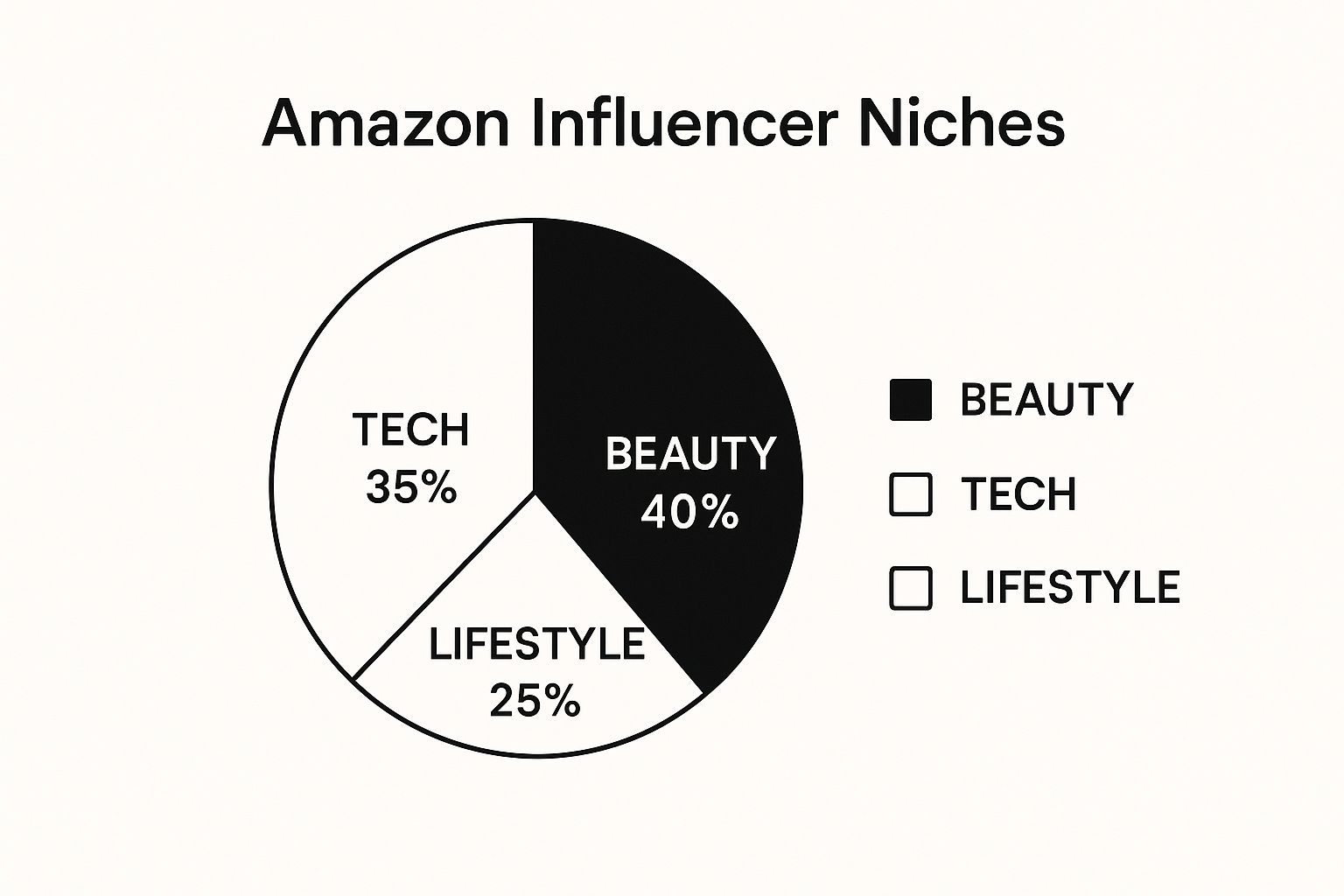
As you can see, beauty and tech are big players, but don't count out the lifestyle niche! This highlights how important it is to refine your search within specific product categories.
Mining Amazon for Influencer Gold
One of the most effective (and often overlooked) strategies is diving into Amazon's review section.
Think about it – enthusiastic reviewers are often influencers in the making! Look for reviewers who go beyond generic comments and provide detailed, insightful feedback. This shows a genuine interest in products, which translates into compelling content.
Another often-missed opportunity is Amazon Live. This is a goldmine for finding influencers actively engaging with their audience in real-time. Watch their presentations, pay attention to their product knowledge, and see how they interact with viewers. It's like a live audition!
Social Listening for Amazon Buzz
Social listening is crucial. But don’t just rely on generic hashtags. Get specific! For example, if you’re selling kitchen gadgets, search for phrases like "best air fryer on Amazon" or "must-have kitchen tools." This uncovers influencers already talking about products similar to yours.
This also gives you a chance to see how they naturally incorporate Amazon links into their content, a key element for driving conversions. Speaking of which, you might find our guide on the Amazon Affiliate Marketing Program helpful for understanding how influencers monetize their content.
Reverse-Engineering Competitor Strategies
Here's a sneaky tip: check out your competitors' Amazon storefronts. Who are they partnering with? What kind of content are those influencers creating? This gives you valuable insights into what's already working within your niche.
Don't just copy, though. Learn and adapt! Figure out what resonates with their audience and find ways to differentiate your own influencer partnerships. This might mean working with micro-influencers who have highly engaged, niche audiences.
Leveraging Amazon's Algorithms
Lastly, let Amazon do some of the work for you! When you find an influencer you like, look at the "Customers who follow this influencer also follow..." section. This often reveals similar influencers you might have missed, especially those hidden gems within your target market.
To help summarize these different approaches, I've put together a comparison table highlighting their effectiveness, cost, and time investment:
Amazon Influencer Discovery Methods Comparison
This table compares the effectiveness, cost, and time investment of different methods for finding Amazon Influencers.
Method | Effectiveness | Time Investment | Cost | Best For |
|---|---|---|---|---|
Mining Amazon Reviews | Medium | Medium | Low | Finding emerging influencers with genuine product interest |
Amazon Live | High | Medium | Low | Discovering influencers actively engaging with audiences in real-time |
Social Listening | High | High | Medium (tools can be costly) | Identifying influencers already discussing relevant products |
Competitor Analysis | Medium | Low | Low | Understanding successful influencer strategies within your niche |
Leveraging Amazon's Algorithms | Medium | Low | Low | Uncovering similar influencers within your target market |
As you can see, each method offers unique advantages. Combining these strategies provides a powerful approach to finding Amazon influencers who truly align with your brand and resonate with your target audience.
Reading Between The Lines Of Influencer Metrics
So, you've found some potential Amazon influencers. Fantastic! But how do you know if they're actually driving sales? Follower counts can be misleading. You need to dig deeper and look at the metrics that tell the real story of their impact on Amazon. Think of it like detective work – uncovering the clues that reveal true influence.
Beyond Vanity Metrics: What Really Matters
Forget massive follower counts. Instead, zero in on conversion rates. How many clicks on their Amazon affiliate links actually result in a purchase? This is the ultimate test of their influence. Take a look at their storefront's performance too. Are products selling? If not, those followers might be more like ghosts than actual customers.
Another key factor is the longevity of their product recommendations. A quick viral moment isn't going to build your brand long-term. You want influencers whose recommendations stay relevant and effective over time. This usually signifies genuine enthusiasm and a loyal audience who trust their advice.
Spotting Red Flags and Golden Opportunities
Watch out for sudden, unnatural spikes in engagement. A dramatic jump in likes or comments could be a sign of fake engagement. Similarly, be wary of an unusually high number of generic, five-star reviews. Authenticity is crucial. A smaller, engaged audience is much more valuable than a massive, uninterested one.
Speaking of smaller audiences, micro-influencers can be a goldmine. Their dedicated followers are often highly receptive to recommendations, resulting in impressive conversion rates.
Also, keep in mind that Amazon influencers typically earn a commission of 1% to 20% per sale, depending on the product category, paid directly by Amazon. They often have separate fees for creating and promoting content, which can vary significantly. A micro-influencer might charge less than a macro-influencer, for example. Learn more about Amazon influencer commission rates. This adds another dimension to your evaluation process.
Cross-Platform Consistency and Content Quality
Check for consistency across their social media presence. Are their messages aligned? Is their content quality high across all platforms? This indicates a genuine personal brand and a dedicated approach to their work.
Look for content that organically leads to Amazon clicks, not forced product placements. It should feel like a genuine recommendation from a friend.
Remember, quality often trumps quantity. A single, well-crafted product review with a compelling story can be far more effective than a dozen generic posts.
Finally, use data to your advantage. Leverage Amazon's own analytics tools like Amazon Attribution to track sales and verify influencer claims. This helps you predict the success of a partnership before you invest. You might also find our article on how to track Amazon sales useful. This data-driven approach will ensure you're collaborating with influencers who genuinely deliver results.
Outreach That Breaks Through The Noise
Getting your influencer discovery right is just the first step. All that effort goes down the drain if your outreach is a dud. Think about it: Amazon influencers are constantly flooded with collaboration requests. So, how do you cut through the clutter? It's not about blasting out generic emails; it's about genuine connection. You need to understand the psychology of influence.
Subject Lines That Spark Curiosity
First impressions matter. Your subject line is that first impression, and it has to be a showstopper. Forget generic subjects like “Collaboration Opportunity.” Instead, personalize it. Something that piques their interest.
For example, if you see an influencer recently reviewed a competitor's product, try a subject line like, "Loved your review of the X-Blender – let’s talk about the Y-Blender." This immediately signals you've done your homework and aren't just spamming them. Think about what they find interesting, not just what you want to push.
Value Propositions That Feel Collaborative
Your initial contact should offer real value right off the bat. Skip the sales pitch. Instead, start by acknowledging their work. Show genuine appreciation for their content. Maybe a specific video or post resonated with you. Mention it!
Something like, "Your video on sustainable kitchen products really spoke to me – we share a similar passion at [Your Brand Name]." This establishes common ground and makes the interaction feel more human. You’re building a relationship, not just closing a deal.
Structuring Proposals That Excite
When you present your proposal, frame it as a collaboration, not a demand. Clearly outline what you’re offering and what you’re looking for in return. Be upfront about compensation, but also highlight the other perks of partnering with your brand.
Think: exclusive access to new products, featuring them on your social media, or joint marketing ventures. What problems can you solve for them? Are they trying to grow their audience or create different types of content? These are great starting points.
Timing and Relationship Building
Timing is crucial. Don't reach out during major sales events when their inbox is probably exploding. Aim for quieter periods. And don't underestimate the power of connecting before you pitch. Follow them on social media, interact with their posts, and join their live streams.
This shows genuine interest and makes your outreach feel much more natural. A platform like Coral can help streamline this, letting you track influencer engagement and manage campaigns efficiently. You can set custom commission rates and manage all your creator partnerships in one central hub. This helps you move beyond transactional interactions and build real, lasting relationships. The bonus? Coral integrates directly with Amazon Attribution, making sales tracking and affiliate fee calculations a breeze. It's not just influencer management; it’s partnership nurturing.
Leveraging Smart Tools Without Breaking The Bank

Manual searches and scrolling through endless feeds? Sure, that works when you're just starting out with influencer marketing. But to really scale your Amazon influencer program, you need smarter tools. The good news is, boosting your discovery process doesn't have to drain your bank account. Let's dive into how you can use tech for maximum impact without a maxed-out budget.
AI-Powered Matching and Social Listening: Finding Your Perfect Match
Imagine AI-powered influencer matching platforms as a matchmaking service for brands and influencers. These platforms use algorithms to analyze data and connect you with creators whose audience aligns perfectly with your target market. No more guessing games! Many also include social listening, so you can find influencers already talking about your niche. Picture this: you get an alert the moment a rising star mentions your brand or a competitor's product. Talk about a game-changer!
And here's another key point: data analytics. These platforms go beyond simple matching, giving you valuable insights into engagement rates, audience demographics, and even predicted partnership performance. This empowers you to make informed decisions, spend your budget wisely, and avoid costly missteps.
The influencer marketing world is booming. By 2025, it's expected to reach $32.55 billion, with over 80% of marketers finding it effective. Check out more insights on this growing market. This data underscores the importance of tools that can help brands navigate this competitive landscape and select the right influencers.
Budget-Friendly Alternatives: Smart Solutions for Every Wallet
What if pricey enterprise platforms aren't an option? No worries! Plenty of free and affordable tools offer similar benefits. Many social listening tools, like Brand24 or Mention, have free versions that let you track keywords and find relevant influencers. You can also use Google Alerts to get notified when your brand, product category, or competitors are mentioned, uncovering potential influencer partnerships.
Thinking outside the box can also be incredibly powerful. Create a simple spreadsheet to track potential influencers, their metrics, and your outreach efforts. This hands-on approach takes more effort, but it can be super effective, especially in niche markets where automated tools might miss those hidden gems.
Here’s a handy table to help you compare some options:
Amazon Influencer Discovery Tools Breakdown: Comprehensive comparison of tools, features, pricing, and effectiveness for finding Amazon influencers
Tool | Key Features | Pricing Tier | Amazon Focus | Best Use Case |
|---|---|---|---|---|
Coral | Influencer Management, Amazon Attribution integration, Customizable Affiliate Fees. | Varies based on usage | Strong | Managing entire influencer program |
Brand24 | Social listening, influencer identification, sentiment analysis | Free & Paid options | Moderate | Monitoring brand mentions and relevant conversations |
Mention | Social listening, competitor analysis, influencer identification | Free & Paid options | Moderate | Tracking brand mentions and industry trends |
Google Alerts | Keyword monitoring, brand mention alerts | Free | Low | Basic brand monitoring and identifying potential influencers |
Custom Spreadsheet | Manual tracking of influencers, metrics, and outreach | Free | Varies based on your input | Niche markets and personalized outreach |
This table gives you a quick overview of various tools you can use, ranging from comprehensive platforms like Coral to free options like Google Alerts and creating your own spreadsheet. Remember to choose the best tool that aligns with your budget and specific needs.
Integration and Automation: Streamlining Your Workflow with Coral
Integrating your chosen tools with your existing marketing systems can be a real game-changer. Platforms like Coral bring together Influencer Management, direct integration with Amazon Attribution and full control with customizable affiliate fees per influencer.This streamlined approach lets you manage your entire influencer program from a single dashboard – from discovery to tracking sales and automatically calculating commissions.
With Coral, you can monitor their performance over time, and even personalize commission structures to reward top performers. It's about shifting from one-time influencer discovery to a continuous, data-driven process that drives long-term growth.
Turning Partnerships Into Long-Term Goldmines
Finding great Amazon influencers is awesome, but the real magic happens when you nurture those relationships over time. Think of it like tending a garden – you don't just plant a seed and forget about it. You water it, give it sunlight, and help it grow. That's exactly how you cultivate influencer partnerships that truly thrive.
Moving Beyond Transactions to True Partnerships
So many brands fall into the trap of viewing influencer collaborations as one-off transactions. Pay for the post, get a bump in sales, and move on. This is such a short-sighted approach! The true potential lies in forging long-term partnerships where everyone wins.
Imagine, for instance, giving your top influencers sneak peeks at new products or even getting their input during product development. This makes them feel like valued partners, not just paid promoters.
You can also think outside the box with exclusive opportunities beyond simple compensation. Maybe host a joint webinar, create co-branded merchandise, or feature them in your email marketing. These kinds of initiatives create a sense of shared purpose, which strengthens your partnership. You might also find our guide on brand ambassador contracts helpful for formalizing these key relationships.
Measuring Relationship Health and Fostering Growth
How can you tell if your partnerships are really working? Don't just rely on sales figures. Look at engagement metrics, such as how often they mention your brand organically or how involved they are in your community activities. These are the telltale signs of a healthy, growing partnership.
Referral programs are another great strategy. Encourage your top performers to bring other talented creators into the fold. This organically expands your network and strengthens your overall influencer ecosystem. Picture a network of passionate advocates actively promoting your products and referring new creators. That's the power of long-term relationship building in action.
Handling Underperformance and Optimizing Partnerships
Let's be real, not every partnership will be a smashing success. And that's perfectly okay. If an influencer isn't performing as expected, don't just write them off. Talk to them! Understand their challenges. Maybe their audience isn't connecting with your product, or maybe they need more support from your team.
Sometimes, a simple tweak in strategy or a shift in focus can completely revitalize a partnership. For example, if product reviews aren't translating to sales, maybe try some lifestyle content that subtly features your products. Data is your friend here. Regularly analyze performance metrics and use that information to make smart decisions about how to optimize your partnerships.
Nurturing Multiple Relationships with a Personal Touch
As your influencer program grows, you'll likely find yourself juggling multiple partnerships. This can feel daunting, but it doesn't have to be. Invest in tools that streamline communication, track performance, and automate routine tasks. Platforms like Coral are built for this, allowing you to manage many partnerships without sacrificing that essential personal touch that makes each one special.
Remember, every influencer is an individual with unique strengths and motivations. Take the time to understand their goals, offer personalized support, and celebrate their wins. It's this personal approach that transforms transactions into enduring, mutually beneficial partnerships. It’s the difference between a struggling seedling and a vibrant, thriving garden.
Your Complete Amazon Influencer Action Plan
Alright, let's get down to brass tacks and turn all this influencer marketing knowledge into a solid action plan. We're not just theorizing here; this is your roadmap to a truly successful Amazon influencer program. Think of it as your personal playbook for finding, connecting with, and building those all-important influencer relationships.
Phase 1: Discovery and Evaluation (Weeks 1-2)
This initial phase is like a treasure hunt. You’re searching for those hidden gems, the influencers who are a perfect fit for your brand. Don't limit yourself to just one method. Cast a wide net!
Mine Amazon Reviews: Set aside a few hours each week to dig through product reviews, particularly for products similar to yours. You're looking for reviewers who show genuine enthusiasm and offer insightful comments. These are often people who are passionate about the product category and already have a following.
Explore Amazon Live: Spend some time each day checking out Amazon Live streams within your niche. Look for engaging and knowledgeable presenters who genuinely connect with their audience. Their on-camera presence is a great indicator of how they might represent your brand.
Leverage Social Listening: Set up alerts on platforms like Twitter and Instagram for keywords relevant to your products. By monitoring these conversations, you can identify influencers who are already talking about products in your space. They've essentially done some of the legwork for you!
Analyze Competitor Strategies: Take a look at 3-5 of your main competitors and analyze their Amazon storefronts. Which influencers are they working with? What kind of content are they creating? This can give you valuable insights and inspiration.
Phase 2: Outreach and Partnership (Weeks 3-4)
Now that you've identified some potential influencer partners, it’s time to reach out. Remember, personalization is key. Nobody wants to feel like they’re just another name on a list.
Craft Personalized Outreach Messages: Templates can be helpful, but always personalize them. Mention something specific they’ve created that resonated with you. Show them you’ve actually taken the time to get to know their work.
Highlight Mutual Benefits: Don't just focus on what you want from the partnership. Clearly explain how the collaboration will benefit them. Offer value beyond just monetary compensation. Think about things like access to exclusive content, early product releases, or co-branded marketing opportunities.
Streamline Communication: A platform like Coral can be a game-changer here. It helps you manage your outreach efforts, track responses, and keep all your communication organized in one place. It's like having a personal assistant for your influencer marketing.
Phase 3: Management and Optimization (Ongoing)
Successfully managing an influencer program is an ongoing process, not a one-and-done deal. You need to constantly nurture these relationships and adjust your strategy as needed.
Track Performance: Coral’s integration with Amazon Attribution lets you monitor sales, calculate commissions, and see exactly how effective each partnership is. Data is your friend!
Provide Ongoing Support: Regularly check in with your influencers, offer support, and celebrate their successes. Building a strong rapport will lead to a more productive and long-lasting partnership.
Analyze and Optimize: Continuously analyze the performance data and adjust your strategy accordingly. What's working? What's not? Use this information to make informed decisions about future collaborations.
Ready to see what influencer marketing can do for your Amazon sales? Coral gives you the tools and resources you need to build a thriving influencer program, from the initial discovery phase to long-term relationship management. Start building your influencer network with Coral today!