Launch Your Private Label on Amazon Brand
Category: Private label on amazon
Yes, selling a private label on Amazon is still an incredibly profitable way to build a business, but let's be clear: the gold rush days are over. This isn't some get-rich-quick scheme. Success today is all about building a real, memorable brand that solves a customer's problem, not just slapping a logo on a generic product. It's more work, absolutely, but the reward is building a tangible asset you can be proud of—and one that's actually sellable down the road.
Is a Private Label on Amazon Still Worth It
If you're looking for a way to make money on Amazon, you’ve probably seen a few different paths you can take. While each has its pros and cons, private labeling is special. It’s the one model where you're not just reselling someone else's stuff; you're creating a brand from scratch.
How It Stacks Up Against Other Models
To really get why private label is so appealing, it helps to see how it compares to the other big players on the Amazon field: retail arbitrage and wholesale. They're all valid, but they play very different games.
Here's how private label compares to other popular ways of selling on Amazon.
Amazon Business Models At a Glance
| Business Model | Upfront Investment | Profit Margin Potential | Brand Control |
|---|---|---|---|
| Private Label | Medium to High | High (20-40%+) | Total |
| Wholesale | High | Low to Medium (10-20%) | None |
| Retail Arbitrage | Low | Low (5-15%) | None |
As you can see, the trade-offs are pretty clear. Let's break them down.
Retail Arbitrage: This is the classic hustle. You hit up the clearance aisles at Walmart or Target, scan items with the Amazon Seller App, and flip them online for a profit. It's cheap to start, but it’s a constant grind. You're always hunting for the next deal, and it's nearly impossible to scale into a serious business.
Wholesale: This is a step up. You're buying products in bulk directly from an established brand and reselling them. It's more scalable than arbitrage, but you’re just another seller on a listing, often fighting a dozen others for the Buy Box. Margins can be razor-thin.
Private labeling is where you take control. You find a high-demand product, partner with a manufacturer to make it better (or just different), and launch it under your own brand. You own the listing, you set the price, and you build the customer experience.
The real power of private labeling is that you're building an asset. Every sale, every review, every happy customer adds value to your brand—something you can one day sell for a life-changing amount of money.
Don't just take my word for it. The numbers show that despite the competition, the potential is massive. More than 54% of private label sellers are hitting profit margins over 20%. That's a huge deal. Plenty of top sellers are pulling in over $100,000 a month by getting this right. You can discover more insights about these profitability stats and how they do it.
The game has shifted. It's no longer about finding some obscure product nobody has thought of. It's about finding a customer need and creating a better solution than what's already out there. It takes an upfront investment, a lot of patience, and an obsession with quality. The barrier to entry is higher now, but for those who build a thoughtful brand, the rewards are bigger than ever.
To get a handle on the entire A-to-Z process, from product research to launch, check out our comprehensive guide to master Amazon private label.
How to Find a Winning Product Idea
This is it. The single most important step in building a private label business on Amazon is finding the right product. So many aspiring sellers get completely paralyzed here, chasing some "perfect" idea that simply doesn't exist.
Let's get one thing straight: the secret isn't about inventing something from scratch. It's about finding an existing, popular product and making it demonstrably better.
Your job is to put on your detective hat. Stop brainstorming in a vacuum and start digging into the real world of customer feedback for products that are already selling. The best intel you'll ever find is buried in the negative reviews of your future competitors.
Become a Customer Review Detective
Start by just browsing categories on Amazon that you find interesting. Think "home organization," "pet supplies," or whatever sparks your curiosity. Find the products that live on the first page—these are the big sellers.
Now for the fun part. Skip right past all the glowing five-star reviews and head straight for the two, three, and even four-star comments. This is where the gold is.
You're looking for patterns and recurring complaints.
- Are people constantly saying the item is "flimsy" or "smaller than expected"?
- Is there a common flaw? A handle that snaps off? A lid that won't seal?
- Do customers wish it had an extra feature, like a carrying case or a different color?
Every single complaint is a clue. It’s a literal roadmap showing you exactly what the market wants but isn't getting. Your winning product isn't a stroke of genius; it's an evolution. It's a better version of something people are already buying.
Imagine you're looking at silicone baking mats. You see a dozen reviews all complaining that they're a nightmare to clean and that grease stains them forever. Boom. Your idea could be a mat made from a new non-staining material or one that comes with a special cleaning scraper. You're not reinventing the wheel—you're just making it roll a whole lot smoother.
Key Criteria for a Strong Private Label Product
Once you have a few ideas, you need to filter them through a proven checklist. A great private label product is the perfect mix of solid demand, manageable competition, and healthy profitability. You absolutely need all three.
The price point is a huge piece of the puzzle. You want to aim for products you can sell in the $20 to $75 range. This is the sweet spot. It's high enough to leave you with a decent profit margin after Amazon fees and ad spend, but low enough that people will still make an impulse buy without weeks of research. A $10 item has no profit, and a $200 item requires a huge investment and faces way more customer hesitation.
To give your venture the best shot, it's also smart to check out what's currently popular by researching top trending products. A rising trend can give your launch a powerful tailwind.
Validating Your Idea with Data
Your gut feeling, backed by all that customer review research, is a phenomenal start. But you can't invest thousands of dollars on a hunch. You have to back it up with cold, hard data.
This is where Amazon seller tools become your best friend.
Software like Helium 10 or Jungle Scout lets you pull back the curtain on any Amazon listing. These tools show you the critical numbers that will turn your hypothesis into a real business case.
Key Data Points to Analyze
- Search Volume: How many people are actually typing your main keywords into the search bar each month? You're looking for keywords with at least 2,000 monthly searches to know there's a real audience.
- Monthly Revenue: What are the top dogs making? If the top 10 sellers are all pulling in over $7,000 per month, that’s a fantastic sign of strong demand.
- Review Count: How crowded is the playground? If every seller on page one has thousands of reviews, it’s going to be a brutal, uphill battle. Look for niches where the top players have fewer than 500 reviews, giving you a fighting chance to break in.
Let’s walk through a real-world example. Say you're digging into "home organization" and land on "under-sink organizers." You spot the reviews complaining about flimsy plastic and nightmarish assembly. Your idea: a sturdier, metal version that clicks together without any tools.
You fire up your research tool and discover the main keyword "under sink organizer" gets a whopping 150,000 searches a month. The top sellers are averaging $35,000 a month in revenue, but here's the kicker—most of them have under 400 reviews.
This is the data that validates your idea. The demand is massive, there's a clear way to make a better product, and the competition isn't untouchable. This is how you go from a simple idea to a data-backed business opportunity.
Sourcing and Vetting Your Suppliers
You’ve done the hard work, crunched the numbers, and landed on a brilliant product idea. That’s a huge first step. But an idea doesn’t become a business until you find someone who can actually make it for you. This is where the rubber meets the road, and it’s a phase you absolutely cannot afford to rush.
Finding the right manufacturing partner isn't about getting lucky. It's a deliberate process. You’re not just looking for the cheapest quote; you're searching for a long-term partner who gets your quality standards and is invested in helping your brand succeed.
For most new sellers, the journey begins on Alibaba, the world's largest B2B marketplace. It connects you with thousands of manufacturers, mostly based in Asia. The sheer volume of choices can feel like drinking from a firehose, but with a clear plan, it's perfectly manageable.
How to Find Great Partners on Alibaba
Start by searching for your product on Alibaba just like you would on Amazon. You'll get a massive list of suppliers. Your first instinct might be to sort by the lowest price—don't do it. Instead, you need to filter for credibility and experience.
Here’s what to look for on a supplier's profile to weed out the pretenders:
- Gold Supplier: This is a paid membership on Alibaba. It doesn’t guarantee quality, but it does show the supplier is serious enough to invest in their business.
- Verified Supplier: This is a big step up. It means a third-party inspection company has physically visited their factory and confirmed their business details. Always prioritize these.
- Trade Assurance: This is an absolute must-have. It’s Alibaba's own payment protection service. Essentially, it holds your money in escrow until you confirm that you’ve received your order and are happy with it. Never work with a supplier who doesn’t offer Trade Assurance.
After applying these filters, you should have a more manageable list. Dig into the profiles and create a shortlist of 5-10 suppliers that look like a good fit. Now, it’s time to make contact.
Making First Contact (And What to Ask)
Your first message to a potential supplier is your first impression, so make it count. Be professional, direct, and specific. A vague message like "How much?" will likely get ignored or a generic, unhelpful response. You need to sound like a serious buyer.
Here’s a simple, effective template to start the conversation:
Hello [Supplier Name],
My name is [Your Name], and I'm the owner of [Your Brand Name]. I'm very interested in your [Product Name, e.g., "stainless steel under-sink organizer"].
I am looking to place an initial order of 500 units and have a few questions:
1. What is your price per unit for an order of 500 units?
2. What is your Minimum Order Quantity (MOQ)?
3. Can you add our brand logo to the product and the packaging?
4. Could you please provide photos of your Business License and any quality certifications you hold (like ISO 9001)?Thank you for your time. I look forward to hearing from you.
Best regards,
[Your Name]
This email immediately shows you’ve done your homework. Asking for their business license is a simple but surprisingly effective way to filter out less-than-reputable operators.
The Sample Order: Your Most Important Investment
Once you've exchanged a few emails and gotten quotes, you’ll probably have your list narrowed down to 3-4 strong contenders. You might be tempted to pick the one with the lowest price and place your big order. This is a classic rookie mistake.
You must order a physical sample from each of your finalists.
Yes, it will cost you a little money upfront—usually $50 to $100 per sample once you factor in express shipping. But trust me, this is the single best investment you will make in your product. It’s the only way to truly feel the quality, test the function, and see the craftsmanship before you commit thousands of dollars to a full production run.
This infographic shows how what you learn from your samples directly impacts how you'll build your Amazon listing.
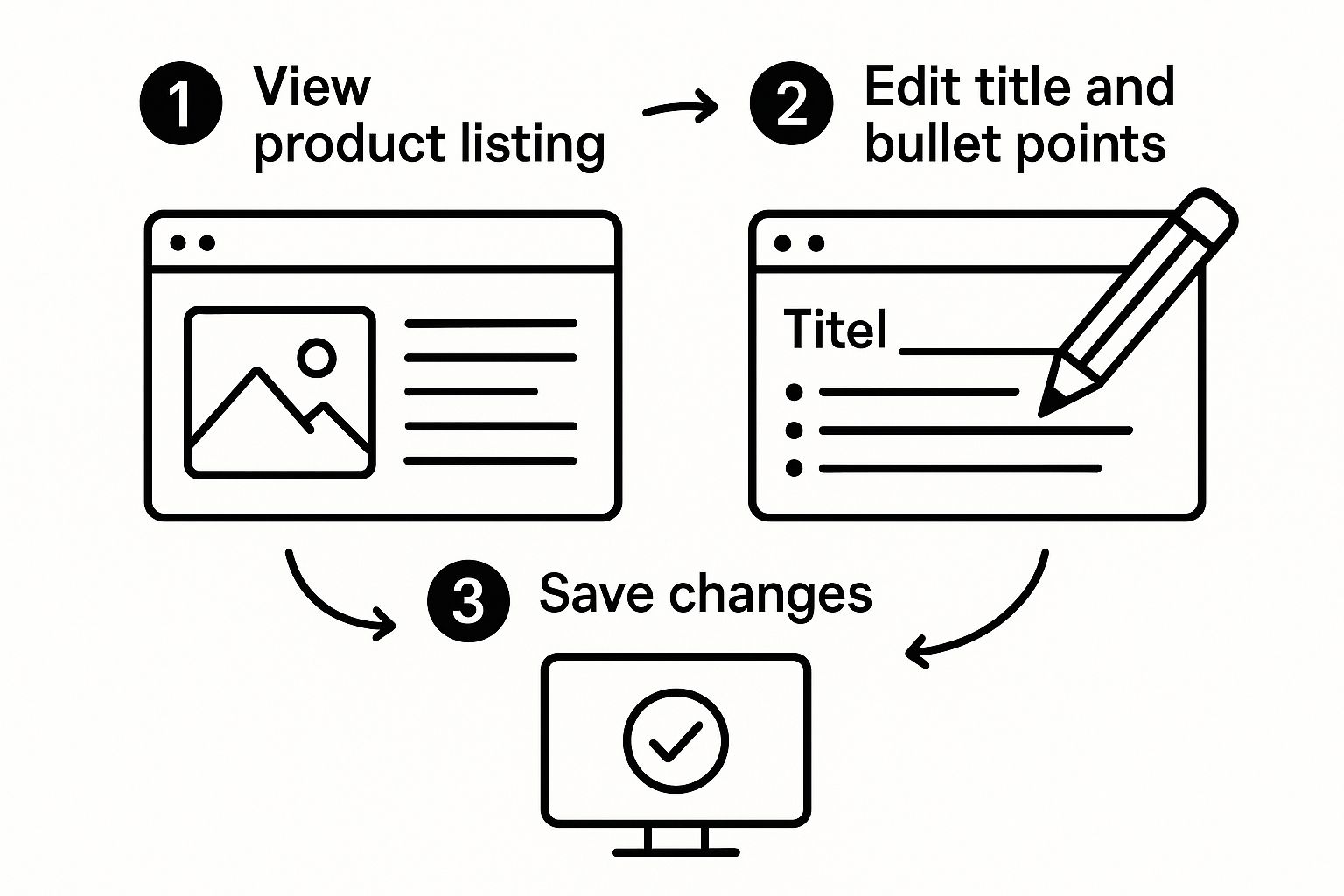
When you're holding a fantastic, high-quality sample in your hands, writing those compelling bullet points for your Amazon listing becomes effortless. You know exactly what makes it better than the competition because you can see and feel it.
When the samples arrive, line them all up for a side-by-side comparison.
- Which one feels the most solid and durable?
- Which has the best finish and attention to detail?
- Is the packaging professional or flimsy?
Nine times out of ten, the cheapest option is cheap for a reason. Pay for the quality that will earn you 5-star reviews, not the product that will get you angry customer emails and costly returns. Your final supplier choice should be based on this real, tangible evidence, not just a price on a spreadsheet.
Building a Brand People Actually Remember
Let's be real: succeeding with a private label on Amazon isn't just about finding a cheap product and flipping it. That's the reseller's game. We're here to build a real asset—a brand.
A strong brand is your secret weapon. It's what lets you charge a little more, what makes people trust you, and what keeps them coming back. It’s the difference between a one-off purchase and a loyal customer who seeks you out.
This is way more than just slapping a logo on a generic box. You're creating an entire experience that has to connect with your ideal customer. It all starts with the basics: a great name and packaging that feels as good as it looks online. Your packaging is the first physical thing your customer touches. Does it feel cheap, or does it feel like they just bought something special? Good packaging instantly bumps up the perceived value of what's inside.
The Nuts and Bolts of Brand Creation
Before you can get to the fun marketing stuff, you've got to take care of a few foundational tasks. They might feel like administrative chores, but they are absolutely essential for protecting your brand and unlocking Amazon’s best tools.
First up, every product you sell needs its own unique identifier. You'll have to buy a UPC (Universal Product Code). Think of it as a social security number for your product; it's non-negotiable for creating a listing. Make sure you get your UPCs from a legitimate source like GS1. Don't cheap out here—shady UPCs can get your listing shut down.
Next, and this is the big one, you need to enroll in Amazon's Brand Registry. For any serious private label seller, this is a must-do. To get in, you'll need a registered trademark for your brand name. Yes, it takes time and money, but the benefits are massive.
Brand Registry is your shield and your sword on Amazon. It helps protect your listings from hijackers and counterfeiters while also giving you access to exclusive marketing features that make you look like a major player, even if you're just starting out.
Unlocking Powerful Marketing Tools
Once you're approved for Brand Registry, a whole new world opens up. You suddenly have access to a suite of tools designed to help you tell your story and make your listings pop.
These aren't just little perks; they give you a serious competitive edge.
- A+ Content: This lets you replace the boring old text description with a beautiful, custom-designed section full of high-quality images and comparison charts. You can finally show, not just tell, what makes your product awesome.
- Brand Stores: You get to build your own multi-page storefront right on Amazon. It's like having a mini-website where you can showcase your entire product line and tell your brand's story in a way that’s impossible on a standard product page.
- Sponsored Brands: This is the ad format that gets your logo, a custom headline, and a few of your products right at the top of the search results. It’s huge for getting your name out there.
Building this kind of presence is what separates the thriving private label businesses from the ones that fizzle out. Just look at Amazon's own brands. In a category like apparel, their private labels make up 9% of sales—proof that a well-built brand can carve out a serious piece of the pie.
As you grow, you might want to look into top AI marketing software to help manage your promotional campaigns more efficiently. The goal of all this work is to turn first-time buyers into genuine fans. For a deeper look at that, check out our guide on how to build brand advocates who will champion your products.
Crafting an Amazon Listing That Actually Sells
Think of your Amazon listing as your best salesperson. It’s on the clock 24/7, and its only job is to convince shoppers that your product is the one they've been looking for. Just throwing up a few photos and a bland description is a surefire way to fail. To really make it with a private label brand, you have to build a product page that’s persuasive, optimized, and impossible to ignore.
Every single piece of your listing—from the headline to the images to the hidden keywords—has to work together. It's a puzzle, and getting all the pieces right is what separates the sellers who barely break even from those who build thriving, profitable businesses.
Nailing the Product Title
Your title is the first handshake. It has two critical jobs: grab the attention of the right customer using keywords and give them a compelling reason to click. A great title is more than just a jumble of search terms; it's a headline that promises a solution.
Get inside your customer's head for a second. What are they typing into that search bar? Your most important, high-volume keyword needs to be right at the front. From there, you can add key features, benefits, or what the product is used for.
Here’s a simple formula I’ve seen work time and time again:
- Main Keyword: "Stainless Steel Under-Sink Organizer"
- Key Feature: "2-Tier Sliding Drawer"
- Best Use Case: "for Kitchen and Bathroom Cabinet Storage"
- Your Brand: "by YourBrand"
Put it all together, and you get: Stainless Steel Under-Sink Organizer - 2-Tier Sliding Drawer for Kitchen and Bathroom Cabinet Storage by YourBrand. See how that’s loaded with relevant terms but still easy to read? That's the goal.
Writing Bullet Points That Solve Problems
This is where you close the deal. Shoppers are impatient; they scan the bullet points to see if your product solves their problem, and they decide in seconds. This isn't the place for a dry, boring list of specs. It's where you sell the benefits.
Don’t just say, "Made from durable steel." That's a feature.
Instead, frame it as a benefit: "Built to Last: Constructed from rustproof stainless steel that holds all your heavy cleaning supplies without ever bending or wobbling." You’re not just listing a material; you’re painting a picture that solves their fear of flimsy, cheap organizers.
Your bullet points are your chance to answer the customer's biggest questions and overcome their objections before they even have them. Tie every point back to a problem you uncovered during your research.
Mastering this is a huge part of the private label game. If you need a deeper dive, there's a lot of great info out there on how to write product descriptions that sell that can help you sharpen this skill.
The Make-or-Break Power of Visuals
People buy with their eyes, especially online. Your product photography is the closest a customer will get to actually holding your product before they buy. Fuzzy, poorly lit photos taken on your phone will absolutely tank your sales. No exceptions.
Your images need to tell a complete story.
- The Hero Shot: Your main image must be a crystal-clear photo of your product on a pure white background. This is an Amazon rule, so don't even think about skipping it.
- Lifestyle Photos: Show the product being used in a real-life setting. Selling a yoga mat? Show someone looking peaceful and happy using it in a beautiful, sunlit room. Help the customer picture it in their own life.
- Infographics: These are images with text overlays that call out key features, dimensions, or benefits. They're perfect for skimmers who want the key info at a glance.
- Comparison Graphics: A simple side-by-side showing why your product is better than a generic alternative can be incredibly powerful.
Seriously, spending a few hundred dollars on a professional photographer is one of the best investments you can make. It screams quality, builds trust, and instantly makes your product feel more valuable.
Using Backend Keywords to Your Advantage
While your title and bullet points are written for people, your backend search terms are your secret message to Amazon's A9 search algorithm. This is your chance to rank for keywords you couldn't fit into your main listing.
This is where you dump all the related search terms: synonyms, common misspellings, and different ways people might search for your item. If you’re selling a "garlic press," your backend terms could include "garlic mincer," "garlic crusher," or even "prensa de ajos" to capture Spanish-speaking shoppers.
A quick pro-tip: Don't waste space by repeating keywords already in your title, bullets, or description. Amazon already indexes those. Use this valuable real estate to cast a wider net and make sure every potential customer has a chance to find you.
Common Questions About Private Labeling
Diving into Amazon private labeling is exciting, but let's be real—it can also feel a little overwhelming. You've probably got a dozen questions running through your mind. That's a good thing! It means you're taking this seriously. Let's tackle some of the most common ones I hear from new sellers.
How Much Money Do I Need to Start?
There’s no one-size-fits-all answer, but a healthy starting point is somewhere in the $3,500 to $8,000 range. The biggest slice of that pie will almost always be your first big inventory order.
But don't forget the other essentials. That budget also has to cover things like getting product samples from a few different suppliers (never skip this!), professional photos, solid packaging design, and a bit of cash for your initial ad campaigns. Can you start with less? Technically, yes, but it’s a risky move. A tight budget boxes you into cheaper product categories and leaves you with zero wiggle room for marketing, which is how you get those crucial first sales.
How Long Does It Take to Launch My Product?
Get ready to play the long game. From the moment an idea sparks to your product going live on Amazon, you should realistically plan for about 4 to 6 months. This isn't a weekend project.
Here’s a rough breakdown of how that time gets spent:
- Product Research: Give yourself a solid 2-4 weeks for this. You'll be deep in the weeds, analyzing niches and checking out the competition.
- Sourcing and Sampling: Finding the right factory and getting physical samples in your hands typically takes another 4-6 weeks.
- Manufacturing: Once you give the green light, your first production run can take anywhere from 4-8 weeks, depending on complexity.
- Shipping: Getting your products from a factory in Asia to an Amazon warehouse via sea freight is the standard, and that voyage alone takes another 4-6 weeks.
Trying to rush this process is a classic rookie mistake. It's how you end up with quality problems, unexpected delays, and expensive headaches that a little patience could have easily prevented.
Is It Too Late to Start an Amazon Private Label Business?
Not at all. But the game has changed. The old "slap a logo on a generic widget and profit" strategy is dead. Amazon is a much more crowded and sophisticated marketplace now, and shoppers expect more.
Today, success is all about building a real brand. You have to find a way to make your product genuinely different and better. Listen to customer complaints about existing products and solve them. Sellers who do the work to understand their audience and offer a superior solution are the ones who are building profitable, long-term businesses on Amazon right now. The opportunity has simply evolved from a gold rush to a real business model.
Should I Form an LLC for My Amazon Business?
While you can technically start selling as a sole proprietor, forming an LLC is one of the smartest things you can do early on. An LLC (Limited Liability Company) creates a legal wall between your business and your personal life.
Why does that matter? It protects your personal assets—your house, your car, your savings—if the business ever runs into debt or legal trouble. If something goes wrong, only the business's assets are at risk, not your own. Plus, it just makes you look more professional and credible. It’s a foundational step for anyone serious about building a real company.
Pro Tip: While your main focus is on selling your product, you can also explore other revenue streams. We break down another popular option in our post on the Amazon affiliate marketing program.
Ready to turn your brand's fans into a powerful sales force? Coral provides the tools you need to build, manage, and scale a high-performing affiliate program right on Amazon. Start for free and see how easy it is to drive authentic, long-term growth. Get started with Coral today!