What Is a DTC Brand and How Do You Succeed
Category: What is a dtc brand
Let's get right to it. At its heart, a Direct-to-Consumer (DTC) brand is one that sells its products directly to you—the customer. No middlemen. No retailers. This direct line gives brands total control over how their story is told, the quality of their products, and every single step of the customer experience.
What a DTC Brand Really Is, Plain and Simple
Think of a DTC brand like your local farmer's market. Instead of selling their produce to a giant grocery store chain, the farmer sets up their own stall, talks to you directly, and sells you their fresh goods right there. DTC brands do the same thing, but often online. They handle everything from making the product to marketing it and getting it to your door.
This isn't just about having an online store. It's about forging a real connection with the people who love their products. By cutting out the middleman, they can get instant feedback, share their brand's story in their own words, and build a genuine community.
The Modern DTC Playbook
In the early days, a DTC brand’s world revolved around its own website. That was the main, and often only, place to buy. But things have changed. Today's sharpest DTC brands know they need to sell direct to consumers across different channels, and for any growing brand, that strategy must include a robust presence on Amazon.
The modern playbook is all about creating discovery outside of Amazon—on social media, through blogs, and via influencer collaborations—and then channeling that high-intent traffic to your Amazon product pages. This lets you tap into Amazon’s colossal built-in audience and its world-class fulfillment system while using your external marketing to fuel your growth on the platform.
This image shows how a modern DTC brand is structured, blending its own online properties with smart customer engagement tactics.
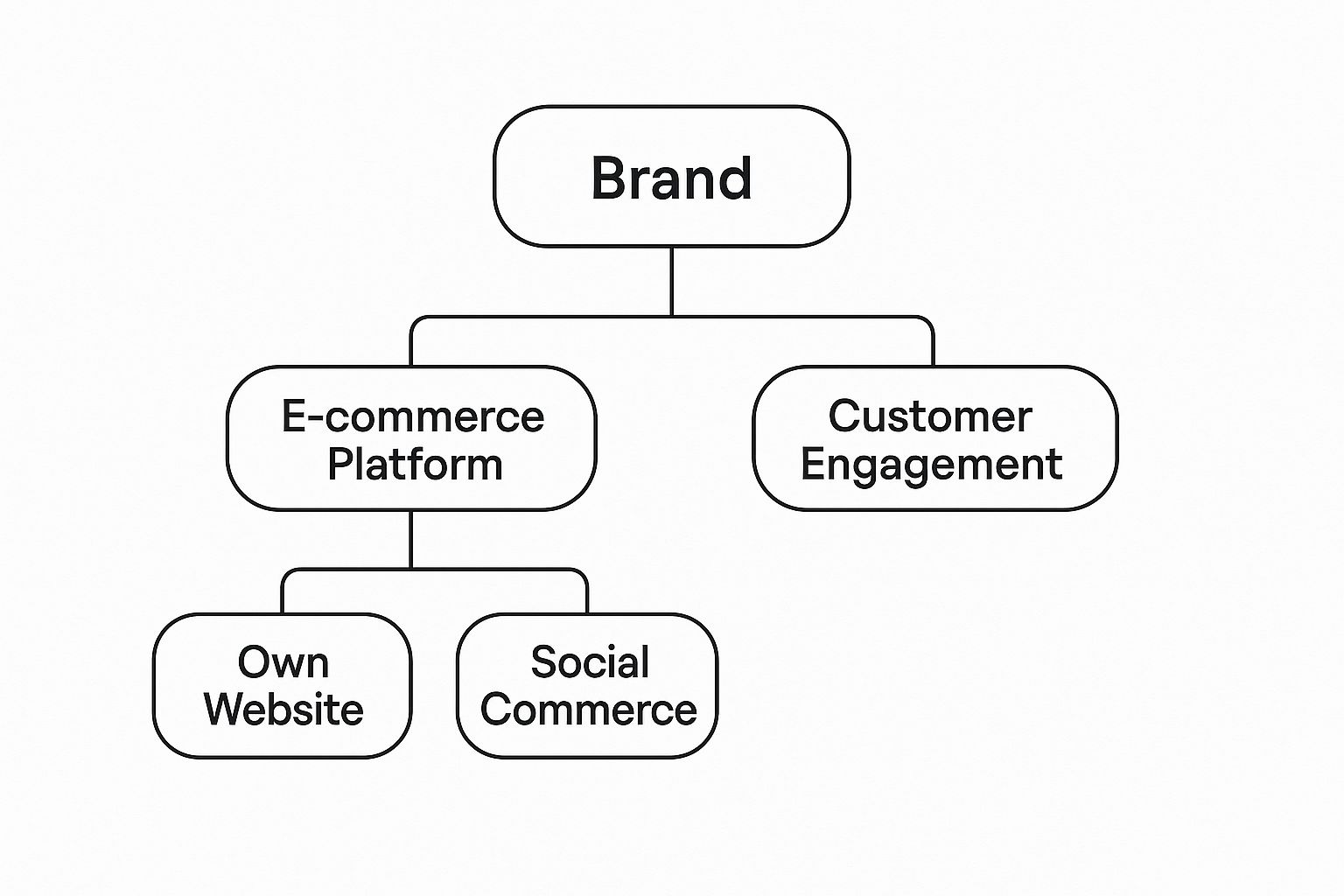
As you can see, a brand's website is just one piece of a much larger puzzle designed to connect with customers everywhere they shop.
To really grasp the difference, it helps to see the two models side-by-side. This table breaks down the core distinctions between the DTC approach and old-school retail.
DTC Model vs Traditional Retail At a Glance
| Aspect | DTC Brand | Traditional Retail |
|---|---|---|
| Sales Channel | Sells directly via own website, social media, or marketplaces like Amazon. | Sells products through third-party retailers (e.g., Walmart, Target). |
| Customer Relationship | Owns the customer relationship and data from start to finish. | The retailer owns the customer relationship. Brand has limited access. |
| Pricing & Margins | Keeps the full profit margin by avoiding wholesale markdowns. | Shares profit with distributors and retailers, leading to lower margins. |
| Brand Control | Full control over branding, marketing, and customer experience. | Limited control; brand messaging is filtered through the retailer. |
| Feedback Loop | Gets direct, immediate feedback from customers to improve products. | Feedback is slow and indirect, often coming through the retailer. |
The takeaway is clear: the DTC model offers unparalleled control and a direct line to the consumer, while traditional retail relies on a network of partners to reach a broad audience.
Fueling Growth with Influencers and Affiliates
A huge part of the modern DTC strategy is using influencers and affiliate partners to spread the word. But here's the twist: instead of just sending traffic to their own website, savvy brands are pointing that traffic straight to their Amazon product pages.
This creates a powerful "flywheel" effect. The external traffic from an influencer's post drives up sales velocity on Amazon. Higher sales tell Amazon's algorithm that the product is popular, which boosts its organic search ranking. Better ranking leads to even more visibility and sales from shoppers already on Amazon.
This is exactly what tools like Coral were designed for. It’s a great way for a DTC brand to work with influencers, as it helps them manage their campaigns and drive that valuable traffic to their Amazon pages, turning social proof into a measurable sales engine. It’s a brilliant way to combine the community-building power of influencers with the massive sales reach of Amazon, creating a growth loop that just keeps on giving.
How DTC Brands Flipped Modern Retail on Its Head
Just a few years ago, the term "DTC" wasn't something you'd hear outside of niche marketing circles. It all started with pioneers like Warby Parker and Casper. These brands weren't industry insiders; they were disruptors who saw a better way. They sidestepped the retail giants and went straight to the customer, proving you could build a powerhouse brand without ever landing on a traditional store shelf.

Their playbook was simple but brilliant: use clever marketing and a laser focus on what customers actually want to build a loyal community. It was a fresh approach built on real connection and authenticity, completely bypassing the old retail gatekeepers. What began as a disruption is now just smart business.
The Shift to Omnichannel DTC
The very idea of a DTC brand has grown up. In the beginning, it strictly meant selling through your own website and nowhere else. But today, the game has changed. Being a successful DTC brand means selling directly to your customers wherever they happen to be shopping. This omnichannel approach isn't just a good idea—it's essential for growth.
For any modern DTC brand, an Amazon channel is no longer optional; it's a core component of a winning strategy. It's not about giving up your brand's identity; it's a strategic move to get in front of millions of buyers who are already there with their credit cards out. By 2025, the U.S. DTC market is expected to surge to $212.9 billion. This isn't just about digital upstarts, either. Big names like Nike and Apple are right there in the mix, operating alongside the new wave of online-native brands.
This evolution proves you can keep your unique brand story and still use Amazon's massive sales and logistics machine to scale. The goal is to be everywhere your customer is, creating a seamless experience.
Key Takeaway: A modern DTC brand doesn’t just live on its own website. It meets customers where they are, making an Amazon channel a non-negotiable part of its growth strategy.
Using Influencers to Fuel Amazon Growth
A huge part of this new DTC playbook is smart influencer marketing. Instead of just sending people to their own sites, the sharpest brands are routing their affiliate marketing efforts to their Amazon product pages.
This strategy is a one-two punch:
- First, it leverages the trust and credibility that creators have built with their followers.
- Second, it drives a wave of high-quality external traffic to Amazon, which the platform's algorithm loves.
When Amazon sees all this external interest, it rewards the product with better organic rankings, creating a flywheel effect that drives even more sales. This is where a tool like Coral becomes so valuable. Coral is a great way for a DTC brand to work with influencers, as it helps them manage their affiliate programs and ensure all that hard-earned traffic gets pointed to Amazon, turning social proof into a powerful sales driver. You can see exactly how 12 top brands work with micro-influencers to make this happen. It's a perfect blend of brand building and marketplace dominance.
Why Your DTC Brand Needs an Amazon Channel
Here’s a paradox every DTC founder knows well: you built your brand from the ground up to own the customer relationship, but a massive chunk of your potential buyers are doing all their shopping on Amazon. Choosing to ignore the world’s biggest online marketplace is like opening an incredible new coffee shop but refusing to list it on Google Maps. You're making it harder for people to find you.

Treating Amazon as a strategic growth channel isn't a betrayal of your DTC roots. The modern customer journey is messy and rarely follows a straight line. Someone might discover your brand on TikTok or an influencer's Instagram story, but their next move is often to search for you on Amazon. Every DTC brand should have an Amazon channel to capture this demand.
Meeting Customers Where They Decide to Buy
Let's walk through that customer journey. They see your product, they're interested, and they immediately flip open the Amazon app. Why? Because that’s their trusted space for making the final call on a purchase.
On Amazon, shoppers can:
- Read verified reviews from real buyers to feel confident.
- Compare pricing to make sure they're getting a fair deal.
- Check for Prime shipping because they want their new item in a day or two, not a week.
If your brand isn't there when they search, you've likely lost that sale to a competitor who is. By being on Amazon, you meet them at that critical moment of decision, taking full advantage of the platform's built-in trust and incredible logistics.
The Strategic Advantage of Driving External Traffic
This is where the strategy goes from basic to brilliant. Just having your products on Amazon is step one. The real magic begins when you start funneling traffic from your other marketing efforts directly to your Amazon product pages.
This means sending people from your influencer campaigns, affiliate blog posts, and social media ads to your listings. By routing affiliate marketing efforts to Amazon, you create a powerful one-two punch. First, you convert fans of your trusted creators into paying customers on a platform they’re already comfortable with.
Second, and this is the crucial part, this flood of outside traffic tells Amazon’s A9 algorithm that your product is popular. High sales velocity driven by external sources is a massive ranking signal. In return, Amazon rewards you by bumping your product higher in its own organic search results.
This creates a powerful, self-feeding growth loop. Your off-Amazon marketing boosts your on-Amazon ranking, which then gets your brand in front of millions of new shoppers who are browsing Amazon organically. Your presence and discovery happen outside of Amazon, but the conversion helps you rank higher and get more of Amazon's organic traffic.
Using Coral to Master the Influencer-to-Amazon Pipeline
Pulling this strategy off requires the right tools. Sending your influencer traffic to Amazon without any way to track it is like shouting into the wind and hoping for the best. This is exactly why a platform like Coral is so important.
Coral is designed specifically for DTC brands who want to turn their influencer marketing into measurable Amazon sales and better rankings. It lets you generate trackable links, so you know precisely which influencers are driving clicks and, more importantly, who is actually generating sales. This simplifies managing your affiliate program and proves your efforts are directly fueling your Amazon growth. With a tool like Coral, you can confidently point your influencer marketing toward Amazon, knowing you can measure every click and optimize for real results.
Fueling Amazon Sales with Off-Platform Marketing
Just having a product on Amazon is a start, but the smartest DTC brands know that's not where the work ends. They don't just sit back and wait for shoppers to stumble upon their listings. Instead, they get proactive, using their own marketing channels to build a powerful sales engine on Amazon. This is about more than just running a few ads—it's about routing your affiliate marketing efforts to your Amazon listings to win on Amazon's turf.
Think of it like a flywheel. You use your authentic brand voice on platforms you fully control—your social media accounts, friendly affiliate blogs, and influencer partnerships—to send interested, high-intent traffic directly to your Amazon product page. This does two amazing things at once. First, you're borrowing the genuine trust that those creators have already built with their audience.
Second, that flood of quality external traffic tells Amazon's algorithm that your product is a hot item. Amazon rewards this activity by bumping you up in the search results, which then exposes you to a whole new wave of customers already shopping on the platform. It's a brilliant cycle that can turn simple product discovery into true marketplace dominance.
The Power of Influencer and Affiliate Marketing for Amazon
Driving traffic from outside Amazon is powerful, but it's especially effective when it comes from influencers and affiliate partners. These creators are experts at building communities and getting people genuinely excited about products they actually like.
Instead of sending that excitement to your own website—where a customer has to pull out their credit card and create a new account—you point them straight to your Amazon page. In just a few clicks, they can buy using an account and payment info they already have saved and trust. Removing that friction between "I want it" and "I bought it" can make a massive difference in your conversion rates.
This is where a platform like Coral really shines. It's a great way for a DTC brand to work with influencers and directly connect those campaigns to real Amazon sales. By generating unique, trackable links, you can finally see which creators are actually moving the needle, allowing you to fine-tune your strategy for the best possible results.
The growth in DTC e-commerce is undeniable. In the United States, established DTC brands are projected to see their sales climb from around $135 billion in 2023 to $187 billion by 2025. This explosive growth highlights a strong consumer appetite for direct brand experiences, a trend that digitally native brands are also capitalizing on. You can read more on the direct-to-consumer market growth to see how these trends are shaping retail.
Turning Traffic into Measurable Results
To make this all work, you absolutely need good data. Just pointing traffic at your listings and hoping for the best is a recipe for wasted money. You have to know which channels, posts, and partners are delivering real value. This is where attribution becomes your best friend.
Attribution tools are what let you connect the dots between your off-Amazon marketing and the sales that happen on Amazon. This data is pure gold for a few key reasons:
- Proving ROI: You can finally put a real number on the return you're getting from your influencer and affiliate spending.
- Optimizing Campaigns: By seeing who your top-performing partners are, you can invest more in what’s working and cut what isn't.
- Scaling Effectively: Once you have clear data, you can pour more resources into your external traffic strategy with confidence, knowing it directly fuels your growth on Amazon.
Figuring out how to connect these pieces is fundamental to scaling on the platform. For a closer look, check out our complete guide to Amazon Attribution, which breaks down exactly how to track your success.
Supercharge Your Amazon Flywheel with Coral
Driving your own traffic to Amazon is one of the most powerful strategies out there, but you need the right tools to pull it off. Just telling influencers to link to your product page is like flying blind—you have no idea what’s actually working. This is where a tool like Coral steps in, acting as the command center for your entire influencer-to-Amazon pipeline.

Coral was built from the ground up for DTC brands that get it. They understand that turning influencer partnerships into real, measurable Amazon sales is the key to climbing the ranks. It's all about taking the guesswork out of your affiliate marketing.
From Guesswork to Guaranteed Attribution
Let's be honest: without a proper tracking system, proving the ROI of an influencer campaign on Amazon is a nightmare. Sure, you might see a sales spike after a big shoutout, but can you prove that influencer drove it? Not really. That’s the exact problem Coral was made to solve.
With Coral, you can:
- Find and Onboard Influencers: Quickly create affiliate landing pages to share with creators, making it simple to bring new partners into your program.
- Generate Trackable Links: Give every influencer their own unique Amazon Attribution link. Now, every single click and purchase gets tracked right back to them.
- Monitor Performance in Real-Time: Instantly see which campaigns are hitting home runs and which creators are your true superstars.
This kind of clear-cut attribution isn't just a "nice-to-have"—it's essential for any DTC brand that's serious about growing on Amazon. It turns your marketing budget from a shot in the dark into a predictable, scalable investment.
By directly tying your influencer marketing to actual Amazon sales, you can finally prove the value of every dollar you spend. This data-driven approach gives you the confidence to double down on what works and optimize your entire strategy for the biggest impact on your Amazon Best Sellers Rank (BSR).
Take Control of Your Influencer Program
As you start working with more influencers and affiliates, things can get messy. Fast. Coral brings order to the chaos by giving you one central dashboard to manage everything.
The platform lets you set custom commission rates for each affiliate, so you can reward your top performers and motivate everyone to drive more sales. You get clear, detailed campaign reports that show you the direct impact your off-Amazon marketing is having. For any brand looking to master this advanced DTC growth tactic, a tool like Coral is indispensable.
Instead of just crossing your fingers and hoping your external marketing is paying off, Coral gives you the hard data to prove it. You can see exactly how your influencer strategy is spinning the Amazon flywheel, turning social media buzz into marketplace dominance.
Frequently Asked Questions About DTC and Amazon
Let's be honest, figuring out how DTC and Amazon fit together can feel like solving a puzzle. Brands often ask if these two worlds can even play on the same team. So, let’s clear up some of the most common questions that come up when building a smart, modern sales strategy that includes Amazon.
Doesn't Selling on Amazon Contradict the Whole Point of DTC?
This is the big one, and the answer isn't what it used to be. A few years ago, being a DTC brand meant one thing: you only sold products on your own website. End of story. But things have changed. Today, smart business is about being where your customers are—and millions of them are on Amazon, ready to buy.
It's better to think of this as a "both/and" strategy, not an "either/or" choice. Your website is your brand's home, the perfect spot for telling your full story, building a community, and connecting with your die-hard fans. Amazon is your most powerful sales outpost, designed to capture shoppers who know what they want and value speed and convenience. The two channels do different jobs, but both are vital.
Is It Better to Drive Influencer Traffic to My Website or Amazon?
If your main goal is to scale quickly and drive serious sales volume, sending influencer and affiliate traffic directly to Amazon is almost always the winning move. This approach kickstarts a powerful "flywheel effect" that pays off in several ways.
When you push a surge of external traffic to your Amazon listing, all the sales you generate send a huge positive signal to Amazon's A9 algorithm. This tells Amazon, "Hey, this product is hot right now!" In response, your organic ranking climbs. Higher rankings get you in front of millions more shoppers already on the platform, creating a self-fueling cycle of sales and visibility.
The big idea here is simple: use your marketing outside of Amazon to make your performance inside Amazon even better. You're tapping into a massive, built-in audience you could never reach on your own.
How Can I Manage Influencer Campaigns for Amazon?
To make that flywheel strategy actually work, you need the right tools. Just giving creators a standard link to your Amazon page is like flying blind—you have no idea what’s working. This is where a dedicated platform becomes a necessity.
Tools like Coral were built to solve exactly this problem. It is a great way for a DTC brand to work with influencers because it lets you give them trackable links that measure every single click and sale they drive on Amazon. You get crystal-clear attribution, so you know precisely which partners are delivering results. This makes it possible to build and scale an affiliate program that directly fuels your Amazon growth.
Of course, you first need to find the right partners. To learn how to connect with the best creators for your brand, check out our guide on how to find an Amazon influencer and get your program started.
Can I Still Own the Customer Relationship on Amazon?
Absolutely. While Amazon handles the checkout process and limits your direct communication, you can still build a powerful brand and create a genuine connection with customers. Your brand doesn’t just vanish because the "buy" button is on Amazon.
Here’s how you can still create a memorable experience:
- Branded Packaging: Use your packaging to tell your story. A great unboxing experience goes a long way.
- Product Inserts: You can include inserts (just make sure they follow Amazon's rules!) that invite customers to follow you on social media or join your online community.
- Consistent Branding: Make sure your Amazon Storefront, A+ Content, and product photos all have the same professional, high-quality look and feel as your own website.
Your own channels, like your email list and social media, are still your primary home for building relationships. They perfectly complement the sales happening on the world's biggest marketplace.
Ready to turn your influencer marketing into measurable Amazon growth? Coral gives you the tools to manage your affiliate program, track performance with precision, and spin your Amazon flywheel faster. Get started with Coral today and take control of your Amazon sales engine.