Amazon Affiliate Marketing for Beginners: Ultimate Guide
Category: Amazon affiliate marketing for beginners
Getting into Amazon affiliate marketing is probably one of the most straightforward ways to start earning money online. The whole idea is pretty simple: you share products you actually like and trust with your audience, and when they buy something using your special link, Amazon pays you a commission. It's a genuine way to build an income stream on a platform that millions of people already use every single day.
Your Start in Amazon Affiliate Marketing
Kicking off any new project can feel a bit overwhelming, kind of like staring up at a huge mountain. Getting started with Amazon affiliate marketing for beginners is no different. But here’s the good news: plenty of people have walked this path before, and all the tools you need are right at your fingertips. The official program, called Amazon Associates, lets you tap into a massive, trusted global market without ever having to stock or ship a single product.
Your job is simply to be a helpful guide. You're the one connecting people’s problems or questions with the perfect products on Amazon that can solve them. Try to think of yourself less as a salesperson and more as a trusted friend offering solid advice through your content.
What Does the Journey Look Like?
This isn't some get-rich-quick scheme. It's a real business model that works when you're consistent and build trust with your audience. The whole process follows a logical path, which I'll walk you through.
Your journey will break down into a few key stages:
- Finding Your Niche: This is about zeroing in on a specific topic you're passionate about, where you can really become the go-to expert.
- Building a Platform: You'll need a home base for your content. This could be a blog, a YouTube channel, or even a strong social media presence.
- Creating Valuable Content: The core of your work will be making helpful product reviews, in-depth how-to guides, and comparison articles that your audience will actually find useful.
- Driving Traffic: Once the content is there, you'll learn how to get the right eyeballs on it—people who are genuinely interested in your recommendations.
- Earning Commissions: This is where your hard work pays off, turning the trust you've built into income.
The sheer size of this opportunity is hard to overstate. Amazon Associates is the biggest affiliate network out there, commanding a massive 46.21% market share. It's a major reason why so many creators choose to start their journey here. For a much deeper dive, you should check out our comprehensive guide on affiliate marketing for Amazon.
Amazon's dominance isn't a fluke. It's built on an enormous product catalog and the rock-solid brand trust they've cultivated over many years. That trust gives you a huge head start when you recommend a product. With the entire affiliate industry expected to be worth over $31 billion by 2031, getting your foot in the door now means you're perfectly positioned to grow right along with it.
Finding a Niche You and Your Audience Will Love
Let's be honest, choosing your niche is the most critical step you'll take. Get this right, and everything else falls into place. Get it wrong, and you'll be fighting an uphill battle from day one. Your niche is that perfect sweet spot where your personal passion, your audience's needs, and real profitability all meet.
Think of it like this: anyone can start a blog about "kitchen gadgets." It's a huge, crowded space. But what if you focused on something specific, like "gear for home coffee brewing"? Suddenly, you're not just another voice in the noise. You’re becoming an expert for a dedicated group of people.
Other ideas could be sustainable pet supplies or building a home gym for beginners. The more dialed-in you are, the easier it is to attract a loyal following that actually trusts what you have to say.
How to Find That Perfect Niche Idea
The absolute best place to start is with your own interests. What do you love talking about? What do you spend hours researching just for fun? Authenticity is magnetic. If you’re genuinely excited about a topic, it will come through in your writing and build a real connection with your readers.
Once you have a few ideas brewing, you need to see if they have legs. A passion project is great, but a profitable one is even better. Here's how I brainstorm and check for real-world demand:
- Look at Your Hobbies: Are you the person everyone asks about building custom mechanical keyboards? Or maybe you've perfected urban gardening on a tiny balcony. These personal obsessions are gold mines.
- Think About Problems You've Solved: Did you figure out the best ergonomic setup for a small home office? That solution is a niche just waiting to be built.
- Dive into Online Communities: Go hang out where your people are. Spend time on Reddit, in niche Facebook Groups, or on specialized forums. What products do you see people asking about or recommending over and over?
The goal is to find a topic that’s broad enough to offer a range of products but specific enough for you to become a go-to authority. For example, "fitness" is way too broad. But "yoga equipment for seniors"? That's a fantastic, highly-targeted niche.
Using Amazon Itself for Niche Research
Don't forget that Amazon is a treasure trove of market research. Start by digging into their "Best Sellers" and "Movers & Shakers" lists for categories you're interested in. This is a direct look at what’s selling right now.
Keep an eye out for products with thousands of positive reviews. A ton of reviews is a clear signal of consistent, long-term demand. Also, look for products with a slightly higher price point. Higher prices naturally mean better commissions for you.
Finally, always check the commission rates for different categories. Amazon's fee structure isn't uniform. A niche in a high-commission category can make a huge difference to your bottom line. Finding something you love that also sits in a category with a 4% or higher commission rate is the perfect launchpad.
Alright, you've picked your niche. Now it's time to build your home base—the place where all your content will live and where you'll eventually send your audience.
For most people starting out with Amazon affiliate marketing, this usually boils down to two options: a blog or a YouTube channel. There isn't a "best" choice here. It really depends on what you're good at and what makes the most sense for your niche.
If you’re a strong writer who enjoys crafting detailed guides, product comparisons, and thorough reviews, a blog is a fantastic route. You can build authority with your words, and search engines love to index that kind of in-depth content. But if you're more of a visual person and your niche is full of products that need to be seen in action—think cooking gadgets or fitness gear—a YouTube channel is probably the smarter play.
The most important thing isn't which platform you choose. It's that you start creating content before you even think about applying to the Amazon Associates program. Amazon wants to see that you're for real and that you've already built a platform with an audience and original content. I always tell beginners to aim for at least 10-15 solid pieces of content before filling out that application.
Getting Your Application Ready for Amazon Associates
Before you even navigate to the Amazon Associates sign-up page, you need to make sure your site or channel is ready. Getting this part right from the start seriously boosts your chances of getting approved the first time around.
So, what is Amazon looking for? It's pretty straightforward:
- A Live and Working Platform: Your site can't have an "under construction" page. It needs to be public, functional, and complete.
- Original, Quality Content: They need to see that you’re creating helpful, unique content for real people, not just churning out low-effort posts or videos.
- A Clear Niche: Your site should be about something. A random mix of content on unrelated topics is a huge red flag for them.
Remember, a real person at Amazon will be reviewing your application. They're looking for partners who will be a good reflection of their brand. A rushed, sloppy site is an almost guaranteed rejection. Take the time to build a quality foundation first. It's worth it.
Once your content is in a good place, it's time to head over and apply. You can start the process right on the Amazon Associates homepage.
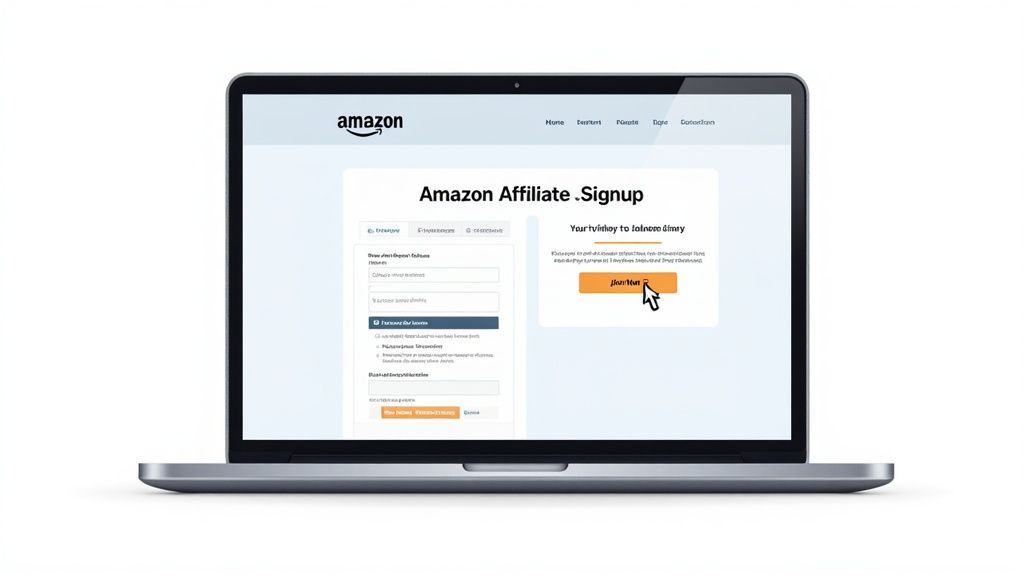
As you can see on their landing page, they lay it out as a simple process: Sign up, Recommend, and Earn. They try to make it feel really approachable, even for total beginners.
How to Avoid Common Application Mistakes
I’ve seen so many aspiring affiliates get rejected for simple, avoidable reasons. The number one mistake? Applying with an empty or half-finished website. Amazon has to see what kind of partner you're going to be, and an empty site tells them nothing good.
Another common trip-up is not having a proper affiliate disclosure. You absolutely must have a clear statement on your site that explains you earn commissions from your recommendations. This isn't just a suggestion; it's a legal requirement and a sign of transparency that Amazon takes very seriously.
Be upfront about it. Put your disclosure somewhere easy for visitors to find, and you'll be one big step closer to getting that approval email.
Creating Content That Genuinely Helps and Sells

Let's get one thing straight: your content is the heart and soul of your entire affiliate marketing effort. Think of it as the bridge connecting someone's problem to a product on Amazon that can actually fix it. If you're just trying to push products with aggressive sales pitches, you're going to fail. The real secret is to create content so genuinely helpful that dropping in an affiliate link feels like you’re doing your reader a favor.
Success isn't a numbers game of promoting every random product you find. It's about earning trust. When you become the go-to, reliable resource in your niche, people don't just come back—they listen to what you have to say and are far more likely to buy based on your recommendations.
So, you need to shift your entire mindset from "selling" to "helping." Your authority, and ultimately your income, will grow directly from your expertise and honesty. That's the bedrock of a profitable affiliate business.
Proven Content Formats That Drive Clicks
You could write about anything, but some content formats are just built better for affiliate marketing. They naturally tap into a buyer's mindset. Instead of throwing spaghetti at the wall to see what sticks, start with these proven approaches that guide people toward making a smart purchase.
Here are three content types I’ve seen work time and time again:
- In-Depth Product Reviews: Don't just list the features from the Amazon page. Get personal. What did you love about it? What was a letdown? The gold standard here is including your own photos or videos of you actually using the product. That's how you build undeniable credibility.
- "Best Of" Comparison Posts: These are absolute gold for readers who are stuck between a few different options. A post like "The 5 Best Drones for Beginner Photographers" does the heavy lifting for them by laying out the key features, pros, and cons all in one easy-to-scan article.
- "How-To" Guides: This is where you solve a real problem for your audience, and the product is just part of the solution. For instance, a tutorial on "How to Create the Perfect At-Home Cold Brew" can naturally feature your favorite cold brew maker, filters, and even the beans you use.
The key takeaway is that your content should be useful even without the affiliate links. If a reader can walk away with valuable information, you've done your job. The commission is simply a byproduct of being genuinely helpful.
Writing with Authority and Honesty
Authenticity is your biggest advantage. Readers are savvy; they can sniff out a fake, overly-hyped sales pitch from a mile away. To build trust that lasts, your recommendations need to be honest, balanced, and grounded in real-world experience.
Don't ever be scared to point out a product's flaws. Seriously. Talking about who a product is not for can actually boost your conversion rate. It proves you're not just chasing a commission; you’re genuinely trying to match the right person with the right product. That kind of transparency makes your praise for the good stuff that much more believable.
This is a make-or-break part of the entire Amazon affiliate marketing program, because it all comes down to your long-term reputation.
Placing Affiliate Links Strategically
Your content can be fantastic, but where you put your links matters just as much. You need to make them easy to click without being obnoxious. The goal is to place them right at the point where a reader is thinking, "Okay, I'm interested."
Think about these high-impact placements:
| Link Placement | Why It Works |
|---|---|
| Product Comparison Table | Readers can scan options quickly and click through on the one that catches their eye. It's efficient. |
| First Mention in Text | Catches the eager buyers. As soon as you introduce the product, give them a path to it. |
| Dedicated CTA Buttons | A clear button like "Check Price on Amazon" stands out and gives a clear, direct call to action. |
| In Your Final Summary | You've made your case. A final link in your conclusion seals the deal for readers who needed that last nudge. |
At the end of the day, your link placement should feel completely natural. If someone has to go hunting for your link, you've probably already lost the sale. Weave your links smoothly into the flow of your content, and you’ll start to see those clicks and commissions climb.
Turning Clicks Into Commissions and Boosting Revenue
Alright, let's talk about the part that really matters: getting paid. It’s one thing to get people to click your links, but it’s another thing entirely to turn those clicks into actual cash in your bank account. How much you make comes down to the choices you make, starting with Amazon's commission structure.
Not all product categories are created equal in Amazon's eyes. You could sell a $100 item in one category and a $100 item in another and earn completely different amounts. This is a critical piece of the puzzle for beginners. For example, promoting products in categories like Luxury Beauty can net you a commission as high as 10%, while a sale in PC Components might only get you 4%.
This is why your niche selection is so important from day one. Choosing a topic you're passionate about is great, but aligning it with a category that pays well is even better.
A Quick Look at Commission Rates
To give you a better idea, here's a simplified table showing how different categories can stack up. This isn't exhaustive, but it should help you start thinking strategically about where you want to focus your efforts.
| Product Category | Commission Rate |
|---|---|
| Amazon Games | 20.00% |
| Luxury Beauty, Luxury Stores Beauty, Amazon Explore | 10.00% |
| Digital Music, Physical Music, Handmade, Digital Videos | 5.00% |
| Physical Books, Kitchen, Automotive | 4.50% |
| Amazon Fire Tablet Devices, Amazon Kindle Devices, Amazon Fashion | 4.00% |
| PC, PC Components, DVD & Blu-Ray | 2.50% |
| Televisions, Digital Video Games | 2.00% |
| Amazon Fresh, Grocery | 1.00% |
Note: These rates are examples and can change. Always check the official Amazon Associates Operating Agreement for the most current information.
Seeing the numbers laid out like this makes it clear: focusing on higher-commission categories can dramatically increase your earnings without needing a massive amount of traffic.
Look Beyond Standard Product Commissions
While your main income will likely come from those product commissions, don't sleep on Amazon's Bounty Program. I've found this to be a fantastic way to add a steady, predictable income stream to my affiliate earnings.
So, what's a "bounty"? It's a fixed payment you receive when a visitor signs up for a specific Amazon service through your link. Instead of a percentage, you get a flat rate. For instance, you might earn $3 when someone starts an Audible trial or $5 for a new Prime Video subscription.
These bounties are often easier to promote because you're recommending a free trial. It's a low-commitment action for your audience and a great way for you to make a few extra bucks. A book blogger can naturally recommend a Kindle Unlimited trial, just as a movie review site can seamlessly promote a Prime Video subscription.
Here are a few ways I’ve seen this work really well:
- Go for High-Ticket Items: If your niche allows, focus on higher-priced products in decent-paying categories. Selling one expensive piece of furniture will always be more profitable than selling dozens of cheap kitchen gadgets.
- Weave in Bounty Offers: Don't just slap bounty banners everywhere. Integrate them naturally. Are you writing about road trip essentials? That’s a perfect spot to mention the benefits of an Audible subscription for long drives.
- Ride the Shopping Wave: Big sales events like Prime Day, Black Friday, and Cyber Monday are your Super Bowl. People are primed to buy. Create gift guides, "best deals" roundups, and update your top-performing articles to capture that massive wave of buyer intent.
Once you start getting traffic, you'll see it coming from different places. For most new sites, the breakdown looks something like this:
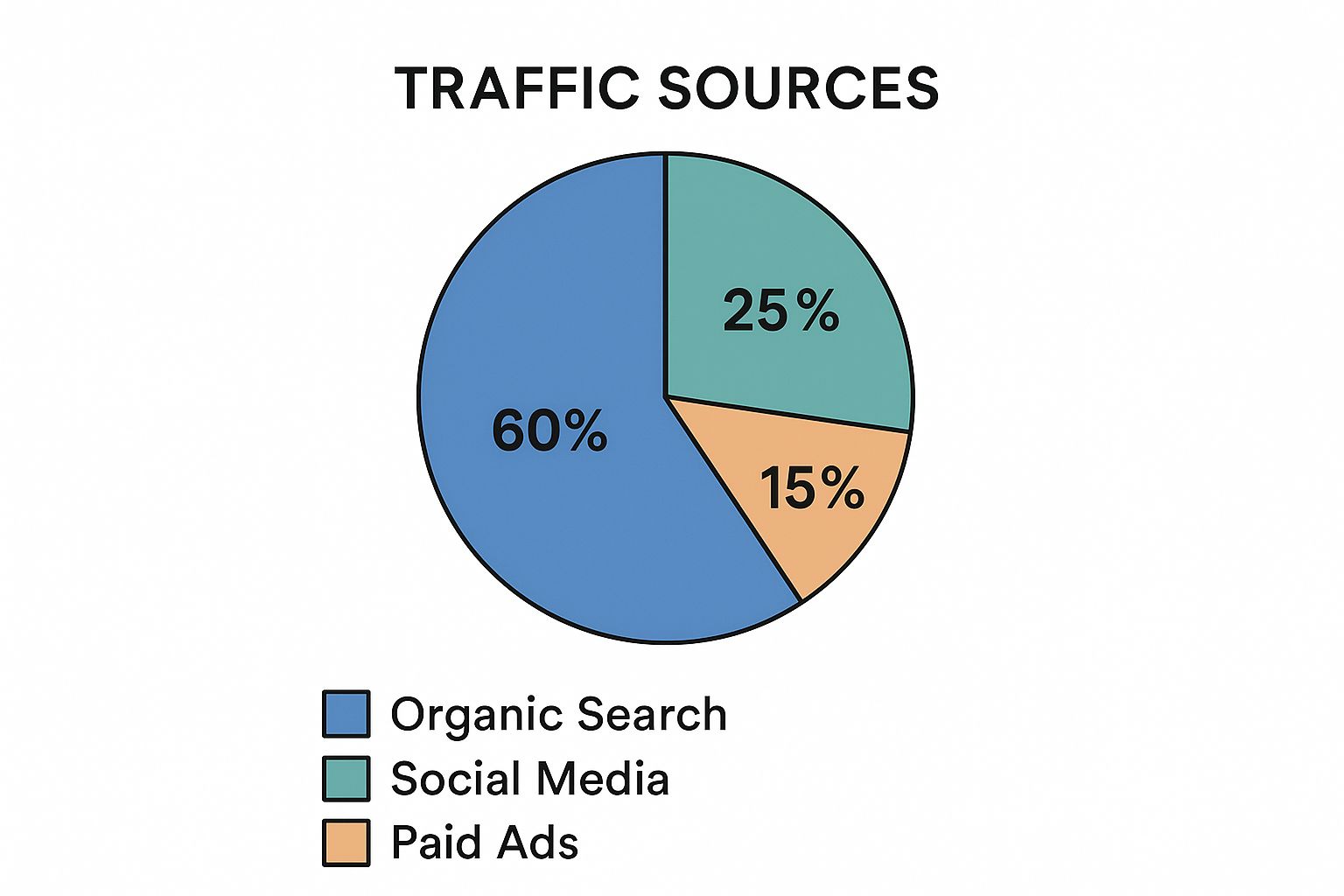
As you can see, organic search is usually the biggest piece of the pie. This is why good, search-friendly content is non-negotiable.
Once that traffic starts flowing, the next step is figuring out what's actually making you money. For a deep dive on connecting your content to your commissions, I highly recommend reading this guide on how to track Amazon sales. Using data to decide what to promote is how you turn this from a side hustle into a real business.
Answering the Big Questions for New Amazon Affiliates
Jumping into the world of Amazon affiliate marketing always stirs up a few questions. It's totally normal. Getting these details sorted out from the start will give you the confidence to really hit the ground running. Let's walk through some of the most common things new affiliates wonder about.
How (and When) Do I Get Paid?
Naturally, one of the first things on everyone's mind is the money. Amazon pays out your earnings about 60 days after the end of the month you earned them in. So, for commissions you make in January, you can expect to see that money around the end of March.
To get paid, you'll need to hit a minimum amount. For direct deposit or an Amazon gift card, the threshold is just $10. If you prefer to receive a check, you'll need to earn at least $100.
Sticking to the Rules
This is a big one. Amazon's Operating Agreement is serious business, and not following it can lead to a permanent ban. The most important rule? Your affiliate disclosure. You absolutely must have a clear statement on your site letting visitors know you're an Amazon Associate and that you earn from their qualifying purchases.
Here are a few other non-negotiables to burn into your memory:
- Be Transparent with Links: Don't try to hide or mask your affiliate links. Link shorteners are fine, but it needs to be clear to the user that they are clicking through to Amazon.
- Keep Links Out of Emails: This is a hard-and-fast rule. You can't put affiliate links in emails, newsletters, or even offline formats like PDFs.
- Never State the Price: Amazon's prices fluctuate constantly. Because of this, you're not allowed to list specific prices. Instead, get used to saying things like, "Check current pricing on Amazon."
Honestly, it all boils down to one thing: transparency. Amazon just wants to make sure customers aren't being tricked. As long as you're upfront about your partnership, you’ll be in good shape.
What About That First Sale Requirement?
Many new affiliates get a little nervous about the initial sales quota. Once you're approved, Amazon gives you a 180-day window to make at least three qualifying sales. If you miss this target, they might close your account.
Don't let this spook you. The real goal isn't just to get three quick sales; it's to build a foundation for long-term success. Focus on creating genuinely helpful content that people are actually searching for. When your reviews and buying guides truly help your audience, those first sales will happen on their own because you've earned their trust.
A quick word of caution: don't ask your friends or family to buy things through your links to meet the quota. This is against the rules and a good way to get your account flagged right out of the gate. Build it right from the start.
Ready to manage your Amazon affiliate partnerships like a pro? Coral provides a central hub to recruit, track, and pay your creators, integrating directly with Amazon Attribution to give you full control over your affiliate program. Build your network of passionate advocates today.