Affiliate Marketing for Amazon Sellers Guide
Category: Affiliate marketing for amazon
When you hear "Amazon affiliate marketing," you're really talking about a performance-based partnership. Sellers like you pay a commission to influencers, bloggers, and creators who send paying customers to your product pages. It’s a powerful way to drive external traffic to your Amazon store and build your brand’s presence far beyond what you can achieve with on-platform ads alone.
The Real Value of Affiliate Marketing for Amazon
Let's be real for a moment. Affiliate marketing on Amazon is often overlooked because it is complicated to understand the actual return on investment of the commissions paid to influencers and the sample products sent out for them to try. So many Amazon sellers I've talked to get frustrated paying out commissions or sending free products, never quite sure if it actually moved the needle. This uncertainty often pushes them right back into the arms of programs like Amazon's Creator Connections.
The issue with relying only on Amazon's built-in tools like Creator Connections is that they're often just transactional. You run a campaign, you get a temporary sales bump, and then... crickets. Once the promotion is over, the momentum disappears, and you're left with no real, lasting relationships with the creators or a network of genuine brand fans.
Moving Beyond One-Off Campaigns
The secret to unlocking the true power of affiliate marketing is to think of it as a sustainable growth engine, not a series of one-off campaigns. Instead of relying on transactional platforms, using an affiliate software specific for Amazon like Coral enables you to build a strategic, relationship-driven program. This is how you cultivate a network of creators who promote your products consistently because they genuinely believe in your brand and see the value in a long-term partnership.
Of course, this approach demands a different kind of strategy and a better set of tools. It’s all about creating a system where you can:
- Build a private network of hand-picked creators who truly fit your brand's vibe.
- Reward more creators that generate more sales with better commission rates or exclusive, custom deals to promote your products.
- Accurately track every single sale that comes from each affiliate.
- Promote their content, which gives them more visibility and more followers to grow their audience.
A well-built affiliate program transforms creators from short-term promoters into genuine, long-term partners. Your marketing spend stops being a one-time expense and becomes a powerful investment in predictable revenue and authentic brand growth.
Understanding Your Options as an Amazon Seller
As an Amazon seller, you have several options to route traffic from influencers, bloggers, and content creators through your Amazon listing and pay them affiliate fees. The giant in the room is Amazon's own Associates program, which commands a massive 46.62% share of the entire global affiliate market. With a catalog of over 350 million products, its reach is undeniable. What's really interesting is that affiliate-referred customers on Amazon have an average order value 21% higher than other customers—proof that this is high-quality traffic. If you want to dive deeper, these affiliate marketing statistics really paint the full picture.
But to make this work for you as a seller, you need the right tools to manage these partnerships. Here are the main options specific to Amazon sellers:
Amazon Creator Connections: This is Amazon’s internal marketplace for connecting sellers with influencers for specific campaigns. It’s a viable starting point for one-time promotions but lacks the features needed to build and manage a private, long-term affiliate team. There is no relationship built with the creators, and after the campaign, the sales die.
Dedicated Affiliate Software: This is where platforms like Coral come in. They are designed specifically for Amazon sellers and plug directly into Amazon Attribution. This gives you the power to create your own private program, set custom commission rates, nurture creator relationships, and track every sale with precision. It’s this level of control and data that lets you reward top performers, build a truly scalable program, and create lasting partnerships.
Amazon Associates On-Site Program: This is an invite-only program where Amazon selects creators to publish content directly on product detail pages. While powerful for visibility, sellers have very little control over which creators are chosen or what content is displayed, making it less of a direct affiliate management tool.
Choosing Your Amazon Affiliate Management Tools
Figuring out the right way to manage your creator partnerships can feel overwhelming. For a lot of Amazon sellers, the first and last stop for affiliate marketing is whatever tools Amazon provides directly. But to build a program that really moves the needle, you need to understand all the options on the table.
Many sellers just default to Amazon's own programs because they seem easy. The problem is, this often hides the real return on investment. You send out product samples, you pay some commissions, but are those efforts actually building long-term value? Or are you just getting a temporary sales bump? That uncertainty is a huge roadblock when you're trying to scale.
Amazon Creator Connections: The Starting Point
For most, the journey begins with Amazon Creator Connections. It's essentially a matchmaking service right inside the Amazon ecosystem, designed to connect brands with influencers for specific, one-off campaigns.
The main draw is its simplicity. You can spin up a campaign, get your product in front of a new audience, and hopefully see a quick sales lift. But that’s also its biggest flaw. The relationships are purely transactional. Once the campaign ends, the sales momentum often evaporates because you haven't built a real, lasting partnership. You miss out on the chance to cultivate your top performers and build a loyal network of brand advocates. We dive deeper into this in our guide to managing affiliates with Amazon's tools.
The biggest issue with programs like Creator Connections is the lack of relationship building. When a campaign is over, the sales often stop. It's a transactional model that prevents you from building a sustainable, long-term growth engine for your brand.
This chart breaks down some of the basic metrics for the Amazon Associates program, like commission rates, cookie duration, and average conversion rates.
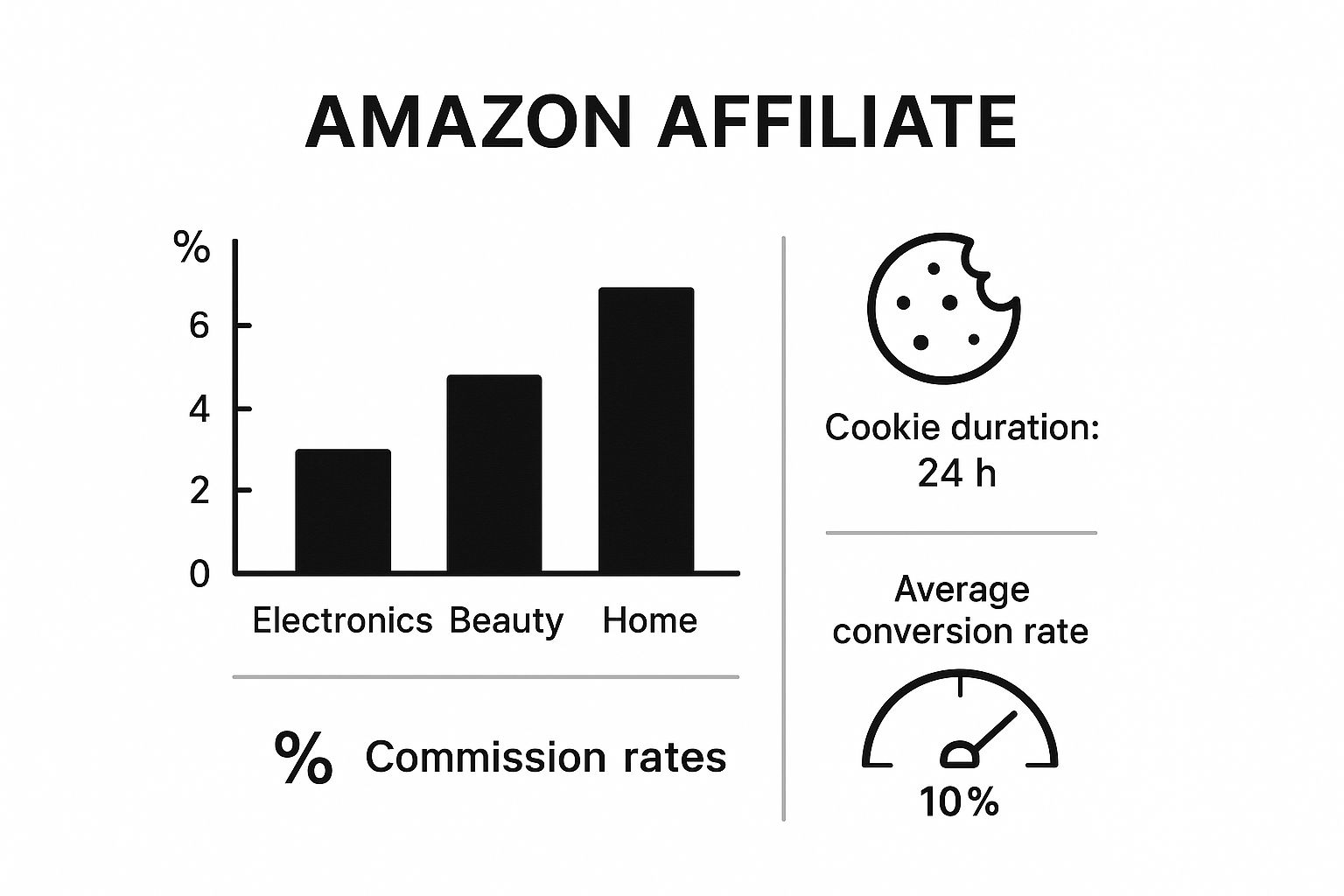
These numbers really drive home why choosing the right tool is so important. With a 24-hour cookie window, every single click counts. You need a solid partnership strategy to make sure you're getting the most out of every interaction.
Dedicated Affiliate Software: The Growth Engine
For sellers who are serious about growth, dedicated affiliate software built for Amazon is the way to go. Platforms like Coral are designed specifically to solve the problems that Creator Connections can't. Instead of one-time transactions, these tools give you the power to build and manage your own private affiliate network.
This approach puts you in control. You can route traffic from influencers, bloggers, and all sorts of content creators straight to your Amazon listing and know exactly where every sale came from. That attribution is everything for tracking ROI and figuring out which partners are actually driving your business forward.
With a dedicated platform, you really start to unlock your program's potential. You can:
- Reward Your Top Performers: Find out who your most valuable creators are and give them custom deals or higher commission rates. This is a powerful way to incentivize them to promote your products even more.
- Build Lasting Relationships: Get away from one-and-done posts. A private program lets you create a real community of creators who become genuine fans and advocates for your brand.
- Promote Their Content: Amplify the great content your affiliates are already making. This gives them more exposure, helps them grow their own audience, and—you guessed it—drives more sales to your listings.
By using an affiliate software like Coral, you're creating a powerful flywheel. You directly reward the creators who generate sales, which motivates them to keep promoting you, leading to the kind of sustained, predictable revenue growth every seller dreams of.
Deciding between Amazon's native tools and a dedicated platform comes down to your long-term goals. To help you weigh the options, here's a side-by-side comparison.
Amazon Affiliate Program Options for Sellers
| Feature | Amazon Creator Connections | Dedicated Affiliate Software (e.g., Coral) |
|---|---|---|
| Partnership Type | Transactional, one-off campaigns | Relational, long-term partnerships |
| Creator Network | Public, based on Amazon's pool | Private, curated network you build and own |
| Commissions | Fixed, based on campaign terms | Customizable, tiered rates to reward top performers |
| Relationship Building | Minimal to none | Core focus, fostering a community of advocates |
| Sales Impact | Temporary spikes during campaigns | Sustainable, long-term revenue growth |
| ROI Tracking | Difficult to measure long-term value | Clear attribution and performance analytics |
Ultimately, while Creator Connections can be a decent starting point for quick exposure, a dedicated software solution is what gives you the control and data you need to build a truly scalable and profitable affiliate program.
How to Build Your Private Affiliate Program
A lot of Amazon sellers I talk to shy away from building their own private affiliate program. It just feels too complicated. They worry about tracking the real ROI, figuring out how to manage influencer commissions, and whether sending out free products is just burning cash. This hesitation usually pushes them toward simpler, more transactional options like Amazon's Creator Connections.
But here’s the catch with Creator Connections: the relationships are temporary. The campaign ends, the sales drop off, and you're back to square one with no lasting partnerships. This is exactly why a private program, powered by a dedicated Amazon affiliate software like Coral, is a game-changer. It’s about building a community of creators who genuinely love and sell your products for the long haul—creating a growth engine that actually lasts.
First Things First: What Are Your Goals?
Before you even think about reaching out to creators, you need to be crystal clear on what success looks like for you. Your goals will dictate everything, from how you pay your partners to the kind of people you want to work with. Are you trying to get your brand name out there, or are you focused on driving hard sales?
- Chasing Brand Awareness? You’ll want to find influencers with big, active followings. The goal isn't just sales; it's about getting eyeballs on your product through impressions, shares, and comments.
- Need Direct Sales? The focus shifts. You’ll be looking for creators who are masters at converting their audience into buyers. Your world will revolve around metrics like click-through rates, conversion rates, and the total revenue each affiliate brings in.
Honestly, the most successful programs I've seen do a bit of both. Awareness fills the top of your sales funnel, while a sharp focus on sales keeps the entire program profitable and running smoothly.
Structuring Commissions That Actually Work
Your commission structure is the heart of your program. It’s what gets creators excited to join and, more importantly, to keep promoting you. It has to be attractive enough to catch the eye of top talent but realistic enough that it doesn't sink your profit margins.
A good starting point for affiliate marketing for amazon commissions is typically between 5% to 15%. This can swing up or down depending on your specific product category and price point.
To really fire up your partners, think about a tiered structure. Everyone might start at a base rate, but you can create higher commission levels for affiliates who consistently knock it out of the park. For instance, a new partner could start at 7%, while a proven top-performer who crushes their sales goals earns 12%. This approach directly rewards your best people and gives everyone a clear reason to push harder.
Key Takeaway: When you're crunching the numbers for commission rates, don't forget to account for your cost of goods sold (COGS) and all those other Amazon fees. Your affiliate payouts have to fit neatly inside your net profit margin for the program to be sustainable.
Finding and Recruiting the Right Creators
The secret to finding great partners isn't just about follower counts; it's about finding the right fit. A micro-influencer with a super-engaged, niche audience can often outsell a macro-influencer with a million generic followers. You're looking for creators whose style, values, and audience look just like your ideal customer.
Once you have a list of potential partners, make your outreach personal. No one likes a generic, copy-pasted email. Show them you've actually paid attention. Mention a recent post of theirs you liked and explain why you think your product would be a perfect match for their community. You're offering a partnership, not just a one-off gig.
Finally, a smooth onboarding experience sets the right tone from day one. Get your new affiliates a welcome kit with everything they need to hit the ground running: clear guidelines, product talking points, high-quality brand images, and, of course, their unique tracking link. A little organization upfront shows you're a professional and gets creators genuinely excited to start.
We dive much deeper into building these strong relationships in our guide on how to manage affiliates for your Amazon brand.
Tracking Affiliate Performance and Driving Traffic
Let's be honest. One of the biggest frustrations for Amazon sellers diving into affiliate marketing is the feeling that you're just throwing money into a black box. You send out free products and pay commissions, but it often feels like a guessing game. You're never quite sure what your actual return on investment is.
Many sellers give up and stick with programs like Amazon Creator Connections just because it’s a familiar environment. The problem is, this is usually a dead end. Once a campaign is over, the sales tend to dry up completely. You're left with no real creator relationships, no network of advocates, and no clear idea of what actually worked.
This is where dedicated affiliate software like Coral completely changes the game by giving you clear, actionable data.
Finally, a Clear Look at Attribution
The real magic of a private affiliate program is its ability to track sales with surgical precision. When you bring a creator into your program, the software generates a unique, trackable link just for them. This isn't your standard Amazon URL. It's a special link, powered by Amazon Attribution, that follows the customer's journey from their content all the way to your product page.
Now, whether an influencer drops that link in a YouTube description, a blog post, or an Instagram story, you can trace every single click and every single purchase back to them. This direct attribution is the key to understanding who your top performers are and calculating a true ROI. It takes the guesswork out of affiliate marketing for amazon and turns it into a data-driven strategy.
Gone are the days of wondering if sending that free sample was worth it. With proper tracking, you can directly compare the cost of a product sample to the revenue generated by that specific creator’s unique link. Marketing spend becomes a measurable investment.
Key Metrics to Watch (Beyond Just Revenue)
While total sales is the end goal, it's not the only number that matters. To really get a handle on how your program is doing, you have to dig into the performance analytics. This data is a goldmine for spotting your most valuable partners and fine-tuning your entire strategy.
Here are the essential metrics I always keep an eye on for each affiliate:
- Clicks: Simple but crucial. How many people are clicking their link? This tells you if their content is generating real interest.
- Conversion Rate: What percentage of those clicks become sales? A high conversion rate is a great sign that the creator’s audience is a perfect match for your product.
- Average Order Value (AOV): How much do customers from a specific affiliate typically spend? You might find some partners drive much higher-value purchases than others.
- Earnings Per Click (EPC): This metric boils it all down. By combining clicks and commissions, it shows you exactly how much you earn, on average, for every single click a partner sends your way.
The sheer scale of Amazon is what makes these partnerships so powerful. Back in 2019, Amazon’s annual net revenue hit a staggering $280 billion, and third-party sellers were responsible for about 53% of that. With Amazon selling around 4,000 items every minute, affiliates have a massive opportunity to tap into that velocity, which makes your program incredibly attractive. You can learn more about the potential of the Amazon affiliate ecosystem here.
Create a Flywheel by Promoting Your Best Affiliates
A great affiliate program isn't a one-way street. Your job goes beyond just cutting commission checks; it's about helping your best partners succeed. When you see a creator whose content is knocking it out of the park, you should promote it!
Think of it as creating a flywheel. You can share their high-performing content on your brand's social media channels or feature it in your email newsletter. This gives them a huge visibility boost, helps them attract new followers, and solidifies their authority in their niche.
As their audience grows, so does your potential customer base. This collaborative approach builds incredible loyalty and turns your affiliates into genuine brand ambassadors who are even more motivated to promote you. It’s a self-sustaining cycle of growth that benefits everyone.
Scaling Your Program with Long-Term Partnerships
A lot of Amazon sellers fall into a common trap. They treat affiliate marketing like a simple transaction: pay for a post, get some traffic, and that's it. This mindset often leads them to platforms like Amazon Creator Connections, which are fine for quick, one-off campaigns. But once the campaign ends, so do the sales. There's no lasting momentum.
If you want to build something that truly scales, you have to shift your thinking. Stop chasing short-term transactions and start cultivating long-term partnerships. The real power of affiliate marketing for Amazon is unlocked when you build a network of creators who genuinely love and advocate for your brand. This is exactly where affiliate software like Coral comes in, giving you the tools to manage these relationships and reward creators based on their actual performance.
Identifying and Nurturing Your Top Affiliates
Once your affiliate program is up and running, your data is gold. You need to get comfortable digging into your analytics to see who’s really moving the needle. It's not just about clicks; it's about identifying the creators who consistently send high-quality traffic that actually buys your products. These are your star players, and they deserve the VIP treatment.
This isn’t just about sending out commission checks. It's about investing in the relationship. Think about creating custom deals for your top performers. Maybe you offer them a higher commission rate, give them exclusive coupon codes for their audience, or grant them early access to new products. When you reward creators who bring in the most sales, you motivate them to do even more, creating a powerful growth cycle for your brand.
Pro Tip: Don't get fixated on revenue alone. Dig deeper into metrics like conversion rate and average order value (AOV) for each affiliate. You might find that a partner with a smaller, highly-engaged audience and a sky-high conversion rate is far more valuable than a big-name influencer with lukewarm engagement.
Beyond Commissions: Building a True Partnership
Money is a great motivator, but building a true community of brand advocates requires more than just financial incentives. You want your top creators to feel like they're part of your team, not just another number on a spreadsheet. This means fostering open communication and a genuinely collaborative spirit.
Here are a few practical ways to strengthen these relationships:
- Promote Their Content: Did an affiliate create an incredible video or a killer blog post about your product? Share it! Post it on your own social media channels or feature it in your email newsletter. This gives them fantastic exposure and shows that you view the partnership as a two-way street.
- Gather Their Feedback: Your most passionate affiliates are also some of your most perceptive customers. Ask for their honest thoughts on your products. Their real-world insights can be incredibly valuable for future product development and refining your marketing message.
- Explore Co-Branded Opportunities: For your absolute best partners, think bigger. Consider co-branded marketing campaigns like a joint giveaway, a co-hosted webinar, or even collaborating on a special limited-edition product bundle.
Navigating the Amazon Affiliate Landscape
It’s also critical to understand what your affiliates are up against. For years, the Amazon affiliate world has been a tough place. Amazon's own commission rates have been on a steady decline for over a decade. The average commission rate, which was a pretty decent 9.25% in 2012, had plummeted to just 3.14% by early 2020. This drop means creators have to push a massive amount of sales just to earn what they used to.
This is precisely what makes your private affiliate program so attractive. By offering competitive, stable, and customizable commission rates, you’re providing a much-needed alternative to the unpredictable nature of Amazon's native program. When you build a system that rewards creators fairly for the sales they drive, you not only attract top-tier talent but also earn their loyalty.
This is the bedrock of a scalable program that delivers predictable, long-term growth. To see how all these pieces fit into a cohesive strategy, check out our complete guide on building your Amazon affiliate marketing program.
Common Questions About Amazon Affiliate Marketing
As an Amazon seller, the idea of launching your own private affiliate program can feel a bit overwhelming. I see it all the time—sellers get stuck wondering about the logistics, the real return on investment, and how it all works when they don't even own the final checkout page.
Because of these unknowns, many just stick to simpler, more transactional programs and miss out. But building your own affiliate program is hands-down one of the most powerful things you can do for sustainable growth. Let's clear up some of the questions I hear most often.
Can I Really Run My Own Affiliate Program If I Only Sell on Amazon?
Absolutely. This is probably the biggest misconception out there. You can have full control over your own affiliate program, even if your products are exclusively on Amazon. The key is using specialized affiliate software built specifically for Amazon sellers.
These platforms work by generating unique, trackable links for each of your affiliates. These links, powered by Amazon Attribution, send traffic from a creator's blog, social media, or YouTube channel straight to your product listing. The software then precisely tracks every sale that comes from that affiliate, so you can pay them commissions directly. This setup gives you complete command over your partnerships and analytics, totally separate from Amazon's own programs.
Should I Use Amazon Creator Connections or a Third-Party Tool?
This really boils down to what you're trying to achieve. If you're just looking for a quick, one-off sales lift, Amazon Creator Connections can be a decent place to start. It’s a straightforward way to get your product in front of a new audience for a single campaign.
The problem with Creator Connections is that you don't build any real relationship with the creators. Once the campaign is over, the sales usually dry up. It’s a purely transactional model, which stops you from building a true growth engine.
For sustainable, long-term growth, a third-party tool like Coral is the way to go. It gives you the power to build and nurture your own private network of creators. You can create custom commission structures to reward your top performers, dive deep into analytics, and foster lasting partnerships that keep delivering value long after a single promotion ends.
How Do I Figure Out the Right Commission Rate for Affiliates?
Finding the right commission rate is a balancing act. You need to be competitive enough to attract great creators, but also keep your profit margins healthy. A common starting range is between 5% and 15%, but this can swing quite a bit depending on your product category and price.
First, take a hard look at your product's profit margins to see what you can comfortably afford. It's also a smart move to do a little digging and see what competitors in your niche are offering. You want to be in the same ballpark.
A fantastic strategy I always recommend is using a tiered structure:
- Base Rate: This is the standard commission you offer to all new affiliates.
- Performance Tiers: Affiliates can unlock higher commission rates by hitting specific sales goals you set.
This model gives your partners a direct incentive to push for more sales. Honestly, the ability to set your own custom rates like this is one of the biggest wins of using a dedicated affiliate platform.
How Do I Track ROI From Sending Free Products to Influencers?
This is a classic marketing headache, but it’s one that the right affiliate software solves beautifully. So many sellers send out free products and commissions, then cross their fingers, never really knowing what came of it. It can feel like a sunk cost with zero data to back it up.
When you run a private affiliate program, that guesswork vanishes.
Instead of just shipping a product and hoping for the best, you give each influencer their own unique tracking link to include in their content. By watching the sales generated through that specific link, you can directly attribute revenue to that influencer's work. This simple shift turns a marketing expense into a trackable investment. You can calculate a clear ROI by comparing the cost of the product sample to the sales it directly drove. Of course, finding the right partners is the first step, and you can learn more about that in our complete guide on how to find Amazon influencers.
Ready to stop guessing and start building a predictable revenue stream? With Coral, you can launch your own private affiliate program for Amazon in minutes. Take control of your creator relationships, track every sale with precision, and build a community of brand advocates that drives long-term growth. Start your free trial with Coral today.