How to Manage Affiliates for Sustainable Growth
Category: How to manage affiliates
When you think about managing affiliates, it's easy to get lost in just sending out links and tracking clicks. But the real magic happens when you treat your affiliates like an extension of your sales team—as true partners, not just another transactional channel. This shift in mindset is the first step toward building a program that actually drives results.
Building a Strong Foundation for Your Affiliate Program
Before you even send your first outreach email, you need to lay the groundwork. A successful affiliate program doesn't just happen; it's built on a solid strategic framework. Think of it like building a house—if the foundation is shaky, the whole structure is at risk. Skipping this part almost always leads to confusion and missed opportunities down the road.
First things first, what does "success" actually look like for your business? Are you chasing a certain number of new customers every month? Or maybe you're trying to get your name out there in a new market. Nailing down these core business objectives from the start will guide every decision you make, from who you recruit to how you pay them.
Define Your Core Objectives
Your program's goals directly shape the kind of affiliates you should be targeting and the commission structures that will motivate them. If your objectives are vague, you'll end up with mismatched partners and results that are, frankly, disappointing.
To get clear, start by asking yourself a few critical questions:
- What’s our number one goal? Is it pure sales volume, bringing in new customers, or maybe boosting the average order value (AOV)?
- Who is our dream affiliate? Are we looking for big-name influencers, niche bloggers with dedicated readers, or content creators who have built incredible communities?
- What can we realistically offer them? This isn't just about money. Think about creative assets, product samples for review, and dedicated, one-on-one support.
A huge mistake I see all the time is brands launching a program without a clear "why." When you know your purpose, you can communicate your program's value in a way that attracts partners who are genuinely excited to help your brand grow.
This planning phase is absolutely crucial, especially considering how big the affiliate world has become. The industry is on track to hit a staggering $31.7 billion globally by 2031, with North America making up over 40% of that revenue. In a market this crowded, a thoughtfully structured program is what will make top-tier affiliates choose you over a competitor.
For example, knowing that the cost-per-sale (CPS) model is the most popular and that video content can boost conversions by as much as 49% helps you design a program that’s attractive from day one. You can dive deeper into trends like these with the latest 2025 affiliate marketing insights on Hostinger.com.
Another thing you absolutely cannot skip is creating clear brand guidelines. This is all about making sure affiliates represent your brand and products the right way, protecting the image you've worked so hard to build. Give your partners everything they need—logos, approved messaging, and a simple list of do's and don'ts. This simple step heads off potential compliance headaches and gives affiliates the confidence to promote your brand accurately.
To really succeed, your affiliate program needs to be built on a few core pillars. Each one supports the others, creating a stable and scalable system for growth.
Core Pillars of Affiliate Program Management
| Pillar | Key Action | Why It Matters |
|---|---|---|
| Recruitment | Actively seek out partners who align with your brand values and audience. | The right partners bring qualified traffic and build brand credibility. Bad fits can damage your reputation. |
| Onboarding | Provide a seamless setup process with clear instructions, resources, and a dedicated point of contact. | A great onboarding experience gets affiliates promoting faster and shows you're invested in their success. |
| Tracking | Use a reliable platform to accurately attribute sales, clicks, and other conversions. | Transparent and accurate tracking builds trust. If affiliates can't trust your numbers, they'll leave. |
| Compensation | Design a fair and competitive commission structure that motivates performance. | Your payment model is a primary driver for affiliate effort. It needs to be attractive enough to retain top talent. |
Getting these fundamentals right from the beginning saves you countless headaches and sets the stage for a program that doesn't just run, but truly thrives.
Finding and Onboarding the Right Affiliates
Let’s be honest: your affiliate program is only as good as the people in it. You could offer the most amazing products and the highest commissions in your industry, but if the wrong people are promoting you, you’ll just be spinning your wheels. The real goal is to find partners whose audience is a mirror image of your ideal customer.
It's all about authenticity. You want partners who genuinely connect with your brand's message and values. When that alignment is there, their promotions feel natural and trustworthy, leading to real sales, not just a bunch of empty clicks.
Locating Your Ideal Brand Advocates
So, where do you find these perfect-fit affiliates? It takes a bit of digital detective work. Instead of just putting up a sign-up form and hoping for the best, you need to go out and find them where they’re already active.
A fantastic place to start is by looking at your competition. See who’s promoting them. Tools like Ahrefs or Semrush can show you who is linking to your rivals, giving you a pre-vetted list of creators who already understand your market. The trick isn't to just poach their partners, but to understand why those relationships work and then find similar voices.
Social media is another goldmine. Keep an eye on hashtags and discussions happening around your industry. Who are the people leading those conversations? Who creates content that gets people talking and sharing? These are often your best future partners, and many of them haven't even considered affiliate marketing yet.
Don't forget to dig into niche communities where your customers hang out.
- Forums and Subreddits: Find the online watering holes for your target audience and see who the most respected voices are.
- Facebook Groups: Join groups focused on your industry and pay attention to who consistently provides the most help and value.
- Niche Bloggers: Look for blogs that review products like yours. A blogger with a small but dedicated readership is often more valuable than a huge, generic influencer.
The best affiliate relationships I've ever seen come from creators who were already huge fans of the product category. You can't fake genuine enthusiasm, and that's precisely what makes their recommendations so powerful and effective.
Once you have a list of potential partners, it’s time to reach out. Forget the generic, copy-paste emails—they go straight to the trash. Your message needs to be personal. Show them you've actually looked at their work. Mention a specific blog post or video you liked and clearly explain why you think a partnership would be a great move for their audience. This shows you respect what they do and instantly sets you apart from the crowd.
Creating a Flawless Onboarding Experience
You’ve got a "yes"! Now what? Your onboarding is the first real impression your new affiliate has of working with you. If it’s confusing or clunky, their excitement will fizzle out before they even create their first link. Your job is to make it incredibly easy for them to get started and feel successful right away.
This is where a dedicated platform like Coral really shines. It gives your affiliates a single, easy-to-use dashboard for everything they need. A great onboarding flow feels less like a manual and more like a guided tour.
Your first step should be to give them a comprehensive digital welcome kit. This isn’t just a simple “welcome to the team” email; it’s a package full of resources designed to help them win.
Here's what it should include:
- A Welcome Guide: A quick rundown of your brand story, what you stand for, and any important program rules (the do's and don'ts).
- Creative Assets: A simple folder with high-quality logos, product photos, and maybe even some pre-written copy they can use as a starting point.
- Link Generation Tutorial: A short video or guide showing them exactly how to create their unique tracking links in the platform.
- First 30-Day Goals: Let them know what success looks like early on and make it clear you're there to help them achieve it.
A smooth onboarding process gives affiliates the tools and confidence they need to start promoting your brand effectively from day one. It’s how you turn a simple sign-up into a strong, profitable partnership.
Getting Your Tracking and Analysis Right
If you can't measure your affiliate program, you can't manage it. It's that simple. Flying blind with guesswork is a surefire way to burn through your budget and miss out on huge opportunities. A data-first mindset is what separates a program that just exists from one that actively drives profit.
The heart of any affiliate program is accurately giving credit where it's due. This all starts when a potential customer clicks an affiliate's unique link. That click drops a small tracking file—a cookie—onto their device, which signals back when a purchase happens. Platforms like Coral handle this behind the scenes by integrating with Amazon Attribution, making sure every single referral gets logged without a hitch.
Choosing an Attribution Model That Fits Your Goals
Not all clicks are the same, and attribution models are how you decide which touchpoint gets the credit for a sale. The two you’ll run into most often are first-click and last-click.
- First-Click Attribution: This gives 100% of the credit to the very first affiliate link a customer ever clicked. This is perfect for rewarding partners who are masters at introducing your brand to new people and creating that initial spark of interest.
- Last-Click Attribution: This is the industry standard. The last affiliate link clicked before the purchase gets all the credit. It’s designed to reward partners who are pros at closing the deal and pushing customers over the finish line.
So, which one should you choose? If your main goal is getting your name out there and reaching new audiences, first-click is a great option. But if you’re laser-focused on immediate sales, last-click is probably your best bet. Your choice here should tie directly back to what you want your program to achieve.
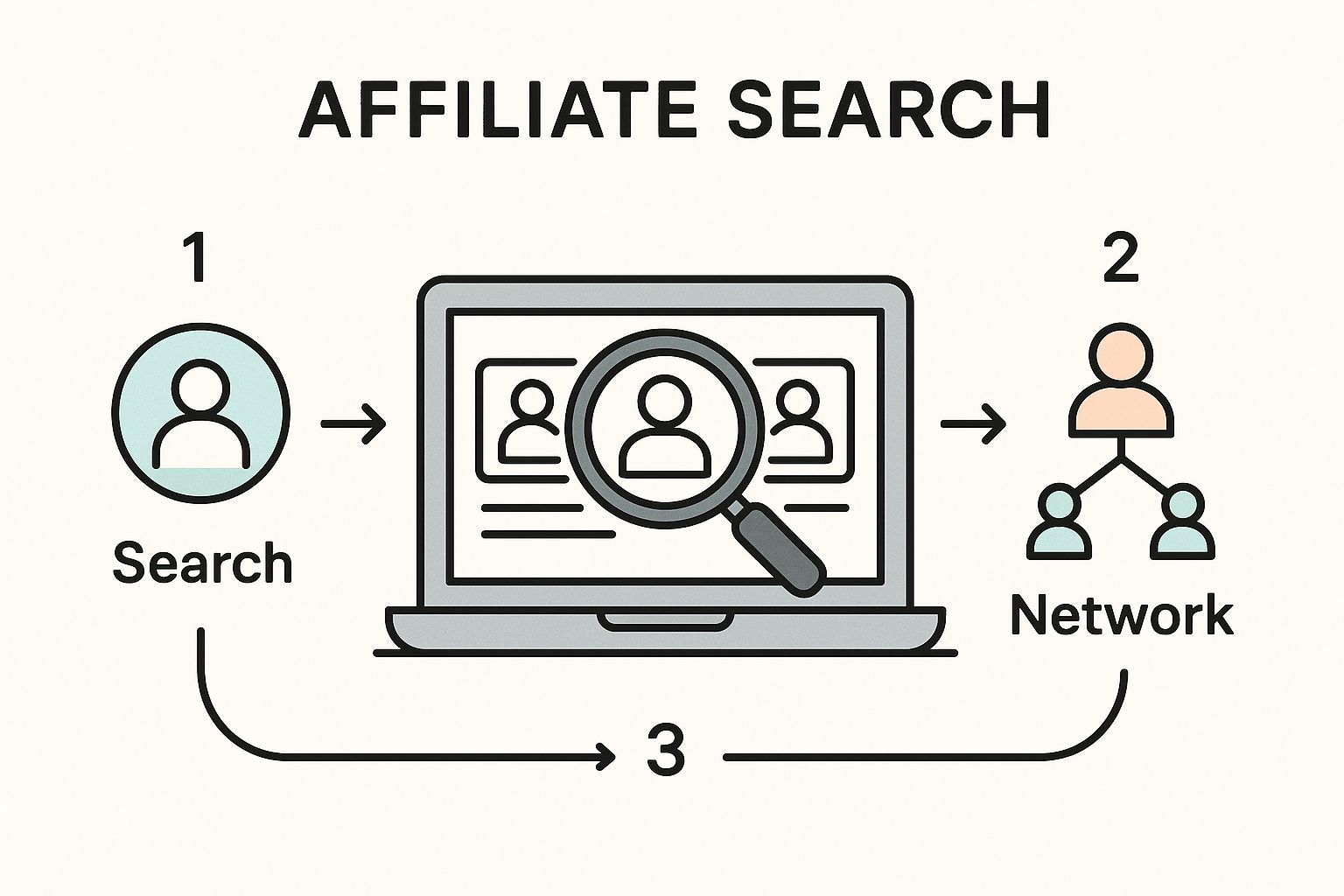
This process of finding, tracking, and analyzing performance is a cycle. As the visual shows, it’s a systematic approach that gives you a clear view from discovery all the way to a partner's final results.
Making Sense of the Key Metrics
Once you’re tracking, the data will start rolling in. Raw data is just noise, though. The real magic happens when you understand the key performance indicators (KPIs) that tell you the story of your program's health. You should be living in your affiliate dashboard, keeping a close eye on these numbers.
Here are the essential KPIs you absolutely need to know:
- Conversion Rate (CR): This is the percentage of clicks that turn into actual sales. A low CR could mean the affiliate's audience isn't a great fit for your product, or maybe their promotional angle just isn't working.
- Average Order Value (AOV): This tells you how much the average customer is spending. An affiliate sending traffic with a high AOV is bringing in more valuable, high-spending customers.
- Earnings Per Click (EPC): This metric boils performance down to a single number: how much money you earn for every 100 clicks an affiliate sends. EPC is an incredible way to quickly see who your most profitable partners are, even if their traffic numbers look different.
By zeroing in on these core metrics, you can quickly spot your superstars. Just as important, you’ll see who might need a little nudge or some extra support to get their numbers up.
Let's look at a real-world scenario. Affiliate A sends 1,000 clicks with a 1% conversion rate, but their AOV is $250. Affiliate B sends 500 clicks with a 5% conversion rate, but their AOV is only $40. Affiliate B is driving more sales, sure, but Affiliate A is bringing in customers who spend way more. This is the kind of insight that helps you manage strategically. For those wanting to learn more about the tools for this, researching affiliate management software will show you what's possible.
Using Reports to Make Smarter Decisions
Your affiliate platform should let you build reports that slice and dice your data however you need. This is where you connect the dots and turn those numbers into an action plan. With regular reporting, you can answer the critical questions that drive effective affiliate management.
Your reports should tell you, at a glance:
- Who are my top-performing affiliates? Pinpoint who consistently brings in the most revenue, the highest AOV, or the best conversion rates. These are your all-stars—nurture these relationships.
- Who is underperforming? Identify partners with low clicks, zero conversions, or a tanking EPC. They might need a re-engagement email, fresh creative, or a bit of extra coaching.
- What are my most successful campaigns? See which products or promotions are killing it with affiliate audiences. Use that knowledge to guide your future campaigns and give your partners more of what works.
A proactive, data-driven approach is the foundation of successful affiliate management. It shifts you from being a passive observer to an active strategist, giving you the power to fine-tune performance, reward your best people, and get the best possible return on your investment.
Designing Effective Commission Structures
Let's talk about one of the most powerful tools you have for motivating your partners: the commission structure. A one-size-fits-all plan is easy, but it rarely inspires top performance. The real art is designing a structure that feels generous to your affiliates while aligning perfectly with your own business goals.
When you move beyond a simple flat percentage, you can start strategically influencing what your affiliates do. By tailoring your commissions, you can encourage them to focus on what matters most to you—whether that’s bringing in brand-new customers, pushing higher-value sales, or getting the word out about a new product. This isn't just about paying people; it's a core part of managing a successful program.
Foundational Commission Models
Every program needs a starting point, a baseline commission model that sets the stage. Most brands I've worked with kick things off with one of two main structures.
Flat-Rate Commissions: This is as straightforward as it gets. You offer a fixed dollar amount for a specific action. For example, you might pay $50 for every new subscription, no matter which plan the customer chooses. This approach is simple, predictable for everyone, and works great if you sell a single product or are focused purely on lead generation.
Percentage-Based Commissions: This is the most popular model for a reason. Affiliates earn a percentage of the total sale, maybe 10-20% of the purchase price. This model naturally encourages partners to promote your more expensive items and drive bigger carts because their earnings scale right along with the order value.
A key insight from my experience? The best model often comes down to your product pricing. If all your products are in the same price ballpark, a flat rate is beautifully simple. But if you have a wide range of prices, a percentage-based model just feels fairer and does a better job of motivating partners.
Getting this right is more than just a minor detail. The global affiliate market is expected to hit $27.78 billion by 2027, showing just how much money is flowing through these partnerships. According to recent affiliate marketing statistics on AuthorityHacker.com, customers who come from affiliate referrals also tend to have a 21% higher average order value. A smart commission structure is your key to attracting the partners who bring in that kind of value.
Tiered Structures and Performance Bonuses
Once your foundation is solid, you can start layering in more advanced incentives to reward your top performers and keep things interesting. This is where you shift from just passively paying out commissions to proactively managing your affiliate relationships.
Tiered commissions are a fantastic way to motivate everyone. The idea is simple: the more an affiliate sells, the higher their commission rate climbs.
- Bronze Tier (0-10 sales/month): 10% commission
- Silver Tier (11-25 sales/month): 15% commission
- Gold Tier (26+ sales/month): 20% commission
This gives newer affiliates a clear growth path and provides a powerful reason for your best partners to keep crushing it. It almost gamifies the experience, making them feel valued as they climb the ranks.
Performance bonuses and limited-time offers can create exciting bursts of activity. Think about offering a $200 cash bonus to any affiliate who drives over $5,000 in sales during a holiday weekend. Or, you could double the commission on a new product for the first 30 days to generate a massive initial push from your partners.
For SaaS and subscription companies, recurring commissions can be a total game-changer. This means you pay affiliates not just for the initial sign-up but for every single payment that customer makes. We dive deep into this in our guide to recurring commission affiliate programs. This model is a magnet for high-quality affiliates who care about long-term customer value, not just a quick conversion.
Building Affiliate Relationships That Actually Last
Let's be honest: your best affiliates are so much more than just a line on a sales report. They’re partners, an extension of your marketing team. I’ve seen firsthand that the difference between a program that thrives and one that just limps along often boils down to the strength of those relationships.
This is where you move beyond just sending automated commission payouts. You have to build a real community. When your partners feel like they're seen, valued, and genuinely supported, their motivation skyrockets. More importantly, the content they create becomes far more authentic and effective because they actually believe in what they’re promoting.
Set a Consistent Communication Rhythm
You can't just onboard an affiliate and then ghost them, hoping they stay engaged. That’s a recipe for a dead program. Consistent communication is the foundation of any good partnership, showing them you're invested in their success, not just the clicks they send your way.
A monthly affiliate newsletter is a great place to start. It’s an efficient way to keep everyone on the same page without blowing up their inbox. Think of it less as a corporate announcement and more as your primary community-building tool.
Make your newsletter a go-to resource packed with value:
- Upcoming Promotions: Give them a heads-up on sales so they can plan their content calendar. No one likes a last-minute scramble.
- New Product Launches: Offer early access to info and creative assets. This makes them feel like insiders, and that exclusivity is powerful.
- Content Inspiration: Share what's working for other affiliates. A little "hey, this angle is really connecting with audiences" can spark great ideas.
- Success Stories: Feature a top-performing affiliate each month. It’s great social proof and stokes a little friendly competition.
But don't stop at mass emails. For your top partners, personalized check-ins are gold. A quick, one-on-one email congratulating them on a great sales month or offering to jump on a call to brainstorm ideas can make all the difference.
A simple, proactive message asking, "How can I help you succeed this month?" is one of the most powerful things you can do. It flips the dynamic from purely transactional to truly collaborative, building loyalty that pays dividends.
What to Talk About to Keep Affiliates Engaged
Knowing what to share is just as crucial as how often you share it. Every piece of communication should have a clear goal: either help your affiliates earn more money or make their job easier.
Think about what would empower them. For example, if you see a specific product catching fire, send out a dedicated email with fresh creative and talking points just for that item. This kind of proactive support is what separates a world-class program from an average one.
It’s also critical to be transparent about any program changes, like updates to your terms or commission rates. Trust is everything. Surprising your partners with changes is one of the fastest ways to lose them.
By making communication a two-way street, you also get incredible feedback. Your affiliates are on the front lines, hearing directly from customers. Their insights on product questions or market perceptions are invaluable. The ROI on these relationships is huge, and you can learn more about measuring it in our guide to calculating influencer marketing ROI.
Handling Difficult Conversations with Grace
Sooner or later, you're going to have a tough conversation. It might be an affiliate accidentally breaking a brand rule, or maybe someone's performance has just fallen off a cliff. How you handle these moments will determine if you save the partnership or lose an asset.
Always approach these conversations with the goal of finding a solution, not placing blame. Assume positive intent; they might not even realize there's an issue.
For something like a compliance problem, frame it as a team effort.
- Start with praise. Acknowledge their past contributions first. "We've always appreciated your partnership."
- State the problem clearly but gently. "Hey, I noticed one of your recent posts had some messaging we can't use. It might just be an oversight, but we need to get it updated to stay compliant."
- Provide the solution. "I've attached our brand guidelines and some pre-approved copy to make it easy. Let me know if you have any questions at all!"
This supportive approach preserves goodwill. By actively nurturing your affiliates with consistent, helpful communication and handling challenges constructively, you build a resilient and highly motivated army of brand advocates.
Avoiding Common Affiliate Management Blunders
Even the most experienced affiliate managers can stumble into traps that slowly poison a program's potential. Recognizing these pitfalls is the first step toward managing your affiliates proactively. It's about turning what could be a disaster into a genuine growth opportunity. These aren't just small slip-ups; they can cause high partner churn, constant payment squabbles, and a revenue line that just goes flat.
One of the biggest mistakes I see is neglecting affiliates once they're onboarded. You put in all that work to recruit a great partner, they're fired up to get started, and then... radio silence. This "set it and forget it" mindset makes affiliates feel disposable and completely kills their initial enthusiasm.
Another classic error is sticking to a boring, one-size-fits-all commission structure. If your heavy hitters are earning the same percentage as someone who just signed up yesterday, where's their motivation to push harder for you? Your most valuable partners will eventually find a program that actually rewards their effort.
Shaky Tracking and Late Payments are Relationship-Killers
Of all the mistakes you can make, maybe the most destructive is having unreliable tracking that leads to payment disputes. Nothing erodes trust faster than an affiliate who's convinced they drove a sale but didn't get credit for it. If your system is buggy or you're constantly late with payouts, your best people will leave. It's that simple.
Think about this scenario—it happens all the time. An affiliate launches a huge promotion for a holiday weekend and drives a massive spike in sales. They log into their dashboard, excited to see the results, but the numbers look wrong. When they ask for help, the response is slow and vague. That single bad experience is often all it takes to lose them for good.
Your entire affiliate program is built on a foundation of trust. Accurate tracking and on-time, predictable payments are the absolute bare minimum. Get this wrong, and you'll spend all your time trying to replace churned affiliates instead of growing with your best ones.
Shifting from Reactive to Proactive Management
Seeing the problems is one thing, but fixing them requires a real shift in approach. You have to get ahead of these issues instead of just reacting to them.
- Seeing High Churn? Don't just watch inactive partners drift away. Launch a re-engagement campaign. A personal email asking what they need can work wonders. You could offer a temporary commission bump, some fresh creative assets, or a quick one-on-one strategy call.
- Performance Feeling Stale? It's time to shake up your commissions. Introduce a tiered system where higher sales volume unlocks better rates. Run a "first to 50 sales" bonus or offer double commission on a new product for the first month. Create some excitement.
- Getting Payment Questions? The answer is more transparency. Your tracking platform, like Coral, should offer a dashboard that's crystal clear and easy to understand. Communicate your payment schedule upfront and never miss it. If a dispute does come up, jump on it fast and be an open book to rebuild that trust.
By getting out in front of these common mistakes, you’re not just protecting your program—you’re building an environment where loyal, high-performing partnerships can thrive.
Got Questions About Managing Affiliates? We’ve Got Answers.

When you're building out an affiliate program, questions are going to pop up. It's completely normal. Over the years, I've heard just about everything, so let's tackle some of the most common ones I hear from brands just like yours.
Your Most Pressing Questions Answered
So, how many affiliates should you actually have? This is probably the number one question I get. The truth is, there’s no magic number. A program with five highly-motivated, top-tier affiliates can absolutely crush one with 50 who aren't doing much. The goal is quality over quantity, always.
Then comes the money talk: what’s the best way to pay affiliates? While it definitely depends on your business model, I’ve found that a hybrid approach keeps everyone motivated. Think about a solid base commission paired with performance bonuses. For example, you could offer a 10% base commission and add a $100 bonus for every 10 sales an affiliate drives. This keeps both your newer partners and your seasoned pros pushing for that next goal.
From my experience, the bedrock of any great affiliate program is crystal-clear communication. When affiliates know the rules of the game—from commission rates to when they’ll get paid—you build trust. And trust is what drives real performance.
What do you do if an affiliate just isn't performing? It's tempting to just cut them loose, but that's a mistake. Your first move should always be to reach out personally. It could be something simple. Maybe they need new marketing materials, a better grasp of your product, or just some fresh ideas for promotion. A quick re-engagement campaign can often breathe new life into a partnership you thought was dead.
And finally, how often should you be talking to your affiliates? Consistency is everything. A monthly newsletter is a fantastic way to keep everyone in the loop with updates, upcoming promotions, and success stories. For your top performers, though? You need to be more hands-on. Regular, one-on-one check-ins show them you’re invested in their success, which in turn, helps you succeed. Learning how to manage affiliates is really about learning how to build strong relationships.
Here's a quick-glance table with a few more common questions we see.
Frequently Asked Questions
| Question | Answer |
|---|---|
| What's a good commission rate? | Start by researching your industry average. For physical products, 5-15% is common. For digital products or services, it can be 20% or higher. The key is to be competitive. |
| How do I track affiliate sales? | Use a dedicated affiliate management platform like Coral. It handles all the tracking, link generation, and reporting automatically, so you can focus on strategy. |
| Should I provide marketing materials? | Absolutely. Providing high-quality banners, email templates, and product photos makes it much easier for affiliates to promote you effectively. It removes friction and ensures brand consistency. |
| What's the biggest mistake to avoid? | Setting it and forgetting it. An affiliate program is not passive income for you. It requires active management, communication, and relationship-building to truly thrive. |
Hopefully, these answers clear things up and give you a solid foundation to build upon.
Ready to stop guessing and start building powerful partnerships? Coral gives you all the tools you need to recruit, track, and pay affiliates without the headache, all integrated directly with Amazon. Start for free and see how Coral can grow your brand.