Influencer Marketing ROI: Build Campaigns That Actually Pay
Category: Influencer marketing roi
Understanding Influencer Marketing ROI Beyond The Surface
Think of influencer marketing ROI like tending a garden. You’re not just counting the tomatoes you harvest this week, you're also nurturing the soil, managing pests, and ensuring long-term health and productivity. Many brands focus solely on the immediate “sales tomatoes” from influencer campaigns, overlooking the broader impact these partnerships can have on their brand ecosystem.
This narrow focus can lead to undervaluing campaigns that are actually contributing significantly to long-term growth. A campaign might not yield a massive initial sales spike, but it could be quietly cultivating brand awareness and building a loyal following – essential ingredients for future harvests.
This shift in how we understand influencer marketing ROI is mirrored in current industry trends. The way marketers measure ROI has evolved significantly. As of 2024, roughly 70% of companies track some form of ROI from their influencer campaigns, but only 30% prioritize direct sales as their primary metric. Instead, metrics like engagement rate, reach, and brand lift are now favored benchmarks for gauging success. Find out more about recent influencer marketing statistics.
Furthermore, fixating solely on short-term sales ignores the ripple effect of influencer collaborations. A successful campaign can generate valuable user-generated content, boost organic reach through shares and mentions, and enhance a brand’s credibility. These benefits extend far beyond the initial campaign period, contributing to sustained growth, like a healthy garden continues to produce season after season.
This means we need a more sophisticated approach to measuring ROI. Savvy brands are adopting more holistic measurement frameworks that encompass both short-term sales and long-term brand building. These frameworks consider metrics like brand sentiment, share of voice, and customer lifetime value – giving a more complete picture of a campaign's true impact. By looking beyond the immediate “tomatoes,” businesses can unlock the full potential of influencer marketing and build lasting partnerships that drive sustainable growth.
Real Performance Numbers That Matter

Let's shift our focus from the buzz around influencer marketing and delve into what genuinely drives success. The line between a booming campaign and a quiet fizzle often comes down to the finer points, details that many brands overlook. By examining real campaign data from different sectors, we can unearth the secrets behind high-performing influencer marketing strategies.
Think of influencer marketing like selecting the right hiking trail. A short, easy stroll might not offer breathtaking views, while an overly ambitious climb might leave you drained and underprepared. The "Goldilocks" principle applies here – the ideal trail balances challenge and reward. Finding the "just right" influencer, one who aligns with your brand and resonates with their audience, often yields the most favorable results.
This balance extends to other campaign elements as well. Factors like posting cadence, the style of content created, and even the time of year can significantly affect your influencer marketing ROI. Posting too little can lose audience momentum, while posting too much might come across as intrusive. Grasping these nuances is key to optimizing performance.
Hidden Costs and ROI Projections
Many campaigns falter due to unexpected expenses. Consider costs such as product samples, shipping, and the time involved in nurturing influencer relationships. Integrating these hidden costs into your influencer marketing ROI calculations provides a more accurate view of your potential returns. This meticulous approach ensures realistic expectations and enables smarter budget allocation.
A 2025 Dash study revealed that brands earn an average of $4.12 for every $1 spent on influencer campaigns on Instagram. This impressive ROI showcases the platform's power. The study also underscores the value of engaging both micro-influencers and larger accounts, noting that micro-influencers often demonstrate even stronger engagement. Learn more about this insightful trend.
The Power of Long-Term Partnerships
Why do some brands consistently excel while others struggle? Strategic differences often play a pivotal role. High-performing brands prioritize authentic relationships with influencers, emphasizing long-term partnerships over one-off transactions. They also implement comprehensive tracking and measurement systems. This allows them to understand what truly resonates with their target audience, enabling them to continuously refine their strategies for maximum influencer marketing ROI. This commitment to ongoing improvement is a key factor that sets them apart.
To illustrate typical ROI benchmarks, consider the following table:
Influencer Marketing ROI Benchmarks by Campaign Type
| Campaign Type | Average ROI | Engagement Rate | Best Use Case |
|---|---|---|---|
| Brand Awareness | 2-5x | 1-3% | Building brand recognition and reaching new audiences |
| Product Launches | 3-7x | 2-5% | Driving initial sales and creating product buzz |
| Lead Generation | 4-8x | 3-6% | Capturing customer information and nurturing leads |
| Affiliate Marketing | 5-10x | 4-8% | Generating direct sales through tracked links |
This table offers a glimpse into the potential ROI variations across different campaign types and their corresponding engagement rates. While these are averages, it's crucial to remember that individual results will vary. For example, a highly targeted lead generation campaign might exceed the average ROI, whereas a broader brand awareness campaign might fall below.
By carefully selecting the right campaign type, building strong influencer relationships, and meticulously tracking your results, you can maximize your influencer marketing ROI and achieve truly outstanding results.
Essential Metrics That Reveal The Complete Picture
Thinking you can measure influencer marketing ROI with just basic calculations is like trying to understand a symphony by only listening to one note. Successful brands take a much more holistic approach, looking at both the immediate impact and the long-term value their campaigns generate. This means going beyond superficial metrics like follower count and likes.
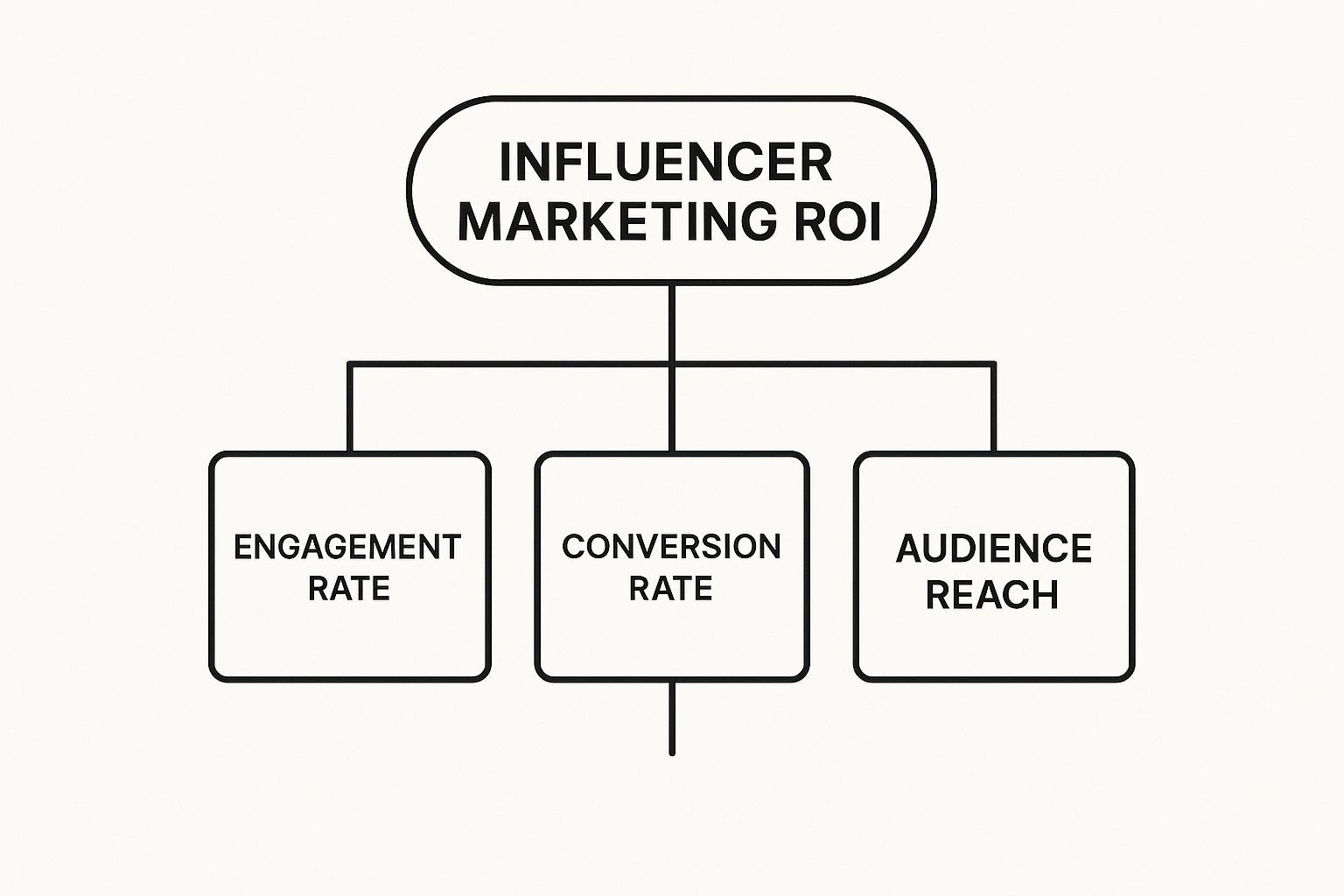
The infographic above illustrates the key components of influencer marketing ROI: Engagement Rate, Conversion Rate, and Audience Reach. Think of these as the interconnected gears that drive a successful campaign. The graphic shows how each element contributes to the overall ROI.
Let's break it down. Engagement rate shows how actively the audience interacts with influencer content. High engagement suggests a genuine connection, meaning the influencer's message is hitting the mark. This positive interaction then influences the conversion rate, which is the percentage of engaged users who take a desired action, like buying a product. Finally, audience reach, the number of unique users exposed to the campaign, amplifies these effects. Greater reach, combined with high engagement and conversions, is a powerful recipe for maximizing influencer marketing ROI.
Beyond Vanity Metrics: Measuring What Truly Matters
To really understand the impact of your influencer marketing, we need to look at a range of key performance indicators (KPIs). These give us a much clearer picture than surface-level observations.
For example, brand lift measures the increase in brand awareness, consideration, and favorability after a campaign. This can be tracked through surveys, social listening tools, and changes in search volume. Engagement quality is another vital KPI, focusing on the type of engagement. While lots of likes are good, comments and shares show a deeper level of audience connection. You might be interested in learning how to find Amazon influencers to broaden your reach.
To get a really detailed picture, let's dive into the specifics with some important metrics:
Before we get started, let's look at a table summarizing the key performance indicators for influencer marketing ROI. This table will provide a quick overview of the metrics we will be discussing.
Key Performance Indicators for Influencer Marketing ROI Essential metrics to track for comprehensive influencer marketing performance measurement
| Metric | What It Measures | Calculation Method | Industry Benchmark |
|---|---|---|---|
| Engagement Rate | Level of audience interaction (likes, comments, shares) | (Total Engagements / Total Impressions) * 100 | Varies by platform, typically 1-5% |
| Conversion Rate | Percentage of engaged users who complete a desired action (purchase, sign-up) | (Number of Conversions / Number of Clicks) * 100 | Varies by industry, typically 2-5% |
| Audience Reach | Number of unique users exposed to the campaign | Total number of unique users reached by the campaign content | Varies by campaign goals |
| Brand Lift | Increase in brand awareness, consideration, and favorability | Measured through surveys, social listening, and changes in search volume | Varies by brand and campaign |
| Engagement Quality | Depth of audience interaction (comments, shares vs. likes) | Measured through analysis of engagement types and sentiment | Qualitative assessment, higher proportion of comments and shares indicates better quality |
| Click-Through Rate (CTR) | Percentage of users who click on a link in the influencer content | (Number of Clicks / Number of Impressions) * 100 | Varies by platform and industry, aim for above 1% |
| Cost Per Engagement (CPE) | Cost of each engagement (like, comment, share) | Total Campaign Cost / Total Engagements | Varies by platform and industry |
| Return on Investment (ROI) | Overall profitability of the campaign | (Total Revenue Generated - Total Campaign Cost) / Total Campaign Cost * 100 | Ideally positive, but benchmarks vary widely |
This table provides a useful framework for understanding and tracking the essential metrics in influencer marketing. Remember that industry benchmarks are just guidelines, and your specific goals will influence the metrics you prioritize.
Tracking and Analysis: Building a Robust System
Having a strong tracking system is essential for accurate ROI measurement. This means setting clear goals, choosing the right KPIs, and using effective tracking tools. Platforms like Coral offer built-in solutions for tracking Amazon Attribution links, giving you valuable data on clicks, conversions, and revenue.
From Data to Insights: Interpreting Your Results
Collecting data is just the beginning. The real value comes from understanding what it means and using it to improve future campaigns. Analyzing trends in engagement, conversions, and brand lift reveals what works with your target audience, which influencers perform best, and what content formats deliver the strongest results. This data-driven approach allows you to refine your strategy, maximize ROI, and create truly impactful campaigns.
Practical ROI Calculation Methods That Actually Work

Calculating the ROI of your influencer marketing campaigns isn't about plugging numbers into a rigid formula. It's more like finding the right balance between precision and flexibility. Many brands fall into the trap of oversimplifying their calculations or getting bogged down in overly complex models that don't offer much practical value. Let's explore a few different calculation methods, from basic revenue tracking to multi-touch attribution, and discuss when each one is most appropriate.
Simple ROI Calculation: Tracking Direct Revenue
For campaigns designed to directly boost sales, a simple ROI calculation is often enough. This method directly connects the revenue generated to the campaign cost.
The formula is straightforward: [(Revenue - Cost) / Cost] * 100.
For example, imagine an influencer campaign costs $1,000 and generates $5,000 in sales. The ROI would be [(5,000 - 1,000) / 1,000] * 100 = 400%. This clear and simple approach works best when you have readily available sales data, like the kind you get from Amazon Attribution links.
Beyond Direct Sales: Measuring Earned Media Value
Of course, not all influencer marketing campaigns are about immediate sales. Think about brand awareness campaigns. These are focused on boosting visibility and reach, not necessarily driving direct purchases. In these cases, Earned Media Value (EMV) becomes a key metric.
EMV tries to put a dollar value on things like organic mentions and social shares generated by the campaign. A simple way to calculate EMV is by multiplying the reach of organic mentions by an estimated cost-per-impression. This gives you a monetary value for the exposure you've gained, even if it doesn't translate into instant sales.
Multi-Touch Attribution: Understanding the Customer Journey
Things get a bit more complex when you have campaigns involving multiple touchpoints. Imagine a campaign that combines social media posts, email marketing, and paid advertising. This is where multi-touch attribution comes in handy. It gives you a deeper understanding of how each channel contributes to conversions.
This method assigns a weighted credit to each touchpoint along the customer journey. For instance, the first touchpoint (maybe an influencer's Instagram post) might receive 30% credit, while the last touchpoint (perhaps a retargeted ad) might receive 50%. This allows you to see the bigger picture and understand how influencer marketing works in conjunction with other channels.
Handling Long Sales Cycles and Brand Awareness
Calculating influencer marketing ROI for campaigns with longer sales cycles or those primarily focused on brand awareness requires a more subtle approach. Assigning a value to brand mentions and measuring how influencer content is organically amplified provides valuable insights, offering a more complete view of the campaign's impact beyond immediate sales.
Using Coral for Streamlined ROI Tracking
Platforms like Coral can simplify tracking and calculating influencer marketing ROI, especially for Amazon sellers. By integrating directly with Amazon Attribution, Coral provides precise data on clicks, conversions, and revenue generated through influencer campaigns. This makes ROI calculation and campaign optimization much more efficient. You might be interested in learning how to optimize your Amazon Attribution links with Coral. This integration streamlines the process of measuring your campaigns' effectiveness.
Building strong tracking and reporting systems is crucial for showing stakeholders the value of your influencer marketing efforts. Clear, data-driven reports can paint a compelling picture of campaign success and justify ongoing investment in influencer partnerships. By presenting data clearly and showcasing the value of influencer marketing, you can secure buy-in from key decision-makers.
Market Growth Trends and Strategic Implications

The influencer marketing world is experiencing a period of rapid growth. This presents exciting opportunities, but also significant challenges for brands looking to achieve a solid influencer marketing ROI. Think of it like a gold rush – lots of potential, but you need a smart strategy to strike it rich.
This growth means changes in how much campaigns cost, how competitive the landscape is, and even how effective influencer marketing is overall. Understanding these shifts is key for marketers to succeed.
This expansion is evident in current adoption rates. Influencer marketing is taking hold globally, with 86% of US marketers planning to work with influencers in 2025. That’s a big leap from almost 70% in 2021 among companies with over 100 employees. The US influencer marketing spend was projected to reach $7.14 billion in 2024, a 15.9% year-over-year increase. Discover more insights on influencer marketing statistics.
Rising Investment and Campaign Performance
As investment in influencer marketing increases, it's impacting campaign performance across different platforms, regions, and target audiences. Imagine more and more brands crowding onto Instagram, trying to partner with the same influencers. Naturally, the cost of these partnerships goes up. This means a higher focus on strategy and optimization is crucial for a good influencer marketing ROI.
Audience attention is also becoming more fragmented. Users are spread across so many platforms now; it's like trying to herd cats. This makes reaching a concentrated audience more difficult. Brands must diversify their influencer partnerships and tailor content to specific platforms for effective reach.
Emerging Platforms and Early Adopters
In this ever-changing environment, early adopters on newer platforms and in emerging markets often see great returns. Think of the brands that first jumped on TikTok for influencer marketing. They benefited from lower costs and less competition, resulting in impressive influencer marketing ROI.
However, as these platforms grow and become more crowded, maintaining a competitive influencer marketing ROI gets tougher. Influencer costs rise, and capturing audience attention becomes a bigger challenge.
Adapting to a Maturing Market
As influencer marketing matures, brands need to adapt. This means carefully evaluating influencer costs, spreading efforts across different platforms, and focusing on long-term partnerships to build brand loyalty. It’s like tending a garden – consistent effort and nurturing yields the best results.
Measuring and analyzing campaign performance becomes even more vital for maximizing influencer marketing ROI. It’s about understanding what works, what doesn't, and adjusting your approach accordingly.
By understanding these market dynamics and adapting, brands can position themselves for ongoing success in the ever-evolving world of influencer marketing. This involves embracing data-driven decisions, building authentic influencer relationships, and constantly refining strategies to stay ahead.
Proven Optimization Strategies For Higher Returns
Optimizing your influencer marketing ROI isn't about chasing the latest fads. It's about establishing a strong core strategy. Imagine building a house: a solid foundation and quality materials are what determine its long-term value. These optimization strategies aren't just suggestions; they're proven tactics used by successful brands to get the most out of their influencer marketing budgets.
Content Optimization: Crafting Compelling Narratives
The content your influencers create is the heart of your campaign. It's the bridge between your brand and their audience. To make sure that bridge is sturdy and attractive, prioritize authenticity and relevance. Forced or generic content simply won’t connect.
Collaborate Closely: Bring influencers into the creative process. They understand their audience better than anyone. Treat them as creative partners, not just paid advertisers. This collaborative approach makes the content feel natural and genuine.
Focus on Storytelling: Go beyond simple product placements. Weave compelling stories that resonate with your audience's emotions and values. Stories are memorable; they forge connections that lead to brand loyalty and a better influencer marketing ROI.
Tailor Content to the Platform: A Tweet is different from an Instagram post, which is different from a YouTube video. Optimize your content for each specific platform, recognizing its unique qualities and audience expectations. This guarantees your message is delivered effectively.
Structuring Partnerships for Mutual Benefit
A successful influencer partnership benefits both sides. It’s a two-way street where both the brand and the influencer gain something of value. Think of it like a mutually beneficial relationship in nature.
Negotiate Win-Win Deals: Go further than simple transactions. Create deals that offer long-term value for everyone involved. Think about offering performance-based bonuses, exclusive content access, or co-creation opportunities. This strengthens the partnership and boosts influencer marketing ROI.
Build Long-Term Relationships: One-off campaigns can generate a brief burst of activity, but lasting success stems from enduring relationships. Nurturing these connections over time builds trust, reinforces authenticity, and strengthens the impact on influencer marketing ROI.
Value Alignment: Work with influencers whose values mirror your brand's. This ensures their message rings true with your target audience. A mismatch in values can harm your brand's credibility and ultimately hurt your influencer marketing ROI.
Timing is Everything: Capitalizing on Key Moments
The when of your influencer campaign is just as critical as the what and the who. Strategic timing can significantly amplify your message.
Leverage Seasonal Trends: Align campaigns with relevant holidays, events, or cultural happenings. This increases visibility and catches your audience's attention when they're most receptive.
Coordinate with Product Launches: Influencer campaigns can create excitement around new products. Timing your campaign with a product launch maximizes impact and drives initial sales.
Monitor Industry Trends: Stay informed about what’s happening in your industry. Find opportunities to integrate your brand into relevant conversations. This maximizes the impact and relevance of your influencer partnerships. Check out our guide on influencer outreach email templates to connect with potential partners effectively.
Advanced Techniques for Amplified Results
Elevating your influencer marketing ROI requires a strategic approach. It’s like refining a recipe — small changes can greatly improve the final product.
Target High-Potential Influencers: Identify rising influencers before their rates skyrocket. Partnering with these up-and-comers is a cost-effective way to reach engaged audiences and maximize your influencer marketing ROI.
Repurpose Content: Extend the life of your influencer content by repurposing it across different channels. A short video clip can become an Instagram Story, a blog post excerpt, or even material for a paid ad. This maximizes reach and your return on investment.
Cross-Platform Amplification: Encourage influencers to share their content across multiple platforms. This broadens your campaign’s reach, introduces your brand to new audiences, and further boosts influencer marketing ROI.
By implementing these strategies, you can transform influencer marketing from a series of isolated campaigns into a powerful engine for sustained growth.
Your ROI Success Action Plan
Transforming your influencer marketing ROI isn't about instant perfection; it's about continually learning and improving. Think of it like tending a garden – you nurture it, make adjustments based on what you observe, and over time, it flourishes. This section provides a practical action plan you can implement today. We'll cover checklists for planning, executing, and measuring campaigns so you can maximize the return on every partnership.
Building a Strong Foundation: Campaign Planning
Before launching any campaign, a clear plan is essential. This plan is your roadmap, guiding you toward your destination and outlining the necessary steps to get there.
Define Clear Objectives: What do you want to achieve with this campaign? Is it increased brand awareness, more website traffic, or boosting sales? Having specific, measurable goals provides focus and direction.
Identify Your Target Audience: Who are you trying to reach? Understanding your audience – their interests, demographics, online behavior – helps you choose influencers who can genuinely connect with them.
Select Relevant KPIs: Which metrics will you use to measure success? Choose KPIs that directly align with your objectives. For example, if your goal is brand awareness, track metrics like reach and engagement. If it's sales, focus on conversions.
Effective Execution: Bringing Your Plan to Life
A solid plan is only as good as its execution. This stage involves selecting the right influencers, giving them clear instructions, and supporting them throughout the campaign.
Choose the Right Influencers: Don't just look at follower count; that's like judging a book by its cover. Prioritize influencers who align with your brand values, resonate with your target audience, and demonstrate genuine engagement.
Provide Clear Briefs: Give influencers a comprehensive understanding of your campaign goals, key messages, and any specific requirements. Think of it as providing them with a detailed blueprint to build from.
Support Your Influencers: Offer resources, answer their questions, and provide constructive feedback. Treat them as valued partners. A collaborative approach fosters stronger relationships and better results.
Measuring Success: Tracking and Analyzing Results
Tracking your campaign's performance is crucial for understanding what's working, what's not, and how to optimize future campaigns.
Monitor Your KPIs: Regularly track your chosen KPIs throughout the campaign. This allows you to identify any potential issues early on and make necessary adjustments.
Analyze Campaign Data: Data collection is just the first step. Analyzing the data helps you uncover valuable insights about your audience and what resonates with them.
Regularly Report and Adjust: Sharing results with stakeholders promotes transparency and accountability. These insights also inform future campaigns, driving continuous improvement.
Avoiding Common Pitfalls
Even the best-laid plans can encounter challenges. Being aware of potential pitfalls helps you navigate them effectively.
Ignoring Audience Alignment: Choosing influencers solely based on follower count can be like shouting into a void. Your message won't connect if it's not reaching the right people.
Lack of Clear Communication: Misunderstandings can lead to misaligned content and missed opportunities. Open and consistent communication ensures everyone is on the same page.
Neglecting Measurement and Analysis: Without tracking your results, you're flying blind. Measuring and analyzing your influencer marketing ROI is essential for learning and growth.
Transforming Your Influencer Marketing with Coral
Coral can significantly enhance your influencer marketing efforts. Think of it as a central hub that streamlines your entire process, from finding the right influencers to tracking campaign performance and maximizing your ROI.
Ready to transform your influencer marketing into a powerful growth engine? Explore Coral and discover how it can elevate your influencer marketing ROI.