Unlocking Sales with an Amazon Attribution Link
Category: Amazon attribution link
Think of an Amazon Attribution Link as more than just a URL. For brand-registered sellers, it's a powerful analytics tool that gives you undeniable proof of what's working—and what isn't—in your off-Amazon marketing. It shows you exactly how your social media ads, email campaigns, and influencer partnerships translate into actual sales.
What Is an Amazon Attribution Link Anyway?
At its core, an Amazon Attribution link is a special tracking URL created by Amazon. Its entire purpose is to measure the impact of your external marketing, taking the guesswork out of your ad spend. Instead of just hoping your campaigns are driving sales, you can see the hard data for yourself.
This tool gives you the confidence to double down on the channels that deliver real results and pull the plug on those that are just burning cash. It's the key to driving and, more importantly, measuring the impact of your external traffic. If you want a deeper dive, you can learn more in our comprehensive guide to Amazon Attribution links.
Key Metrics and Data Insights
Amazon Attribution gives you a goldmine of data to fine-tune your campaigns. The dashboard tracks several key performance indicators (KPIs), painting a clear picture of the customer journey from the moment they click your ad to when they complete a purchase.
Here are the crucial metrics you'll be tracking:
- Clicks: The total number of times someone clicked your link.
- Detail Page Views: How many of those clicks resulted in a visit to your product page.
- Add to Carts: The number of times your product was added to a shopper's cart.
- Purchases & Sales: The total units sold and the revenue you generated.
- Brand Referral Bonus: The bonus credit you earn on each sale, which directly lowers your Amazon fees.
One important detail to remember: Amazon only shows links that have received at least 10 clicks. If you're seeing zeros in your stats on Amazon Seller Central, don't panic. Your link just needs a bit more traffic before the data starts showing up.
The Problem with Standard Links
There's a catch, though. An important thing to consider is that Amazon attribution links are not deep links.
Imagine a customer scrolling through Instagram sees your ad and clicks it. Instead of opening your product page in their Amazon app, the standard link opens a browser on the user's phone where they will need to log in. That friction is often enough to kill an impulse purchase right then and there. An Amazon deep link allows the Amazon app to be opened directly, keeping the high conversion rate of an impulse buy.
This is where Coral comes in. Coral creates Amazon attribution links that are mobile-friendly and have deep linking capabilities. So a Coral link is an Amazon attribution link which is also a deep link, able to open the Amazon app if clicked within a social media app like Instagram or Facebook.
The Financial Impact of the Brand Referral Bonus
Let's get straight to the point: using an Amazon Attribution link isn't just about tracking data—it's about making and saving money. Every sale coming from an Amazon Attribution Link rewards the brand with the Brand Referral Bonus. This is where the tool stops being a simple metric-tracker and becomes a serious financial advantage for your brand.
Every single sale you drive through an attribution link makes you eligible for the Brand Referral Bonus. This program is Amazon's way of rewarding you for bringing outside traffic to their platform, and it can slash your fees significantly. The average commission for the Brand Referral Bonus is 10%, which makes sales coming from Amazon Attribution Links much cheaper in terms of Amazon fees.
Think about a standard sale. You'd typically pay an average 15% referral fee right off the top. But if that same customer buys through your attribution link, Amazon gives you a bonus back, averaging about 10% of the sale price. Suddenly, your effective fee drops from 15% to just 5%.
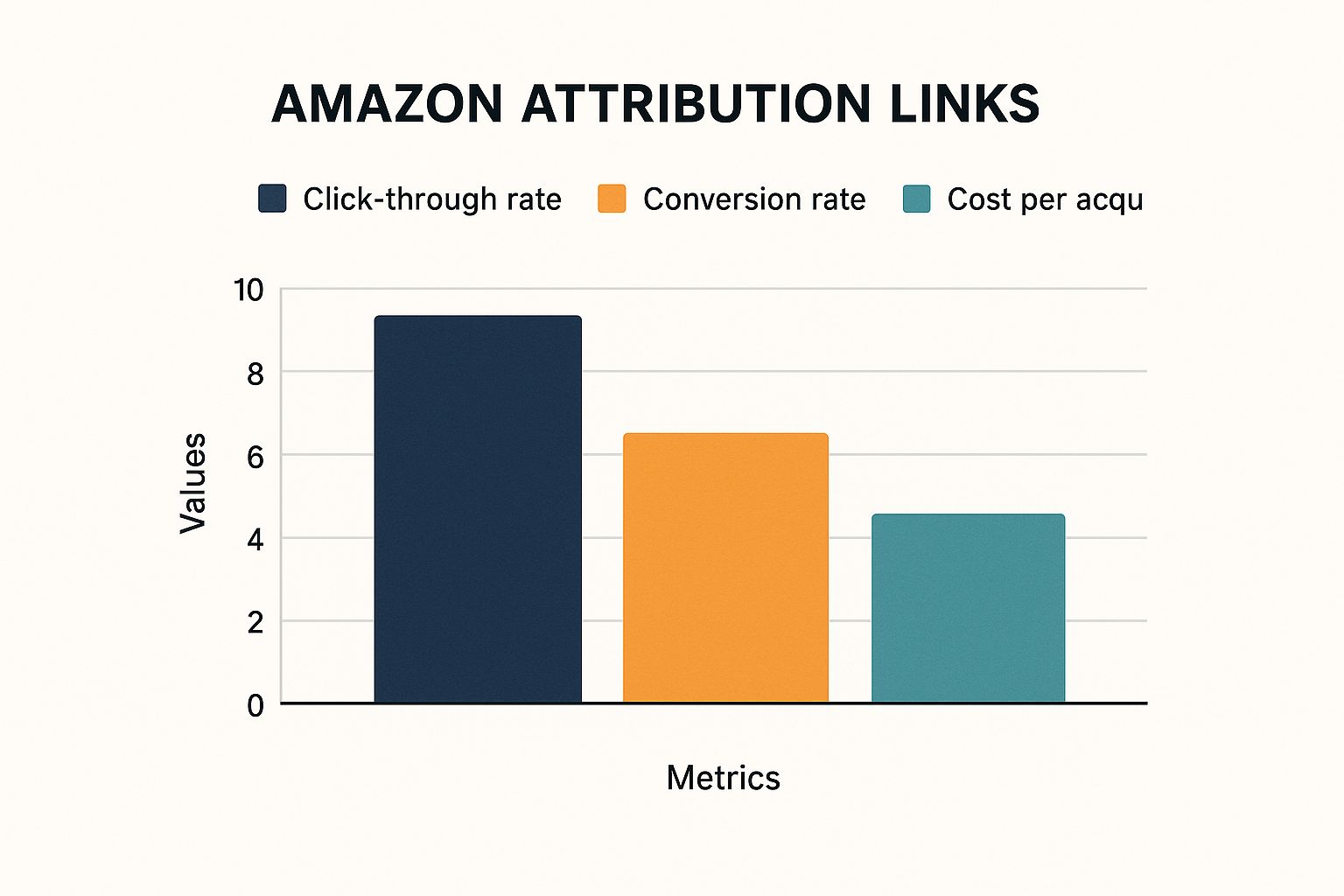
As you can see, when you manage your campaigns well, the improved targeting and smoother customer journey lead to much better conversion rates and a lower cost to acquire each customer.
Amazon Fees vs. D2C Costs
This fee reduction completely changes the math. Let's do a quick comparison. A sale happening on a D2C website like Shopify has a payment processing fee of 2.9% + 30 cents per order. A sale made on Amazon using an Amazon attribution link has an average of 15% Amazon fee but gets refunded a 10% brand referral fee, resulting in an average 5% fee from Amazon. This is only about 2% more expensive than fulfilling directly from your own website.
Amazon Sale Fee Comparison With and Without Attribution
This table shows the real-world cost difference for an Amazon seller. It contrasts a standard Amazon sale with one made through an Attribution link, factoring in the Brand Referral Bonus.
| Sale Type | Standard Amazon Referral Fee | Brand Referral Bonus | Effective Amazon Fee | Compared to D2C (e.g., Shopify) |
|---|---|---|---|---|
| Standard Amazon Sale | 15% (example) | $0 | 15% | Significantly higher |
| Attribution Link Sale | 15% (example) | -10% (average) | 5% | Only ~2% higher |
As you can see, the bonus makes driving traffic to your Amazon listings incredibly competitive from a cost perspective.
That small 2% difference in fees is often a fantastic investment. For that tiny premium, you get all the advantages of Amazon: higher conversion rates and the Amazon ecosystem to take care of customer support, FBA delivery, and so on.
How Coral Integrates with Attribution
This is exactly why we built Coral. As a marketing platform, Coral is integrating Amazon Attribution right within the platform, so that affiliates and brands can both see the data. It brings all the critical metrics into one clean dashboard.
This means both you and your affiliate partners can see everything that matters, all in one place:
- Clicks on every unique link
- Sales generated from those clicks
- Affiliate fees your partners have earned
- Referral fees (Brand Referral Bonus credits) your brand has earned
This integration removes the guesswork and the back-and-forth. It lets you create powerful, mobile-friendly links and gives everyone transparent, real-time access to performance. For a deeper dive, you can explore our dedicated blog post about how the Brand Referral Bonus works.
How to Create and Use Your Attribution Links
Putting your Amazon Attribution links to work is pretty simple on the surface, but a few insider details can save you a world of frustration. The core idea is to create a unique link for every single marketing channel you use. That means one link for your Facebook campaign, a different one for an influencer's Instagram Story, and yet another for your email newsletter.
Why bother with all the separate links? It’s all about getting clean, actionable data. This is how you find out, with certainty, which of your efforts are actually driving sales and which are just wasting your time and money.
Understanding Publisher Labels
When you create links, Amazon Attribution allows you to create them for different publishers. However, selecting a different publisher is mostly for the brand to organize their links and understand where the traffic is coming from.
The only substantial difference happens when an Amazon attribution link is used directly in a Google advertising or Facebook advertising campaign. For these two platforms, Amazon can tie in the attribution and connect the campaign name, the group name, and the creative name directly to the Amazon attribution link. Any other Amazon attribution link has the same structure in terms of tags, campaign names, and ad group names.
Pro Tip: Just launched a campaign and seeing nothing but zeroes in your Amazon Attribution dashboard? Don't panic. Amazon won't show you any data for a link until it gets at least 10 clicks. The clicks are being tracked, they just won't show up until you hit that minimum threshold.
Driving external traffic isn't just a "nice-to-have" anymore; it's a critical part of the game. Think about it: about 70% of Amazon shoppers never even look past the first page of search results. Amazon’s ranking algorithm rewards listings that bring in their own traffic, making your off-Amazon marketing more important than ever. You can learn more about how external traffic impacts your Amazon rank on sellerlabs.com.
The Problem with Mobile and How to Fix It
There’s a massive pitfall with a standard Amazon Attribution link that trips up a lot of sellers: it's not a deep link.
Here’s the scenario. A customer sees your product on Instagram or TikTok and clicks your link. Instead of opening the Amazon app they use every day, it opens a clunky, slow, in-app web browser where they aren't logged in. That's a deal-killer. That one bit of friction is enough to lose an impulse buy completely.
This is exactly why Coral creates Amazon Attribution links that are also mobile-friendly deep links. When someone clicks a Coral link, it’s smart enough to send them straight to the product page inside their Amazon app. This keeps the shopping experience smooth and protects your conversion rate. This is especially crucial when you're working with creators, a strategy we dive into in our guide on the Amazon Affiliate Marketing program.
The Hidden Conversion Killer in Standard Links
There's a sneaky issue with standard Amazon Attribution links that most sellers don't realize is tanking their conversion rates. It’s a simple but devastating detail: they aren't deep links. This one flaw can completely undermine your social media and influencer marketing campaigns.
Let's walk through a common scenario. A potential customer is scrolling Instagram, sees your ad, and taps the link, excited to buy your product. But instead of landing on the product page in their Amazon app, they're dumped into a clunky in-app web browser. And, of course, they aren't logged in.
That purchase-ready customer is now staring at a login screen. All that excitement and momentum? Gone. This friction is a well-known conversion killer, bringing an impulse buy to a screeching halt. More often than not, they'll just abandon the effort and keep scrolling.
When your link doesn't open the app, you're paying to drive traffic into a leaky bucket. A huge chunk of your ad spend and potential sales vanishes before a customer even sees your product page.
The App-to-App Advantage
This is where the difference between a standard link and a true deep link really matters. A deep link is smart enough to know the user is on their phone and should be sent directly to the product page inside the Amazon app, completely skipping the browser.
It's all about preserving that smooth, one-tap shopping experience that’s absolutely essential for converting customers on platforms like TikTok and Instagram. Without deep linking, you’re throwing up a frustrating roadblock right at the finish line. All the time and money you poured into creating the perfect ad can be wasted by that final, clunky step.
Fixing the Leak with Smart Links
This is exactly the problem we built Coral to solve. We think an Amazon Attribution link should do more than just track—it should actually help you convert.
Here’s how a Coral link works differently:
- It acts as both a fully functional Amazon Attribution link and a mobile deep link.
- It automatically detects when a click comes from a social app.
- It then opens your product page directly within the user's Amazon app, just as it should.
This simple change helps you keep the high conversion rates you're aiming for with your off-Amazon traffic.
While Amazon Attribution provides essential data, it's not without its headaches. Many sellers report frustrating data discrepancies—sometimes over 20%—when comparing clicks and sales to what they see on other platforms. This is often due to tricky setup or tracking window mismatches. You can read more about this on Amazon's own guide to managing attribution data discrepancies.
Coral helps clean up this mess by pulling all your data into a single, clear dashboard. This makes it much easier to spot issues, manage your campaigns, and ensure you’re getting both accurate tracking and a user experience that actually sells.
How Smart Links Solve the Deep Link Problem
This is exactly where smart links come in to save the day. They effectively fix the "leaky bucket" problem that standard URLs create on mobile. Platforms like Coral generate a single link that acts as both a fully functional Amazon Attribution link and a mobile-friendly deep link. You get the best of both worlds.
So, when a shopper clicks your Coral link from an app like Instagram or TikTok, the link is smart enough to know they're on a phone. Instead of kicking them out to a clunky mobile browser, it sends them straight to the product page inside their native Amazon app.
This one simple fix keeps the shopping experience smooth and frictionless, which is absolutely critical for capturing those impulse buys. If you're weighing your options, you can check out a full comparison of the best Amazon deep link tools to see how different platforms handle this.
Unifying Your Data and Workflow
The real magic is how it all works together behind the scenes. Coral is built to integrate directly with Amazon Attribution, creating one seamless system for your brand and any partners you work with. This lets you generate these high-converting links and see all the critical data in one spot. No more juggling spreadsheets.
Inside a single dashboard, both brands and affiliates can see:
- Total Clicks on every unique link.
- Purchases & Sales from each campaign.
- Affiliate Fees your partners have earned.
- Brand Referral Bonus credits the brand has earned back.
This consolidated view makes campaign management so much easier. You get a clear, accurate picture of your performance without having to cross-reference a half-dozen different reports, freeing you up to focus on strategy.
This unified approach solves a massive headache for sellers. It turns a complicated, multi-step tracking process into a single, intuitive workflow, saving you time and maximizing your sales potential.
A Powerful Tool for a Growing Market
Amazon Attribution itself is a fairly new program, launched to give sellers better visibility into where their off-Amazon traffic is coming from. Since its launch, it has become a non-negotiable tool for any brand-registered seller trying to optimize their marketing budget.
As of 2025, the tool is available to sellers and vendors in major markets like the United States, Canada, the UK, Germany, Spain, France, and Italy. Amazon continues to roll it out to more countries, which shows just how much they value brands that drive their own external traffic. For more details on its features and availability, you can discover more insights about Amazon Attribution on sarasanalytics.com.
By combining the powerful tracking of an Amazon Attribution link with the conversion-lifting power of deep linking, you create a truly optimized path to purchase. You get the data needed to make smart decisions and ensure the customer experience is smooth enough to turn clicks into sales. This two-pronged approach is the key to winning with off-Amazon marketing.
Got Questions About Amazon Attribution? We’ve Got Answers.
Jumping into Amazon Attribution can bring up a few questions. It’s a powerful tool, but like any tool, it takes a little getting used to. We've seen these same questions pop up time and time again from sellers, so we’ve answered them here to help you get ahead of any potential snags.
"Help! Why Do My Amazon Attribution Stats Say Zero?"
This is probably the most common point of panic for new users, so let’s clear it up right away. If you see a big fat zero across all your metrics—clicks, sales, the whole shebang—don't sweat it. Your link isn't broken.
Amazon’s dashboard simply won’t show you any data until a specific Amazon attribution link gets at least 10 clicks. It's a minimum threshold they have in place. The data is being collected in the background, but it stays hidden until you hit that magic number. Just give it a little time for the clicks to roll in.
"Can I Just Use One Link for All My Marketing?"
You could, but that would be like trying to figure out which of your employees is the most productive by looking at the company's total revenue. You'd get a number, but it wouldn't tell you anything useful.
The whole point of attribution is to see what’s working and what isn't. To do that, you need to create a unique link for each specific marketing effort. One for your Instagram bio, a different one for your Facebook ad campaign, and another for your weekly email newsletter. This is how you find out that your email list is a goldmine, but your Facebook ads need tweaking.
The golden rule of attribution is simple: one link per marketing initiative. This granularity is what turns a messy pile of data into clear, actionable insights for your business.
"What's the Difference Between an Attribution and an Affiliate Link?"
This is a really important one to get right, as they serve two very different functions.
- An Amazon Attribution Link is for you, the brand owner. Its job is to measure your own external marketing and help you qualify for the Brand Referral Bonus. It's an analytics tool.
- An Amazon Affiliate Link (from the Amazon Associates Program) is for content creators, publishers, and influencers. It’s how they earn a commission when they send traffic to Amazon that results in a sale. It's an income tool.
Think of it this way: Attribution links are for your analytics and bonus program. Affiliate links are for their paycheck. Platforms like Coral are brilliant because they help merge these two worlds, letting brands and affiliates collaborate using powerful attribution links.
"Do I Really Need Deep Links for My Google Search Ads?"
Good question. For Google Search ads, usually not. The "deep link" issue is most painful on social media platforms like Instagram, TikTok, Facebook, and Pinterest. On those apps, clicking a standard link traps the user in a clunky, built-in browser where they're almost never logged into Amazon. That friction kills sales.
Google Search ads, on the other hand, typically open in the phone's default browser (like Chrome or Safari). Since most people are already logged into their Amazon account in their main browser, the journey is much smoother. But for any social media campaign? A deep link, like the ones Coral generates, is non-negotiable. It's the difference between a lost click and a new customer.
Ready to stop guessing and start seeing your true marketing ROI? Coral generates high-converting Amazon Attribution links that are also deep links, making sure every single click has the best chance to convert.
Get started with Coral today and turn your external traffic into a powerful sales engine.