Build a Winning Amazon Brand Advocate Program
Category: Brand advocate program
What if you could build a volunteer marketing team filled with your most passionate customers? That’s the core idea behind a brand advocate program. It’s a strategy that channels genuine customer love into a powerful force for building trust and driving sales, moving way beyond what traditional advertising can do.
Why Advocates Are Your Amazon Secret Weapon
Trying to win on Amazon with paid ads alone is a tough, expensive game. Shoppers are getting savvier and more skeptical of slick marketing campaigns every day, and the cost of acquiring a new customer just keeps climbing. Your real competitive edge isn't a bigger ad budget; it's an asset you already have: the authentic voices of your happy customers.
A brand advocate program gives structure to this idea, turning it into a repeatable growth engine powered by real enthusiasm. Unlike influencers or affiliates who are often in it for the paycheck, advocates promote your brand simply because they believe in your products. Their recommendations slice right through the advertising clutter because they come across as genuine and trustworthy.
The Power of Authentic Recommendations
Think about your own shopping habits on Amazon. Are you more likely to trust the sponsored ad at the top of the search results, or a detailed, glowing review from someone who actually bought and used the product? For most of us, it’s the real customer every time. Advocates provide that kind of social proof on a much larger scale, creating a positive feedback loop that builds credibility and drives conversions.
Word-of-mouth from a trusted source is incredibly effective at cutting through the noise on social media and elsewhere. This is where a brand advocate program shines, transforming satisfied customers into your brand's most powerful allies.
This move toward authentic, peer-to-peer influence is more than just a passing trend. The global brand advocacy software market, which provides the tools for these programs, was valued at around $392.78 million and is expected to keep growing. That tells you just how critical these strategies have become.
Advocates vs. Other Partnerships
It’s really important to understand what makes an advocate different from other partners. Influencers and affiliates definitely have their place in a marketing strategy, but advocates come from a place of pure, unprompted loyalty. If you want to dive deeper, you can explore our complete guide on what brand advocates are.
Let's break down the key differences between advocates and other common marketing partners.
Advocates vs Influencers vs Affiliates
| Type | Primary Motivation | Compensation Model | Key Value to Brand |
|---|---|---|---|
| Brand Advocates | Genuine love for the product | Often none; rewards-based (discounts, early access) | High-trust, authentic word-of-mouth |
| Influencers | Audience engagement & monetization | Paid (flat fee, per post) | Broad reach and awareness |
| Affiliates | Earning commissions | Commission on sales (rev-share) | Performance-based sales generation |
While influencers and affiliates are transactional, brand advocates are relational. They are driven by a genuine connection to your brand, not a contract.
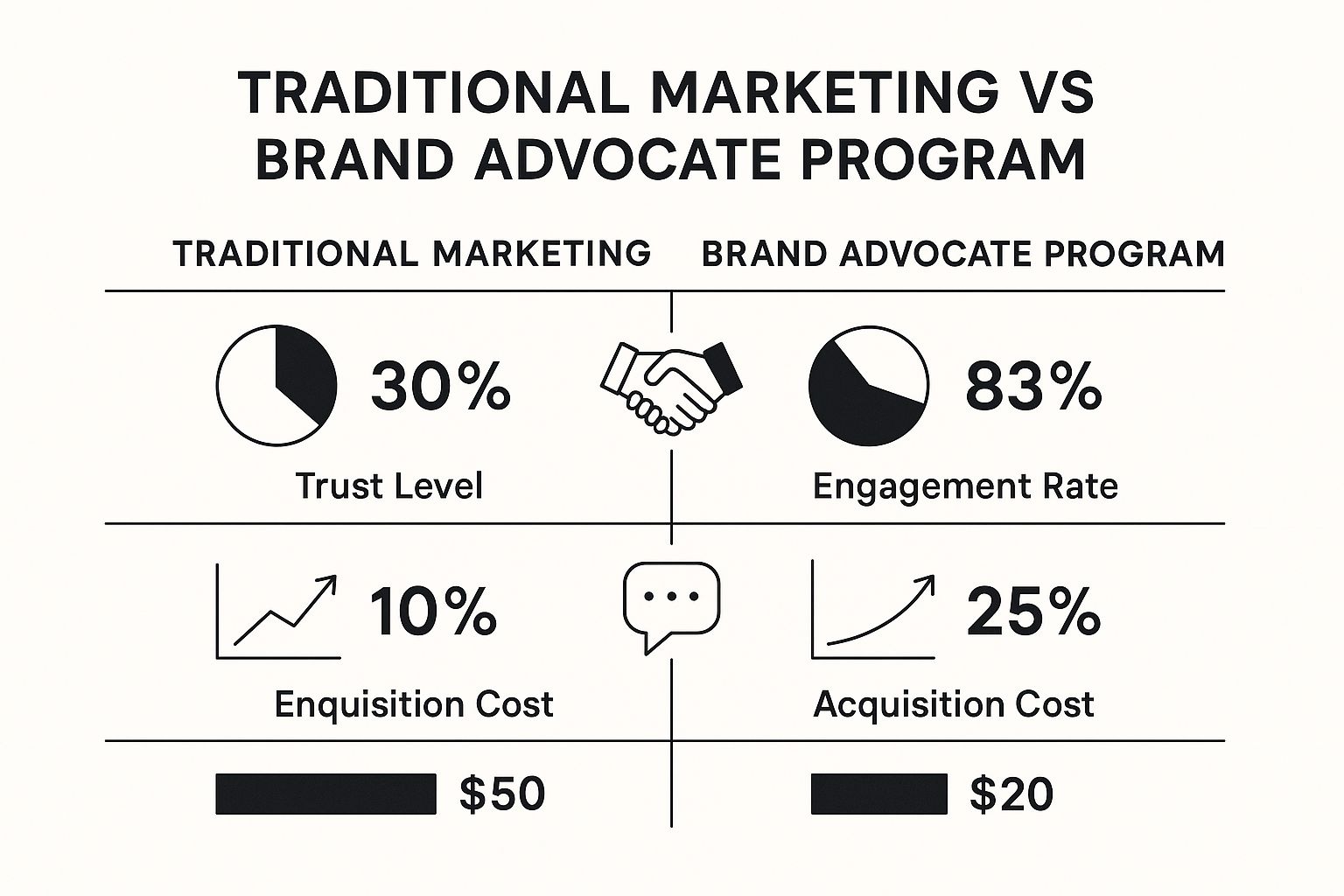
As you can see, advocacy consistently delivers higher trust and engagement while significantly lowering your customer acquisition costs. When you invest in these relationships, you're not just getting a single sale. You're building a loyal community that will champion your brand for the long haul.
Finding Your First Brand Advocates
Your most powerful advocates are often hiding in plain sight. These are the people already buying and loving your products. The real trick isn't to find professional promoters, but to spot the genuine, authentic enthusiasm that already exists within your customer base. Think of yourself as a detective, searching for clues of passion.
Forget about spending a fortune on influencer searches. Your first stop should be your Amazon product reviews. I'm not talking about just any five-star rating; look for the customers who leave detailed, multi-paragraph reviews overflowing with specific praise. They're telling a story about how your product fits into their lives, and that's pure gold.

Uncovering Advocates in Your Data
Beyond the reviews, your own sales data is packed with clues. Repeat purchasers are the definition of low-hanging fruit. When someone has bought from you three, four, or even five times, they're voting with their wallet. They clearly trust your brand and are perfect candidates for your brand advocate program.
At the same time, you need to keep an eye on social media for organic mentions. Set up alerts for your brand and product names. When someone posts an unboxing video or shares a photo of your product without being paid or prompted, you've found a real advocate. This is where you see raw, unfiltered excitement for what you're selling.
The most compelling advocacy comes from a place of authenticity. Your job is to find the sparks of genuine enthusiasm that are already happening and simply add fuel to the fire. It's about recognizing and rewarding loyalty, not manufacturing it.
Effective social listening is a huge part of this. To make this process a lot smoother, you can explore some of the top AI tools for social listening that can help automate the hunt for these valuable mentions.
Crafting a Personal Invitation
Once you've identified a handful of potential advocates, how you reach out is everything. A generic, automated message will fall flat—it can even feel like an insult to someone who has shown genuine loyalty. The goal here is to make them feel seen and truly appreciated.
Make sure your outreach mentions their specific actions. For example:
- "Hi [Name], I'm [Your Name] from [Brand]. I just read your incredibly detailed review for our [Product Name] on Amazon, and our whole team was blown away by your feedback on [specific feature]. We’re so grateful for supporters like you."
- "Hey [Name], we saw the amazing unboxing video you posted on Instagram! The way you showcased [Product Feature] was fantastic. We're launching an exclusive community for our top fans and would be honored if you'd consider joining."
This personal touch proves you've done your homework and value what they've already done. It makes them far more likely to say yes.
Creating an Easy On-Ramp
To catch people who are already looking for you, create a simple sign-up or application form on your website. This gives passionate customers a direct path to engage more deeply with your brand. You can promote this landing page through your email list, in your social media bios, or even with a QR code on your product inserts.
Keep the application itself short and sweet. You just want to gauge their passion and see if they're a good fit. Ask simple questions like:
- Why do you love our products? (This reveals their genuine enthusiasm.)
- Which of our products is your favorite and why? (This helps you understand their specific connection.)
- On which social media platforms are you most active? (This gives you a peek into where they can best support you.)
By combining proactive outreach with an easy way for people to sign up, you build a powerful system for finding and recruiting your first advocates. For more strategies on this, check out our guide on how to https://coral.ax/blog/build-brand-advocates from the ground up.
Designing a Program That Actually Motivates
So, you've identified your potential advocates. Great! Now comes the fun part: creating a program that makes them want to shout your brand's name from the rooftops. A killer advocate program shouldn't feel like a chore or a job. It should feel like an exclusive club—a community built on a genuine love for what you do.
The trick is to create a clear path for growth. A tiered system, like a Bronze, Silver, and Gold level, works wonders here. It gamifies the whole experience. People love having something to work towards, and this structure offers progressively better rewards as they get more involved. It gives their contributions real, tangible meaning.
Thinking Beyond Just Cash
Listen, cash rewards are fine, but relying on them alone can make the whole relationship feel transactional and, frankly, a bit cheap. The strongest, most loyal advocate communities are built on perks that money can't buy. It's all about making them feel like true insiders.
Try mixing up your incentives to appeal to different motivations:
- Early Product Access: Let them be the first to try your new products before they even hit Amazon. This kind of exclusivity is a massive ego boost and helps you get that crucial early buzz and those first few reviews.
- Exclusive Discounts: Give them a special, hefty discount code just for them. It’s a practical reward that encourages them to keep using (and loving) your products.
- Free Swag & Products: Who doesn’t love free stuff? Sending advocates your products or cool branded merchandise is a simple but powerful way to say "thanks." Plus, it gives them more to talk about.
- Social Media Shout-Outs: Nothing beats public recognition. Featuring your top advocates on your brand’s social media channels is a huge motivator and gives them bragging rights.
To get the most out of their amazing content, you'll want to build out a comprehensive user generated content strategy. This helps you guide them and put their authentic posts to good use.
Honestly, the best incentives are all about the experience. I've seen a handwritten thank-you note paired with early access to a new product generate way more genuine excitement than a simple gift card.
We're seeing brand advocate programs get more sophisticated. A global survey showed that successful programs now connect with advocates across five or more channels on average. It also confirmed what many of us have seen firsthand: success comes from deeply engaged fans, not just big-name influencers. This means you need a personal touch and a mix of rewards, from simple recognition to cash bonuses, to keep everyone happy.
Building Your Tiered Reward Structure
Let’s get practical. Imagine you sell high-quality kitchen gadgets on Amazon. You want to design a tiered system that rewards actions that directly help your sales and visibility on the platform.
Here’s a simple way you could structure it:
| Tier Level | How to Get In | The Perks |
|---|---|---|
| Bronze | Join the program & give one social media shout-out. | 15% personal discount code and access to an exclusive Facebook group. |
| Silver | Create 3 pieces of user-generated content (photos, videos, etc.). | 25% personal discount and one free product of their choice each quarter. |
| Gold | Post an approved video review on your Amazon product page. | 40% personal discount and early access to all new products. |
This kind of structure lays out a crystal-clear roadmap. A new advocate joins, gets an immediate benefit (that discount!), and can easily see how to climb the ladder to get even better perks. And the best part? The tasks are all things that directly help your Amazon business, like generating awesome UGC and landing those super-valuable video reviews.
How to Manage All This Without Going Crazy
As your advocate community grows, trying to manually track who did what and which rewards to send out becomes a nightmare. Seriously, don't even try. This is where a dedicated management tool becomes your best friend.
Platforms like Coral are built for Amazon sellers to handle exactly this.
You can set up your tiers, automatically track what your advocates are doing using Amazon Attribution, and manage all your rewards from a single dashboard. This automation saves you from drowning in admin work, freeing you up to do what really matters: building real relationships with the people who love your brand the most.
Launching and Managing Advocate Campaigns
Alright, you've built the foundation of your advocate program. Now for the fun part: putting your biggest fans to work. This is where you move from having a list of loyal customers to generating real, tangible results for your Amazon business.
We're not just talking about sending out random requests. This is about launching strategic, focused campaigns that directly tie into your goals, whether that's a new product launch or a big push for Prime Day. The best campaigns make your advocates feel like they're on a special mission with you, not just checking off a task on your marketing to-do list.
Crafting the Perfect Campaign Brief
If there's one thing I've learned, it's that clarity is everything. Before you even think about asking your advocates to lift a finger, you need a rock-solid campaign brief. This simple document is your single source of truth—it prevents a ton of back-and-forth and ensures you get exactly what you need.
Keep your brief short, sweet, and to the point. Ditch the corporate jargon and focus on these essentials:
- The Big Goal: What's the one thing you're trying to achieve? Is it getting the first 10 video reviews on a brand-new product? Or maybe driving a wave of social media buzz for a sale?
- The Specific Task: Be crystal clear about the action you want them to take. "Post one unboxing video to your Instagram Stories and tag our brand" is so much better than a vague request like "promote our new product."
- Key Talking Points: Give them a few bullet points about the product's best features. This isn't a script—far from it. It's just a little guidance to help them create content that feels authentic and hits the right notes.
- Campaign Timeline: Simple enough. When does it start? When does it end?
- The Reward: What's in it for them? Make it obvious. Spell out whether they're getting bonus points, a free product, or an entry into a giveaway for participating.
This simple framework turns a fuzzy idea into an actionable plan your advocates can actually get excited about.
Sample Campaign Ideas for Amazon Advocates
Need some inspiration? Here are a few campaign ideas I've seen work incredibly well for Amazon-focused brands. Each one is designed to move a specific needle on the platform.
A few campaign concepts can make a huge difference for your Amazon store. The table below breaks down some ideas, their main goal on Amazon, and how you'd measure if they're actually working.
| Campaign Type | Primary Goal on Amazon | Key Performance Indicator (KPI) |
|---|---|---|
| New Product Launch Blitz | Generate early reviews & social proof | Number of authentic photo/video reviews |
| Prime Day Hype Machine | Drive traffic to your Amazon Storefront | Clicks on special affiliate links |
| UGC Photo Contest | Source high-quality lifestyle images | Number of approved UGC submissions |
| Q&A Answering Bee | Improve listing conversion rate | Number of helpful "votes" on answers |
These campaigns are designed to be simple for advocates but deliver high-impact results exactly where you need them on Amazon.
The most successful campaigns make advocates feel like insiders. Giving them a sneak peek of a product before anyone else and asking for their help to make the launch a success builds a powerful sense of ownership and community.
Keeping Engagement and Excitement High
Kicking off a campaign is just the beginning. The real magic lies in how you manage it day-to-day. You need to keep the energy up so your advocates stay motivated and want to participate again and again.
A private community group, maybe on Facebook or Discord, is an absolute game-changer here. It becomes the home base for your program—a place to share updates, answer questions, and let advocates connect with each other. It’s how you turn a list of names into a real team. For a deeper dive into building this kind of community, check out our guide on how to build a successful brand ambassador program, which shares many of the same core principles.
Here are a few more tips for keeping the momentum going:
- Run Friendly Contests: A little competition never hurts. Offer a bonus prize for the "most creative" video or the "most helpful" Q&A answer. It gamifies the experience and pushes people to deliver their best work.
- Share Regular Updates: Post leaderboards, celebrate wins ("We just hit 20 new reviews!"), and give public shout-outs to your top contributors. Recognition is a powerful reward that costs nothing.
- Make Them Feel Heard: Ask them for feedback on your products and campaigns. When they see you actually implement their suggestions, it makes them feel like true partners in your brand's journey.
Turning Your Team into Internal Advocates
While your customers are obviously your go-to for advocacy, don't forget about the experts you have right in your own building. Your employees live and breathe your products. They know your brand's mission backward and forward and are genuinely invested in seeing it succeed. Tapping into that passion is a powerful—and often overlooked—way to get your brand message out there with real authenticity.
This is what an employee advocacy program is all about. It’s a structured way to encourage your team to share company news, product launches, and big wins on their own social media. The goal isn't to force them to post generic marketing copy. It’s about arming them with the tools and the confidence to share their genuine excitement in a way that feels right for them and their audience.
Setting Clear and Simple Guidelines
First things first, you need some ground rules. This isn't about creating a stuffy, corporate policy manual. Think of it more as a simple framework to protect both your brand and your team. The idea is to empower them, not tie them up in red tape.
Keep it brief and cover the essentials:
- Tone of Voice: Just encourage them to be positive, helpful, and authentic—basically, to reflect the brand’s personality in their own way.
- Disclosure: A quick reminder to be transparent is all you need. A simple hashtag like
#BrandEmployeeor#BrandLifedoes the trick. - Confidentiality: Clearly outline what’s off-limits. This usually means things like unreleased product info or internal performance numbers.
When you provide this clarity, you build trust. It gives your team the confidence to jump in without worrying about making a mistake. You're creating a safe space for them to become part of the conversation.
Making It Easy to Share
Let's be real: the biggest hurdle to getting employees to post is usually just the time and effort involved. Everyone is busy. So, you have to make sharing ridiculously easy.
Set up a central spot—a dedicated Slack channel or even a shared Google Drive folder works great—where you can drop pre-approved content they can grab and tweak.
Your content library could include things like:
- High-quality lifestyle photos of your products.
- Links to positive blog posts or recent press.
- Short, eye-catching video clips.
- A few suggested captions they can personalize to sound like themselves.
When you do the heavy lifting, you make it a no-brainer for them to participate. It shows you respect their time while still making sure the content they share looks great and hits the right notes for your brand advocate program.
Don't just give them content; give them stories. Share the 'why' behind a new product or a company milestone. When employees feel connected to the narrative, their advocacy becomes far more passionate and compelling.
This strategy isn't just a "nice-to-have" anymore. Recent research shows that 61% of business leaders now see employee advocacy as extremely or very important. And the results are there to back it up—52% of companies say increased brand awareness is the top benefit. Plus, content shared by employees is incredibly cost-effective and can boost reach and engagement by as much as 19%. You can dive deeper into these stats in the 2025 Employee Advocacy Benchmark Report.
At the end of the day, your own team can be your most credible and enthusiastic champions. If you give them clear guidelines, make sharing a breeze, and celebrate what they do, you'll build an internal advocacy powerhouse that strengthens your culture and extends your brand’s reach in the most genuine way possible.
Measuring and Scaling Your Program
Getting your brand advocate program off the ground is a huge win, but the real work starts now. To turn this into a genuine growth engine for your Amazon brand, you have to stay on top of what’s working, what’s falling flat, and how to make it better. After all, if you can't measure it, you can't manage it—and you definitely can't scale it.
This means looking past vanity metrics like how many followers someone has. For an Amazon brand, success is all about actions that directly boost your product listings and drive sales. You need to focus on tangible results that prove your program is worth the time and money you're pouring into it.
What to Actually Track on Your Dashboard
To really get a feel for your program's impact, you need to define and track the right numbers. A good starting point is understanding the top influencer marketing KPIs, which can give you a solid framework for proving its ROI.
For those of us selling on Amazon, here are the metrics that truly move the needle:
- Product Reviews Generated: This is probably the single most valuable metric you can track. Keep a close eye on how many authentic photo and video reviews your advocates are posting each month.
- User-Generated Content (UGC) Volume: Count up all the high-quality photos, videos, and social posts your advocates create. Think of this as building a library of powerful, reusable marketing assets.
- Referral Traffic to Your Listings: Using a tool like Amazon Attribution is key here. It lets you see exactly how much traffic your advocates are sending directly to your product pages. It’s a direct measure of their ability to spark interest.
- Attributed Sales: This is the ultimate proof. Tracking the sales that come directly from your advocates' unique links gives you a clear, hard number for your return on investment.
A platform like Coral pulls all of this into one dashboard, which saves you the massive headache of trying to stitch together reports from a half-dozen different sources.
The goal isn't just tracking what people are doing, but connecting those actions to real business results. Being able to say that 25 advocates generated 40 new reviews and $5,000 in sales last month tells a story that everyone in your business will understand.
Building a Smart Growth Plan
Once you have that solid data, you can start making smart decisions about how to grow the program. Scaling isn't just about throwing more people at the problem; it's about growing in a way that’s strategic and sustainable.
Your growth roadmap should really focus on three main areas:
When to Bring on More Advocates Don't get ahead of yourself. A good rule of thumb is to wait until your current advocates are consistently engaged and hitting their goals. If your first group of 20 advocates is active and delivering, that’s your green light to open up applications and welcome a new cohort.
How to Fine-Tune Your Incentives Let the data guide your rewards strategy. If you see that advocates are going nuts for early access to new products but aren't really motivated by a small discount, it’s a no-brainer—double down on what gets them excited. You could even introduce a new, exclusive reward tier to push your top performers to do even more.
How to Automate the Day-to-Day Grind When you go from managing 20 advocates to 100 or more, trying to do everything by hand is a recipe for burnout. At this point, automation is a must. Use your program software to handle things like sending out rewards, tracking campaign submissions, and giving performance updates. This frees you up to do the one thing you can't automate: building genuine relationships with your advocates.
Your Brand Advocate Program Questions, Answered

Diving into your first brand advocate program always brings up a few questions. I've been there. Let’s tackle some of the most common things Amazon brands wonder about when they're just getting started.
How Many Advocates Do I Really Need to Start?
You can relax—you don't need a massive army of followers right away. Honestly, a small, dedicated group of 10-15 enthusiastic customers is the sweet spot for launching your program.
Starting small is actually a strategic advantage. It lets you build real, personal relationships and test what works without getting swamped. You'll quickly learn that deep engagement from a few true fans is way more powerful than shallow participation from hundreds.
What's the Biggest Mistake I Should Avoid?
The most common trap I see brands fall into is treating their advocates like hired help. If your program feels purely transactional, like you're just paying for posts, you'll lose the magic.
The goal is to build a genuine community. Focus on making your advocates feel like valued insiders who are part of something special. When you nail the relationship, the authentic promotion you're looking for will happen naturally.
Another killer mistake? Going silent. Inconsistent or poor communication makes your community feel neglected and kills momentum fast. Keep them in the loop!
Can I Run This if I Only Sell on Amazon?
Absolutely. It just requires a bit of creativity to bridge the gap. While Amazon's terms make direct contact tricky, you have plenty of other ways to connect with your customers.
Here are a few proven tactics:
- Product Inserts: A simple QR code on an insert can direct happy customers straight to your advocate community sign-up page.
- Social Media: Find out where your customers hang out online and build your community there. An exclusive Facebook Group or Instagram channel works wonders.
- Post-Purchase Emails: Use Amazon's messaging system or other tools to follow up after an order is delivered and invite them to join.
The great thing is, the activities you'll run—like generating reviews and social media content—are tailor-made to drive growth for an Amazon-centric business.
Ready to turn your most passionate customers into your best marketing asset? With Coral, you get all the tools you need to design, launch, and run your Amazon brand advocate program from one central place. You can start building your community today by visiting the Coral website.