Private Label Amazon Your Guide to Building a Real Brand
Category: Private label amazon
Selling your own private label on Amazon is a totally different ballgame than just reselling other companies' stuff. Instead of being a middleman, you're creating your own unique, branded products. This shift puts you in the driver's seat, giving you full control over how your product looks, how it's made, and what it costs. You're not just making sales; you're building a real business asset.
Beyond Reselling: Building a Brand with Private Label
When people first dip their toes into the Amazon waters, they usually hear about models like online or retail arbitrage—basically, hunting for deals and flipping products for a quick profit. Others might look into wholesale, where you buy big batches of existing brands to resell. These are fine ways to start, but the private label Amazon model is on another level. It’s about creating something new, not just moving boxes.
The real magic of private label is building a brand that can live and breathe outside of Amazon. Sure, Amazon is an incredible launchpad. It gives you immediate access to millions of shoppers with high conversion rates, which is fantastic for getting those first sales and building momentum. But the long-term play is to build a business that has its own direct relationship with its customers. The core advantage in creating an Amazon private label business is to start building a brand outside of Amazon and adding more products to your catalogue for the same customers who purchased your existing products.
Once you have that trust, you can expand your product line, knowing you have a built-in audience ready to see what you come up with next. You're no longer just a one-hit-wonder; you're building a complete catalog and a direct-to-consumer business that isn't entirely at the mercy of Amazon's algorithm.
Creating a Defensible Business Asset
Think of a private label brand as something tangible you can grow and, if you choose, eventually sell. This model unlocks marketing strategies that are simply off-limits to resellers. For example, you can harness the power of influencer marketing, building an army of brand ambassadors promoting your brand and your products. These are creators who actually use and love what you sell, sharing your story with their followers.
The real power of private label lies in transforming a simple product listing into a defensible, sellable brand that isn't entirely dependent on a single sales channel. It's the shift from renting customer attention to owning it.
Juggling all those influencer relationships, from tracking sales to handling payouts, can get messy fast. This is where a tool like Coral can help make the process easy. It streamlines the whole process, letting you manage your influencer network, automate payments and sales tracking. It makes a complex marketing channel feel much more manageable.
By 2025, the private label model has cemented its place as a top strategy on Amazon, with over 60% of sellers now running their own brands. This move is fueled by much better profit margins, often landing between 30-50%, and the total control over branding that helps you sidestep the brutal price wars common in other models. You can learn more about these key insights for sellers and see why so many are making the switch.
Choosing Your Amazon Selling Strategy
Picking the right way to sell on Amazon really comes down to your personal goals, how much money you can invest, and your appetite for risk. While the private label Amazon path gives you the chance to build a real brand, it’s just one of several ways to make money on the platform. It's crucial to understand how they differ so you can choose the one that fits your vision.
Other popular models include online arbitrage (OA), retail arbitrage (RA), and wholesale. Arbitrage is all about finding discounted products—either online or in physical stores—and reselling them on Amazon for a profit. It’s a fast-paced game of flipping existing products, which is great for learning the Amazon ecosystem with a relatively small upfront investment.
Wholesale is a step up. It involves buying products in bulk directly from established brands to resell them on their existing Amazon listings. This model is more stable and scalable than arbitrage, but you're still a reseller, not a brand owner. Each of these models serves a different kind of entrepreneur.
Comparing Core Amazon Business Models
Arbitrage and wholesale are fundamentally about reselling. Your success hinges on finding profitable goods and, most importantly, winning the "Buy Box" against a crowd of other sellers listing the exact same item. Your main job is sourcing and fulfillment, not creating a brand. You're basically piggybacking on another company's hard-earned brand equity.
In complete contrast, an Amazon private label business is about building your own brand from scratch. You aren’t just reselling; you’re creating a unique product and controlling everything about it—the design, the quality, and the packaging. This is the leap from being a simple merchant to becoming a true brand owner.
This chart helps visualize how these models stack up on key metrics like profit margin and brand control.
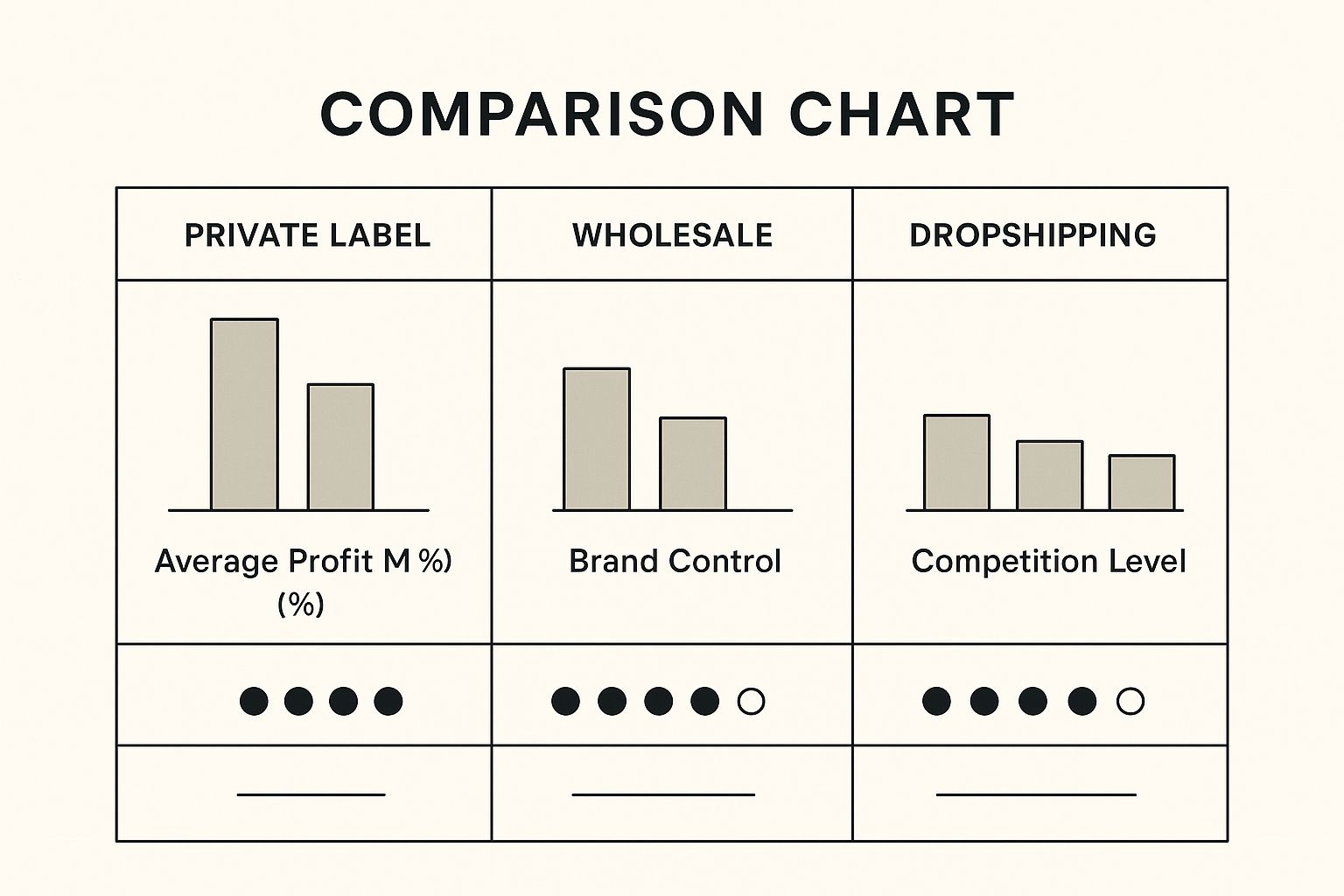
As you can see, private label offers the highest potential for both profit margins and brand control. That said, it often comes with more competition. The data clearly shows the trade-off: more control and profit demand a much stronger strategy to stand out from the crowd.
To get a clearer picture, let's break down how these business models compare on the factors that matter most to new sellers.
Comparing Amazon Business Models
| Metric | Private Label | Wholesale | Online Arbitrage | Retail Arbitrage |
|---|---|---|---|---|
| Upfront Cost | High ($5,000+) | Medium-High ($2,000+) | Low ($500+) | Very Low ($100+) |
| Profit Margins | High (25-45%) | Medium (10-20%) | Low-Medium (8-15%) | Low-Medium (8-15%) |
| Brand Control | Total Control | None | None | None |
| Scalability | High | Medium | Low | Low |
| Time to Start | Slow (3-6 months) | Medium (1-2 months) | Fast (Days-Weeks) | Fast (Days-Weeks) |
This table lays it all out. If you're looking for low risk and a quick start, arbitrage is your ticket. If you want to build a scalable, long-term asset with high-profit potential, private label is the clear winner, but it requires more capital and patience.
The real magic of a private label Amazon business is that Amazon becomes your launchpad, not your entire universe. It’s the starting point for building a brand that can eventually thrive on its own, independent of any single marketplace.
Building an Asset Beyond Amazon
Amazon is an incredible sales channel with millions of customers ready to buy, but the true advantage of private label is creating a brand that has a life outside of Amazon. Your ultimate goal is to build a brand that goes beyond Amazon—a business that people recognize, trust, and seek out directly.
This is something arbitrage and wholesale sellers simply can't achieve. When you build a private label brand, you get to cultivate a direct relationship with your customers. You can use your initial success on Amazon to:
- Build a loyal customer base: These are people who bought your brand, not just a generic product.
- Add more products to your catalogue: You can introduce new items to the same customers who already trust your quality, which drastically lowers the cost of launching future products.
- Drive traffic to your own website: Over time, you can encourage your Amazon customers to buy from your own e-commerce store, giving you more control and better margins.
This strategy turns your Amazon listing from a simple sales page into the foundation of a durable, multi-channel business. It's the difference between just running a sales operation and building a brand asset you could one day sell.
Harnessing the Power of Influencer Marketing
Another huge advantage of the Amazon private label model is the ability to tap into influencer marketing. Resellers can’t exactly build a compelling story around a random product they're flipping, but brand owners can. A unique brand identity gives influencers something real and interesting to share with their audience.
You can build an army of brand ambassadors who genuinely love your products and promote them authentically. This creates a powerful and scalable marketing engine fueled by real word-of-mouth.
Of course, managing these relationships can get complicated fast. Juggling campaigns, tracking sales, and making sure dozens of influencers get paid on time is a major operational headache. This is where platforms like Coral can be a lifesaver. Coral can help make the process easy by automating affiliate payments and sales tracking, freeing you up to focus on what matters: building genuine relationships with your creators. By simplifying the backend logistics, you can effectively scale your influencer program and grow your brand both on and off Amazon.
Building Your Brand Beyond the Marketplace
Let’s be honest. Business models like online arbitrage, retail arbitrage, and wholesale are really just about one thing: finding profitable products to resell. You're essentially a middleman competing for the Buy Box. While it can be lucrative, you're not building anything that's truly yours. You're just a merchant renting space on another brand's listing.
An Amazon private label business is a completely different ballgame. You aren't just flipping products; you're creating a brand from scratch. This is the only model where you build real, tangible equity that belongs to you and you alone. Think of Amazon's massive customer base as the perfect launchpad to get your brand off the ground.
The real magic, though, happens after that initial launch. The ultimate goal isn't just to sell on Amazon. It's to use that success to build a brand that can thrive anywhere.
The True Asset You Are Building
With arbitrage or wholesale, customer loyalty belongs to the original brand, not you. They bought a Nike shoe or a Sony headphone, and you just happened to be the seller with the best price. But when you sell your own private label product, the customer is buying your brand.
That single difference changes everything. You're no longer just a seller; you're a brand owner with a growing customer base. This opens up doors that are permanently closed to resellers.
- Cultivating a Loyal Following: You can finally build a direct relationship with the people buying your products, turning one-time purchasers into repeat fans.
- Expanding Your Product Catalog: Launching new items is suddenly much easier. Instead of starting from zero, you can market new products to an audience that already knows and trusts your quality.
- Creating Off-Amazon Channels: The long-term play is to build your own website. This gives you total control over the customer experience and, just as importantly, much healthier profit margins.
The core advantage of creating an Amazon private label business is to start building a brand outside of Amazon and adding more products to your catalogue for the same customers who purchased your existing products. This transforms your business from a simple sales operation into a sellable, long-term asset.
Using Influencers to Grow Your Brand
Here's another powerful tool only available to brand owners: influencer marketing. Resellers can’t really do this because they don't have a brand story to tell. As a private label owner, you have a unique product and a mission. You can partner with authentic creators who genuinely love what you've built and want to share it.
This creates a powerful word-of-mouth engine that drives traffic and sales both on and off Amazon. It builds social proof and credibility that you just can't get from running ads.
Of course, managing these relationships needs to be organized to be effective. A platform like Coral can streamline the whole process, from automating influencer payments to tracking the sales they generate. It takes a potentially messy marketing effort and turns it into a predictable growth channel. With a solid system, you can manage dozens of partnerships and make influencer marketing a core part of your strategy.
To get the most out of these efforts, you’ll also want to make sure your brand is officially protected on the platform. You can learn more about the benefits of Amazon Brand Registry to see how it works.
Using Influencers to Grow Your Private Label Brand
Sure, selling on Amazon automatically gets your product in front of people ready to buy. But the real magic of a private label business happens when you build a brand that lives and breathes both on and off the marketplace. You aren't just reselling someone else's stuff; you have a unique story to tell. That story is the perfect fuel for influencer marketing.
Think about it: arbitrage and wholesale sellers can't really use influencers. What would they promote? They're just moving boxes for another company. As a private label owner, however, you can build a genuine army of brand ambassadors—people who actually connect with your mission and are excited to share your products with their followers.
This completely changes the game. Your marketing stops being just about ads and becomes authentic, word-of-mouth promotion. It builds a level of social proof and trust that a PPC campaign could never touch, creating a powerful growth engine for your brand.
From Collaboration to Community
The goal here isn't to pay for a few sponsored posts and call it a day. It’s about building a community of advocates who genuinely love what you sell. When you foster these long-term partnerships, you create a flywheel. Their authentic promotion consistently brings new customers to your brand, month after month.
This is where having your own unique brand story becomes a massive advantage. You can seek out creators whose values and audience are a perfect match for your own, which leads to content that feels real and convincing. It's one of the biggest perks of the private label Amazon model.
To get this right, you have to find the right people, build real relationships, and launch campaigns that actually drive sales. If you're just getting your feet wet, our detailed guide on how to find Amazon influencers is a great place to start your search.
Building a network of brand ambassadors isn't just a marketing tactic; it's about creating a community around your product. This community becomes a durable asset that helps your brand grow far beyond its initial Amazon listing.
Scaling Your Influencer Program
Managing an "army" of brand ambassadors sounds great, but the logistics can get messy fast. Keeping track of unique links, calculating commissions, and making sure everyone gets paid on time is a nightmare to do manually. If you want to scale, you have to automate.
To turn influencer marketing from a chaotic time-suck into a powerful growth engine, you need a system. This is where a dedicated platform can be a lifesaver.
Platforms like Coral, for example, are built for exactly this. They handle the entire workflow, from getting creators set up to tracking their sales and sending out payments. By automating all the tedious backend work, you can focus your energy on what matters most: building strong, authentic relationships with your partners.
With a tool like Coral, you can:
- Automate Payouts: No more spreadsheets and manual bank transfers. The system handles calculating and sending commissions automatically.
- Track Sales: By using Amazon Attribution, you can see exactly which influencers are driving sales and what your true return on investment is.
- Manage Relationships: All your creator info, performance data, and communication can live in one organized dashboard.
A structured approach like this turns a complex marketing channel into a predictable and scalable part of your business, letting you fully capitalize on the unique brand you've worked so hard to build.
So, How Does Private Label Stack Up Against Other Ways to Sell on Amazon?
When you first dip your toes into the world of Amazon FBA, you’ll quickly realize there are a few different ways to make money. Most people start with models like Online Arbitrage (OA), Retail Arbitrage (RA), or Wholesale. These are all about reselling products that already exist. Think of it as being a digital shopkeeper—you find good deals on other companies' products and try to resell them for a profit, fighting for the Buy Box.
But a private label Amazon business is a completely different ballgame. You're not just a reseller; you're the creator. Instead of selling someone else's stuff, you're building your very own brand from scratch. This means you control everything from the product itself to the packaging and marketing. It's a shift from just making a quick sale to building a real, lasting business.
It's About Building a Real Brand, Not Just an Amazon Listing
The biggest draw of the private label model is the chance to build something that can stand on its own, with or without Amazon. Let's be clear: Amazon is an incredible launchpad. It gives you immediate access to millions of shoppers ready to buy. But the long-term play is to create a brand that people know and trust.
When you have a private label, you're not just selling a one-off item. You're building a loyal customer base that likes your brand, not just the product they found. This opens the door to launching new products under the same brand, knowing you have an audience waiting. You’re no longer just “renting” Amazon’s customers; you’re building your own following.
The real magic of an Amazon private label business is that you're laying the groundwork for a brand that lives outside of Amazon. You can launch new products to the same customers who already trust you, turning a single listing into a sustainable, multi-channel business.
The Power of People Who Love Your Brand
Here’s something you just can’t do as a reseller: influencer marketing. As a brand owner, you can connect with creators and build a network of ambassadors who genuinely believe in your products. They can share your story and drive sales in a way that feels authentic, creating a word-of-mouth buzz that's hard to replicate.
Of course, managing a growing team of creators—from tracking their sales to making sure they get paid on time—can get messy. This is where a tool like Coral comes in handy. It’s designed to streamline the whole process, helping you manage your creator network, see exactly how they're performing, and automate payouts. It takes a potentially chaotic part of brand-building and makes it a scalable growth engine.
So, How Profitable Is a Private Label Business, Really?
This is the million-dollar question, isn't it? Let's cut through the hype and look at the real numbers. While you'll hear plenty of success stories, it’s crucial to understand that Amazon private label profitability isn’t about luck—it's the direct result of smart strategy, relentless research, and smooth operations.
The financial success of your brand comes down to a few core things. Getting your product at a good price, building a brand people trust, and running a tight ship to keep Amazon's fees low. When you get these pieces right, the results can be fantastic.
Data-Backed Revenue Potential
So, what are sellers actually making? The latest data gives us a pretty clear picture. In 2025, sellers are pulling in some serious profits, but they're also having to navigate a more complex market to do it.
A solid 54% of private label sellers are reporting profit margins above 20%, which is incredibly healthy for an e-commerce business. Many are hitting six-figure monthly revenues. In fact, 63% of the larger brand sellers on Amazon are pulling in over $100,000 a month. The absolute top performers can even clear $500,000 in a single month.
This isn't just about selling a few items. It's about building a legitimate financial asset with life-changing potential if you execute it properly.
The Key Drivers of High Margins
Those impressive profit margins don't just happen by accident. They're built by mastering the fundamentals that protect your bottom line.
Here’s what separates the top earners from everyone else:
- Strategic Sourcing: This is non-negotiable. Finding a reliable manufacturer who delivers quality products at a competitive price is the foundation of your business. It directly sets your cost of goods sold (COGS) and dictates your entire pricing strategy.
- Strong Branding: A brand that resonates with customers can justify a higher price point. Great branding, smart packaging, and effective marketing create a perceived value that goes way beyond the product itself, giving you room for healthier margins.
- Operational Efficiency: You have to be on top of your game here. That means managing inventory wisely, keeping storage fees to a minimum, and optimizing every penny of your ad spend. Every dollar you save on operations goes straight to your profit.
The most profitable private label sellers treat their business like a finely tuned machine. They are obsessed with their numbers, constantly digging into the data to find ways to boost margins, slash costs, and scale up.
Ultimately, your private label venture will be as profitable as the strategy you put into it. The potential is definitely there, but it's earned through disciplined, data-driven execution.
And if you're curious about other ways to earn on the platform, it can be interesting to see how much Amazon affiliates make to compare business models.
Common Questions About Private Label
Jumping into a new business model like **private label Amazon** always brings up a lot of questions. That’s perfectly normal. This section tackles some of the most common ones I hear from new sellers, giving you clear, straightforward answers to help you get started with confidence.There are plenty of ways to make money on Amazon, but they aren't all the same. Models like online arbitrage (OA), retail arbitrage (RA), and wholesale are all about one thing: reselling someone else's products. You're basically a digital middleman, hunting for deals on existing goods and fighting other sellers for the Buy Box.
Private label is different. It’s not just about reselling; it's about creating. You build your own brand from scratch, which means you control everything from the product itself to the customer's unboxing experience. It's the difference between leasing a kiosk in a mall and owning the entire building.
How Is Private Label Different from Arbitrage and Wholesale?
The biggest difference comes down to what you’re actually building. Arbitrage and wholesale are purely cash-flow businesses. Your success hinges on your ability to constantly find profitable products and win price wars. When you make a sale, the customer's loyalty goes to the brand on the box—not to you. You're building someone else's brand equity.
With a private label Amazon business, you're building a real, tangible asset. Every single sale reinforces your brand, creating a sustainable business that has value far beyond a single Amazon listing.
The real power of an Amazon private label business is that you're creating a brand you can actually grow. Once you have customers who trust you, you can launch more products under that same brand, turning one successful product into an entire business that can thrive on and off Amazon.
This ownership of the brand unlocks marketing tactics that resellers can only dream of.
How Does Private Label Help Build a Brand Off-Amazon?
Think of Amazon as the ultimate launchpad. It gives you immediate access to a massive audience of shoppers who are ready to buy. But the long-term goal for any serious private label seller is to build a direct relationship with those customers. You want people looking for your brand, not just "a product."
Once you earn that trust, you can:
- Drive traffic to your own website, where you have full control and much better profit margins.
- Build an email list so you can talk directly to your most loyal customers.
- Launch new products to an audience that's already bought from you and loves what you do.
This is how you turn Amazon from your entire business into just the beginning. It’s about owning the customer relationship for the long haul, not just making a single sale.
Can I Use Influencer Marketing with Private Label?
Yes, absolutely. In fact, this is one of the most powerful tools in your toolbox. A unique brand with a real story gives influencers something authentic and interesting to talk about. You can create a network of genuine brand fans who connect with your products, generating the kind of word-of-mouth promotion that ads just can't buy.
This is how you build real social proof and credibility for your brand, both on Amazon and across social media.
Of course, trying to manage dozens of influencer relationships, track their sales, and handle payments can get messy fast. That's where a dedicated platform becomes essential. For instance, a tool like Coral can take the chaos out of managing your creator network. It helps you track their sales using Amazon Attribution and automates commission payouts, turning a logistical headache into a scalable way to grow your brand.
Ready to turn your influencer marketing from a headache into a streamlined growth engine? Coral gives you the tools to manage your brand ambassadors, automate payments, and track sales with precision. Start building your creator army today.