How an Affiliate Marketing Agency Works (And When to Choose an Alternative)
Category: Affiliate marketing agency
Think of an affiliate marketing agency as an extension of your own team—a specialized partner whose entire job is to build, manage, and scale your affiliate program so you don't have to. They are the experts you hire to handle everything from recruiting the right partners to tracking performance and processing payments, all with the singular goal of driving more sales for your brand.
What Exactly Does an Affiliate Marketing Agency Do?
Let's use an analogy. Imagine your affiliate program is a professional sports team. You have the star product (the team), but you need a general manager to scout talent (affiliates), negotiate contracts (commissions), draw up winning plays (campaigns), and analyze game-day performance. That's precisely what an affiliate marketing agency does.

They handle the complex, time-consuming tasks that go into running a successful program, freeing you to focus on your core business. An agency's role isn't just to find people to link to your products; it's to build a powerful, revenue-generating marketing channel from the ground up, providing a fully managed service.
Core Agency Offerings
A good agency takes a holistic approach to affiliate program management, covering several key areas to ensure your program grows and thrives. This is a breakdown of what a full-service agency typically handles.
Core Agency Services at a Glance
| Service Area | What It Involves |
|---|---|
| Strategy Development | They work with you to understand your brand, customers, and goals, then create a custom roadmap for your affiliate program. |
| Recruitment & Onboarding | A major part of their job is actively finding, vetting, and recruiting the best partners—from niche bloggers to major media sites—that are a perfect fit for your brand. |
| Campaign Management | The agency handles the day-to-day work of running promotions, providing affiliates with creative assets, and ensuring campaigns run smoothly. |
| Tracking & Reporting | Using specialized tools, they track every click and conversion, then translate that data into clear reports showing you what's driving results and ROI. |
| Payments & Compliance | They manage the critical financial details, ensuring affiliates are paid correctly and on time, all while making sure the program adheres to legal guidelines. |
All these components work together to turn a promotional idea into a well-oiled machine that drives consistent, scalable sales.
An agency’s real value is turning a random collection of individual promoters into a focused, high-performance sales force. They bring the strategy, relationships, and daily management needed to make your revenue growth predictable.
How Much Should I Expect to Pay for Agency Services?
Let's talk money. When you start researching affiliate marketing agencies, a primary question is, "How much is this going to cost?" Agency pricing isn't one-size-fits-all, but most models fall into a few common structures.
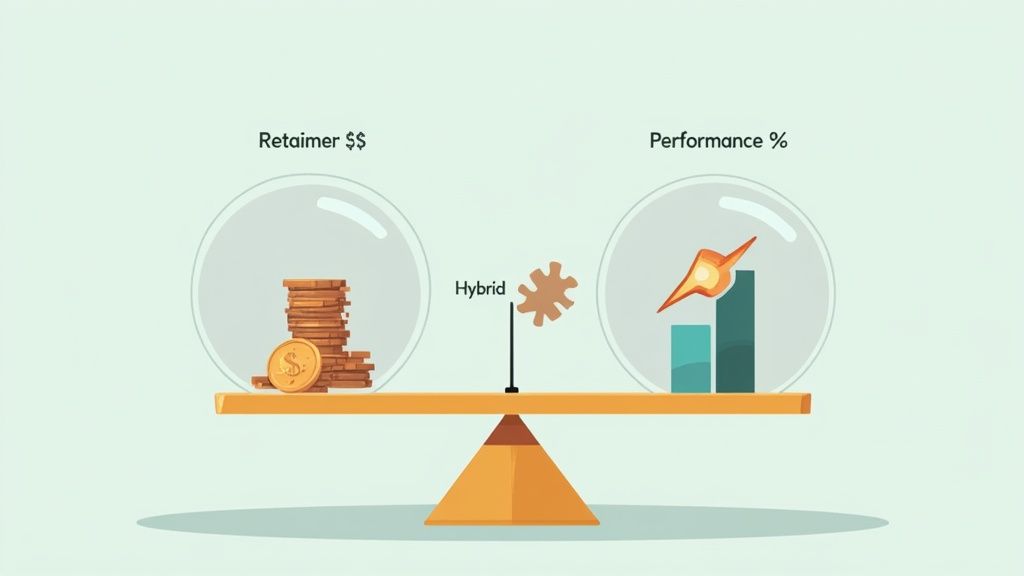
Most agencies you'll encounter will propose a monthly retainer. This is a fixed fee for managing your program, giving them a predictable income to dedicate resources to your brand. These retainers can range widely, from around $2,000 to over $10,000 per month, depending on the agency's reputation, size, and the scope of work your program requires.
Common Pricing Structures
Beyond a simple retainer, many agencies use performance-based or hybrid models to tie their success directly to yours, ensuring everyone is aligned on the same goals.
- Performance-Based Model: The agency takes a percentage of the revenue their affiliate program drives, typically between 10% and 30%. If they don't perform, they don't get paid as much. It’s a powerful incentive.
- Hybrid Model: This is the most common setup. It blends a lower monthly retainer with a smaller performance percentage. This gives the agency stability to cover overhead while still giving them a share of the upside when they exceed your sales targets.
So, which is right for you? It depends on your budget and risk tolerance. A pure performance model is attractive, but many of the best affiliate marketing agencies require a retainer to secure their time and expertise.
The right pricing model creates a true partnership. When an agency’s compensation is tied to your success, their goals become your goals, leading to more strategic and dedicated program management.
Is the Investment Worth It?
Seeing a multi-thousand-dollar monthly retainer can cause sticker shock, but it should be viewed as an investment, not just an expense. When executed properly, affiliate marketing delivers some of the best returns in digital marketing.
Consider this: studies consistently show that brands see an average return of $15 for every $1 spent on affiliate marketing. That makes it one of the most efficient channels for sales growth. A great agency won't just pay for itself—it will build a scalable, profitable sales channel that becomes a core part of your brand's long-term growth.
What are the Limitations of Traditional Agencies?
Hiring a traditional affiliate marketing agency can feel like a big step forward, and sometimes it is. They bring significant expertise. But their model isn't always the right fit, especially for modern e-commerce and Amazon brands trying to scale smartly. Before signing a long-term contract, it’s crucial to understand the potential drawbacks.
For many brands, the conversation starts and stops with the price. High monthly retainers, often paired with a percentage of sales, can be a non-starter for small and medium-sized businesses, effectively locking them out of expert management.
But even if you can afford the fees, the operational model of many traditional agencies can be a major roadblock.
The Black Box Problem
Ever feel like you’re flying blind? That’s what it can be like working with an agency that only sends reports once a week or, worse, once a month. This "black box" approach means you have little real-time insight into your own affiliate program. You won't know which creators are performing well today or how a new product launch is tracking until a report hits your inbox.
In a market that moves as fast as Amazon's, waiting a week for data is like trying to drive a race car by only looking in the rearview mirror. You can't make the quick, informed decisions needed to capitalize on opportunities.
Manual Processes and Lack of Transparency
This is where the cracks in the old agency model really start to show. Many still rely on a surprising amount of manual work—think spreadsheets for tracking, individual emails for onboarding, and clunky payment processing. When an agency is juggling dozens of clients, these manual tasks inevitably lead to slower responses and a cookie-cutter strategy that might not fit your brand.
This is exactly the problem that modern platforms like Coral were built to solve. They automate the tedious, time-consuming tasks that bog agencies down, putting the power of speed and efficiency directly in your hands. Instead of paying a premium for someone else's manual labor, you get direct access to a robust, automated system that offers complete transparency and control.
How Coral Provides Agency-Level Services Without the High Costs
While a traditional affiliate marketing agency brings expertise, its old-school model often struggles with the speed and data needs of a modern brand. The high costs, manual work, and lack of real-time data create serious roadblocks. This is where platforms like Coral provide a powerful alternative, delivering agency-level results through automation and comprehensive analytics—without the agency price tag.
Think of it like this: hiring an agency is like having a personal chauffeur. They'll get you where you need to go, but it’s expensive, and you’re on their schedule. A platform like Coral is like owning a high-performance car with a top-of-the-line GPS. You’re in control, you get instant data, and you have the power to go wherever you want, whenever you want, for a fraction of the cost.
Breaking Free from the Black Box with Superior Analytics
One of the biggest frustrations with the agency model is the "black box" effect—waiting for weekly or monthly reports to understand performance. That time lag makes it nearly impossible to react quickly to opportunities or address underperforming campaigns.
Modern platforms shatter that black box. With Coral, you get a real-time analytics dashboard providing a crystal-clear view of your program's performance. You can see exactly which affiliates are driving sales, which products are top performers, and what your ROI is at any moment. This direct access to comprehensive analytics lets you make smarter, data-driven decisions on the fly, a level of insight traditional reporting can't match.
The Power of Automation and Control
Many agencies are still bogged down by manual, time-consuming tasks like onboarding affiliates, tracking performance, and handling payments. This often involves a clunky mess of spreadsheets and hours of admin work—and you end up paying for that time.
Platforms solve this by automating the heavy lifting. Coral streamlines everything from affiliate sign-up to commission payout. This automation doesn't just save you money; it frees up your time, cuts down on operational headaches, and creates a smoother experience for your partners, helping you build a stronger affiliate network. For more on this, check out our guide on choosing the best affiliate program software.
A platform approach puts you in the driver’s seat. Instead of paying a premium for someone else's manual processes, you gain direct access to a sophisticated, automated system that gives you superior control and insight for a fraction of the cost.
Traditional Agency vs. Modern Platform
To make the difference perfectly clear, let's break it down side-by-side. The gap between the old agency model and a modern platform is stark when you look at the details.
| Feature | Traditional Agency | Coral Platform |
|---|---|---|
| Cost | High retainers, percentage of sales, hidden fees | Transparent, predictable monthly subscription (often lower) |
| Speed | Slow; manual onboarding, weekly/monthly reporting | Instant; real-time dashboards, automated workflows |
| Transparency | Limited; often a "black box" until reports are sent | Full; 24/7 access to all data and performance metrics |
| Control | Low; dependent on the agency's team and priorities | High; you're in the driver's seat of your own program |
| Scalability | Difficult; scaling often means higher fees & more staff | Easy; designed to grow with your brand without friction |
The choice becomes clear for an agile, data-driven brand. The global affiliate marketing space was valued at around $18.5 billion in 2024 and is on track to hit $31.7 billion by 2031. This explosive growth is being driven by technology that makes affiliate marketing more accessible and measurable than ever before. You can find more insights about this growing market on Hostinger.com. With seamless tools like Amazon Attribution, platforms give you precise, closed-loop tracking that proves the value of every single affiliate.
Key Metrics for Measuring Program Success
To really know if your affiliate program is pulling its weight, you have to look beyond surface-level numbers like clicks and impressions. Real success lives in the key performance indicators (KPIs) that connect directly to your bottom line. Tracking the right data shows you not just what's happening, but why.
Vanity metrics can fool you. Sure, a post with thousands of clicks looks great, but if none of them convert into sales, you're not actually growing your business. Focusing on the right KPIs empowers you and your affiliate marketing agency to make smart, data-backed decisions that drive real profit.
Core Metrics That Drive Growth
Here are the essential KPIs you absolutely need to track to get a true read on the health and performance of your affiliate partnerships.
- Conversion Rate (CR): This is simple but powerful: what percentage of clicks actually turn into a sale? A high CR tells you that an affiliate is sending high-quality, relevant traffic—people who are primed and ready to buy. A low CR, on the other hand, might signal a mismatch between the affiliate's audience and your products.
- Average Order Value (AOV): This metric reveals the average dollar amount customers spend each time they check out. A rising AOV is a fantastic sign, showing that your program is attracting customers who buy more, which is key to squeezing more revenue out of every single conversion.
- Return On Ad Spend (ROAS): This is the ultimate measure of profitability. ROAS calculates the gross revenue you earn for every dollar you spend on affiliate commissions and program costs. For example, a 10:1 ROAS means you’re bringing in $10 in revenue for every $1 you spend.
It's also smart to think about the bigger picture. Understanding the return on investment (ROI) from different marketing channels gives you a more complete view of your program's success. For instance, guides on measuring social media ROI can offer some great parallel insights for evaluating performance.
The Importance of Amazon Attribution
For anyone selling on Amazon, one tool is an absolute must-have for accurate measurement: Amazon Attribution. This program lets you create unique tracking links for each and every affiliate.
This is a game-changer because it connects their off-Amazon marketing—whether it's a blog post, a YouTube video, or an email newsletter—directly to a purchase on your Amazon listing.
Without Amazon Attribution, you’re flying blind. You have no way to prove which affiliates are actually driving sales, making it impossible to calculate a true ROAS or figure out which partnerships are worth investing more into.
This kind of precise tracking is everything. It gives you the hard data you need to identify your top-performing partners, justify your marketing spend, and scale your program with confidence.
To get a better handle on how these links work behind the scenes, check out our guide on affiliate link tracking. By using these tools, you can transform your affiliate program from a hopeful expense into a predictable, high-return revenue machine.
Choosing the Right Affiliate Solution for Your Business
So, you’re ready to dive into affiliate marketing. The big question now is how. Do you go with a traditional affiliate marketing agency, or does a modern software platform make more sense? It all boils down to your brand’s specific needs, your budget, and how much hands-on control you really want.
An agency can be a fantastic choice if you're looking for a true partner to handle the strategy and heavy lifting. This path works best if you have the budget for their monthly retainers and want an expert team in your corner. If you go this route, be ready to ask some tough questions. Dig into their experience in your specific niche, how they report progress, and which affiliate networks they prefer. You need to be sure their approach lines up with what you want to achieve.
On the other hand, if you crave real-time data, want to keep costs predictable, and prefer to keep your hands on the wheel, a platform solution is probably your best bet.
Making an Informed Decision
When looking at platforms like Coral, your focus should shift to features, user-friendliness, and how well it plays with your existing tools. Can it automate the tedious stuff like signing up new affiliates and handling payouts? Most importantly for Amazon sellers, does it offer a clean integration with Amazon Attribution so you can actually see what’s working?
You’ll also want to look for solid customer support and a straightforward pricing model with no surprises. If you're weighing your options, this guide to starting an affiliate program can offer some extra perspective.
The best solution isn't just about managing affiliates; it's about gaining clear, actionable insights into what drives sales. Whether agency or platform, your choice should eliminate guesswork and provide a direct line of sight to your ROI.
This decision tree gives you a great visual for the key performance indicators (KPIs) you should be obsessed with—things like Average Order Value (AOV), Return On Ad Spend (ROAS), and Conversion Rate (CR).
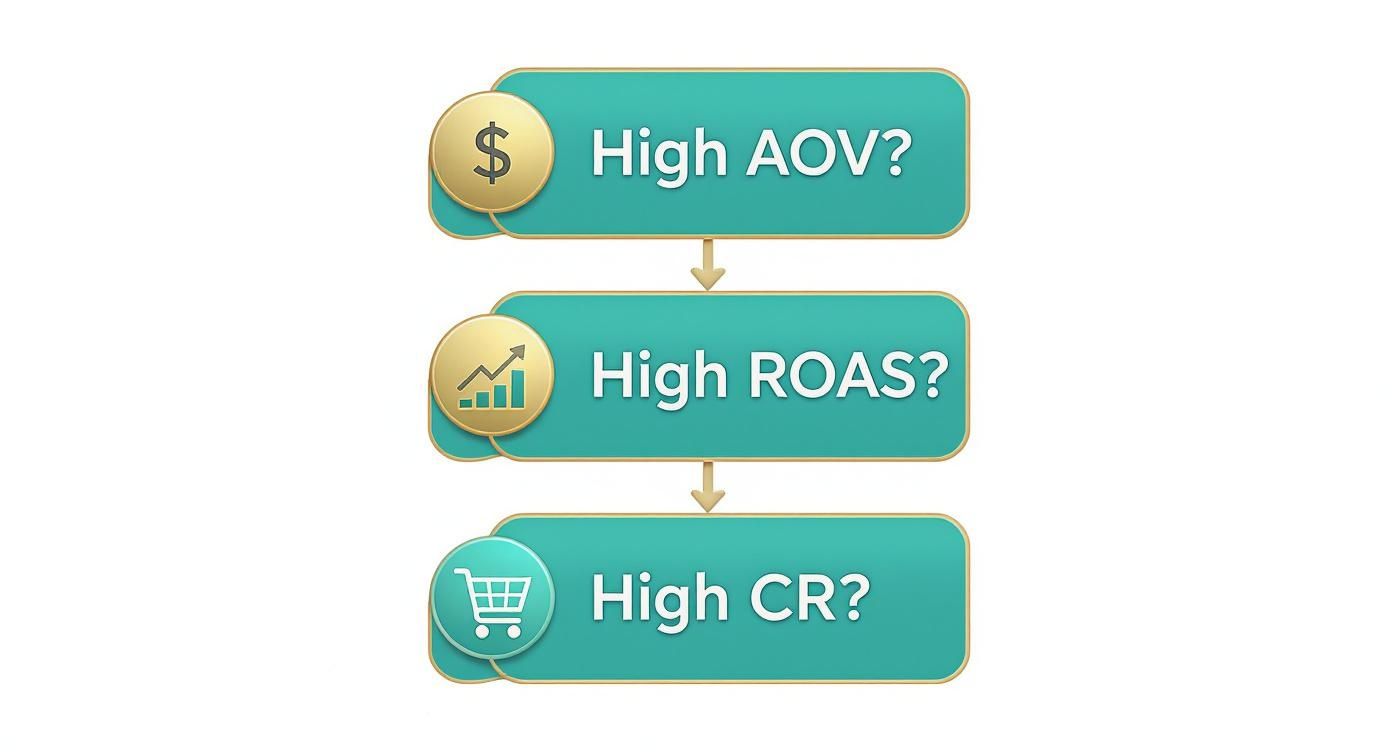
Ultimately, focusing on these core metrics is what lets you measure real profitability and tweak your program for sustainable growth. By taking the time to weigh these factors, you can pick the affiliate solution that not only fits your business today but will help you scale for years to come.
Frequently Asked Questions
Thinking about bringing on an affiliate marketing agency? You're not alone. Let's tackle some of the most common questions that come up for business owners diving into this world.
What’s the Difference Between an Agency and a Network?
This is a big one. Think of an affiliate network like a giant, sprawling marketplace. It’s a self-serve platform that connects you to thousands of potential partners, but the day-to-day management? That’s all on you.
An agency, on the other hand, is your dedicated management team. They handle everything from finding the right affiliates to crunching the numbers and optimizing your campaigns. A platform like Coral actually sits in a sweet spot, offering you the power to build your own network directly, but with the kind of sophisticated tools you'd expect from an agency.
How Long Until I Actually See Results?
This is where you need to play the long game. While you might get a few quick wins early on, a truly effective affiliate program takes time to warm up.
You should budget 3-6 months to see real, consistent momentum. That's the typical timeframe needed to recruit quality affiliates, build solid relationships, and fine-tune your campaigns until they become a reliable revenue stream.
Can I Even Run an Affiliate Program for My Amazon Store?
Absolutely! In fact, it's one of the best ways to drive external traffic to your listings. The key is using a tool like Amazon Attribution.
Attribution lets you generate unique tracking links for each affiliate. This way, you can see exactly which blog post, YouTube video, or social media campaign is driving sales on Amazon. It’s how you prove your ROI and figure out which partners are truly moving the needle.
No matter how you structure your program, getting the partnership terms right from the start is non-negotiable. Solid legal groundwork prevents headaches down the road and makes sure everyone is on the same page. To get a jump on this, check out this comprehensive affiliate agreement template and start your partnerships off on the right foot.
Ready to take the reins of your affiliate program with the clarity and control of a modern platform? Coral gives you the tools to automate, track, and scale your Amazon affiliate network, all without the hefty agency price tag. Get started for free today!