A Guide to Affiliate Program Software
Category: Affiliate program software
Think of affiliate program software as the mission control center for your entire partnership marketing strategy. Instead of getting bogged down in messy spreadsheets to keep track of sales, this software automates the whole process. It finds, tracks, and pays your affiliates for you.
Simply put, it’s the engine that lets you grow your brand's reach through partners without all the manual guesswork.
How Affiliate Program Software Works

At its heart, this software is the digital backbone for your affiliate relationships. It automates every step of the journey, from bringing a new partner on board to paying them for a successful sale. What could easily become a logistical nightmare turns into a smooth, efficient operation.
The biggest problem this software solves is attribution—figuring out exactly which partner sent you which customer.
Trying to manage this manually is a recipe for disaster. You'd be stuck with clunky spreadsheets and endless calculations, a process that’s not just slow but also full of potential mistakes. Those errors can quickly damage the trust you have with your partners, and trust is everything in this game.
The Core Functions of Affiliate Platforms
This software gives both you and your affiliates a central dashboard to log into. Everyone sees the same transparent, real-time data, which keeps things fair and clear. To really get it, it helps to understand the fundamental aspects of an affiliate program first.
The software takes care of a few critical jobs automatically:
- Unique Link Generation: It creates a special tracking link for every single affiliate. When a shopper clicks that link and buys something, the software instantly knows who gets the credit.
- Performance Tracking: It keeps an eye on clicks, conversions, and sales as they happen. Your partners can see which of their efforts are paying off, which keeps them engaged and motivated.
- Commission Calculation: Based on the rules you set—whether it's a percentage of the sale or a flat fee—the system calculates the exact commission owed for every purchase.
- Automated Payments: It handles paying your partners, making sure they get their money accurately and on time. This is absolutely key for building strong, lasting relationships.
In essence, affiliate program software replaces manual grunt work with reliable automation. It creates a single source of truth for all sales data, ensuring fairness and transparency for you and your partners. This rock-solid foundation of trust is what lets you scale your program with confidence.
Ultimately, this technology gives you the power to build your own army of brand advocates. It provides the essential framework to run a marketing channel based purely on performance, driving serious revenue without the massive upfront costs of traditional ads.
What Are The Core Features of an Affiliate Platform?
Think of good affiliate program software as the mission control for your partnership efforts. It's not just a single tool; it's a collection of essential features that work together to keep your program from turning into a chaotic, spreadsheet-fueled nightmare.
Getting a handle on these core functions is the first real step in picking the right platform for your brand. At its heart, the software needs to nail the basics: tracking, reporting, and payments. Get these right, and you build the trust needed to create strong, lasting relationships with your affiliates.
Reliable Affiliate Tracking
If there’s one non-negotiable feature, it’s tracking. This is the technology that assigns a unique ID to every single one of your partners. That ID gets embedded in their promotional links, so when a customer clicks through and buys something, the software knows exactly who to credit for the sale.
This isn't just some techy detail—it's the foundation of your entire program's integrity. If your tracking is off, commissions get messed up, trust evaporates, and your best partners will walk. For a closer look at the mechanics, our guide on commission tracking software solutions breaks it down even further.
A Centralized Dashboard
The best affiliate software gives you and your partners a shared space to see what’s happening in real-time. This centralized dashboard is like a team scoreboard, keeping everyone aligned and focused on the same goals.
As the brand manager, you get a high-level view of your entire program's health. For your affiliates, it’s their personal performance hub, giving them instant feedback on key metrics like:
- Link Clicks: How many people are actually clicking on their links?
- Conversion Rates: How many of those clicks are turning into sales?
- Total Commissions Earned: A transparent, up-to-the-minute tally of their earnings.
This kind of transparency is a huge motivator. When partners can clearly see what’s working, they’re far more likely to lean in and do more of it.
A great dashboard empowers your affiliates to act like true business partners. By giving them access to real-time data, you enable them to optimize their own campaigns, which directly fuels your brand’s growth.
Automated Commission Payouts
Let's be honest: nobody wants to spend hours manually calculating commissions and processing payments. It's tedious and a recipe for mistakes. That’s why automated commission management is a must-have feature. You set the rules—whether it’s a percentage of each sale or a flat fee—and the platform takes care of the calculations and payouts.
This automation guarantees your partners get paid correctly and on schedule, every single time. It's a simple sign of professionalism that shows you value their work, which goes a long way in building loyalty.
The demand for these automated systems is skyrocketing. The global affiliate marketing software market was valued at USD 2.1 billion in 2025 and is expected to hit nearly USD 9.8 billion by 2035, climbing at a 16.8% CAGR. You can dig into more details about this expanding market on futuremarketinsights.com.
To help you connect the dots between features and real-world results, here’s a quick breakdown of what these core functions actually do for your business.
Essential Affiliate Software Features and Their Business Impact
| Feature | What It Does | Why It's Critical for Your Business |
|---|---|---|
| Affiliate Tracking | Assigns unique IDs to partners to accurately attribute sales and commissions. | Builds trust with affiliates, ensures fair compensation, and provides clean data for decision-making. |
| Centralized Dashboard | Provides a real-time, unified view of key performance metrics for both you and your partners. | Empowers affiliates to self-optimize, boosts motivation, and saves you time on reporting. |
| Automated Payouts | Calculates commissions based on your rules and processes payments on a set schedule. | Eliminates manual errors, ensures partners are paid on time, and strengthens your brand's reputation. |
| Reporting & Analytics | Gathers and visualizes data on clicks, conversions, top performers, and overall program ROI. | Helps you identify what's working (and what's not) so you can make smarter strategic decisions. |
| Creative Management | A central library where you can upload and share approved marketing assets like banners and links. | Ensures brand consistency across all partner promotions and makes it easy for affiliates to start. |
Ultimately, these aren't just bells and whistles; they are the fundamental building blocks of a program that can scale and succeed over the long term.
Here’s a look at the real, tangible benefits you get when you switch to dedicated affiliate software.
Moving past spreadsheets isn't just about saving time; it's about unlocking serious business growth that manual methods simply can't deliver. Think of it like this: you can navigate a new city with a paper map, but a GPS gets you there faster, more accurately, and with a whole lot less stress. That's what dedicated software does for your affiliate program.
Picture a small but growing brand trying to juggle ten affiliates with a messy spreadsheet. Commissions get miscalculated, payments are late, and the best partners start losing interest because they have no idea how they're really doing. It’s a recipe for friction and stalled growth.
Now, imagine that same brand implements proper affiliate software. Suddenly, everything changes. The platform becomes the one and only source of truth, tracking every click and sale with perfect accuracy. This shift doesn't just free up hours of tedious admin work; it rebuilds trust. Partners can now log in and see their earnings update in real-time, which is a powerful motivator.
Achieve Higher ROI and Scalability
One of the biggest wins is a much higher return on investment (ROI). At its core, affiliate marketing is a pay-for-performance game—you only spend money when you make money. The right software sharpens this edge by giving you crystal-clear data on your top-performing partners and campaigns.
With that clarity, you can confidently double down on what’s working and cut what isn’t, making sure every dollar in your marketing budget pulls its weight. It also lets you scale up by recruiting hundreds of affiliates without having to hire a massive team to manage them all. For a deeper dive, check out our guide on creating an affiliate program for ecommerce.
The real magic of affiliate software is turning a high-effort, manual task into a scalable, automated revenue stream. It gives you the foundation to build an army of brand advocates who get paid based on the results they drive.
Enhance Data Accuracy and Fraud Prevention
Good data is the foundation of any smart marketing plan. Affiliate software gives you precise, real-time analytics on clicks, conversion rates, and revenue. These insights are gold, helping you make strategic decisions on the fly. You can see exactly which products are clicking with a specific affiliate's audience and tailor your promotions for even better results.
On top of that, modern platforms have fraud prevention baked right in. These systems automatically flag sketchy behavior, like tons of clicks from the same IP address or conversion rates that look too good to be true. This layer of security protects your budget from bogus claims and ensures you’re only paying for legitimate, valuable traffic.
It's no surprise that demand for these tools is exploding. The Affiliate Marketing Software Market was valued at USD 12.29 billion in 2024 and is on track to nearly double to USD 23.96 billion by 2032. This trend shows just how essential sophisticated software has become for managing performance marketing in a competitive e-commerce world. You can read the full market analysis on credenceresearch.com to learn more.
How to Choose the Right Affiliate Software
Picking the right affiliate program software is a lot like choosing a new business partner. This isn't just another tool; it's the central hub for your entire partner marketing strategy. The platform you land on will shape everything from your budget to your team's daily grind, so you want to get it right.
To make things simpler, I always tell people to focus on three core pillars: pricing, integrations, and support. Nail these three, and you'll have a platform that not only works for you today but can also scale as your brand grows. As you weigh your options, it’s always a good idea to research the best affiliate marketing platforms to see what the industry leaders are using and what features have become standard.
Understanding Pricing Models
First things first, let's talk about money. How you pay for the software is a huge deal, and it's your first major checkpoint. Generally, you’ll run into a few different pricing structures, and each has its pros and cons depending on where your business is at.
To give you a clearer picture, here’s a breakdown of the most common models.
Comparing Software Pricing Models
A comparison of common pricing structures for affiliate software to help businesses choose the best fit for their budget and scale.
| Pricing Model | Best For | Potential Downsides |
|---|---|---|
| Subscription (SaaS) | Established brands with predictable revenue. You pay a fixed monthly or annual fee. | Can be a bigger upfront cost, especially for new programs. |
| Network Fee / Revenue Share | New programs or those with smaller budgets. You pay a percentage of affiliate-driven sales. | Costs scale with revenue, so it can get expensive as you grow. |
| Hybrid (Base + %) | Brands who want a mix of predictability and performance-based cost. | Can be more complex to forecast total costs. |
It's tempting to go with the lowest upfront cost, but you have to think long-term. A revenue-share model might seem cheap to start, but those percentage fees can really add up once your affiliates start driving serious sales volume.
Ensuring Seamless Integration
Your affiliate software can't live on an island. It has to play nicely with all the other tools you're already using, especially your e-commerce platform. Clunky integrations are a recipe for disaster—think tracking errors, hours of manual data entry, and some very unhappy affiliates.
Look for platforms that offer native, one-click integrations with your store, whether it’s Shopify, WooCommerce, or BigCommerce. If a direct plugin isn't available, make sure there's a solid, well-documented API your developer can work with. The easier the setup, the faster you can get your program off the ground.
A platform's ability to integrate effortlessly is a direct reflection of its reliability. If the software can't talk to your store without causing headaches, it will create bigger problems down the line with tracking accuracy and data management.
This decision tree visualizes how to navigate these key choices, from pricing to integration and support levels.
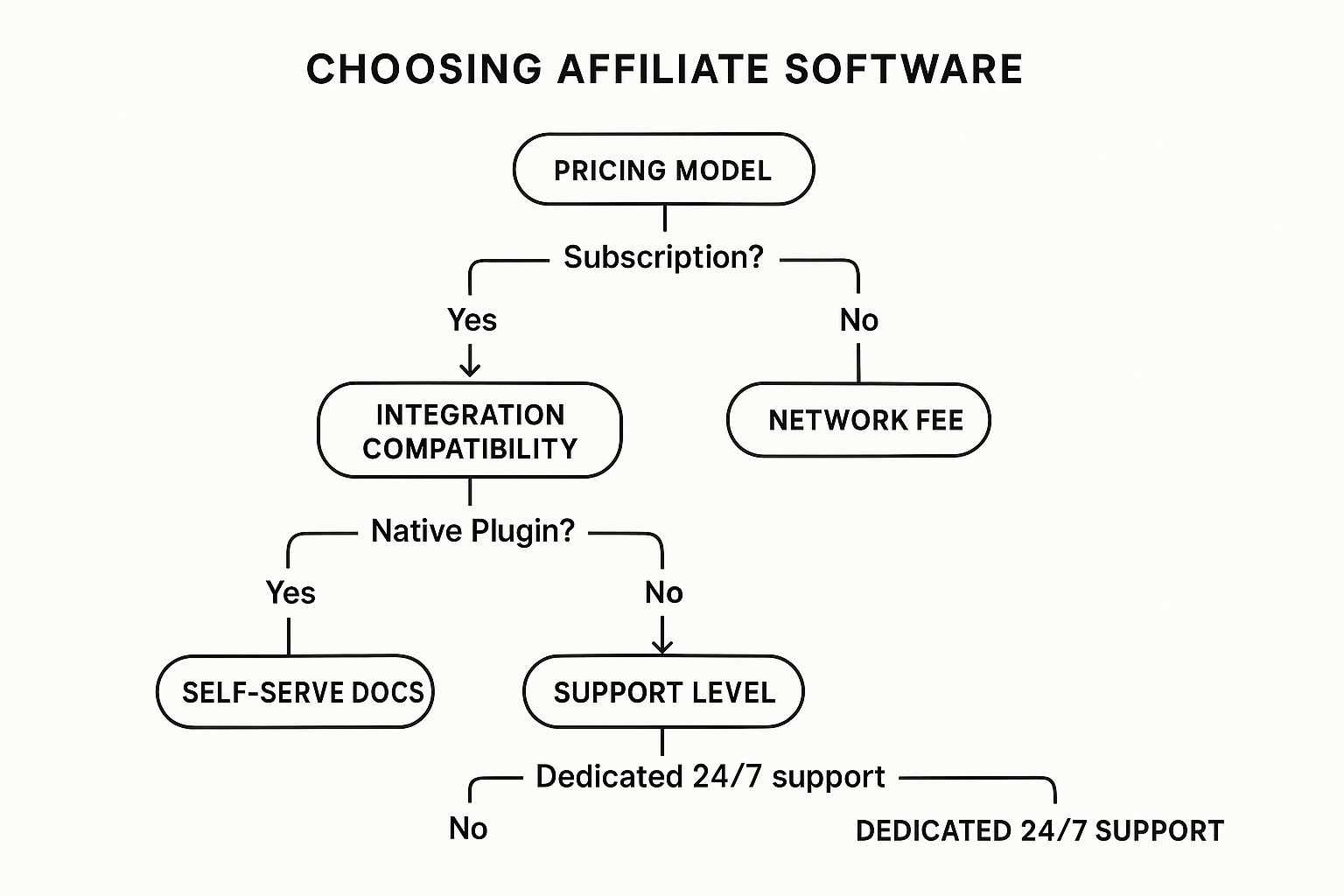
As you can see, your budget, tech resources, and how much hand-holding you need are the main things that will point you toward the right solution.
Evaluating Support and User Experience
Last but certainly not least, never underestimate good old-fashioned customer support and a clean user interface. When a tracking pixel breaks or you have a question about a payout, you need help fast.
Before committing, check out what kind of support they offer. Is it just email, or do they have live chat? Dig into reviews and see what real users say about how quickly the support team responds.
And don't forget about your affiliates! If their dashboard is a confusing mess and they can't figure out how to create a simple link, they're not going to stick around. A clean, intuitive experience for both you and your partners is a non-negotiable feature of good affiliate management software. The goal is to make it easy for them to succeed, not to frustrate them with bad tech.
Setting Up Your Affiliate Program for Success

Getting the right affiliate program software is a great start, but it won't run itself. Think of your software as a high-performance engine; you still need a smart strategy to get it across the finish line. This is where you lay the foundation for a program that attracts top-tier partners and drives real revenue.
Remember, your affiliates are genuine partners, not just another marketing channel. The most successful programs are built on strong relationships. When you treat your affiliates with transparency and support, you create a partnership that benefits everyone involved.
Define a Compelling Commission Structure
The first thing any potential partner will look at is your commission structure. It’s the core incentive, so it has to be competitive enough to attract great talent but still make sense for your bottom line. Get this wrong, and you'll either struggle to find affiliates or end up with unsustainable costs.
Here are a few popular models to consider:
- Percentage of Sale: Simple and effective. Affiliates earn a set percentage of every sale they bring in. This is the most common approach because it directly ties their reward to the revenue they generate.
- Flat Fee Per Sale: This works well if you sell products with a fixed price. Partners get a specific dollar amount for each conversion, which makes their potential earnings very predictable.
- Tiered Commissions: A fantastic way to motivate your best partners. You reward top performers with higher commission rates when they hit certain sales targets, giving them a clear reason to push even harder.
There’s no single "best" model. It all comes down to your product margins and what you want to achieve. You can always start with a straightforward structure and tweak it once you have some performance data.
Your commission plan sends a clear message about how much you value your partners. A fair and motivating structure is the foundation of a program that people are excited to join and promote.
Recruit the Right Affiliates
Don't just open the floodgates and accept anyone who applies. That’s a fast track to low-quality traffic and disappointing sales. The key is to find partners whose audience is a natural fit for your brand.
Focus your energy on targeted recruitment. Look for influencers, bloggers, and content creators who are already trusted voices in your niche. We cover this in more detail in our guide on how to recruit affiliates. The goal isn't just to get clicks; it's to find genuine advocates who truly believe in what you sell.
Equip Your Partners with High-Quality Assets
You want to make it incredibly easy for your affiliates to start promoting your products. This is where your software’s asset library comes in. It should be a one-stop shop for all the pre-approved marketing materials they'll ever need.
Your creative library should be stocked with:
- High-Resolution Banners: Make sure you have a variety of sizes ready for blogs, websites, and social media posts.
- Email Templates: Give them some plug-and-play copy they can quickly adapt for their email lists.
- Brand Guidelines: A simple guide helps ensure everyone represents your brand professionally and consistently.
Providing these tools right from the start removes friction and empowers your partners to hit the ground running. A well-equipped program is essential, especially when you consider that the affiliate marketing industry is projected to grow from USD 18.5 billion in 2025 to a massive USD 31.7 billion by 2031. You can find more insights in these affiliate marketing statistics on hostinger.com and see why a solid setup is crucial for getting your piece of the pie.
Frequently Asked Questions
Jumping into the world of affiliate program software always brings up a few questions. If you're trying to figure out the best path for your brand, you're not alone. Let's clear up some of the most common points of confusion with simple, direct answers.
Can I Run an Affiliate Program Without Software?
Technically, yes—if you only have a couple of partners and love spreadsheets. But I wouldn't recommend it. Trying to manage commissions and track sales manually is a recipe for disaster.
It’s just too easy for human error to creep in, leading to missed payments or incorrect payouts. That’s the quickest way to break the trust you have with your affiliates, and trust is everything in these partnerships.
Good software handles all the tracking, reporting, and payments for you. It builds a professional, reliable foundation that lets you scale your program instead of getting stuck in administrative quicksand.
What Is the Difference Between an Affiliate Network and Software?
This is a big one, and the difference is key. Think of it like this: an affiliate network is like setting up a booth in a giant, crowded flea market, while affiliate software is like building your own custom boutique shop.
- Affiliate Network: You get access to a huge, pre-existing crowd of affiliates. The network provides the tech, but they also take a hefty slice of your sales, and you have very little direct control over your brand's presentation or the relationships you build.
- Affiliate Software: This is your own private platform. You're in charge of recruiting your own affiliates, but in return, you get total control, build direct relationships, and usually end up with much lower long-term costs.
With your own software, you can design a program that truly reflects your brand and goals, rather than fitting into someone else's mold.
How Much Does Affiliate Program Software Cost?
The price tag can really vary, so it's all about finding a solution that fits where you are now and where you want to go. The costs usually fall into a few buckets.
For small businesses just getting their feet wet, many entry-level platforms start around $50-$100 per month. As your brand grows and you need more powerful features, you'll see mid-tier options in the $150 to $500 monthly range. For major brands needing all the bells and whistles, enterprise platforms can easily run into the thousands.
Don't just look at the monthly fee. The real question is, what's the value? The right platform will pay for itself many times over by helping you grow. When you're budgeting, it’s also a good idea to explore different commission structure examples to get a full picture of your potential costs.
What Level of Support Should I Expect?
Great support isn't just a nice-to-have; it's a must. The last thing you want is to be stuck with a technical problem and no one to turn to. Your software provider should feel more like a partner than just another vendor.
At the very least, look for a comprehensive knowledge base and responsive email or chat support. Good onboarding help is also critical. The best platforms often include dedicated account managers for their higher-tier plans. My advice? Always read recent customer reviews about their support experience before you sign anything. It can make all the difference.
Ready to build and scale your own high-performing affiliate program on Amazon? Coral gives you the tools to recruit, track, and pay your partners seamlessly. Start your free plan today and turn your biggest fans into your best marketers!