A Better Way Than PPC: The Affiliate Program for Ecommerce Brands on Amazon
Category: Affiliate program for ecommerce
For too long, Amazon brands have been stuck in a costly cycle: to make sales, you have to pour money into Pay-Per-Click (PPC) ads. An affiliate program is a straightforward alternative where you partner with creators to promote your products and pay them a commission for sales. But what if this wasn't just an alternative, but a fundamentally smarter, more aggressive strategy to dominate your niche?
This is a direct challenge to the PPC-first mentality. It's time to talk about the controversial truth: your PPC spend is likely funding a broken system, and you could be reinvesting it into a high-commission affiliate program for ecommerce that yields far greater returns at the exact same cost.
The Hidden Costs of Amazon PPC Dependency
If you sell on Amazon, you know the drill with pay-per-click (PPC) advertising. It often feels less like a strategic choice and more like a mandatory toll just to get your products noticed. Brands get caught in a cycle of pumping huge chunks of their budget into ads, fighting for visibility in a marketplace that's getting more crowded by the day.
The go-to metric everyone talks about is Advertising Cost of Sales, or ACoS. Many brands on Amazon who spend money on PPC optimize for a certain ACoS, and a common value to aim for is a 30% ACoS. But let's be blunt: that means for every $100 in sales generated through advertising, you’re handing $30 right back to Amazon to generate those sales. That's a huge slice of your profit, gone on every single ad-driven sale. We get into the nitty-gritty of this in our complete guide to Amazon PPC marketing strategies.
Beyond the ACoS Number
The real price of relying on PPC goes way beyond that 30% figure. It’s a constant drain on your most precious resources: your time and your sanity. You're essentially just renting visibility. The second you turn off the ad spend, your traffic can dry up overnight. This forces you into a reactive mode, always chasing short-term sales instead of building a lasting brand.
The fundamental problem with a PPC-only strategy is that you're paying for clicks, not for advocacy. You acquire a customer, but you don't build a relationship or create any lasting marketing assets.
This is exactly why so many brands are searching for a more sustainable way to grow. Affiliate marketing has become a go-to alternative, with spending in the US alone expected to hit nearly $12 billion. This boom is almost entirely fueled by B2C brands who see the power in authentic partnerships over paid clicks. For a closer look at the data, check out these affiliate marketing statistics and findings. So, what if you could take that same 30% you’re spending on ads and invest it in something that grows in value? The answer might surprise you.
Challenging the PPC Status Quo
For too long, Amazon brands have been stuck in a costly cycle: to make sales, you have to pour money into Pay-Per-Click (PPC) ads. The accepted wisdom says to aim for a 30% Advertising Cost of Sales (ACoS), which has become the standard price of admission for visibility. But what if that thinking is outdated? What if you could hit that same cost target, but instead of buying temporary clicks, you invested in lasting partnerships and genuine content?
This is exactly where a high-commission affiliate program for ecommerce flips the script. It’s a bold move that directly challenges the PPC-first mentality by shifting your marketing budget away from fleeting ads and toward valuable creator relationships. This isn't just an alternative; it's a fundamentally smarter way to grow on Amazon.
An affiliate program builds a powerful network of advocates who all have a stake in your success, driving sustainable growth that ads alone just can't match.
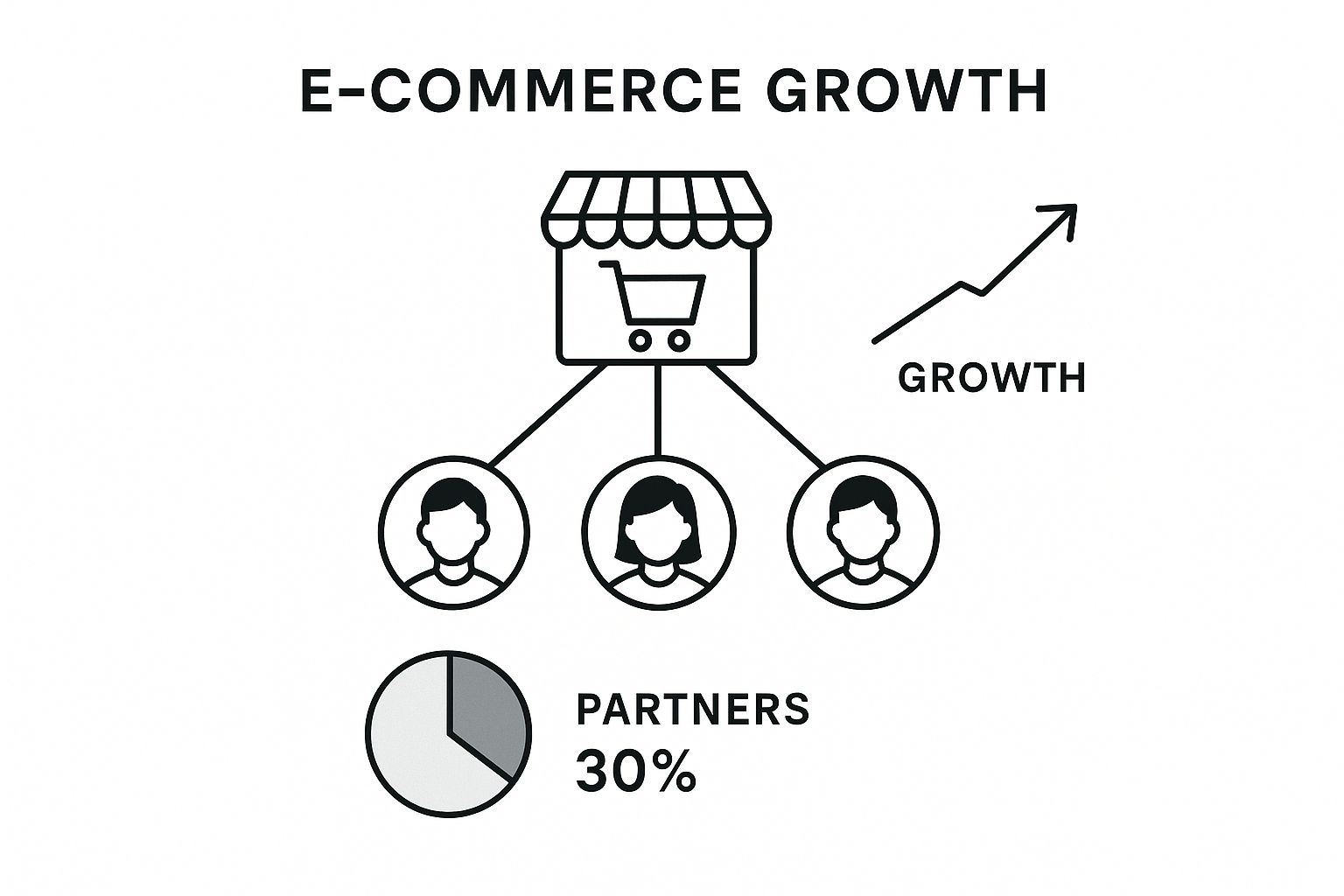
This web of partners becomes a core asset, actively contributing to your brand's upward trajectory in a way that paid ads never could.
The 40 Percent Commission Gambit
Now, picture this: using a program like Coral that leverages Amazon Attribution and the brand referral bonus, you offer an influencer an unheard-of 40% commission on every sale they drive. On the surface, that sounds insanely high, especially when you’re used to the 30% ACoS benchmark for PPC. But this is where the strategy gets really clever, thanks to a powerful—and often overlooked—Amazon tool.
The secret ingredient is Amazon's Brand Referral Bonus. This program gives brands a bonus, averaging 10% of the sale price, for bringing external traffic to their Amazon listings. So when an influencer in your program makes a sale, you pay them their 40% commission, and almost immediately, Amazon credits you back 10% of that very same sale.
Let's do the math:
- Each sale the influencer makes, you give them 40% of that sale.
- But you also get 10% of the sale price from Amazon as a brand referral fee.
- So the actual amount that you give to the influencer for generating the content that generates the sale is only 30% of the sale from you.
Suddenly, that "insanely high" 40% commission lands you at the exact same 30% ACoS that you have on Amazon PPC. You've matched your customer acquisition cost, but what you get for that money is worlds apart.
Amazon PPC vs High-Commission Affiliate A Head-to-Head Cost Analysis
| Metric | Standard Amazon PPC | High-Commission Affiliate Program |
|---|---|---|
| Direct Cost | 30% ACoS on average, paid directly to Amazon for clicks. | 40% commission paid to the affiliate. |
| Amazon Rebate | None. The money spent on ads is gone. | 10% Brand Referral Bonus credited back to you. |
| Effective Net Cost | 30% of the sale price. | 30% of the sale price (40% commission - 10% bonus). |
| What You're Buying | Temporary ad placement and clicks. The visibility stops the moment you stop paying. | A lasting partnership, authentic content, and a sale from a trusted recommendation. |
| Marketing Asset | No lasting asset is created. | You gain evergreen content (videos, posts) that can drive sales long after it's published. |
As you can see, the final cost is identical. The real difference lies in what you’re actually paying for: temporary clicks versus permanent assets and authentic partnerships.
A New Value Proposition for Influencers
This financial model isn't just a win for your brand; it's how you attract top-tier talent. The standard Amazon Associates program, which most influencers are stuck with, offers a tiny commission averaging just 4%. It’s a system that forces creators to promote dozens of products just to make a decent income, breeding little loyalty to any single brand.
Now, imagine your pitch. You can approach a high-quality creator and offer them ten times their typical earnings for promoting the exact same products on the same platform. This isn't just a slightly better deal; it's a complete game-changer that immediately makes your brand their most valuable partner.
This strategy lets you bypass the low-payout, high-volume chaos of the standard Associates program. Instead of being just another brand an influencer links to, you become their priority. We'll get more into this competitive edge later, but the math is simple: you can offer creators unparalleled income at the same cost you’re already paying for ads. This is the heart of a truly superior affiliate program for ecommerce.
The Influencer Earning Gap You Can Exploit
Now that we’ve covered how to match your PPC costs, let’s talk about your secret weapon: a massive—and frankly, unfair—gap in how most influencers get paid. This isn't just a small detail. It's the key to pulling in top-tier talent and building an army of creators who will go to bat for your brand over anyone else.
Why? Because very few influencers get offered a 40% affiliate fee. Almost everybody else is doing the same thing, funneled into the standard affiliate setup for ecommerce brands on Amazon, which is fundamentally broken for creators.
Most influencers pushing products on Amazon get funneled into the Amazon Associates program. It’s the biggest game in town, but the payouts are notoriously low. On average, they get an affiliate fee from Amazon that is just 4%. Think about that. To earn a decent living, they have to constantly churn out content for a huge volume of products, with very little loyalty to any one brand. If you want a deeper look at the flaws, we break it down in our guide to the Amazon Associates program.
The 10x Earning Proposition
This is where you swoop in with an offer they can’t ignore. Imagine the difference when they can make 40% promoting the same exact products. For many creators, this isn't just a better deal; it's a life-changing one. You’re offering them 10 times what they’d typically earn, by using a software like Coral that leverages Amazon Attribution and allows the brand to offer commissions so high at the same cost that they have for Amazon PPC.
Imagine the power of that pitch. An influencer can earn $4 promoting a competitor's product through Amazon Associates, or they can earn $40 promoting your product through your direct affiliate program. It’s the same amount of work for them. The choice is a no-brainer.
That huge difference in earning potential instantly makes your brand the most attractive partner in the room. You’re no longer just another product in a creator's lineup—you become their main focus. This is how you build real, high-value relationships with the best influencers and pull them away from the low-payout churn and into your corner.
This isn’t happening in a vacuum. The global affiliate marketing industry is already worth around $18.5 billion and is expected to hit $31.7 billion by 2031. Amazon Associates owns a whopping 46.21% of that market, but it's all built on a foundation of tiny commissions. You can see more on these trends in the latest affiliate marketing statistics.
Why This Gap Is Your Strategic Weapon
The jump from a 4% to a 40% commission is more than just a number—it’s a strategic weapon. By offering a rate this compelling, you get a few immediate advantages that PPC could never give you:
- Attract the Best Talent: Top-tier influencers—the ones with genuinely engaged audiences who trust them—know their worth. A 40% commission shows you’re a serious partner ready to invest in quality.
- Build Real Loyalty: When you become an influencer's main source of income, their loyalty naturally follows. They'll feature your products more prominently and become true advocates for your brand.
- Gain Negotiating Power: This high commission gives you leverage. You can be more selective about who you work with and expect a higher standard of content in return.
- Inspire Better Content: A real financial stake is a powerful motivator. Creators are driven to produce their best, most authentic work because their success is directly tied to yours.
You aren't just offering them more money; you're offering them a real partnership. You’re giving creators the chance to build a sustainable business around your brand, which is a world away from the gig-work feel of the standard Associates program. This is how you stop being just another seller in Amazon's world and start building your own marketing powerhouse.
Why a 40 Percent Commission Is Your Ultimate Advantage
A 40% commission might sound steep, maybe even a little reckless at first glance. But when you're playing in the Amazon ecommerce arena, that number isn't just an expense—it's one of the sharpest strategic tools in your kit. It shifts your marketing spend away from temporary ad clicks and reinvests it into something far more permanent: authentic content from trusted voices that keeps selling long after the initial push.
This is where a smart affiliate program for ecommerce truly shines, leaving traditional PPC in the dust.
A PPC ad vanishes the second your budget runs out. In contrast, the content your affiliates create sticks around. An influencer's YouTube review, a detailed blog post, or an Instagram story becomes a lasting marketing asset for your brand. This user-generated content (UGC) doesn't just drive a single sale; it builds the kind of social proof and brand equity a PPC campaign could only dream of.
From Transactional Clicks to Lasting Brand Equity
Let's break down the fundamental difference here. PPC is purely transactional. You pay for a click and cross your fingers, hoping it converts. An affiliate program, particularly one with a compelling commission, is all about relationships. You’re investing in a partner who has a real, tangible stake in seeing your brand succeed.
A PPC campaign essentially rents attention. A high-commission affiliate program builds a loyal army of marketers who create lasting assets for your brand. You're not just buying sales; you're investing in a self-sustaining engine for growth.
And this model is becoming more important by the day. The affiliate marketing industry is booming, with projections showing it will climb toward $37.3 billion, a surge driven largely by ecommerce. It’s no wonder, given that businesses are reporting an average return on investment (ROI) as high as 15:1, proving just how efficient this approach is. You can dig into more of these affiliate marketing industry trends to see the full picture.
The Math That Makes It All Work
The strategic side makes perfect sense, but let's get back to the numbers. A 40% commission is what gets you in the door with top-tier influencers, but it doesn't have to blow up your budget. For Amazon brands, the math is actually quite elegant.
- You start by offering a very attractive 40% commission to an influencer.
- For every sale they drive, Amazon's Brand Referral Bonus program credits you back 10% of the sale price.
- This means your actual out-of-pocket cost is only 30%—which is likely the same ACoS you were already aiming for with PPC.
This is the key detail that makes the whole strategy work. You get to offer a commission rate that is 10 times higher than the standard Amazon Associates program, all while keeping your effective cost right in line with your existing ad spend.
Building an Unbeatable Competitive Edge
This high commission isn't just about matching costs. It’s about crafting an offer so compelling that the best creators in your niche will put your brand at the top of their list. In return, you get their best work, their most engaged audiences, and their long-term loyalty.
While your competitors are stuck in the cycle of paying for fleeting ad impressions, you'll be building a library of authentic reviews, tutorials, and testimonials that continuously draw in new customers. This is how you transition from being just another seller dependent on Amazon's ad ecosystem to becoming a true brand builder with a powerful, scalable marketing machine.
Suddenly, that 40% commission doesn't look like an expense. It looks like your ultimate advantage.
Building Your High-Commission Affiliate Program
Moving from idea to action is where most brands stumble. But here’s the good news: setting up a powerful affiliate program isn’t the technical headache it used to be. With the right tools, you can shift away from a total reliance on PPC and build a scalable partnership engine in just a few simple steps.
This whole strategy really comes down to using two key Amazon features together: the Brand Referral Bonus and Amazon Attribution. While PPC keeps you inside Amazon's world, this approach builds a bridge from outside content directly to your product pages, making sure you get credit for every customer you bring to the platform.
A platform like Coral makes this incredibly straightforward. It handles the heavy lifting by connecting your Amazon account, tracking sales from your partners, and making sure they get paid on time, all from one place.
The ACoS Showdown: Amazon PPC vs. Affiliate Programs
When it comes to marketing on Amazon, everything seems to circle back to one metric: Advertising Cost of Sales (ACoS). Most sellers feel pretty good if they can keep their PPC campaigns around a 30% ACoS. That means for every $100 in sales from ads, they're spending $30. It’s just the cost of playing the game.
But what if you could offer influencers a jaw-dropping 40% commission and still end up with the same 30% effective ACoS? It sounds like a trick, but the math is surprisingly simple—and it’s a game-changer for Amazon brands.
Here’s the breakdown:
- The High Commission: You start by offering an influencer an irresistible 40% commission on every sale they drive. That kind of number gets attention immediately.
- The Amazon Bonus: Because the influencer uses a special Amazon Attribution link, Amazon gives you a 10% bonus back on the sale price through its Brand Referral Bonus program.
- The Final Cost: Your actual cost is just 30%. You pay the influencer 40%, but you get 10% back from Amazon.
Suddenly, you’re matching your PPC spend, but you're funding a completely different kind of marketing—one that builds relationships and lasting content.
The real provocation here is that countless brands are spending 30% of their revenue on temporary ad clicks, when they could be investing that same 30% into building lasting partnerships and a library of authentic, evergreen content.
The Influencer Earning Disparity: Your Unfair Advantage
This model gets even more powerful when you look at it from the influencer’s perspective. Most creators who promote Amazon products are stuck in the standard Amazon Associates program, where commissions average a measly 4%.
Now, imagine their reaction when you show up offering 40% to promote the same kind of product. The difference is night and day. They earn ten times more with you for every single sale. This isn't just a small leg up; it's a recruitment superpower. While other brands are lost in the sea of low-paying offers, you instantly become an influencer’s most valuable partner. Our deeper analysis of affiliate marketing for Amazon shows just how much of an edge this gives you.
This incredible earning potential means you can be picky. You get to attract top-tier creators who make amazing content and have real, engaged followers. You’re not just throwing money at them; you’re offering a real partnership that values their work—all for the same effective cost you were already paying for ads. This is how you stop renting traffic and start building a genuine brand asset.
Moving From Ad Spend to Strategic Partnerships

For a long time, the playbook for Amazon brands has been simple: spend big on pay-per-click ads. The industry has practically normalized a 30% Advertising Cost of Sales (ACoS) as the price of doing business. Think about that. Brands are conditioned to accept that nearly a third of their revenue from ads goes right back to Amazon for temporary visibility. It’s a hamster wheel of renting clicks that disappear the second you turn off the spend.
But what if you could break that cycle? Let's consider a provocative alternative. Imagine offering influencers a massive 40% commission to promote your products. It might sound crazy at first, but when you look at the numbers, especially with Amazon Attribution and the Brand Referral Bonus, it’s a brilliant move.
The Real Cost Showdown
Here’s how it works. An influencer drives a sale using one of your tracked links, and you pay them their 40% commission. But then, Amazon steps in and credits you back an average of 10% of the sale price through its Brand Referral Bonus program.
Suddenly, your actual out-of-pocket cost for that sale is just 30%. That’s the exact same effective ACoS you were already comfortable with on your PPC campaigns. The cost is identical, but the return is night and day. One path gets you a single, fleeting click. The other gets you a genuine partnership and authentic, evergreen content from a creator their audience trusts.
The core choice for Amazon brands is stark: continue spending 30% of your revenue to rent temporary ad space, or reinvest that same 30% into building a network of loyal advocates who generate sales assets that grow in value over time.
An Offer Influencers Can't Refuse
This strategy gets even better when you look at it from the influencer's perspective. Most creators promoting products on Amazon are stuck with the standard Amazon Associates program, where commissions average a measly 4%. It's rare for them to see anything better.
Then your brand comes along, offering ten times that amount to promote the exact same products. This isn't just a slightly better deal—it's an offer that can genuinely change their business, making you their most valuable partner overnight. You're not just buying a sale; you're earning loyalty, creativity, and a powerful voice on your team.
Of course, managing these high-value relationships is crucial. Our guide on how to manage affiliates walks you through building a program that lasts. This is how you stop buying clicks and start building a powerful, self-sustaining marketing engine.
Got Questions? We've Got Answers
Diving into a high-commission affiliate program, especially one built around Amazon, naturally brings up a few questions. Let's walk through some of the most common things brands wonder about before making this powerful shift in their marketing.
Who Can Use the Amazon Brand Referral Bonus?
The Amazon Brand Referral Bonus is exclusively for sellers enrolled in Amazon's Brand Registry. This means you'll need a registered and active trademark for your brand to qualify.
Once you're in, the program lets you earn a bonus back—averaging 10%—on sales you generate from your own off-Amazon marketing. This bonus is the key that makes a high-commission affiliate strategy so financially smart.
How Do I Actually Track Sales from Different Influencers?
This used to be a huge headache, but modern tools make it simple by plugging directly into Amazon Attribution.
When an influencer signs on, they get a unique, trackable Amazon Attribution link. Every click and purchase that happens through their link is automatically credited to them. It provides clear, reliable data, so you can pay out commissions with complete confidence.
The Bottom Line: Guesswork is a thing of the past. By using Amazon Attribution, you get precise data, ensuring every partner is paid fairly for the sales they drive.
Won't a High Commission Just Attract a Bunch of Low-Quality Affiliates?
It's actually the opposite. A high commission gives you the power to be more selective, not less. Think about it: top-tier creators are business owners. An offer that’s potentially 10x the norm gets their attention.
You’re not obligated to accept everyone who applies. You have total control to vet and approve only those influencers who truly match your brand's quality and values. It’s about attracting professionals who can deliver real results.
Can I Run This Kind of Affiliate Program and Still Use PPC?
Absolutely. Not only can you run them at the same time, but they work incredibly well together.
You can keep using PPC for broad, top-of-funnel keyword targeting right on Amazon. Meanwhile, your affiliate program will be driving warm, high-intent traffic from trusted external sources. Many brands test the waters by shifting a small slice of their PPC budget to a pilot affiliate program. As they see the returns, they scale up from there. It's a great way to diversify your efforts and connect with shoppers at every stage.
Ready to stop renting clicks and start building lasting partnerships? Coral gives you the tools to launch a high-commission affiliate program for your ecommerce brand on Amazon, turning your marketing spend into a powerful growth engine. Launch your affiliate program today with Coral.