Affiliate Marketing for YouTube: The Complete Guide to Success
Category: Affiliate marketing for youtube
If you're a YouTube creator, you've probably heard about affiliate marketing. At its core, it’s a simple concept: you talk about products you like, drop a special link in your video description, and earn a commission when someone buys through that link.
But it’s more than just a way to make a few extra bucks. Done right, it can transform your channel from a passion project into a serious, sustainable business.
Why YouTube Affiliate Marketing Is a Game Changer
Let's be real—the ultimate goal for most creators is to make a living doing what they love. This is where affiliate marketing for YouTube really comes into its own. It’s the perfect blend of authentic content and commerce, letting you monetize the trust you've built with your audience.
Imagine a tech reviewer unboxing the latest gadget or a fitness vlogger demonstrating their favorite resistance bands. These aren't just sterile product placements; they're real-world use cases. You're showing your audience how a product works and why it's valuable, helping them make smarter buying decisions.
The Power of Authentic Recommendations
When you recommend something you genuinely use and believe in, it stops feeling like a sales pitch. It feels like a friend sharing a great find. That authenticity is the secret sauce to making affiliate marketing work on YouTube. People subscribed to you for your take on things, so your endorsement carries real weight.
This trust-based approach pays off in a few huge ways:
- Better Conversion Rates: A recommendation from you is far more powerful than a random pop-up ad. Your viewers are already warmed up and trust your judgment, making them much more likely to click and buy.
- Stronger Community: When you're honest and only promote products you stand behind, it reinforces your relationship with your audience. They know you have their best interests at heart.
- Long-Term Income: A single brand deal is great, but affiliate links in your evergreen videos can keep earning you money for months, or even years, on autopilot.
Unmatched Scale and Opportunity
The sheer size of YouTube is staggering. You have a potential audience of 2.53 billion unique users at your fingertips. Whether your niche is incredibly specific or super broad, your people are on the platform.
This massive user base, paired with YouTube's powerful discovery algorithm, gives you a runway to scale your affiliate income in a way that just isn't possible elsewhere.
The real magic happens when your content solves a problem. If your video on "How to fix a leaky faucet" recommends the exact wrench you're using, that affiliate link isn't an ad—it's a solution.
This isn't just theory; it's a practical blueprint for building a real creator business. You get to make content that helps people and generates revenue. To learn more about how to make these two powerful forces work together, check out our guide on YouTube and affiliate marketing. This is how you build a channel that lasts.
Finding and Choosing the Right Affiliate Programs
Your first big move in YouTube affiliate marketing is picking the right partners. This is more art than science. Honestly, not all programs are created equal, and your choice here will make or break both your earnings and your audience's trust. You're looking for that sweet spot between what pays well and what your viewers will genuinely thank you for.
You'll quickly find there are two main paths you can take: jumping into a massive affiliate network or working directly with a brand. Each has its own vibe and benefits.
Networks vs. Direct Partnerships
Huge networks like Amazon Associates are the go-to for many because they have everything. If you run a DIY or home decor channel, you could recommend a dozen different tools or gadgets in one video, all from one place. The convenience is amazing, but the trade-off is often lower commission rates.
Then there’s the direct route. Partnering with a niche brand can be way more profitable. Imagine you have a tech review channel—teaming up with a high-end gaming mouse company could net you a much bigger commission per sale than you’d ever get from a handful of small Amazon purchases. The product range is smaller, but the payout can be massive.
I’ve learned this the hard way: choosing the right affiliate partner isn’t just about the commission—it’s about alignment. Pushing a high-ticket item that feels random or forced can damage your credibility way more than a lower-paying product that fits your channel perfectly.
Comparing Top Affiliate Program Types for YouTubers
To help you decide what's best for your channel, it's useful to see the options side-by-side. Each type of program serves a different purpose, and what works for a beauty vlogger might not work for a finance guru.
| Program Type | Best For | Typical Commission | Key Advantage |
|---|---|---|---|
| Large Retail Networks | Creators covering diverse product categories (e.g., lifestyle, DIY). | 1-10% | Massive product selection and a single platform to manage links. |
| Direct Brand Partnerships | Niche creators with a dedicated audience (e.g., tech, high-end fashion). | 15-30%+ | Higher commission rates and a closer relationship with the brand. |
| Digital Product/SaaS | Creators in business, tech, or education niches. | 20-50% (often recurring) | Recurring revenue from subscriptions is a huge plus. |
| CPA/Lead Gen Offers | Channels focused on finance, insurance, or specific services. | Flat fee per lead/action | You get paid even if a sale isn't made, just for the sign-up. |
Ultimately, the best strategy often involves a mix. You might use Amazon for your general, one-off recommendations while building a few key direct partnerships for your core, high-value products.
What to Look for in a Program
When you're digging into potential partners, don't let a big commission percentage blind you. There are a few other critical details that really determine how valuable a program is.
- Commission Structure: Is it a flat fee for every sale, or do you get a percentage? For expensive products, you definitely want a percentage.
- Cookie Duration: This is huge. It’s the time window after someone clicks your link where you still get credit for a sale. A 30 to 90-day cookie is gold. A 24-hour one? Not so much.
- Payout Threshold: How much money do you have to make before they’ll actually pay you? Some programs set this so high that new creators struggle to ever see a dime.
The affiliate marketing world is booming, expected to hit a staggering $31.7 billion by 2031, and creators like us are the engine driving it. With over 80% of advertisers running affiliate programs, you've got options. Still, Amazon Associates holds a massive 46.21% market share, making it a key player you can't ignore. You can dive deeper into these trends on Hostinger's affiliate marketing overview.
This chart gives you a quick look at how much commission rates can swing between different industries. It really drives home the point that picking a profitable niche is half the battle.
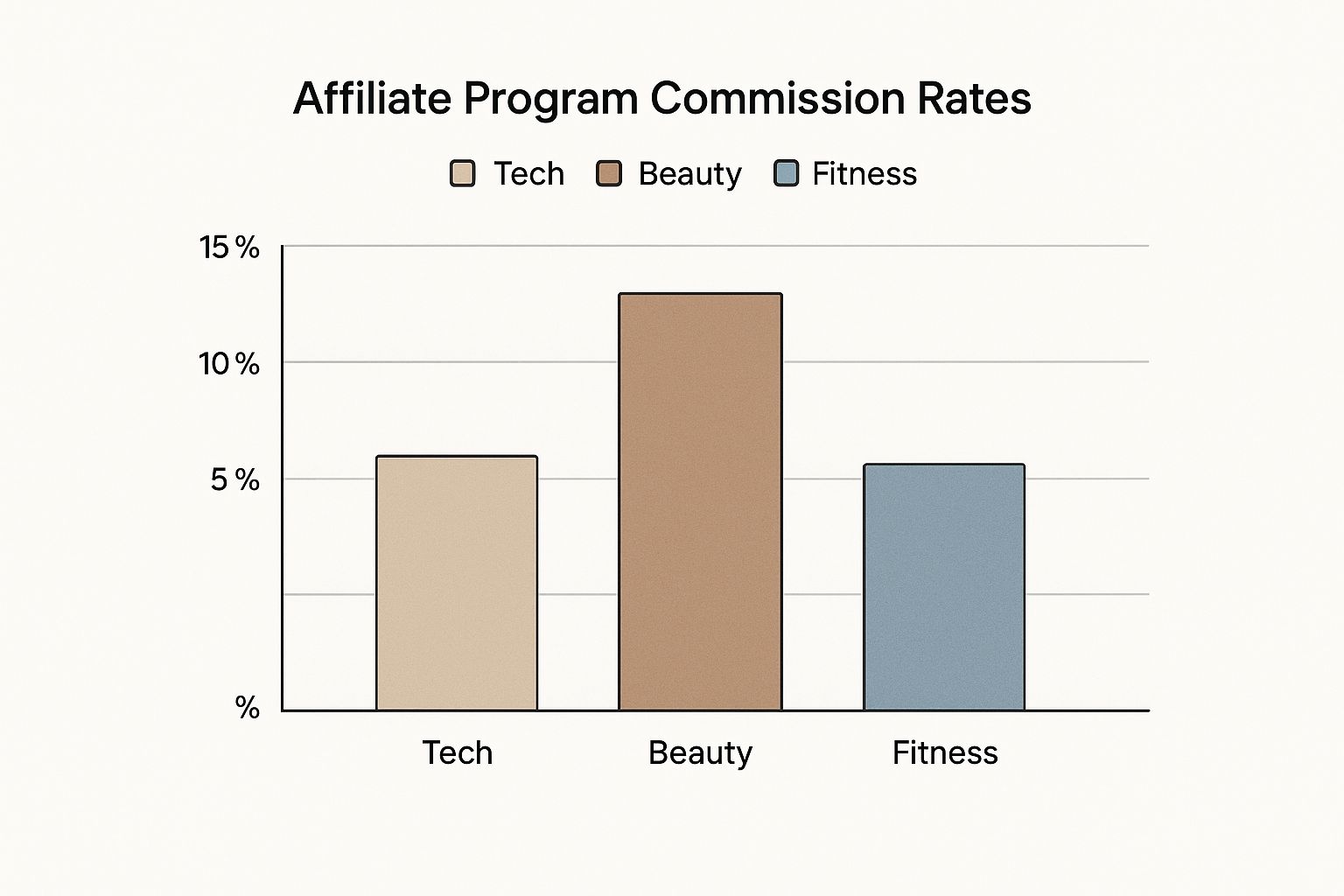
As you can see, a niche like Beauty can offer much juicier commission rates. If your content lines up, leaning into these more profitable areas is a smart way to build an income stream that lasts.
Creating Content That Naturally Converts Viewers
The real secret to making affiliate marketing work on YouTube is to create videos that sell without ever feeling like a sales pitch. Your audience trusts you because your recommendations feel real, not like you're reading from a script.
The whole point is to weave products into your content so organically that they seem like a natural part of the conversation. Think of it as a helpful tip from a friend, not a commercial. This means you need to stop thinking about "selling a product" and start focusing on "solving a problem" for your viewer. When you deliver genuine value first, the affiliate commissions just become a great side effect of helping people out.
Content Formats That Get the Clicks
Some video formats are just perfectly designed for affiliate marketing. They don't just tell people a product is great; they show them.
Here are a few of the most effective formats I've seen work time and time again:
- In-Depth Product Reviews: This is a classic for a reason. Go way beyond the specs on the box. Film the unboxing, show yourself setting it up, and most importantly, put the product to the test. A real, hands-on demo builds a ton of credibility.
- Tutorials and How-To Guides: These are incredibly powerful because the product is part of the solution you're offering. A video on "How to Get Cinematic Drone Shots" that features a specific drone and filter set is a perfect, seamless plug for your affiliate links.
- Comparison Videos: Putting two popular products head-to-head is a fantastic way to help viewers who are stuck on the fence. When you honestly break down the pros and cons, you become their go-to resource, and they'll happily use your link for whichever product they decide on.
- "Top 5" or "Best Of" Lists: Let's be honest, people love lists. A video on the "Top 5 Mics for Podcasting Under $100" saves your audience hours of research. It also positions you as an expert and gives you multiple chances for affiliate commissions in a single video.
The best affiliate content makes the viewer feel like they've made a discovery, not like they've been sold something. When their reaction is, "Wow, that's the exact thing I need to fix my problem," you've won. Clicking your affiliate link becomes the obvious next step for them.
Weaving Mentions into Your Script
The trick is to make product mentions feel like a natural beat in the story you're telling. Don't just pause the video to do a hard sell. Instead, integrate it.
If you’re a vlogger reviewing a cafe, you might say, "The audio in here is actually great because I'm using this little lavalier mic..." and then you just move on. The mention is quick, it adds context, and it's genuinely helpful. It serves the video instead of interrupting it.
To make this all happen, you'll need the right tools. Your editing can make or break how professional your content feels, so it's worth looking into the best video editor for YouTube to make sure your final cut is clean and engaging.
How you frame your call-to-action is just as important. Instead of a boring "link in description," try something more personal. "If you want to check out the exact camera I'm using to get this shot, I've put a link for you down below." It’s a tiny shift, but it makes the link feel like a resource, not a demand.
If you're an Amazon seller looking to team up with creators who've already mastered this, our guide on how to find YouTube influencers is the perfect place to start. At the end of the day, your content has to put the audience first—that’s how every recommendation becomes a trusted solution.
You've created a great video that solves a problem for your audience. Now what? The next step is making it dead simple for them to follow your recommendation. How you place your affiliate links is just as critical as the quality of your content. You want them in high-visibility spots that feel helpful, not pushy.
Put yourself in your viewer's shoes. They just watched your video, they're convinced, and they want to check out the product. Your job is to bridge the gap between their interest and the product page. That means putting your links exactly where they'll look for them.
High-Impact Link Placements
Not all link placements are created equal. Some spots on your YouTube page are prime real estate for clicks, while others get completely ignored. If you want to actually see conversions, focus your energy on these three key areas.
Above the Fold in Your Description: The first two or three lines of your video description are gold. This is what everyone sees without having to click "Show more." Put your most important affiliate link right here at the top. Make it impossible to miss.
The Pinned Comment: After the description, where do people look? The comments. A pinned comment sticks right to the top of the feed, giving it massive visibility. It's a perfect place to repeat your recommendation and drop the link again, maybe with a friendly little call-to-action.
YouTube Cards: You know those little "i" icons that can pop up during a video? Those are YouTube Cards. You can time a card to appear at the exact moment you mention a product. It creates a smooth, interactive path for the viewer to follow without breaking the flow of your video.
Key Takeaway: The best affiliate marketing on YouTube feels like a genuine service. By putting links in intuitive, helpful locations, you're not just selling. You're giving your audience a convenient shortcut to the solutions they came looking for.
The Non-Negotiable Rules of Disclosure
Trust is everything. Being completely transparent about your affiliate relationships is how you build and keep that trust. Failing to disclose isn't just shady—it's a direct violation of FTC guidelines and YouTube's own policies.
It’s easy to do it right. Just say it out loud in your video. Something simple like, "Just so you know, the links in the description are affiliate links, which means I might earn a commission if you buy something."
Then, back it up with a clear written disclaimer in your description. Just adding (Affiliate Link) next to the URL works perfectly. To really solidify that relationship with your audience, it's worth learning more about building trust in faceless affiliate videos, because the same principles apply to any creator.
The data shows just how important this is. By 2026, 48% of consumers are expected to buy something based on an affiliate link they found in a YouTube video. On top of that, it's predicted that 60% of top affiliates will be using YouTube as their main platform by 2025. Honesty isn't just about following the rules; it's about building a sustainable business for the long haul.
Tracking Performance and Scaling Your Earnings
Making great videos is just the first step. If you're serious about turning your YouTube affiliate marketing into a real income stream, you have to stop guessing and start measuring. The data you gather is your roadmap to growth—it shows you what’s working, what’s not, and where the real money is.
This goes way beyond glancing at your affiliate dashboard once a week. The magic happens when you connect the dots between your YouTube Analytics and your actual affiliate sales data. That's how you uncover the insights that actually move the needle.
Identifying Your Most Valuable Content
The core mission here is simple: figure out which of your videos are driving the clicks and, more importantly, the conversions. You might be surprised by what you find.
For instance, maybe you discover that your in-depth tutorial videos generate three times more affiliate revenue than your unboxing videos, even though the unboxings get way more views. That kind of discovery is pure gold.
This tells you exactly what kind of content resonates most with buyers and what you should be creating next. To get started, you'll want to dig into these key metrics for every video:
- Click-Through Rate (CTR): What percentage of viewers are actually clicking your affiliate links? A high-view video with a terrible CTR is a red flag.
- Conversion Rate: Out of everyone who clicked, how many followed through and made a purchase? This shows if you're attracting an audience that's ready to buy.
- Earnings Per Video (EPV): This is the bottom line. Calculating the total commission from each video reveals your true top performers.
The most profitable affiliate marketers I know treat their YouTube channel like a business. They don't just create; they analyze, optimize, and double down on what works to systematically grow their income.
This analytical mindset is a game-changer, especially for creators working with brands on Amazon. We dive deeper into this in our guide on https://coral.ax/blog/affiliate-marketing-for-amazon, which has more strategies for tying your content directly to sales.
A Framework for Optimization and Growth
Once you’ve identified your winning videos, the next step is to figure out why they won so you can replicate that success. Don't just make a carbon copy of the video. Break down the formula. Was it the specific call-to-action you used? The way you demonstrated the product? The problem you solved for the viewer?
Look for patterns across your best-performing content. Do you see any common threads in these areas?
- Video Format: Are tutorials, detailed reviews, or comparison videos your biggest earners?
- Product Type: Does your audience convert better on high-ticket items or on more affordable everyday products?
- Call-to-Action: Which phrases actually get people to click? Test different approaches, like a soft "Check out the gear I used below" versus a more direct "Get the best price on this camera here."
If you really want to scale, you have to learn how to measure marketing attribution and prove ROI from your YouTube channel. By constantly testing, analyzing the data, and refining your strategy, you can turn affiliate marketing from a side hustle into a predictable and scalable revenue machine.
Common Questions About YouTube Affiliate Marketing
Jumping into YouTube affiliate marketing brings up a lot of questions. That's totally normal. Getting the basics straight from the get-go helps you build a strategy that’s actually based on trust with your audience, which is what really matters.
Let's tackle some of the most common things creators ask before they start.
How Many Subscribers Do I Need to Start?
This is the best part: you can start with zero subscribers. Seriously.
Unlike the YouTube Partner Program, which makes you hit certain numbers to run ads, most affiliate networks don't have those kinds of requirements. The key isn't your subscriber count; it's creating genuinely helpful content for a specific group of people.
A small, dedicated community that hangs on your every word is way more valuable than a huge, passive audience that doesn't really care. Think about it—authenticity and relevance are your secret weapons here.
Can I Promote Any Product I Want?
Technically, yes. But you absolutely shouldn't. The whole game is built on trust, and one of the quickest ways to lose it is by pushing random products that have nothing to do with your channel.
Your best bet is to stick to products you actually use and believe in. Things that you know will solve a real problem for your viewers. When your recommendations come from a genuine place, they feel less like an ad and more like a helpful tip from a friend.
Your audience is sharp—they can smell a forced sales pitch a mile away. When you promote something you’d genuinely recommend to a friend, that sincerity builds a much stronger connection.
What's the Best Way to Disclose My Links?
Be transparent. That’s it. A simple, upfront approach is all you need, and it’s also required by the FTC. You don't need to sound like a lawyer.
Here’s an easy way to handle it:
- Say it out loud: A quick mention in your video works perfectly. Something like, "By the way, all the links for the gear I mentioned are down in the description. They are affiliate links, which just means I may get a small kickback if you buy something, with no extra cost to you."
- Put it in writing: Add a clear note right near your links in the video description. Something as simple as
(Affiliate Link)next to the link or a short sentence at the top is perfect.
People appreciate the honesty, and it just makes you a more credible source.
How Much Can I Realistically Earn?
Ah, the million-dollar question. The honest answer is... it completely depends.
Your income is a mix of a bunch of different things: your niche, how engaged your audience is, and the commission rates for the products you're linking to. For example, a smaller channel focused on high-end camera gear could easily earn more than a massive channel that only recommends low-cost items.
Instead of getting fixated on a number, focus on creating great content and building a loyal community. When you get that right, the income will follow.
Ready to turn your channel into a reliable source of income? Coral gives you one place to manage all your affiliate links, see what's working, and grow your earnings. Start building your affiliate program today.