Amazon Private Label A Modern Launch Guide
Category: Amazon private label
So, what exactly is an Amazon private label business? In short, it’s about finding a generic, often unbranded product, putting your own brand name on it, and selling it exclusively on Amazon. You're not just reselling someone else's stuff; you're creating your own brand from scratch, complete with unique logos, packaging, and a dedicated product listing.
The Reality of Amazon Private Label Today
Let’s be real for a moment. The gold rush days of stumbling onto a "get rich quick" gadget on Amazon are pretty much over. Building a successful private label business today isn’t about finding some secret, untapped product. It's about building a real, sustainable brand.
This takes a strategic mindset, solid branding, and smooth operations right from the start. The market is definitely crowded, but that doesn't mean it's impossible. It just means the opportunity now lies with sellers who are willing to put in the work to stand out. Success is no longer just about competing on price; it’s about winning on quality, customer experience, and telling a compelling brand story.
Shifting From a Product to a Brand
The biggest change I've seen in the private label space is the massive shift toward brand building. A few years back, you could find a simple item, slap a logo on it, and the sales would roll in. Not anymore. Shoppers are savvier, and Amazon itself rewards brands that cultivate a genuine following.
This means your thinking has to go way beyond just one product. You need to ask yourself the big questions:
- What's our mission? What problem are we actually solving for people? What does our brand even stand for?
- What's our look? Your logo, packaging, and color scheme need to look professional and stick in people's minds.
- How do we connect? How are you going to talk to your customers and build a community that cares about what you're doing?
Building a brand is your ultimate competitive advantage. While competitors can copy a product, they can't replicate the trust and loyalty you build with your customers. It's the only real long-term moat in ecommerce.
To put the private label model into perspective, let's quickly compare it to other common ways of selling on Amazon.
Private Label Business Model At a Glance
| Business Aspect | Private Label Approach | Key Benefit |
|---|---|---|
| Product Sourcing | Find a manufacturer to create a product under your brand name. | Full control over product quality and design. |
| Branding | Create a unique brand identity, logo, and packaging. | Builds long-term customer loyalty and asset value. |
| Inventory | Purchase stock in bulk from a supplier. | Higher profit margins due to bulk pricing. |
| Competition | Compete based on brand, quality, and unique value proposition. | Less direct, price-based competition. |
| Scalability | High potential to expand the product line and brand reach. | You're building an asset you can grow or sell. |
This table shows how private label is fundamentally about building something you own, which is a huge advantage over simply reselling existing products.
Understanding the Modern Economics
While the potential for high profit margins is still a massive draw, the costs involved have definitely changed. With ad costs on the rise and more sellers entering the market, you have to be meticulous with your numbers. You need a rock-solid grasp of your landed costs, Amazon FBA fees, storage fees, and what it costs to acquire a customer through advertising.
But don't let that scare you. The profitability is still there for those who get it right. In fact, over 54% of private label sellers on Amazon are still pulling in profit margins of over 20%. That’s a powerful testament to the model's potential. And scaling isn't just a pipe dream; 63% of large brand sellers are already blowing past $100,000 in monthly sales. You can dive deeper into these private label profitability statistics on phoenixwipes.com.
At the end of the day, launching an Amazon private label brand is about building a real business asset. It’s a chance to own something, control your destiny, and create lasting value. The path is more demanding than it used to be, but the rewards—both financial and personal—are bigger than ever for anyone with a strategic, long-term vision. This is the grounded, no-nonsense truth about the challenges and rewards that lie ahead.
Finding a Product Worth Building a Brand Around

Let's be honest, this is the step that trips up most aspiring sellers. The product choice. It's so easy to get sucked into chasing a hot trend or picking something you personally love, only to discover there's no real market for it. The goal isn’t finding a mythical “perfect” product, but rather a real opportunity that the data supports.
So, forget aimlessly scrolling through Amazon, hoping for a lightbulb moment. That’s a recipe for disaster. A systematic, data-first approach is your best defense against a costly mistake. It’s about moving past guesswork and using the right tools to find out what customers are actually searching for and buying.
Uncovering Opportunities with Data
In today's market, using product research tools like Helium 10 or Jungle Scout is non-negotiable. Think of them as your secret weapon, giving you a peek behind the Amazon curtain to analyze the metrics that truly signal a product's potential.
Don't just get hypnotized by big sales numbers. You need to dig deeper into the data points that tell the whole story of a product niche. This holistic view is what keeps you from jumping into a market that looks great on the surface but is secretly a minefield.
Here's what I always focus on when vetting potential products:
- Consistent Sales Velocity: Look for products that sell steadily all year, not just during a holiday rush. A product moving 300+ units a month shows there's reliable, everyday demand.
- High Search Demand: Use keyword tools to confirm people are actively looking for what you want to sell. High search volume means a built-in audience is already there.
- Low Competition: A great sign is when the top sellers have fewer than 500 reviews. This tells you the market isn't totally locked down, and a new brand can still make a dent.
- Room for Improvement: This is gold. Read the customer reviews of existing products. Are people constantly complaining about the same thing? A weak handle, a confusing manual, a poor design? That’s your invitation to create a better version.
A classic rookie mistake is chasing products with massive revenue. A niche where sellers are pulling in millions might seem tempting, but it's usually hyper-competitive and costs a fortune to even get noticed. Instead, look for the "boring" products with steady demand and obvious flaws you can fix.
The Art of Manual Research
Tools are critical, but they don't replace good old-fashioned manual digging. Put on your detective hat and start piecing together clues from across Amazon to spot gaps in the market. This hands-on work adds a human layer to all that data you just pulled.
A great place to start is Amazon's Best Seller lists. Go beyond the top 10 and dig into the top 50 or 100 in categories that interest you. Keep an eye out for simple, lightweight products—things without complex electronics or heavy regulations are way easier for a new amazon private label brand to manage. We cover this strategy in more detail in our guide on launching an Amazon FBA private label business.
Once you have a shortlist, it's time to become obsessed with customer reviews for the top competitors. I find the three-star reviews are often the most telling. They're from people who are disappointed but not furious, and they give brutally honest feedback about specific flaws they wish were fixed.
Conducting a Profitability Analysis
Okay, you've found a product with solid demand. That's only half the battle. Now you have to make sure you can actually turn a profit on it. A quick "back-of-the-napkin" calculation right now can save you a world of hurt later.
As a rule of thumb, you should be able to sell your product for at least three times its landed cost. The landed cost is everything it takes to get one unit from your factory to an Amazon warehouse—the manufacturing price, shipping, and import duties.
Here's a quick and dirty example:
| Cost Component | Example Calculation |
|---|---|
| Retail Price | You plan to sell your product for $30. |
| Landed Cost | Sourcing and shipping costs you $10 per unit. |
| Amazon Fees | FBA and referral fees are roughly $10 (about 33% of the sale price). |
| Gross Profit | $30 - $10 - $10 = $10 per unit. |
That $10 in gross profit gives you a healthy 33% margin. This is the money you'll use to pay for advertising, cover any returns, and ultimately, pay yourself. If your initial numbers don't look this good, it’s a major red flag. It means you either need to find a way to lower your costs or it's time to go back to the drawing board. This final check makes sure your great idea is also a smart business decision.
From Idea to Inventory: How to Source and Brand Your Product

A great product idea is just that—an idea. Until you find a reliable manufacturer to actually make it, it’s not a business. This is the stage where your concept becomes a real, physical product, and honestly, it's not as scary as it sounds.
The journey from a validated idea to a warehouse full of inventory really boils down to three key phases: finding a supplier, creating a brand that stands out, and figuring out the shipping. Get these right, and you've built the foundation for a successful Amazon private label business.
Finding and Vetting Your Manufacturing Partner
For most sellers starting out, the first stop is almost always Alibaba. It's a huge marketplace connecting people like us with manufacturers, mostly from Asia. It can feel like drinking from a firehose at first, but with a clear plan, you can navigate it just fine.
Start by searching for your product and using the filters for "Verified" suppliers and "Trade Assurance." This gives you a baseline level of security for your orders. I like to build a shortlist of about 5-10 potential partners before I start reaching out.
When you do make contact, be professional but direct. Introduce your brand and lay out exactly what you need, including those little improvements you thought of during your research. Remember, this isn't just a one-off purchase; it's the start of what should be a long-term business relationship.
Pro Tip: Never, ever commit to a big order without getting your hands on physical samples first. This is non-negotiable. It's the only real way to check the quality, feel, and function of the product before you sink thousands of dollars into inventory.
Once samples start arriving, be meticulous. Line them up and compare everything—the materials, the construction, the finish. Does it feel cheap? Does it live up to the standard you want for your brand? Spending a little on samples now can save you from a massive, expensive quality control disaster later.
Creating a Brand That Connects
Okay, so you've locked in a great supplier. Now it's time to build your brand identity. This goes way beyond just slapping a logo on a box; it’s the whole feeling and experience a customer gets from your product. Your branding is what will make someone choose your item over a dozen nearly identical ones.
First, think about the story you want to tell. Who are you selling to, and what do they care about? That story should guide every branding decision.
Here are the core pieces you need to nail down:
- Brand Name: Make it memorable, easy to say, and relevant to your product. Before you fall in love with a name, check that you can get the trademark and the domain name.
- Logo Design: This is the face of your brand. You don’t need to spend a fortune; platforms like Fiverr or 99designs have plenty of talented freelancers who can create something professional.
- Packaging: Your package is the first physical thing your customer will touch. It needs to do more than just protect the product—it should look great and reinforce that you're a quality brand.
For a deeper dive into this entire process, our complete guide to https://coral.ax/blog/amazon-private-label has even more strategies.
Navigating Logistics and Shipping to Amazon
With your products made and branded, the last piece of the puzzle is getting them to an Amazon warehouse. Welcome to the world of freight forwarding and customs.
You’ve got two main options for shipping from your manufacturer:
- Air Freight: This is the fast option, usually taking just a week or two. It's also way more expensive, so it’s best for small, light products or when you desperately need to restock.
- Sea Freight: Shipping by boat is the go-to for most sellers. It's much cheaper for bigger, heavier orders but also much slower—think 30-45 days, sometimes more. This is how you'll ship your main inventory orders to keep costs down.
Getting a handle on the logistics of moving pallets of product can feel complex. To get a really solid grasp on the specifics, check out this guide on how to ship freight.
The engine that makes all this run smoothly is Fulfillment by Amazon (FBA). You ship your inventory to Amazon's warehouses, and they take care of everything else: storage, picking, packing, and shipping every single order. They even handle customer service and returns. Using FBA is a must for private label sellers because it makes your products Prime-eligible, which is a massive sales driver and a huge trust signal for shoppers.
Crafting a Product Listing That Actually Converts
Think of your Amazon product page as your digital storefront. It's the only one you've got, and it's where a curious browser decides in a split second whether to hit "Add to Cart" or bounce to a competitor. A listing that truly converts isn't just about stuffing in keywords; it’s a masterclass in persuasion, blending sharp copywriting with visuals that do the talking.
Your job is to stop the scroll. From the main image to the very last word of your description, every single element needs to work in harmony. You're building trust, answering questions before they're asked, and making it painfully obvious why your product is the solution they've been looking for.
The Anatomy of a Powerful Title
Let's be clear: your title is the most critical piece of SEO on your entire listing. It has to pull double duty, catching the eye of both the Amazon algorithm and a real, live human shopper. A great title grabs attention, says what the product is, and is packed with the exact keywords people are typing into the search bar.
I see sellers make two common mistakes all the time. They either cram the title with so many keywords it reads like gibberish, or they write something so short and clever it misses all the essential search terms. You need to find the sweet spot right in the middle.
Here’s a simple formula that just works:
- Brand + Product Name: Start here for instant clarity.
- Top 2-3 Keywords: Weave in your most important search terms naturally.
- Key Feature or Benefit: What’s the big selling point? Is it extra large, organic, or perfect for travel?
- Use Case or Audience: Something like "for Kitchen Organization" or "for Yoga Lovers."
This structure gives Amazon the data it needs to rank you while telling a customer, "Yes, you've found it."
Writing Bullet Points That Solve Problems
Right after the images and title, shoppers scan the bullet points to justify the purchase to themselves. This is your moment to sell the benefits, not just list the features. Remember, nobody buys a drill bit because they want a quarter-inch piece of metal; they buy it because they want a perfect quarter-inch hole.
Frame every single bullet point around a problem or desire your customer has. Kick it off with a benefit-driven headline, then back it up with the feature.
Pro Tip: Always write from the customer's point of view. Don't just say, "Made with 100% durable silicone." Instead, try something like, "Enjoy a Leak-Proof Seal: Crafted from 100% durable silicone, our containers keep your food fresh and your bag clean."
This approach immediately connects the dots for the shopper, making the value of your Amazon private label brand crystal clear.
Visuals Are Your Best Salesperson
In the world of e-commerce, your photos and videos have to do all the heavy lifting of an in-person salesperson. Professional, high-quality visuals are completely non-negotiable. I've seen countless listings fail because of grainy, poorly lit phone pictures—it kills conversions faster than anything.
Your visual game plan needs to include:
- A Killer Main Image: This has to be on a pure white background and show the product clearly. It's your digital handshake.
- Lifestyle Shots: Show your product being used in real-life situations. Help customers imagine it in their own lives.
- Infographics: Use clean text and icons to highlight key features, dimensions, or instructions. Make it easy to digest.
- A Product Video: A short demo can boost conversion rates like you wouldn't believe. It builds trust and shows exactly how your product works.
Seriously, investing in a professional photographer or videographer is one of the best moves you can make.
Using A+ Content to Tell Your Brand Story
If you're enrolled in Amazon Brand Registry (and you should be), A+ Content is your playground. It lets you swap out that boring, plain-text product description for a rich, visual layout with custom images, comparison charts, and brand storytelling.
This is your chance to go deeper. Tell your brand's story, show off your other products, and tackle common customer questions head-on. With third-party sellers—many of whom are private label brands—making up 61% of total sales on Amazon, tools like A+ Content are how you elbow your way to the front. You can find more insights on these powerful trends for Amazon private label products on accio.com. A well-designed A+ section keeps people on your page longer and builds a real connection, which almost always leads to a higher conversion rate.
Your First 90 Days Launching and Scaling on Amazon
So, your inventory has finally landed at an Amazon fulfillment center. This is it. This is where the real work begins. I can't stress this enough: a powerful product launch is the single most important factor for long-term success. It sets your initial sales velocity, which is what Amazon’s algorithm looks at to decide where you rank in search results.
Those first 90 days are a flat-out sprint. Your only goals should be driving traffic, getting those first critical sales, and gathering reviews. This initial push creates a flywheel effect—more sales lead to a higher rank, which leads to more organic visibility, and that, in turn, leads to even more sales.
Igniting Your Launch with Targeted Traffic
Hoping shoppers will just stumble upon your shiny new product listing isn't a strategy. You have to get proactive and push targeted traffic to your page right from day one. This is where Amazon Pay-Per-Click (PPC) advertising becomes your best friend.
Start with an "Automatic" campaign. This lets Amazon’s algorithm do the heavy lifting, testing your product against a ton of different search terms. It's a goldmine for data, showing you which keywords actually convert into sales. Let it run for a week or two to gather enough intel.
At the same time, set up a "Manual" campaign targeting the top 5-10 most relevant keywords you found during your product research. This is a more surgical approach, making sure you show up for the exact phrases you know your ideal customers are searching for. Don't sweat profitability on ads at this stage; the name of the game is sales velocity and data.
Securing Your First Crucial Reviews
On Amazon, social proof is everything. A potential buyer sees a listing with zero reviews and immediately feels hesitant. That's why getting your first handful of honest reviews is a top priority. While Amazon strictly forbids incentivizing positive reviews, they do offer a legitimate program to get you started.
The Amazon Vine program is your best bet here. You offer free units of your product to a pool of Amazon's most trusted reviewers, called Vine Voices. They can then choose to leave an honest, unbiased review. Getting even 5-10 Vine reviews can give your conversion rate a serious boost right out of the gate.
Remember, the launch phase is an investment in your product's future. Breaking even or even taking a small loss on ads and promotions is completely normal. In fact, it's often necessary to carve out your spot in a crowded marketplace.
This process is a foundational part of a strong launch, as you can see below.
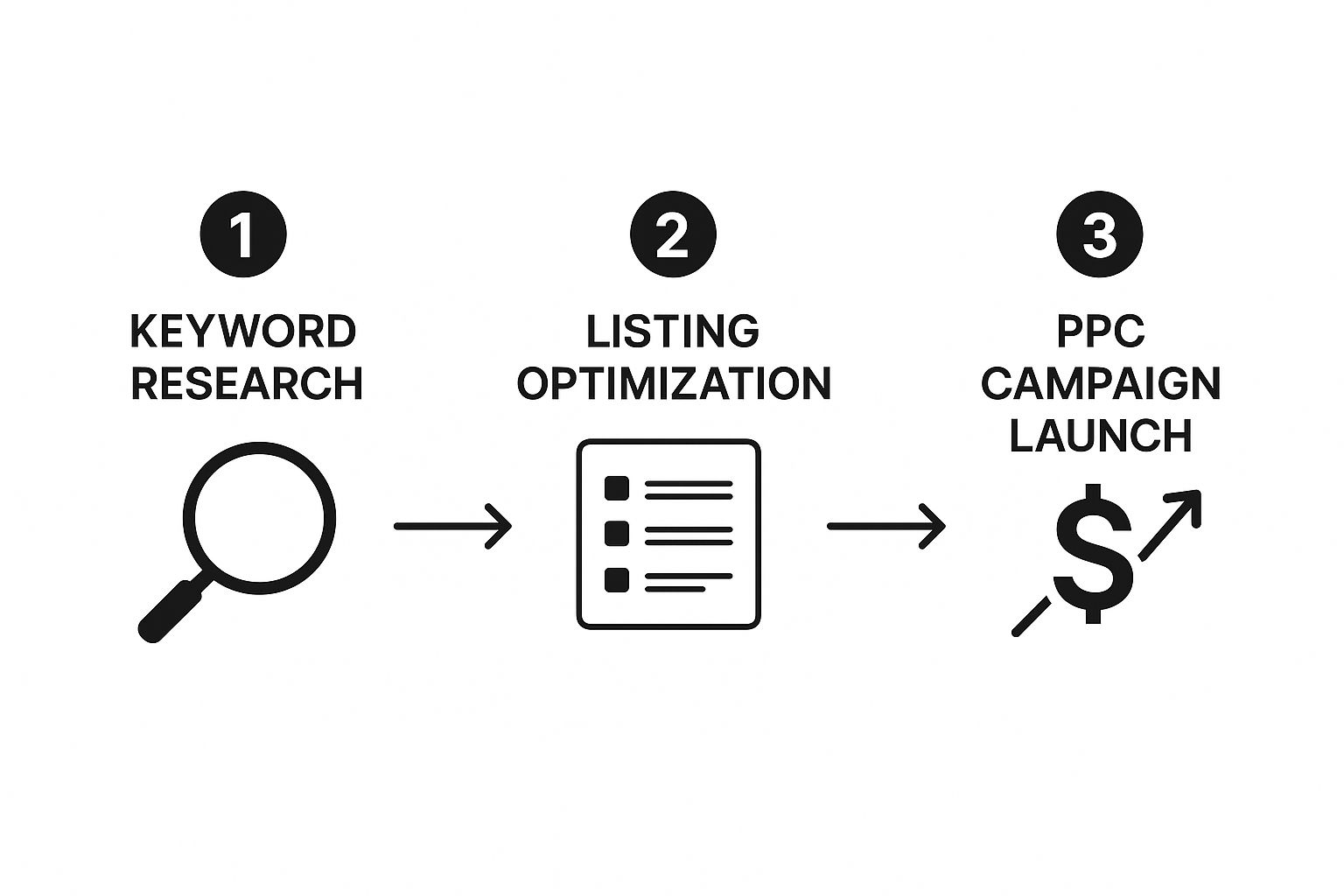
The visual makes it clear: a successful PPC launch is built on a foundation of solid keyword research and a well-optimized listing.
Transitioning from Launch to Scale
After that initial 30-day launch blitz, it’s time to shift gears. You're moving from a pure sales velocity mindset to one focused on profitable growth. This means digging into your metrics, staying on top of your inventory, and fine-tuning your ad spend.
Start by diving into your PPC campaign reports. Find those high-performing keywords from your automatic campaign and move them over to your manual campaigns. This gives you much tighter control over your bids. Just as importantly, find and "negate" the irrelevant keywords that are just eating up your budget. For a deeper dive into this whole process, check out this excellent A-Z guide for new product launches on Amazon.
Managing your inventory is just as critical. Seriously, running out of stock will kill your momentum. Your sales rank will tank, and clawing your way back up can take weeks. Set up alerts to reorder when you hit a specific stock level, making sure to factor in both manufacturing and shipping lead times.
To effectively manage and scale your business, you'll need to get comfortable with the lingo. Amazon has a whole language of its own, filled with acronyms and metrics that can be confusing at first.
Essential Amazon Seller Acronyms and Metrics
Understanding these key terms is non-negotiable for making data-driven decisions. This table breaks down some of the most common ones you'll encounter.
| Acronym/Metric | Full Name | What It Measures |
|---|---|---|
| PPC | Pay-Per-Click | A model of internet marketing in which advertisers pay a fee each time one of their ads is clicked. |
| ACOS | Advertising Cost of Sale | The percentage of your sales spent on advertising. (Ad Spend ÷ Ad Sales) x 100. |
| TACOS | Total Advertising Cost of Sale | The percentage of your total sales spent on advertising. (Ad Spend ÷ Total Sales) x 100. |
| BSR | Best Seller Rank | A product's ranking based on sales, updated hourly. A lower number is better. |
| FBA | Fulfillment by Amazon | A service where Amazon stores, packs, and ships your products on your behalf. |
| ASIN | Amazon Standard Identification Number | A 10-character alphanumeric unique identifier assigned by Amazon for product identification. |
Getting a handle on these metrics will help you understand the health of your business at a glance and pinpoint areas for improvement.
Protecting and Growing Your Brand Asset
Once your Amazon private label brand starts gaining traction, you have to protect it. The first, most important step is getting enrolled in Amazon Brand Registry. This unlocks a whole suite of powerful tools designed to protect your intellectual property and gives you access to cool branding features like A+ Content and Brand Stores.
Think of Brand Registry as your primary defense against hijackers—shady sellers who try to jump on your listing and sell counterfeit versions of your product. By registering your trademark with Amazon, you get the power to report and remove these bad actors quickly.
Beyond just protecting your brand, it's time to think about growing it. As you gather sales data, you’ll get a much clearer picture of who your customer is and what else they might want. This is the perfect time to start brainstorming your next product. Look for something that complements your first offering and helps you build out a real, cohesive brand. To see how your off-Amazon marketing efforts are paying off, you can learn more about how to measure their effectiveness in our guide on how Amazon Attribution works.
Common Questions About Building an Amazon Brand
Jumping into the Amazon private label world is a huge step, and it’s completely normal to have a ton of questions swirling around. Let's break down some of the most common concerns I hear from new sellers to give you the clarity you need.
The first question is always about money: "How much do I really need to start?" You might see old forum posts about people launching with a few hundred dollars, but honestly, those days are pretty much gone.
For a realistic shot at success today, you should plan for a starting budget between $5,000 and $10,000. This gives you enough runway to clear the initial hurdles without cutting dangerous corners.
So, where does all that money go?
- Initial Inventory: This will be your biggest check to write. You need enough product to launch and sustain sales so you don't stock out immediately.
- Product Samples: Never skip this. You have to verify the quality before you commit to a massive order.
- Branding and Design: Think logo, packaging, and any thank-you inserts.
- Professional Photography: Your images are your digital storefront. Don't skimp here.
- Amazon Fees: Your professional seller account has a monthly fee right off the bat.
- Launch Advertising: You'll need to run PPC campaigns to get those first eyeballs and sales.
Trying to launch with less is technically possible, but it severely limits your product options and marketing budget, making an already tough climb that much steeper.
Is the Amazon Market Too Saturated Now?
It’s definitely crowded, no doubt about it. But is it "too saturated"? No. The game has just changed.
Success isn't about finding some random widget anymore. It's about carving out a specific niche and serving that audience better than anyone else. Differentiation is your secret weapon.
You can stand out by:
- Superior Quality: Make a more durable, better-functioning version of what's already out there.
- Smarter Branding: Build a brand that actually connects with a specific type of person.
- Better Customer Service: Go the extra mile. A positive experience is a huge differentiator.
- Solving a Problem: Dig into competitor reviews, find the common complaints, and fix them with your product.
Even Amazon is doubling down on private label. They recently launched Amazon Saver, a private-label grocery brand for budget-conscious shoppers. This is part of a larger trend—private label goods currently make up about 19% of U.S. grocery sales and are on track to hit 30% by 2033. This shows that even in the most competitive categories, there's plenty of room for well-positioned brands to win. You can dig into the numbers in this report on Amazon's private label strategy on metricscart.com.
How Long Does Profitability Take?
Patience is a virtue here. Realistically, it takes most new brands 6 to 12 months to become consistently profitable. The first few months are all about reinvesting every dollar you make right back into the business.
Don't expect to pull significant profits from your business in the first year. The launch phase is an investment in growth, focusing on building sales velocity and ranking. Treat it like a marathon, not a sprint.
This reinvestment cycle is what separates the brands that fizzle out from the ones that scale. That early revenue should go straight into ordering more inventory and fueling your ad campaigns. It's how you build the momentum you need for real, long-term success.
Ready to scale your brand with the power of affiliates? With Coral, you can build and manage your own creator program, turning passionate advocates into a powerful sales force. Track performance, pay commissions, and drive word-of-mouth growth—all from one simple dashboard. Start building your affiliate army today at https://coral.ax.