Best affiliate marketing platforms: Top 12 for 2025
Category: Best affiliate marketing platforms
Affiliate marketing is a powerful engine for growth, but choosing the right platform can feel overwhelming. For Amazon brands, the challenge is even greater. You need more than just a link generator; you need an affiliate management software that integrates seamlessly with Amazon's ecosystem, provides accurate sales attribution, and helps you build lasting relationships with creators. This guide cuts through the noise to reveal the best affiliate marketing platforms available today, with a special focus on what works for brands on Amazon.
We'll compare key features like tracking capabilities, creator management, commission structures, and analytics to help you find the perfect partner for your growth journey. Each option includes direct links and an honest look at its capabilities. Of course, a great platform is only half the battle. When considering an affiliate tracking platform, it's equally important to master fundamental strategies like understanding 9 keyword research best practices to effectively drive traffic to your offers. Let's dive in.
1. Coral
Best for: Amazon sellers seeking to maximize creator partnerships and Brand Referral Bonus benefits.
Coral positions itself as the standout choice for Amazon sellers, offering a comprehensive creator partnership platform built to master Amazon's ecosystem. It provides a centralized, robust system for managing affiliate, influencer, and ambassador programs, moving beyond one-off collaborations to foster scalable, long-term partnerships. The platform’s core strength lies in its superior attribution through a native integration with Amazon Attribution, ensuring every sale is accurately tracked back to the specific creator and content that drove it.
This direct link to Amazon’s ecosystem allows for automated commission calculations and provides brands with granular control over commission structures. You can create custom, branded affiliate landing pages, approve applicants individually, and assign unique commission rates for each creator. This level of creator management and customization is a significant advantage over more generic affiliate networks.
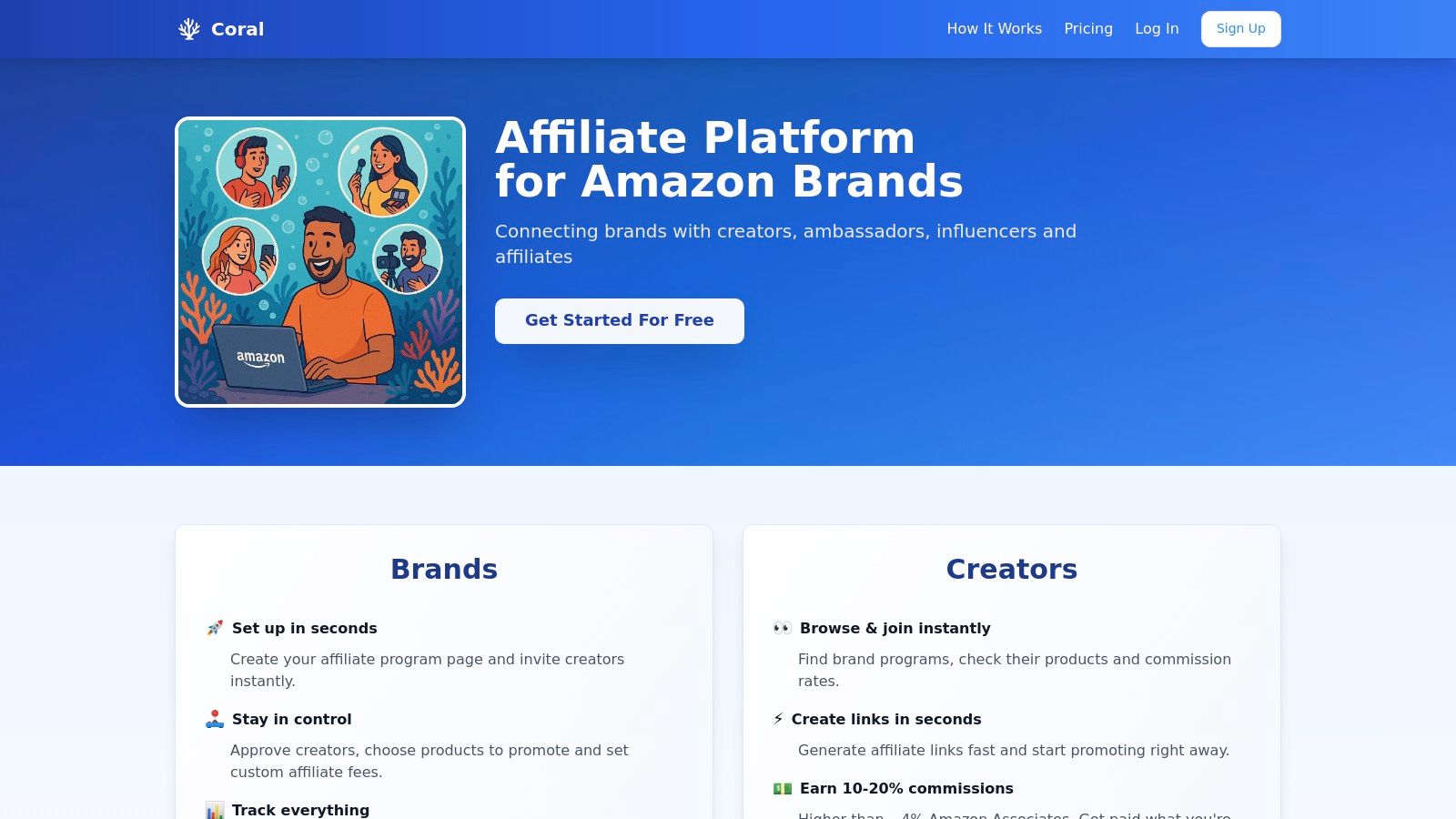
Creators also benefit from a streamlined, user-friendly dashboard where they can generate Amazon Attribution links, monitor their clicks and sales in real-time, and track progress. By facilitating higher payouts than the standard Amazon Associates program, Coral incentivizes top-performing creators to prioritize promoting your brand. The analytics also clearly highlight the 10% Amazon Brand Referral Bonus, showing brands the direct financial upside of driving external traffic—a key benefit making it the best affiliate marketing platform for savvy Amazon brands.
Key Features & Use Cases
- Superior Amazon Attribution: Automatically links creator content to sales for precise performance tracking and commission payouts, providing unmatched analytics for Amazon sellers.
- Comprehensive Creator Management: Approve specific affiliates, set custom commission structures per creator, and host branded program landing pages to maintain brand consistency.
- Brand Referral Bonus Optimization: Analytics are designed to track and showcase the 10% bonus, helping brands maximize their return on external traffic.
- Flexible Pricing Model: A free plan (currently in beta) and a Growth plan at $97/month with 0% sales fees and unlimited affiliates make it accessible for brands at all stages.
Pros and Cons
| Pros | Cons |
|---|---|
| Native Amazon Integration for superior tracking and bonus attribution. | Restricted to sellers enrolled in Amazon Brand Registry. |
| High degree of brand control over commissions and affiliate approvals. | No built-in creator marketplace for discovery (feature is planned). |
| Creator-centric tools that encourage loyalty and performance. | Currently in beta, meaning features and pricing are subject to change. |
| Cost-effective pricing with a zero-fee Growth plan. |
Website: coral.ax
2. CJ (formerly Commission Junction)
Best for: Established publishers seeking a diverse range of global brand partners.
As one of the oldest and largest affiliate networks, CJ earns its spot for its sheer scale and reliability. It's a vast marketplace connecting publishers (affiliates) with thousands of well-known advertisers across nearly every industry. This makes it an ideal platform for established creators looking to monetize their audience with a wide variety of global brands. The platform is free for publishers to join, offering a one-stop shop for discovering programs, generating links, and receiving consolidated monthly payments.
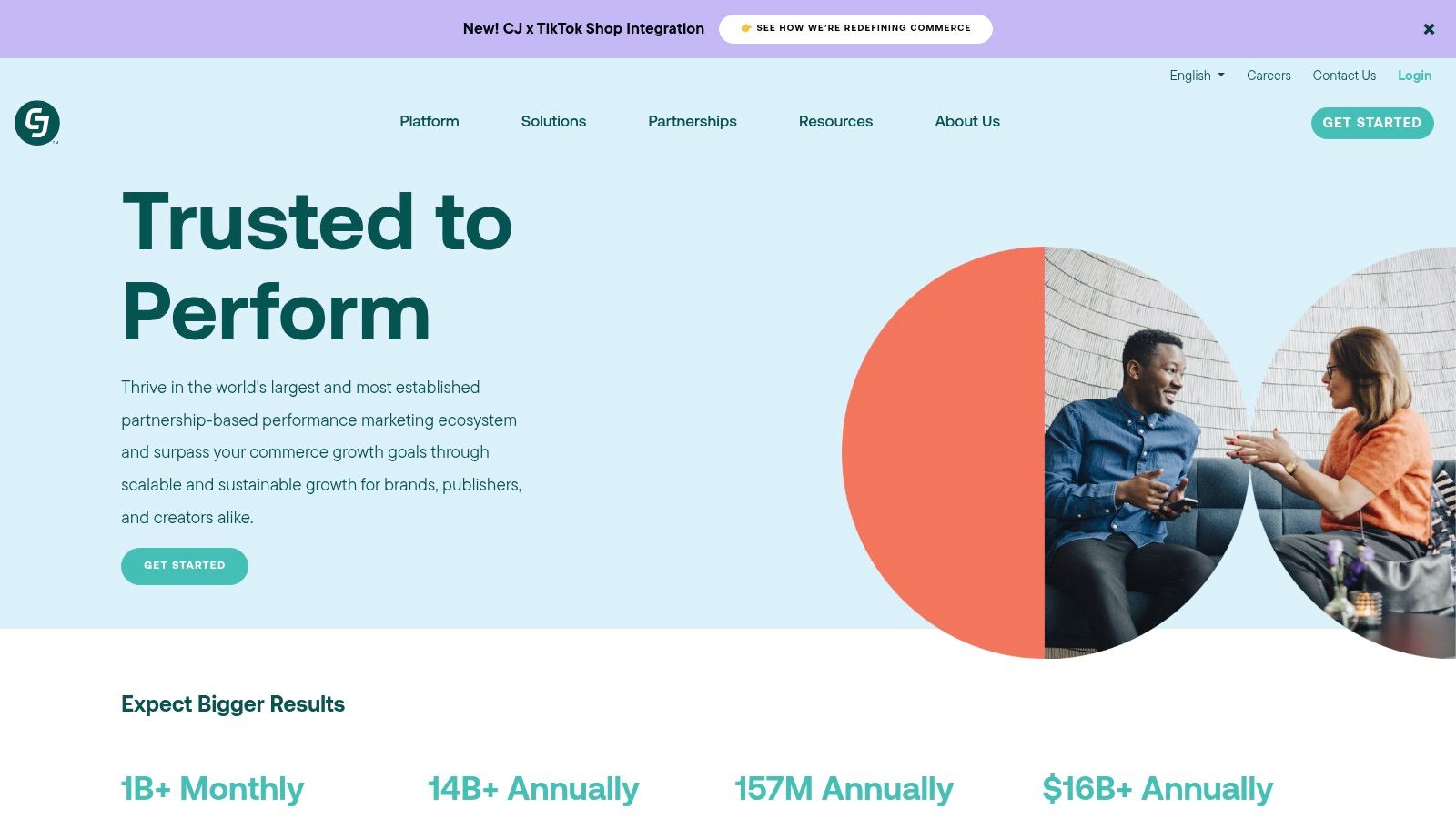
CJ's strength lies in its robust tracking and reporting tools. However, its massive size can also be a drawback. For brands, the pricing models and platform are powerful but often better suited for enterprise-level businesses rather than small or emerging Amazon sellers.
Key Features & Use Cases
- Robust Tracking & Analytics: Provides detailed, real-time reporting on affiliate performance.
- Flexible Commission Structures: Supports various models like CPA, CPL, and CPC.
- Large Advertiser Marketplace: Offers access to thousands of brands across diverse industries.
- Pricing Model: Free for publishers; advertisers typically face significant setup and recurring fees, making it an enterprise-focused solution.
Pros & Cons
| Pros | Cons |
|---|---|
| Massive Advertiser Selection: Access thousands of brands. | Individual Approvals: Must apply to each program. |
| Reliable Tracking: Decades of trusted performance data. | Competitive Marketplace: High competition for top programs. |
| Consolidated Payments: Simplifies receiving earnings. | Enterprise-Level Pricing: Can be costly for most Amazon brands. |
- Website: https://www.cj.com/
3. Impact
Best for: Enterprise brands managing a wide range of partnership types.
Impact stands out by unifying multiple partnership channels—including affiliates, influencers, and strategic business partners—into a single, comprehensive system. It's designed for brands that want to manage their entire partnership lifecycle, from discovery and recruitment to contracting, tracking, and payments. This all-in-one approach simplifies complex programs, providing powerful automation and detailed analytics.
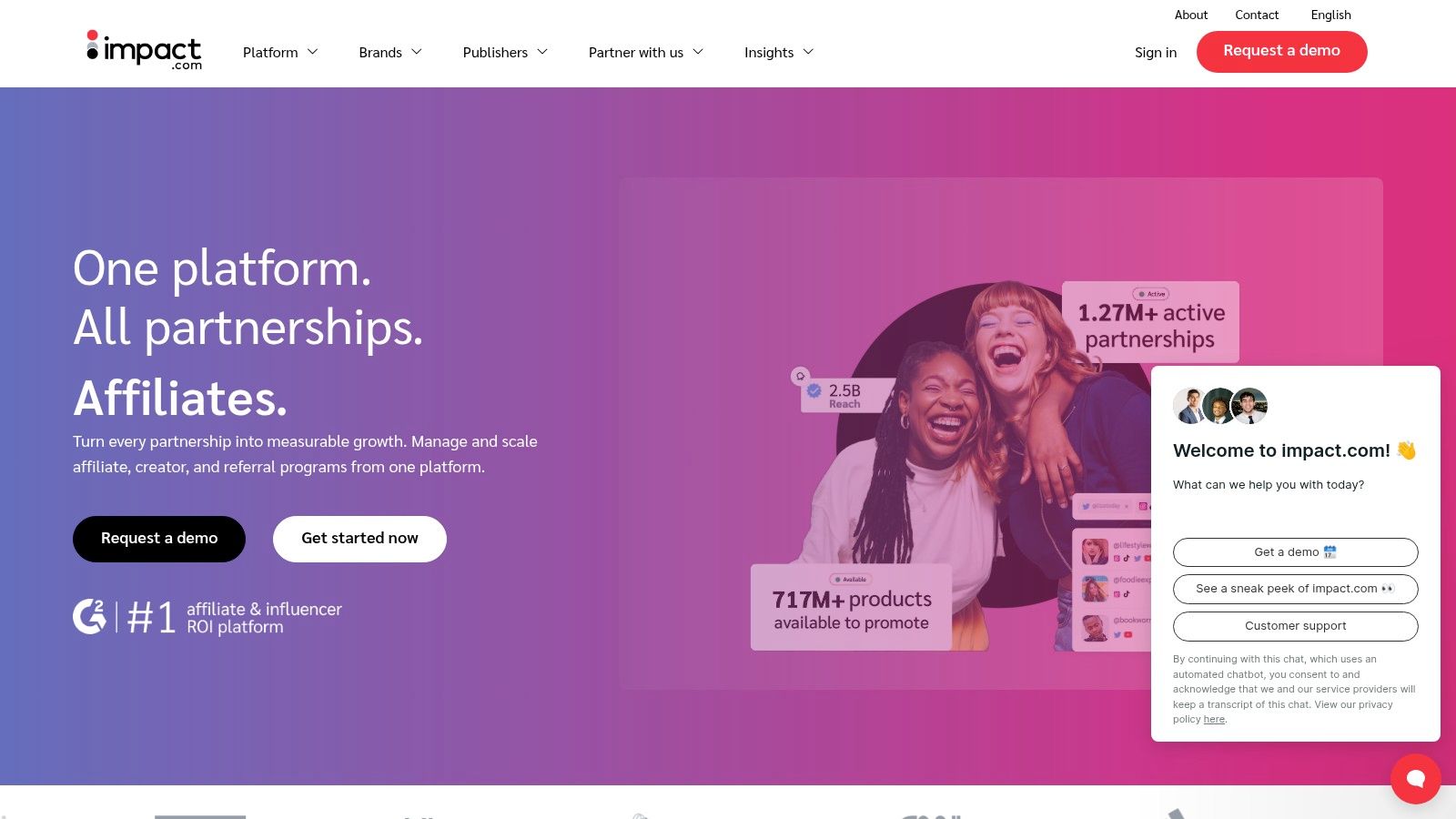
The platform’s strength is its enterprise-grade analytics and robust tracking technology, including cross-device attribution. However, its comprehensive nature can be overkill for small businesses, especially Amazon brands who need specific attribution features. For a deeper look at how it works, you can explore more about Impact as an affiliate tracking platform.
Key Features & Use Cases
- Unified Partnership Management: A single platform for affiliates, influencers, and strategic partners.
- Advanced Tracking: Offers cross-device tracking and detailed analytics for complex funnels.
- Creator Management: Includes tools for discovering, recruiting, and communicating with partners.
- Pricing Model: Custom, sales-led pricing for its core platform, though more accessible tiers are available via its Shopify app.
Pros & Cons
| Pros | Cons |
|---|---|
| Enterprise-Grade Analytics: Powerful, in-depth reporting. | Sales-Led Pricing: Core plans require a custom quote. |
| Unified Platform: Manages all partner types in one system. | Complex for Beginners: Can be overkill for small programs. |
| Accessible Shopify App: Offers public pricing for SMBs. | Not Optimized for Amazon: Lacks deep Amazon-specific integrations. |
- Website: https://impact.com/
4. ShareASale
Best for: Bloggers and SMBs looking for a user-friendly, US-focused network.
Acquired by Awin in 2017, ShareASale remains a favorite in the US market, particularly for small to medium-sized businesses and bloggers. It stands out for its user-friendly interface and a diverse merchant directory that features both niche boutiques and larger, established brands. For publishers, joining is free and the platform simplifies the process of finding programs, generating links, and receiving consolidated payments. It’s a great starting point for those new to affiliate marketing.
ShareASale's strength lies in its transparency and robust toolset for merchants, including recruitment features to attract new affiliates. However, like other large networks, publishers must apply to each merchant program individually. For advertisers, there is a one-time network access fee and a recurring minimum monthly transaction fee to consider, and it lacks the specialized tools needed for Amazon sellers.
Key Features & Use Cases
- Simple Tracking & Reporting: Easy-to-understand analytics for beginners.
- Flexible Commission Structures: Supports various payout models.
- Creator Management: Basic tools for approving and communicating with affiliates.
- Pricing Model: Advertisers pay a network setup fee plus monthly minimums and transaction fees.
Pros & Cons
| Pros | Cons |
|---|---|
| User-Friendly Interface: Easy for beginners to navigate. | Individual Approvals: Must apply to each merchant program. |
| Good Merchant Mix: Access niche and mainstream brands. | US-Centric Programs: Many merchants are US-only. |
| Strong SMB Focus: Great for smaller online businesses. | Network Fees: Advertisers face setup and monthly fees. |
- Website: https://www.shareasale.com/
5. Awin (including Awin Access)
Best for: DTC brands and small businesses seeking entry into a large global network.
Awin is a global affiliate network that stands out for its strong international reach and a more accessible entry point for emerging merchants. It connects advertisers with a diverse pool of over one million vetted partners. Its most notable feature is Awin Access, a self-managed solution designed to lower the barrier to entry with a smaller initial commitment, allowing smaller businesses to tap into a massive affiliate network without enterprise-level costs.

The platform is known for its intuitive reporting and strong support through webinars and educational content. However, merchants on the Awin Access plan should account for the tracking fee, which is applied on top of partner commissions. While the self-managed nature of Awin Access provides flexibility, it means brands are responsible for partner recruitment and program management.
Key Features & Use Cases
- Global Publisher Network: Access to over a million partners worldwide.
- Cross-Device Tracking: Ensures sales are attributed correctly across user devices.
- Creator Management: Includes a directory for discovering and inviting new publishers.
- Pricing Model: Awin Access offers a lower-cost entry point but includes a tracking fee on top of commissions.
Pros & Cons
| Pros | Cons |
|---|---|
| Low-Risk Merchant Entry: Awin Access offers an affordable start. | Additional Tracking Fee: Access plan has a 3.5% fee on sales. |
| Strong International Coverage: Excellent for global expansion. | Self-Managed Plan: Requires more hands-on effort from the brand. |
| Helpful Support Content: Frequent webinars and guides. | Limited Included Services: Advanced support comes at a higher cost. |
- Website: https://www.awin.com/
6. Rakuten Advertising
Best for: Premium brands and publishers seeking a curated, full-service network.
Another veteran in the affiliate marketing space, Rakuten Advertising is a global network renowned for connecting publishers with premier, established brands. It stands out by offering a more curated experience, using AI and machine learning to recommend ideal partnerships. For advertisers, the platform offers robust support, including migration assistance, making it a solid choice for established businesses seeking a full-service affiliate solution.

While its focus on premium, enterprise-level relationships ensures high-quality partnerships, it can also mean that program approvals are more selective for newer publishers. Advertiser pricing is not publicly listed and is generally geared toward larger companies with significant budgets.
Key Features & Use Cases
- AI-Powered Matchmaking: Intelligent recommendations for ideal brand-creator partnerships.
- Advanced Analytics: Provides deep insights into campaign performance.
- Creator Management: Strong tools for managing relationships with premium publishers.
- Pricing Model: Pricing is not public and is tailored for enterprise-level advertisers.
Pros & Cons
| Pros | Cons |
|---|---|
| Established Premium Brands: Access to a curated network. | Selective Program Approvals: Can be difficult to get accepted. |
| AI-Powered Matchmaking: Smart partner recommendations. | Opaque Advertiser Pricing: Costs are not publicly available. |
| Helpful Onboarding: Great support for new publishers. | Enterprise Focus: Less suited for small advertisers. |
7. PartnerStack
Best for: B2B SaaS companies building comprehensive partner ecosystems.
PartnerStack has carved out a distinct niche specifically for B2B SaaS companies. It moves beyond traditional affiliate links, positioning itself as a complete partner ecosystem platform designed to manage affiliate, referral, and reseller programs under one roof. The platform excels at automating the entire partner lifecycle, from onboarding and training to tracking and payouts, which is critical for scaling B2B growth.
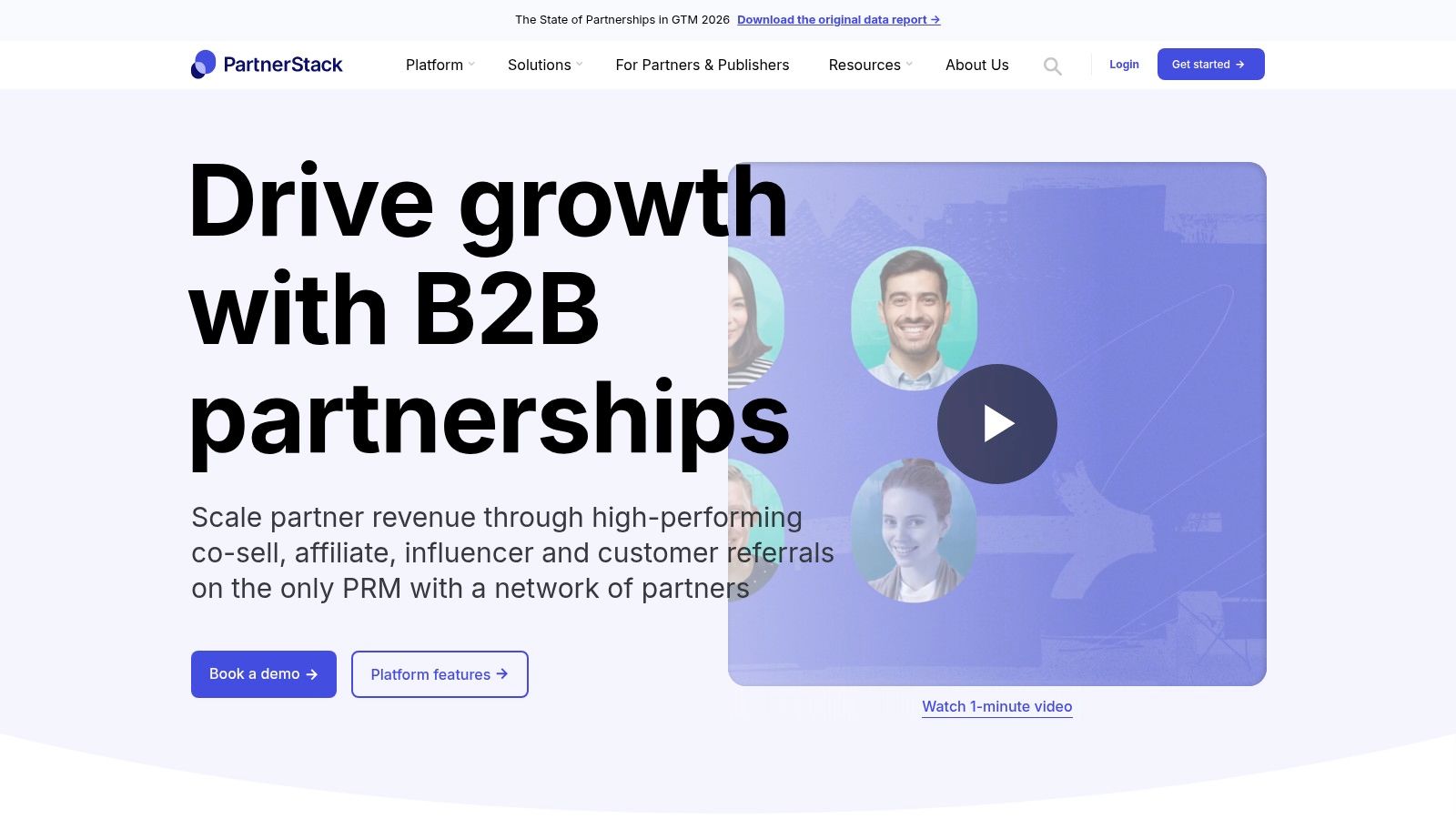
The platform's strength is its laser focus on the SaaS business model, providing tools and analytics tailored to recurring revenue. This specialization, however, means it's not suitable for e-commerce or Amazon brands. The detailed approach to affiliate program management makes it a powerful but specific tool.
Key Features & Use Cases
- SaaS-Specific Tracking: Built to handle recurring revenue and tiered commission structures.
- Partner Automation: Automates onboarding, training, and payouts for various partner types.
- Integrated Marketplace: Helps SaaS brands discover and recruit relevant B2B partners.
- Pricing Model: Custom pricing requiring a sales quote, geared towards established B2B companies.
Pros & Cons
| Pros | Cons |
|---|---|
| Tailored for B2B/SaaS: Features align with SaaS growth. | Niche Focus: Not suitable for e-commerce or Amazon sellers. |
| Partner Automation: Reduces manual partner operations. | Custom Pricing: Not transparent; requires a sales quote. |
| Integrated Marketplace: Helps discover and recruit partners. | Complexity: May be more than needed for simple programs. |
- Website: https://partnerstack.com/
8. Amazon Associates
Best for: Beginners and content creators monetizing with Amazon products.
As Amazon's own in-house affiliate program, Amazon Associates is arguably the most popular and accessible entry point into the world of affiliate marketing. It allows content creators, publishers, and bloggers to monetize their traffic by linking to the millions of products available on Amazon. The platform is entirely free to join and uses a straightforward system where affiliates earn commissions on qualifying purchases made through their unique links.
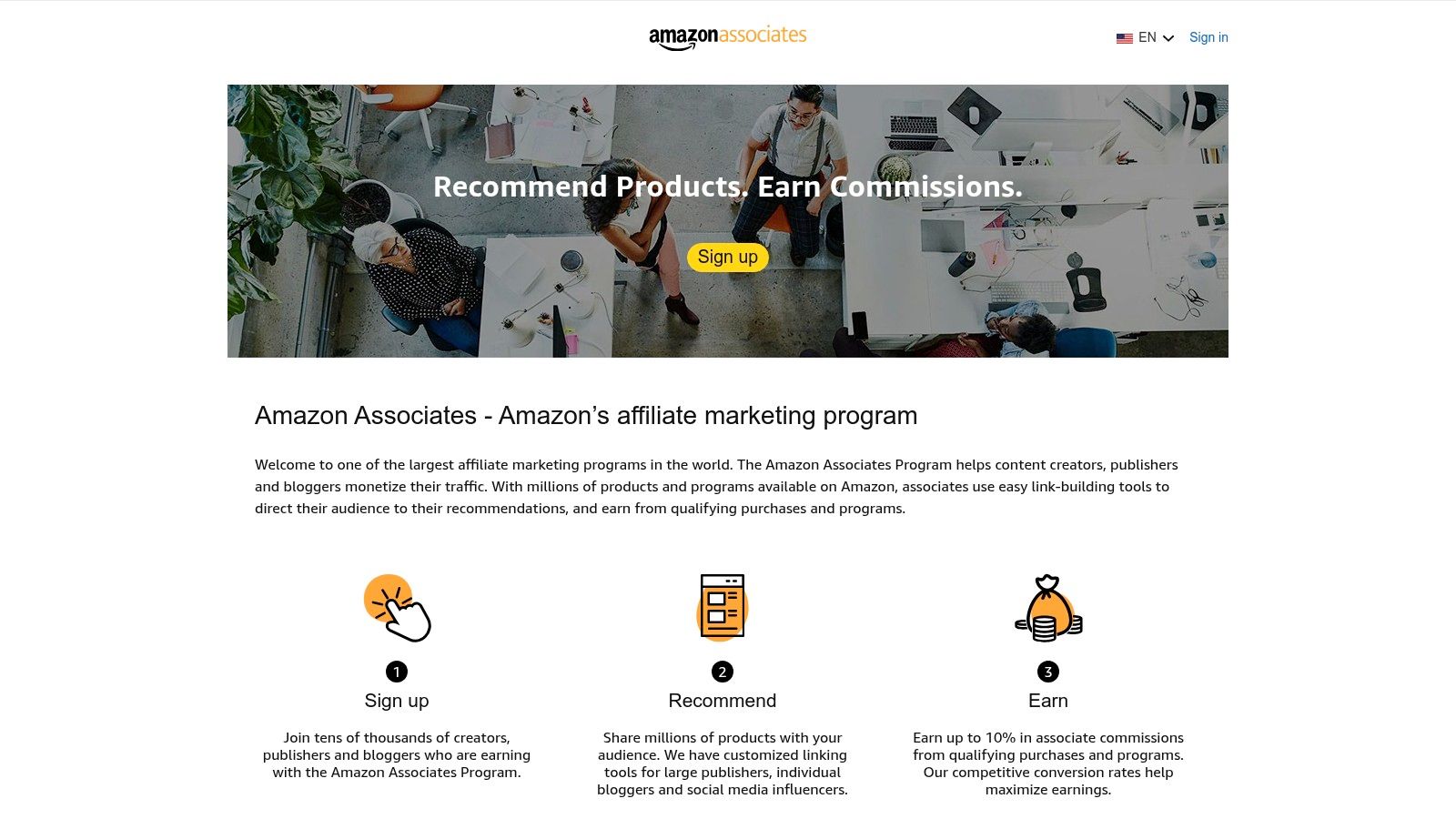
The primary strength of Amazon Associates is its simplicity and brand recognition. However, its commission rates can be low in certain categories and are subject to change. For Amazon brands, this program offers no direct creator management, custom commission structures, or advanced analytics, making it insufficient for building a strategic partnership program.
Key Features & Use Cases
- Basic Link Tracking: Standard affiliate links with a 24-hour cookie duration.
- Fixed Commission Structure: Payouts are based on predetermined product categories.
- Simple Analytics: Basic reporting on clicks, orders, and earnings.
- Pricing Model: Free for affiliates to join; brands have no direct cost but also no control.
Pros & Cons
| Pros | Cons |
|---|---|
| Massive Product Catalog: Virtually endless products to promote. | Low, Fixed Commission Rates: No ability for brands to customize payouts. |
| High Brand Trust: Amazon's reputation boosts conversions. | No Creator Management: Brands cannot build direct relationships. |
| Easy to Start: Simple sign-up and link creation process. | Lacks Advanced Tracking: No integration with Amazon Attribution. |
9. eBay Partner Network (EPN)
Best for: Publishers promoting diverse and dynamic product listings from eBay.
The eBay Partner Network (EPN) is eBay's official in-house affiliate program, offering publishers direct access to one of the world's largest online marketplaces. It stands out by providing partners with powerful APIs and product feeds, making it an excellent platform for those who can build scalable, custom integrations to showcase billions of live listings. For creators in the US and UK, the Ambassador program offers a streamlined way to build and share shoppable storefronts.
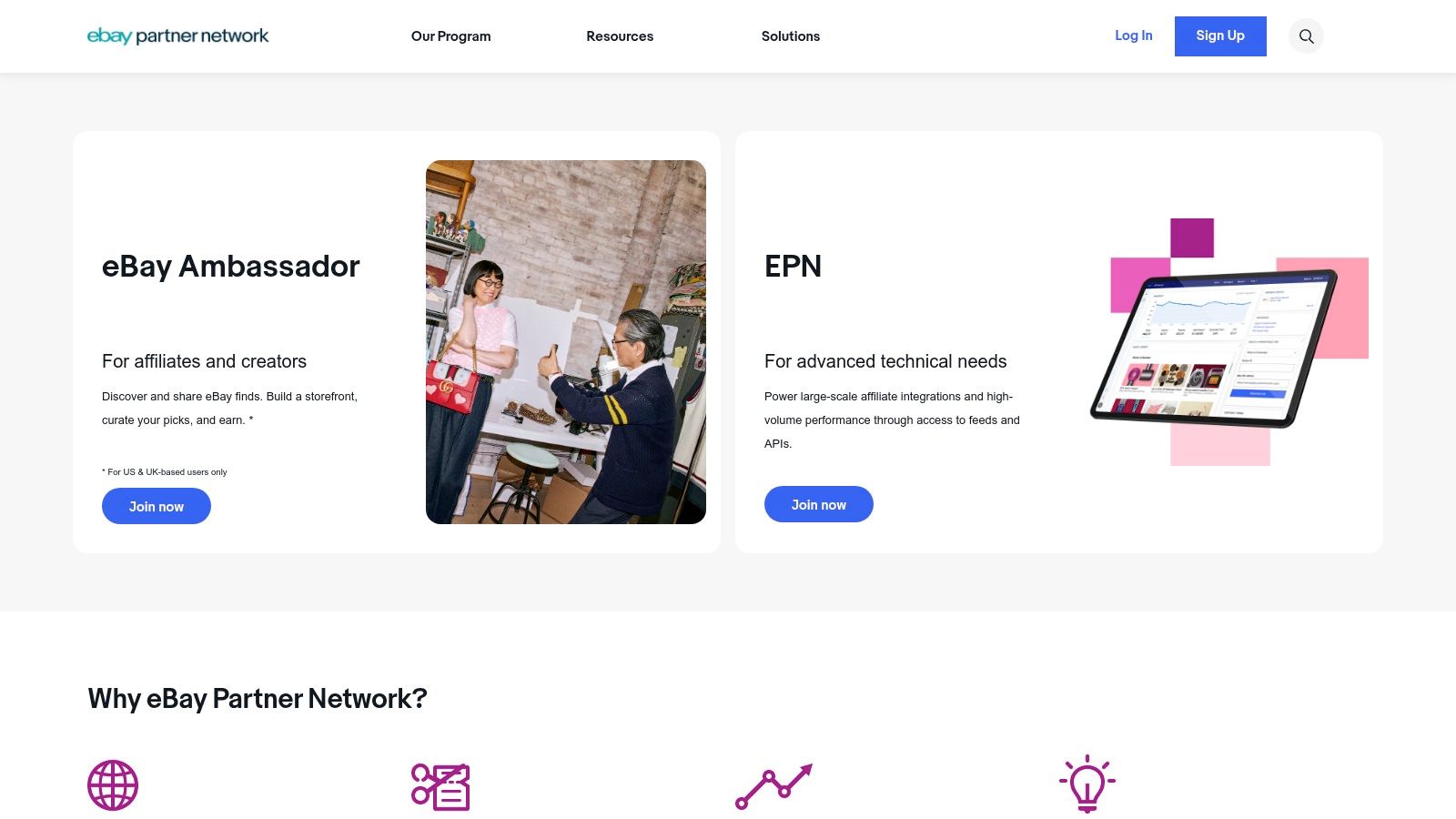
Unlike broad affiliate networks, EPN connects you directly to eBay’s vast inventory. This direct relationship allows for potentially higher commissions on a unique product mix. However, its strength in technical tools can present a steeper learning curve for beginners.
Key Features & Use Cases
- Direct-to-Marketplace Tracking: Connects publishers directly with eBay listings.
- Scalable APIs and Feeds: Ideal for high-volume deal sites and technical partners.
- Creator Storefronts: The Ambassador program allows for easy creation of shoppable pages.
- Pricing Model: Free to join (with an approval process).
Pros & Cons
| Pros | Cons |
|---|---|
| Access to Billions of Listings: Unmatched product variety. | Approval Process: Program acceptance is not guaranteed. |
| Robust Technical Tools: APIs and feeds for scalable partners. | Regional Limitations: Ambassador storefront is only in the US/UK. |
| Educational Resources: Strong support for new partners. | Steeper Learning Curve: Can be complex for non-technical users. |
- Website: https://partnernetwork.ebay.com/
10. ClickBank
Best for: Affiliates focused on high-commission digital products.
ClickBank is a long-standing affiliate network that carves out a niche primarily in the digital product space, including e-books, online courses, and software. It operates a public marketplace where affiliates can browse offers, view performance metrics, and choose products to promote without a lengthy approval process. This transparency makes it a popular starting point for new affiliates looking to find high-commission digital products.
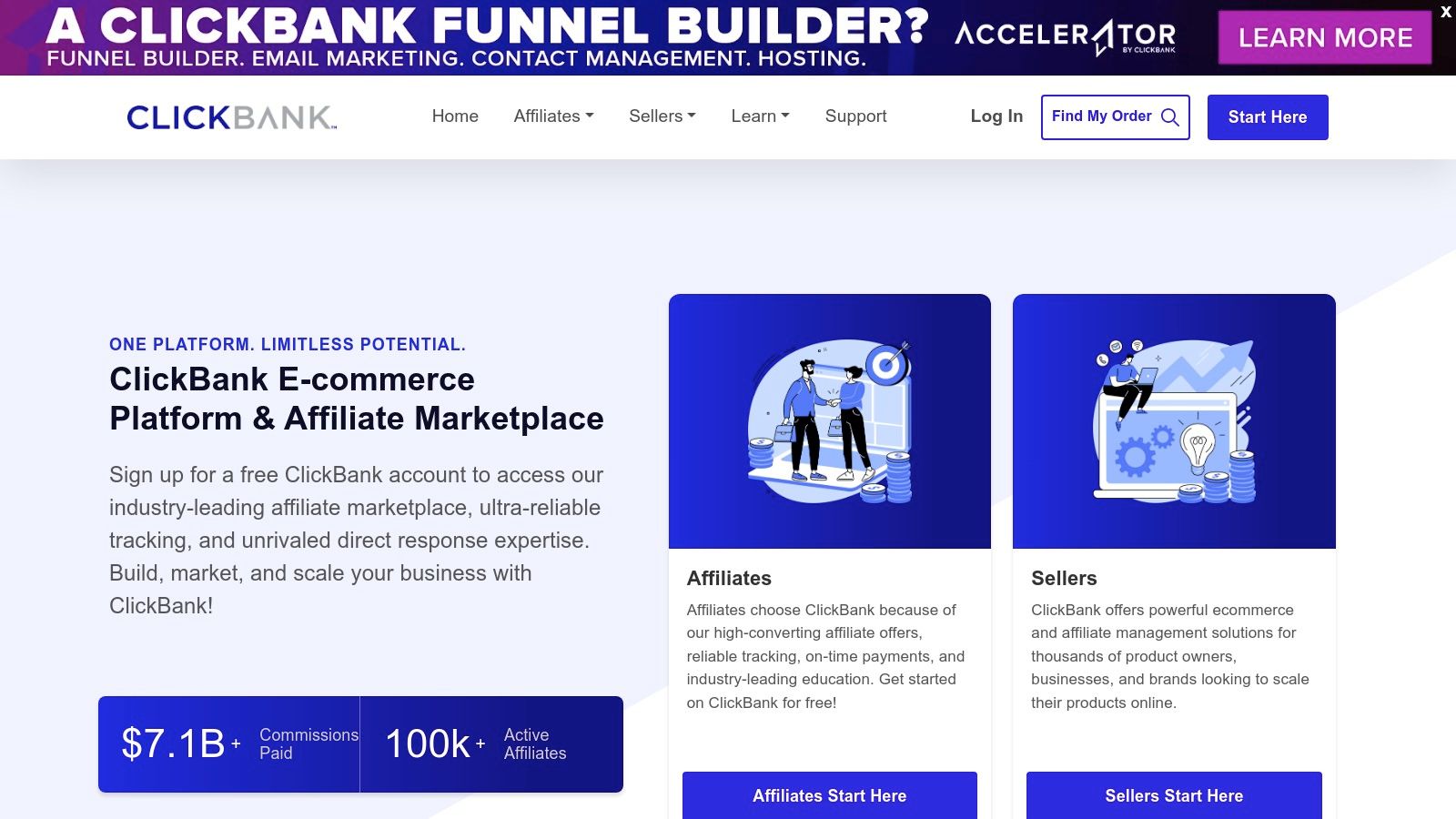
While its strength is in digital goods, the quality of offers can vary significantly, requiring affiliates to carefully vet products before promotion. For creators building an audience and an affiliate website, ClickBank provides a unique inventory of potentially lucrative, niche-specific digital offers.
Key Features & Use Cases
- Marketplace Model: Affiliates can browse and promote offers directly.
- High Commission Structures: Digital products often offer very high revenue shares.
- Beginner-Friendly Analytics: Straightforward reporting for new affiliates.
- Pricing Model: Revenue share model; platform and vendors take a percentage of each sale.
Pros & Cons
| Pros | Cons |
|---|---|
| Transparent Offer Metrics: Public stats help in offer selection. | Variable Offer Quality: Careful vetting of products is essential. |
| High Digital Commissions: Potential for high payouts on courses/software. | Pre-Approval Needed: Some top offers require manual approval. |
| New Affiliate Friendly: Extensive resources to help beginners start. | Niche Focus: Less variety for physical product affiliates. |
- Website: https://www.clickbank.com/
11. FlexOffers
Best for: High-volume publishers leveraging automation and data feeds.
FlexOffers stands out for publishers who value sheer volume and automation. By aggregating over 10,000 advertisers and connecting with more than 65 other networks, it provides an enormous marketplace of potential partners. The platform is free for affiliates to join and is particularly well-suited for content creators who manage multiple sites or rely on large-scale product feeds to monetize their traffic.

Its strength lies in powerful automation tools like FlexLinks, which automatically converts standard URLs into monetized affiliate links. However, like other large networks, publishers must apply to each advertiser individually. The interface, while powerful, can feel overwhelming for absolute beginners.
Key Features & Use Cases
- Aggregated Network: Access to over 10,000 advertisers in one place.
- Automation Tools: Features like FlexLinks automate the link monetization process.
- Data Feeds & APIs: Provides robust tools for technically savvy publishers to integrate product data.
- Pricing Model: Free for publishers; advertiser terms are program-specific.
Pros & Cons
| Pros | Cons |
|---|---|
| Very Broad Advertiser Reach: Access a huge selection of programs. | Individual Approvals: Must apply to each advertiser separately. |
| Useful Automation Tools: Feeds and scripts help scale monetization. | Dense Interface: Can be complex for new users to navigate. |
| Active Support & Onboarding: Good resources for getting started. | Best Suited for Technical Users: Some tools require technical skills. |
- Website: https://www.flexoffers.com/
12. Skimlinks
Best for: Large editorial sites seeking automated, hands-off content monetization.
Skimlinks is a commerce-content monetization platform that automates the affiliate process. Instead of joining individual programs, content creators can install a simple piece of JavaScript, which automatically scans their content for existing merchant links and converts them into trackable affiliate links. This makes it ideal for large-scale editorial sites, blogs, and forums that want to monetize their content without the manual overhead of managing individual partnerships.
The platform’s core strength is its "set it and forget it" simplicity. However, this convenience comes at the cost of control and a portion of earnings, as Skimlinks takes a percentage of the commissions generated.
Key Features & Use Cases
- Automated Link Conversion: JavaScript automatically turns standard links into affiliate links.
- Centralized Reporting: A single dashboard to track performance across all merchants.
- Large Merchant Network: Access to thousands of merchants through a single integration.
- Pricing Model: Revenue share model, where Skimlinks takes a cut of the publisher's commissions.
Pros & Cons
| Pros | Cons |
|---|---|
| Monetize at Scale: Automates link conversion across sites. | Revenue Share Model: Skimlinks retains a percentage of commissions. |
| No Upfront Cost: Free for publishers to join and use. | Less Direct Control: Less control than managing programs directly. |
| Access Exclusive Offers: Taps into negotiated merchant rates. | Delayed Program Discovery: Not a direct merchant discovery tool. |
- Website: https://www.skimlinks.com/
Top 12 Affiliate Marketing Platforms — Comparison
| Platform | Core features | Quality ★ | Pricing & Value 💰 | Target audience & USP 👥 ✨ |
|---|---|---|---|---|
| Coral 🏆 | Amazon Attribution, per-affiliate commissions, branded program pages, creator link builder | ★★★★☆ | 💰 Free (β) +5% sales; Growth $97/mo (0% fees) | 👥 Amazon Brand Registry sellers & creators |
| CJ (Commission Junction) | Large advertiser directory, real-time reporting, consolidated payouts | ★★★★☆ | 💰 Free for publishers; brand pricing via sales | 👥 Broad publishers & advertisers |
| Impact | Unified tracking, contracting, automated payouts, marketplace | ★★★★★ | 💰 Enterprise pricing; Shopify tiers for SMBs | 👥 Enterprise & mid-market brands |
| ShareASale | Merchant directory, link generators, consolidated network payouts | ★★★★ | 💰 Free for affiliates; advertiser fees vary | 👥 SMBs & US-focused publishers |
| Awin (inc. Awin Access) | 1M+ partners, reporting, Shopify integrations, Awin Access self-managed | ★★★★ | 💰 Access fee + tracking fee (e.g., ~3.5%) | 👥 International merchants & publishers |
| Rakuten Advertising | AI/ML partner discovery, migration support, global in-market experts | ★★★★ | 💰 Free publisher signup; advertiser pricing private | 👥 Premium brands & publishers |
| PartnerStack | B2B marketplace, automated onboarding, partner journeys & payouts | ★★★★ | 💰 Custom pricing (RFP/quote) | 👥 B2B/SaaS companies & resellers |
| Amazon Associates | SiteStripe, category-based commissions, consolidated reporting | ★★★ | 💰 Free to join; variable commission rates | 👥 Publishers & creators for consumer products |
| eBay Partner Network (EPN) | Feeds/APIs, reporting, creator storefronts (US/UK) | ★★★★ | 💰 Free to join (approval required) | 👥 Technical/high-volume partners & creators |
| ClickBank | Public marketplace, rev-share & CPA models, training resources | ★★★ | 💰 Marketplace rev-share; variable offer fees | 👥 Affiliates for digital products |
| FlexOffers | FlexLinks auto-monetization, massive product feeds, promo/coupon feeds | ★★★★ | 💰 Free sign-up; advertiser terms vary | 👥 Publishers needing feed/automation scale |
| Skimlinks | JS/plugin auto-converts links, centralized reporting, merchant tiers | ★★★★ | 💰 Rev-share model (platform retains % of commission) | 👥 Editorial publishers & content teams |
Making Your Final Decision: The Right Platform for Your Brand
Navigating the landscape of the best affiliate marketing platforms requires aligning a platform’s strengths with your brand’s specific goals. While large networks like CJ and Awin offer massive reach, and specialized platforms like PartnerStack cater to B2B, the criteria for Amazon brands are unique and non-negotiable.
For sellers building a brand on Amazon, generic tracking and impersonal affiliate directories don’t provide the precision needed to succeed. The key takeaway is this: your affiliate platform must provide superior Amazon attribution. This means seamless integration with Amazon Attribution and the ability to leverage programs like the Brand Referral Bonus. Platforms that can't offer this level of insight leave Amazon sellers flying blind, unable to accurately measure ROI or optimize creator partnerships.
The Clear Choice for Amazon Sellers
This is where Coral emerges as the standout choice. It was built specifically to solve the core challenges Amazon sellers face, offering:
- Superior Attribution: Native integration with Amazon Attribution provides the most accurate sales tracking possible.
- Comprehensive Creator Management: Go beyond basic links to build and scale authentic partnerships with custom commission structures.
- Brand Referral Bonus Maximization: The platform is designed to help you track, prove, and capitalize on the 10% bonus from external traffic.
Ultimately, choosing the right affiliate management software is about gaining control, clarity, and the ability to scale authentic partnerships. While traditional networks offer reach, modern brands on Amazon thrive on the precision and direct creator relationships that platforms like Coral champion. By prioritizing Amazon-native functionality, you are not just tracking sales; you are building a sustainable, profitable, and brand-aligned creator program.
Ready to unlock the full potential of your Amazon creator partnerships? Coral was built from the ground up to master Amazon Attribution and the Brand Referral Bonus, giving you the control and clarity you need to scale effectively. See how the best affiliate marketing platform for Amazon sellers can transform your strategy by starting your free trial with Coral today.