How to Make an Affiliate Website: A Complete Guide
Category: How to make an affiliate website
Starting an affiliate website is simpler than you might think. At its core, you pick a topic you enjoy, set up a basic website (I'm a big fan of WordPress for this), and then create genuinely useful content that points people to products you actually stand behind. You're basically becoming a trusted guide for a specific audience, and you earn a small commission when they take your advice. This guide will walk you through exactly how to do that, step by step.
Your Blueprint for a Profitable Affiliate Website
Building a successful affiliate website isn't about being a tech genius; it's about following a clear, methodical plan. Think of it as a journey from a simple idea to a reliable source of income, all built on providing real value to your readers. The whole game is about becoming the go-to resource for a specific niche, whether that's home espresso machines, sustainable travel gear, or even coding bootcamps.
You don't have to be the world's leading expert on day one. All you need is genuine curiosity and the drive to share what you learn along the way. Your job is to help people make smarter buying decisions by creating content that answers their questions, compares their options, and offers honest insights.
Laying the Foundation for Success
Before you get bogged down in themes and plugins, let's zoom out and look at the big picture. An affiliate site starts with finding a problem or an interest, building a platform to talk about it, and then connecting your audience to the right products through affiliate links. A lot of people get stuck overthinking the planning stage, but the real secret is to start small and improve as you go.
The process boils down to three main phases: coming up with the initial idea, handling the technical setup, and then monetizing your content.
This infographic lays out the journey from a concept to your first commission check.
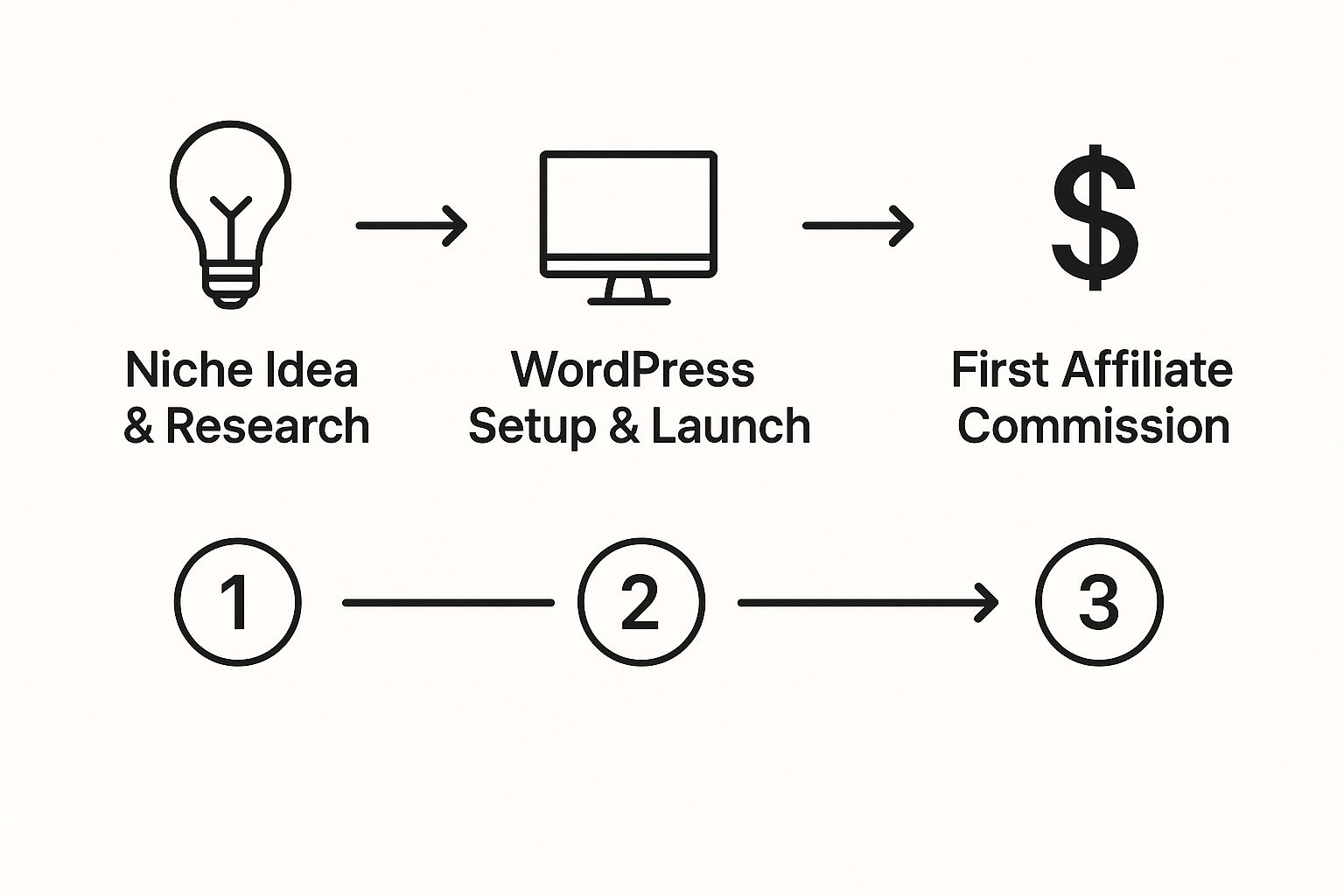
Each of these stages builds on the one before it, creating a solid foundation for a business that can grow for years to come.
To give you a clearer roadmap of what's ahead, here's a quick look at the entire process.
Affiliate Website Creation At a Glance
This table breaks down the core stages you'll go through when building and launching your affiliate website.
| Stage | Key Objective | Estimated Time Commitment |
|---|---|---|
| Niche Selection | Find a profitable topic you're interested in. | 1-3 days |
| Platform & Setup | Choose a domain, hosting, and install WordPress. | 1 day |
| Content Strategy | Plan the articles that will attract your audience. | 1-2 weeks (initial planning) |
| Content Creation | Write and publish your first foundational articles. | 2-4 weeks (for the first 5-10) |
| Monetization & Launch | Join affiliate programs and add links to content. | 1 week |
| Promotion & Tracking | Drive traffic and analyze what's working. | Ongoing |
This timeline is a rough guide, but it shows how you can get a site off the ground in just a couple of months with focused effort.
Understanding the Opportunity
The potential here is massive and it’s still growing. The global affiliate marketing industry is already valued at over $18.5 billion and is expected to climb to nearly $28 billion by 2027. With roughly 81% of advertisers and 84% of publishers already on board with affiliate programs, this isn't some fringe strategy—it's a core part of modern online business.
The best affiliate marketers don't just push products; they solve problems. Your content is the bridge between someone's question and the perfect solution. Your affiliate link is just the final, helpful step on that path.
This shift in mindset is everything. Instead of asking, "How can I sell this?" you should be asking, "How can my content help someone with this product?" That audience-first approach is what builds the trust needed for people to actually click your links and make a purchase.
Of course, choosing the right partners is a huge piece of the puzzle. Taking the time to understand the differences between the best affiliate marketing platforms will give you a major leg up. This guide will give you the blueprint, but it's your unique perspective and dedication to helping people that will ultimately make your site a success.
Finding a Niche You Can Actually Win
This is it. The starting line. And honestly, it's where most people trip. They see the massive potential in markets like "fitness" or "travel," dive in, and immediately get swamped by the big players who have been there for years.
The secret to a successful affiliate site isn’t about going big; it’s about going deep. It’s about finding a focused corner of the internet that you can genuinely make your own. Your passion is the fuel here. If you're not interested in the topic, you'll burn out long before you see a single commission check. So start with what you actually enjoy.
Going From Broad Topic to Focused Niche
The real magic happens when you start narrowing things down. By carving out a specific sub-niche, you start talking to a much more dedicated audience, which makes it infinitely easier to rank on Google and build real authority. You want to be a big fish in a small pond, not a minnow lost at sea.
Let's break it down with a classic example. "Fitness" is a monster of a topic. You’ll never rank for it. But watch what happens when we drill down:
- Broad Topic: Fitness
- Sub-Niche: Home workouts
- Focused Niche: Sustainable yoga gear for home practice
- Hyper-Focused Niche: Non-toxic, cork yoga mats for beginners
See the difference? By zeroing in on "sustainable yoga gear," you’re suddenly targeting a very specific person. This isn't just someone looking for a cheap mat; this is someone who cares about eco-friendly products and is ready to invest in quality. That’s an audience you can connect with and win over.
How to Uncover Winning Niche Ideas
Your sweet spot is where your interests, what people are searching for, and real money-making potential all overlap. The very first skill to master is learning how to find your niche the right way.
Here are a few practical ways to start digging:
- Hang Out in Online Communities: Spend time in Reddit subreddits or niche Facebook Groups that are all about your hobbies. Pay attention to the questions people ask over and over. What problems do they complain about? What products are they always asking for recommendations on? This is pure gold.
- Check the Search Trends: Pop your ideas into a free tool like Google Trends. Is this a passing fad or a topic with staying power? You’re looking for stable, evergreen interest, not a flash in the pan.
- Do a Quick Gut-Check on the Competition: A simple Google search tells you a lot. If the entire first page is packed with household names like Forbes, Wirecutter, or the New York Times, it’s probably a tough nut to crack. Look for niches where you still see smaller blogs, forums, and real people ranking.
Key Takeaway: A great niche isn't just about finding something with low competition. It's about finding a group of people with a specific problem you can solve through fantastic content and genuinely helpful product suggestions.
Validating Your Niche With Affiliate Programs
Okay, you've got a few solid ideas. Now for the million-dollar question: can you actually make money with them? A perfect niche is worthless if there are no good affiliate programs to join.
Start with a simple Google search for "[your niche] + affiliate program." What pops up? Are the brands reputable? Are these products your target audience would actually get excited about buying?
As you evaluate programs, keep these three things in mind:
- Commission Rate: This is the cut you get from each sale. It can be all over the map, from a tiny 1-4% on physical goods (think Amazon) to a hefty 20-50% or more for software and digital products.
- Cookie Duration: This is how long you get credit for a sale after someone clicks your link. A longer window—like 30, 60, or even 90 days—is always better than a short 24-hour one.
- Brand Reputation: Promoting junk is the quickest way to kill your credibility. Only partner with companies and products you’d feel good about recommending to a friend.
A lot of beginners find it helpful to look at successful Amazon affiliate website examples to get a feel for what works. While Amazon's commissions are famously low, people trust Amazon and buy from it constantly, so it converts well. It’s a fantastic starting point for physical products, and you can always layer in other, higher-paying affiliate programs as you grow.
Alright, you've nailed down a promising niche. Now comes the fun part: building the actual home for your content.
This is where we get into the nuts and bolts, but don't worry—you don't need to be a coding genius to get this done. Building an affiliate site today is surprisingly simple, and getting this foundation right from the start will save you a world of pain later on. Our goal is to set up a reliable, fast, and easy-to-manage "tech stack" so you can pour your energy into what actually makes you money: your content.
Choosing Your Domain and Hosting
First things first, you need a domain name. Think of this as your brand's address on the internet. It's the first thing people will see, so make it good. Aim for something memorable, easy to spell, and connected to your niche. If you can, steer clear of hyphens or numbers; they just make it harder for people to remember and share. A classic .com is almost always your best bet.
Next up is web hosting—the piece of digital real estate where your website will live. This is one area where you absolutely should not skimp. A cheap, slow host will sabotage your site's performance, killing your Google rankings and driving visitors away. Look for hosts known for rock-solid uptime, helpful customer support, and, most importantly, speed.
Many beginners start with shared hosting because it's cheap, but I'd suggest looking at providers like Rocket.net or Cloudways. They offer a huge step up in speed and can handle traffic spikes as you grow, which is a total game-changer.
Why WordPress is the Gold Standard
When it comes to the platform for your site, there's really only one conversation to be had: WordPress.org. And yes, it has to be the .org version, not .com. The self-hosted version gives you total control, which is non-negotiable for a serious affiliate marketer.
There's a reason WordPress powers over 43% of all websites on the planet. It's open-source, which means there's a massive community building themes and plugins for it. You can build pretty much anything you can dream of, and that flexibility is exactly what we need.
Once you’ve signed up for hosting, most providers have a one-click WordPress install. It typically takes less than five minutes and is the first real step to bringing your site to life.
Picking a Theme That Puts Performance First
Your WordPress theme controls the design and layout of your site. It’s easy to get distracted by flashy designs with tons of features, but your number one priority here should be speed. A bloated, slow-loading theme will sink your SEO efforts before you even get started.
I always recommend lightweight, performance-focused themes like GeneratePress, Blocksy, or Kadence. These are built to be incredibly fast and clean, giving you a perfect canvas for your content without dragging the site down. They’re also super customizable, so you can easily get the look and feel you want for your brand.
Pro Tip: Resist the urge to install a heavy, complex page builder right away. Modern themes that use the native WordPress block editor (Gutenberg) are significantly faster and much easier to maintain over the long haul.
Your Essential Affiliate Plugin Toolkit
Plugins are just little apps you install to add new features to your WordPress site. The key is to be a minimalist; installing too many can slow down your site and open up security holes. That said, a few are absolutely essential for any serious affiliate marketer.
The official WordPress plugin directory has thousands of free tools available, so you can find something for almost any function you can imagine.
Here's the core toolkit I recommend for every new affiliate site:
- An SEO Plugin: This is your command center for on-page optimization. A tool like Rank Math or All in One SEO will walk you through optimizing your titles, meta descriptions, and content to give you the best shot at ranking in Google.
- Affiliate Link Management: A link cloaking plugin is non-negotiable. Tools like Pretty Links or ThirstyAffiliates take those long, ugly affiliate URLs and turn them into clean, branded links (like
yoursite.com/go/product). This not only looks more professional and trustworthy but also lets you manage every single link from one central dashboard. - A Caching Plugin: Site speed is everything for user experience and SEO. A solid caching plugin like WP Rocket or FlyingPress creates static, lightning-fast versions of your pages. This dramatically cuts down load times and makes your site feel snappy to visitors.
- Analytics: You can't improve what you don't measure. You need a simple way to install Google Analytics to track your traffic, see where people are coming from, and figure out which content is actually working.
By getting this handful of foundational tools in place, you’ll have a powerful and efficient platform, ready for the most important step: creating content that people love and that drives sales.
Creating Content That People Trust and Buy From
Alright, your website is live and you've got the essential plugins installed. Now comes the part that really makes or breaks an affiliate site: the content.
Think of your content as the engine of your entire operation. It's what brings people in, earns their trust, and ultimately helps them feel confident clicking "buy" based on your recommendation.
The biggest mistake I see new affiliates make is trying to just push products. That's not your job. Your real job is to be a problem-solver. You're there to answer questions, clear up confusion, and guide your reader to the best possible solution. The affiliate link is just the final, helpful step in that journey.
The Most Effective Types of Affiliate Content
You can write a hundred articles, but if they aren't the right kind of articles, you won't see many commissions. Certain content formats are just naturally built to help people who are already in a buying mindset.
Let's dig into the three powerhouses you absolutely need to master.
In-Depth Product Reviews
This is the bread and butter of affiliate marketing, and for good reason. A truly great product review goes so much deeper than just listing off features from the manufacturer's website. It needs to feel real. It needs to share a genuine, hands-on experience that gives your reader the full story—the good and the bad.
- Get Beyond the Spec Sheet: Don't just say a coffee maker has a 12-cup carafe. Talk about the rich aroma it produces, how the coffee actually tastes, or how easy it is to clean. If it's a software tool, explain a specific problem it solved for you and how it made your workflow better.
- Show, Don't Just Tell: Use your own photos and videos. Stock photos are an instant red flag for a savvy buyer. Show the product in your hands, from different angles, in a real-world setting. A quick video walkthrough can do wonders for building trust.
- Be Brutally Honest (About the Flaws): Nothing is perfect. Pointing out a minor downside or explaining who the product isn't a good fit for makes your review exponentially more believable.
A truly great review answers the questions a reader didn't even know they had. It anticipates their doubts and provides clear, honest answers, making the decision to buy feel easy and confident.
Detailed Comparison Posts
People are often stuck between two or three popular options. They're not deciding if they should buy, but which one they should buy. This is where you can be a hero.
Comparison posts, like the classic "Product A vs. Product B," are absolute conversion machines. You pit two popular products against each other and help your reader make that final, difficult choice.
A simple table right at the top can make a huge difference in helping people digest complex info quickly:
| Feature | Product A | Product B | Our Verdict |
|---|---|---|---|
| Price | $99 | $129 | Product A |
| Ease of Use | Beginner-friendly | Steeper learning curve | Product A |
| Performance | Good for daily tasks | Pro-level features | Product B |
This kind of post targets people at the very bottom of the sales funnel—the ones with their credit cards practically in hand.
"Best Of" Roundup Posts
Articles like "The 7 Best Drones for Beginners" or "Best Web Hosting for Small Businesses" are magnets for people who are just starting their research. Your role here is to act as the expert curator, saving them countless hours of sifting through options online.
These posts are fantastic for several key reasons:
- They naturally target valuable, high-intent keywords.
- They allow you to place multiple affiliate links in a single article.
- They position you as an authority and a trusted resource in your niche.
The key to a good roundup is transparency. Don't just list products; explain why you chose them. What was your selection criteria? What makes each one a "best" pick for a certain type of person? That's how you build the trust that leads to a click.
Writing for People First, Search Engines Second
Let's be clear: the old days of stuffing your articles with keywords are dead and gone. Thank goodness.
Today, Google and other search engines are smart enough to prioritize high-quality, helpful content that actually satisfies the user. This is great news for us, because it means that what's good for your reader is also good for your rankings. Learning this is a critical piece of building an affiliate website that actually lasts.
Some of the most successful affiliate marketers I know can pull in over $44,000 a month simply because they've mastered this user-first approach.
Your on-page SEO strategy should feel simple and natural, not forced:
- Use Your Main Keyword Naturally: Pop your main keyword in your title, somewhere in the first paragraph, and maybe in a couple of subheadings. That's usually enough.
- Write a Killer Meta Description: This is the little blurb that shows up under your title in Google. Think of it as an ad for your article—make it compelling enough to earn the click.
- Structure with Clear Headings: Use H2s and H3s to break your content into logical, scannable chunks. It makes the article easier to read for people and easier to understand for search engines.
At the end of the day, authentic and genuinely helpful content always wins. This holds true whether you're writing for a blog or exploring a different medium like affiliate marketing for YouTube. Be the trusted guide your audience is looking for, and the commissions will naturally follow.
Getting Traffic and Measuring What Works
Alright, you’ve got your content machine running. Now for the million-dollar question: how do you get people to actually see it? Building a great affiliate site is one thing, but getting a steady stream of the right kind of traffic is what separates a hobby from a business.
Your main goal is to get in front of people who are already looking for the answers you provide. While you can dabble in paid ads or social media, your long-term bread and butter will almost always be search engine optimization (SEO).
The whole point of SEO is to create content so genuinely helpful that Google can't help but show it to its users. Bringing visitors to your site is the name of the game, so it's always smart to be learning how to increase website traffic and testing new ideas.
Building Your Authority with SEO
For an affiliate site, good SEO really boils down to two things: amazing content (which we just talked about) and high-quality backlinks.
Think of a backlink as a vote of confidence. When another website links to one of your articles, they're essentially telling Google, "Hey, this content is legit." The more of these "votes" you get from respected sites in your niche, the more authority your own site builds.
The trick is to earn these links, not buy them. Here’s how real-world affiliates do it:
- Guest Posting: Write a killer article for another blog in your space. In return, you usually get a link back to your site in your author bio. It’s a classic win-win.
- Create Link-Worthy "Assets": Go beyond standard blog posts. Build something unique—original data, a killer infographic, or a simple free tool—that other creators will naturally want to share and link to.
- Build Real Relationships: Get active in your community. Connect with other bloggers and creators. When you build genuine connections, linking to each other's work often happens naturally.
Measuring What Matters Most
Getting a flood of traffic feels great, but if you don't know where it's coming from or what it's doing, it's just a vanity metric. You have to track your performance to understand what’s actually driving revenue. This is where analytics save the day.
Setting up a free tool like Google Analytics is non-negotiable. It’s your command center for understanding key metrics:
- Traffic Sources: Are people finding you through Google, Pinterest, or a link from another blog?
- Top Pages: Which of your articles are a hit with readers?
- User Behavior: How long are people sticking around? Which pages make them leave?
Tracking isn't just about counting visitors; it's about understanding behavior. The data tells you what your audience loves, what they ignore, and where your biggest opportunities for growth are hiding.
This data is your roadmap. Industry reports show that while 80% of brands value affiliate marketing, 59% struggle to see how it connects to other channels and 43% have issues with tracking. By setting up solid analytics from the get-go, you’re already ahead of nearly half the competition.
The final piece of the puzzle is connecting your website traffic to your affiliate income. Your affiliate dashboards show you the clicks, sales, and commissions. By comparing that data with your Google Analytics, you can see exactly which articles are making you money.
This lets you double down on what’s working and fix what isn’t. This entire feedback loop is critical for understanding your bottom line, and you can learn more about how to measure marketing ROI right here.
Got Questions? Let's Clear a Few Things Up
As you dive into building your own affiliate site, you're bound to have some questions. Everyone does. Let's tackle some of the most common ones I hear so you can move forward with confidence.
Think of this as the FAQ you'd ask a seasoned pro over a cup of coffee. We'll get straight to the point on what it costs, how long it really takes to see money, and more.
How Much Does It Really Cost to Start an Affiliate Website?
This is one of the biggest hurdles for people, but it's mostly a mental one. You don't need a massive budget to get this off the ground. Honestly, your only essential startup costs are a domain name and web hosting.
A good domain name will set you back about $10-$20 for a year. Then, you'll need reliable web hosting, which is non-negotiable for a fast, trustworthy site. A solid starter plan will run you somewhere between $10 to $30 per month.
All in, you're looking at an initial investment as low as $120-$380 for your first year. Plenty of fantastic tools for SEO and link management offer free versions that are more than enough to get you started. You can always upgrade to the paid stuff once your site is actually making money.
Key Takeaway: You don't need thousands of dollars to get started. Just focus your initial funds on a quality domain and fast hosting. Everything else can be added later as you grow.
How Long Until I Start Making Money?
Ah, the million-dollar question. The honest-to-goodness answer is... it depends. There’s no switch you can flip, but a realistic timeframe to see your first real commission is anywhere from 6 to 12 months.
Why so long? Well, it takes time for Google to find your site and start taking it seriously. It also takes time for you to build a foundation of genuinely helpful content that people want to read and that can start ranking for keywords.
Your timeline is really in your hands and depends on a few things:
- Your Niche: A less crowded, more specific niche can often see results faster.
- Content Quality: If your articles are truly top-notch and solve a real problem, they'll climb the ranks quicker.
- Content Volume: The more great content you consistently publish, the more lines you have in the water.
- Promotion Efforts: You can't just publish and pray. Your work on SEO and outreach will dramatically speed things up.
The most important thing is consistency. If you treat this like a real business and stick to your plan, the results will come. Don't get bummed out if you're not seeing sales in month three—that's completely normal.
Can I Do Affiliate Marketing Without a Website?
Technically, sure. You can see people dropping affiliate links on YouTube, Pinterest, and Instagram all the time. But if you're serious about this, building your own website is a much smarter, more sustainable play for the long term.
A website is an asset that you own and control. You're not at the mercy of some platform's random algorithm changes, new rules, or the risk of getting banned overnight. Your site is your home base—a place to build a real brand, an email list, and a library of content that works for you around the clock. Social media can be a great traffic source, but a dedicated website is the bedrock of a real affiliate business.
Is Amazon Associates the Only Program to Join?
Not even close. While the Amazon Associates program is a fantastic place to start, think of it as training wheels. Its biggest strengths are the endless product selection and the fact that everyone already trusts Amazon, which helps with conversions when you're new.
But let's be real: their commission rates are pretty low, often just 1-4% in most categories. As your site gains traction, you absolutely need to diversify. Thousands of companies have their own in-house affiliate programs that offer much better rates—think 20-50% or even more, especially for software and digital products. A healthy, mature affiliate site pulls in revenue from a mix of different programs.
Ready to build and manage your own powerhouse team of affiliates? With Coral, you can recruit, track, and pay your creators all from one simple dashboard. Take control of your brand's growth and turn your biggest fans into your best marketers. Get started with Coral today