How to Measure Marketing ROI: The Ultimate Guide
Category: How to measure marketing roi
So, what does measuring marketing ROI actually mean? It’s pretty simple: it’s the process of figuring out the financial return you get from your marketing campaigns compared to what you spent on them. It’s how you go from guessing which campaigns are working to knowing exactly which ones are making you money and which are just draining your budget.
What Marketing ROI Really Means

Marketing ROI, or Return on Investment, is way more than just a buzzword thrown around in meetings. It’s the metric that ties your marketing activities directly to business growth. It tells you exactly how much revenue you’re generating for every single dollar you spend, making it the ultimate measure of accountability for your team.
Without tracking ROI, you're basically marketing with a blindfold on. Sure, you might feel busy running ads, posting on social media, or sending out emails, but you have no real idea if any of it is actually contributing to the bottom line. This is where so many marketers go wrong, pouring money into channels that don't perform or struggling to justify budget increases to the people upstairs.
Why You Can’t Afford to Ignore ROI
Having a data-driven mindset isn’t optional anymore. When you consistently track your ROI, you start making smarter, more strategic decisions that actually move the needle.
Here’s why it’s such a big deal:
- Justify Your Budget: It gives you hard evidence to prove the value of your marketing spend. This makes it a whole lot easier to get the resources you need for your next big campaign.
- Optimize Your Strategy: By seeing which channels are the most profitable, you can double down on what’s working and pull back on what’s not. No more guesswork.
- Prove Your Worth: ROI connects your work to tangible business outcomes. It flips the script, showing that marketing isn't just a cost center—it's a powerful revenue driver.
This isn’t just my opinion; the industry is laser-focused on this. Today, 83% of marketing leaders say that demonstrating ROI is their absolute top priority. The catch? Only 36% of marketers feel they can measure it accurately, and almost half of them struggle with attribution.
When it comes to affiliate campaigns, this is even more critical. Measuring influencer marketing ROI isn't just about counting clicks. It's about understanding how creators actually drive sales and build your brand's equity over the long haul. For a deeper dive, check out our complete guide on how to calculate influencer marketing ROI.
To get you started, here's a quick look at the essential numbers you'll need for your ROI calculations and what they reveal about your performance.
Key Metrics for Your ROI Calculation
| Metric | What It Measures | Why It's Critical for ROI |
|---|---|---|
| Total Revenue | The total income generated from your affiliate campaign sales. | This is the "return" part of ROI. It's the top-line number your marketing efforts produced. |
| Gross Profit | Your revenue minus the cost of goods sold (COGS). | This gives you a more accurate picture of profit, which is a better measure of true return. |
| Marketing Spend | The total cost of your campaign, including creator fees, ad spend, and tool subscriptions. | This is the "investment" part of ROI. You need to know exactly what you spent to calculate your return. |
| Cost Per Acquisition (CPA) | The average cost to acquire one new customer. | This tells you how efficient your campaign is at converting leads into paying customers. |
| Customer Lifetime Value (CLV) | The total revenue a business can expect from a single customer account. | CLV helps you understand the long-term value of the customers you're acquiring, not just their first purchase. |
Getting a handle on these metrics is the first step toward real clarity.
At the end of the day, learning how to measure marketing ROI is all about gaining control. It transforms your strategy from a bunch of separate tactics into a cohesive, goal-oriented machine designed for one thing: sustainable growth.
Gathering the Right Data for an ROI You Can Actually Trust

You've heard it a million times: you can't measure what you don't track. When it comes to ROI, this isn't just a cliché; it's the absolute truth. Any calculation is only as good as the data behind it. Garbage in, garbage out.
Before you even touch a formula, you need a painfully honest picture of two things: what you actually spent and what you actually earned. Let's break down how to get those numbers right.
Defining Your Total Marketing Investment
Getting a true handle on your costs means looking far beyond your ad spend. Your total investment is a mix of several different expenses, and if you miss any, your ROI calculation will be a fantasy.
Make sure you're tracking all of these:
- Direct Ad Spend: This is the easy one. It’s what you pay directly to platforms like Meta, Google, or TikTok.
- Software and Tools: Don't forget the monthly subscriptions for your analytics tools, CRM, email marketing platform, and anything else in your marketing stack.
- Content and Creative Costs: Did you pay a freelancer to write blog posts? A designer for new graphics? An agency for video ads? All of that counts.
- Affiliate and Influencer Fees: This includes not just the commissions you pay out, but also the cost of sending free products (product seeding) and any flat-rate collaboration fees.
My rule of thumb is simple: if you had to spend that money to make your marketing happen, it belongs in the "investment" column. Getting this comprehensive view is the only way to honestly assess your performance. Once you've got your costs tallied, it's time to connect your marketing efforts to the money coming in.
I see this all the time: marketers track the big ad spend but completely ignore the "smaller" recurring costs of software and creative freelancers. Those expenses can easily add up to 15-20% of a total marketing budget. Forgetting them will give you a dangerously inflated ROI.
Attributing Revenue with Precision
Here’s where a lot of marketing ROI calculations fall apart. Accurately attributing revenue requires a solid tracking setup that connects specific actions—like a click on an affiliate link—to a final sale. Without it, you’re just guessing which channels are actually working.
If you’re running an e-commerce store on your own website, you’re likely using a tracking pixel, like the Meta Pixel or Google Ads tag. These little code snippets are your best friends for linking conversions back to the ads that drove them. You should also be using UTM parameters on all your links to get a clear view of your traffic sources in Google Analytics.
But for Amazon sellers, it's a different ballgame. You can't just slap a pixel on your product detail page. This is exactly why tools like Amazon Attribution are so critical. And for brands running affiliate programs that drive traffic to Amazon, using a platform that syncs directly with Amazon Attribution is a must-have.
If you need a deeper dive, we've put together a full guide on https://coral.ax/blog/how-to-track-amazon-sales.
At the end of the day, solid data is the bedrock of any precise calculation, which is why it's so important to have effective PPC reporting strategies in place. When you combine a full accounting of your costs with a rock-solid system for attributing sales, you finally have a dataset you can trust.
The ROI Formulas You Actually Need to Know

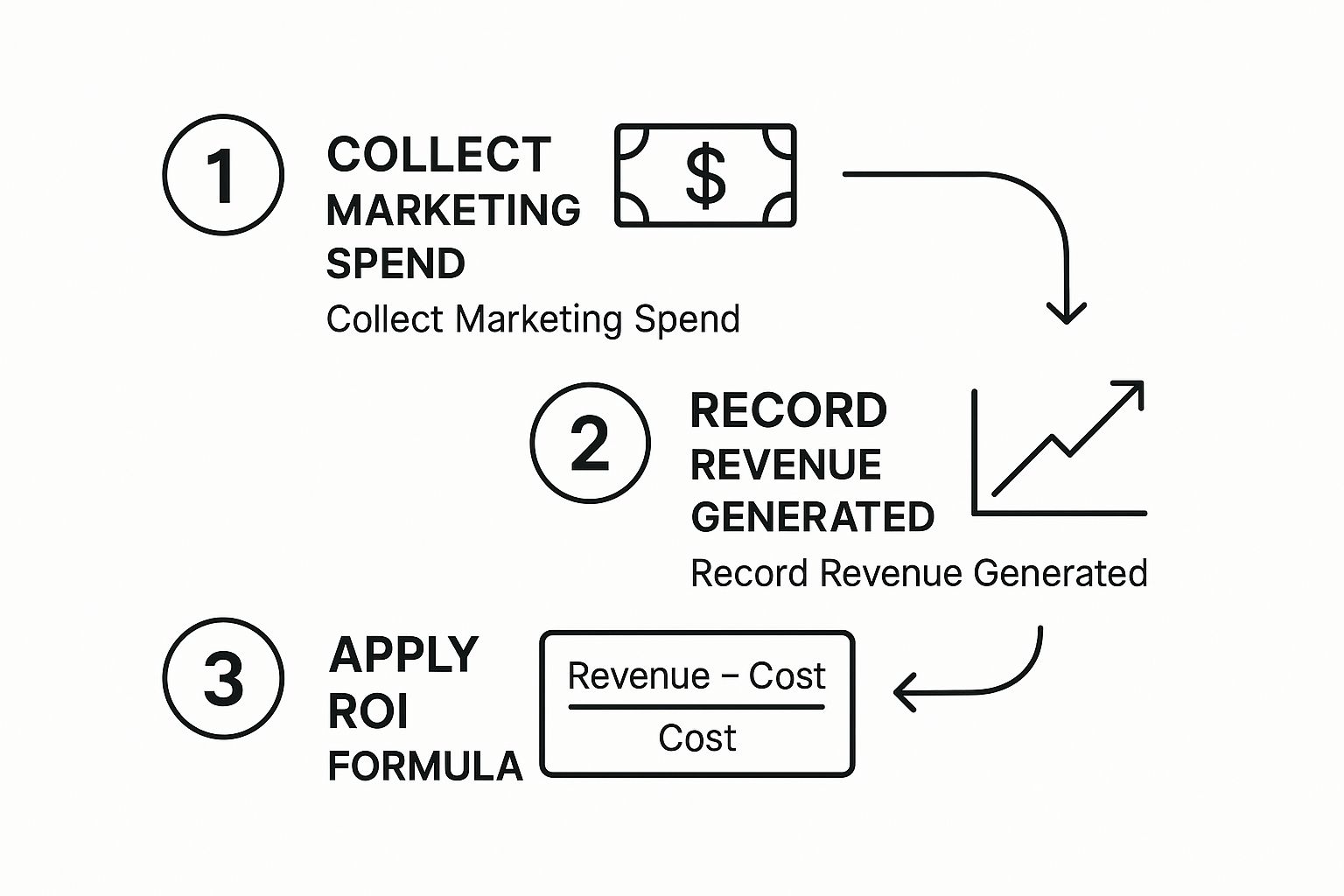
Let's cut through the noise and get straight to the math that matters for measuring your marketing success. At its heart, the main ROI formula is refreshingly simple. It’s built to answer one question: for every dollar I spent, how much did I get back?
The classic formula looks like this: [(Sales Growth - Marketing Cost) / Marketing Cost] x 100%
To see it in action, picture a local coffee shop spending $1,000 on a social media campaign for a new seasonal latte. That campaign brings in $4,000 in sales.
Here’s how the numbers play out:
- [($4,000 - $1,000) / $1,000] x 100% = 300% ROI
What does that mean? For every dollar the coffee shop invested, they earned back $3 in profit. It’s a clear, straightforward win. But as any seasoned marketer knows, this simple calculation only scratches the surface.
Going Beyond the Basic Formula
To really get a handle on your marketing ROI, you have to think past the immediate return of a single campaign. The smartest brands focus on the long-term value of the customers they bring in. This is where two other crucial metrics become your best friends: Customer Acquisition Cost (CAC) and Customer Lifetime Value (CLV).
Customer Acquisition Cost (CAC): This is simply your total marketing spend divided by the number of new customers you gained. For our coffee shop, if that $1,000 campaign attracted 100 new customers, their CAC is $10 per customer.
Customer Lifetime Value (CLV): This metric is a powerful forecast of the total revenue you can realistically expect from a single customer over their entire relationship with you.
Calculating CLV is a total game-changer. It completely reframes how you look at your marketing spend. A $10 cost to acquire someone might seem steep for a single $5 coffee, right? But what if that customer loves the latte so much they come back every week for the next two years? All of a sudden, that $10 investment looks like a stroke of genius.
The Long-Term Impact of CLV on ROI
Let's go back to our coffee shop one last time. The initial campaign pulled in a respectable 300% ROI. Great stuff. But when you start factoring in CLV, the real value becomes undeniable.
Let’s say the average customer from that campaign has a CLV of $500. Now, the $10 you spent to get them in the door didn't just generate a small profit on one latte; it unlocked a long-term revenue stream. The campaign didn't just sell coffee; it built a loyal customer base.
This shift in perspective is what separates good marketing from great marketing. You move from a short-term, campaign-focused view to a long-term, business-growth mindset. Combining basic ROI with CAC and CLV gives you a much more accurate, holistic picture of what your marketing is truly achieving. Using tools like an SEO ROI calculator can also make it easier to apply these formulas to different types of campaigns.
Cracking the Marketing Attribution Code
Let's be honest, figuring out which marketing effort actually led to a sale can feel like the toughest part of the entire ROI puzzle. This is the core challenge of marketing attribution: deciding how to assign value to all the different ads, emails, and content that a customer sees before they finally buy something.
If you don't have a clear system, most platforms just fall back on Last-Touch attribution. This means they give 100% of the credit to whatever the customer clicked right before the conversion. It’s simple, sure, but it's also incredibly misleading. This model completely ignores all the earlier steps that brought the customer to your brand and warmed them up to the idea of buying.
To get the real story, you have to look at the entire journey.
A Quick Look at Common Attribution Models
Picture a typical customer's path. They might first find your brand by reading a blog post (the First Touch), see a retargeting ad on Instagram a week later (a Middle Touch), and then finally click a link in a promotional email to make their purchase (the Last Touch).
Different attribution models see this journey in completely different ways:
- First-Touch Attribution: In this view, that initial blog post gets 100% of the credit. This model is fantastic for figuring out which channels are your best for creating brand awareness.
- Last-Touch Attribution: Here, the email gets all the glory, receiving 100% of the credit. This tells you which channels are your heavy hitters for closing deals.
- Linear Attribution: This model spreads the love around. The credit is split evenly, so the blog, the ad, and the email each get 33.3%. It’s a way of saying that every touchpoint played a part.
This image below does a great job of showing how these different models slice up the credit.
As you can see, the model you choose completely changes which channels look like your winners. That, in turn, has a huge impact on where you decide to put your marketing budget.
Which Model is Right for You?
The best attribution model really just depends on your goals for a specific campaign.
Are you trying to bring in totally new customers? A First-Touch model will shine a spotlight on your best top-of-funnel channels. Is your main goal to get your existing audience to convert? Then Last-Touch will show you what’s pushing people over the finish line.
For a more holistic view, many experienced marketers lean towards multi-touch models like Linear or Time Decay (which gives more credit to the interactions that happened closer to the sale). If you want to dive deeper into all the options, we break them down in our detailed guide on attribution modeling.
Here’s the bottom line: Relying only on last-click data is a trap. It can lead you to completely undervalue the channels that build crucial awareness. You might end up cutting the budget for a blog that introduces hundreds of new customers, just because it doesn't directly close the sale.
Think of it this way: before you can even get to the ROI formula, you need a trustworthy way to connect your marketing spend to actual revenue. Moving beyond the default attribution models gives you the confidence to invest smartly across the entire customer journey, not just at the very end.
Here’s how to measure ROI for different channels, rewritten to sound like an experienced marketing expert.
How to Measure ROI for Different Channels
Let's be honest: not all marketing channels are the same, so why would you measure them with the same yardstick? Applying a blanket ROI formula across the board is a surefire way to miss critical insights. To really get a handle on what's working, you have to adapt your measurement strategy to fit the channel.
This means getting past the vanity metrics and tying specific actions to actual revenue. For some channels, that line is pretty straight. For others, you have to play the long game.
Getting a Real Number on Social Media ROI
Ah, social media ROI. It's the white whale for so many marketers. Likes and shares are nice for the ego, but they don't keep the lights on. The real challenge—and the real goal—is to draw a straight line from your social media efforts to actual sales.
It’s a major headache in the industry. I’ve seen it time and time again: leadership wants proof. In fact, 65% of leaders are demanding a clear link between social campaigns and business outcomes, but only about 30% of marketers feel confident they can actually deliver it. The thing is, the potential is massive. A whopping 81% of consumers admit that social media has nudged them into making an impulse buy. You can dig deeper into these numbers and see how they're shaping marketing strategies in these latest social media ROI statistics.
So, how do you get a clearer picture? Focus on the metrics that matter:
- Conversion Rate: This is where trackable links are your best friend. Use tools like Amazon Attribution for your affiliate campaigns. Drop those links in your posts and bios to see exactly how many clicks turn into paying customers.
- Cost Per Acquisition (CPA): If you're running paid social ads, this is non-negotiable. Just divide your total ad spend by the number of new customers you brought in. It tells you, in plain dollars, what it costs to get a new customer from Instagram, Facebook, or any other platform.
Measuring the Payoff from Content and SEO
Content marketing and SEO aren't about quick wins; they're about building an asset over time. A blog post you write today might not bring in a direct sale for six months, but its value grows as it starts climbing the search rankings. Measuring its ROI is all about patience and understanding the value of a lead.
First, you need to track how many leads your content is actually generating. This could be anything from newsletter sign-ups and ebook downloads to contact forms filled out by people who found you through a Google search.
Once you have that, you have to assign a dollar value to each lead. Dig into your historical data. What percentage of your newsletter subscribers eventually buy something? What's their average order value? This lets you put an estimated revenue figure on each piece of content, giving you a much more tangible sense of your return.
My Two Cents: Don't just glance at your overall organic traffic and call it a day. Dive into Google Analytics and see which specific blog posts or pages are driving the most conversions. This is how you find your golden topics and know exactly where to double down.
Nailing Down Email Marketing Profitability
Email marketing is often the easiest channel for measuring ROI because the path from campaign to sale is so direct. You send a promo email, and you can track who opened it, who clicked, and—most importantly—how much money that single email brought in.
The killer metric here is Revenue Per Email (RPE). Most email marketing platforms like Mailchimp or Klaviyo will do the math for you, but the formula is dead simple: Total Revenue from Campaign / Number of Emails Delivered. This number is pure gold. It lets you compare different campaigns, subject lines, and audience segments with incredible precision. When you know which emails are making you the most money, you can start fine-tuning your entire strategy to squeeze every last drop of value from your subscriber list.
To put it all in perspective, here's a quick look at how the focus shifts from one channel to the next.
Channel-Specific ROI Measurement Focus
Measuring ROI isn't a one-size-fits-all game. The metrics and tools you lean on will change depending on whether you're looking at a quick-turnaround email campaign or a long-term SEO strategy. The table below breaks down the primary focus for each of the main digital marketing channels.
| Marketing Channel | Primary ROI Metric | Key Tools for Tracking |
|---|---|---|
| Social Media | Cost Per Acquisition (CPA) & Conversion Rate | Amazon Attribution, Platform Ad Managers, UTM Trackers |
| Content & SEO | Lead Value & Organic Conversion Rate | Google Analytics, Google Search Console, SEMrush |
| Email Marketing | Revenue Per Email (RPE) & Click-Through Rate | Mailchimp, Klaviyo, HubSpot |
| Affiliate Marketing | Return On Ad Spend (ROAS) & Commission Value | Coral, Amazon Associates, Impact |
Ultimately, the goal is the same across the board: to understand how much revenue your efforts are generating. But how you get to that number requires a tailored approach, using the right tools to measure what truly matters for that specific channel.
Got Questions About Marketing ROI? We've Got Answers
Even with the best formulas in hand, diving into marketing ROI for the first time usually brings up a few questions. That’s perfectly normal. Let's walk through some of the most common ones I hear from brands just starting out.
How Often Should I Be Checking My ROI?
There’s no one-size-fits-all answer here—it really comes down to the pace of your marketing efforts.
If you’re running something fast-moving, like weekly paid ad campaigns for an e-commerce store, you'll want to check in on your ROI just as frequently. A weekly review lets you react quickly, shifting your budget away from what's not working and doubling down on your winners.
On the other hand, for long-game strategies like content marketing or SEO, you’re playing a different sport. Those results take time to marinate and build momentum. Looking at your ROI daily or even weekly would be like pulling a plant out of the soil to see if it’s growing. For these, a monthly or quarterly check-in is much more effective. It gives your efforts the time they need to bear fruit and helps you see the bigger picture.
The real secret is consistency. Pick a rhythm that makes sense for your sales cycle and marketing channels, and then stick with it. That consistency builds a reliable baseline, making it much easier to spot real trends versus random noise.
What’s Actually a "Good" Marketing ROI?
Ah, the million-dollar question. The honest answer? It completely depends. A "good" ROI isn't a universal number; it's entirely relative to your industry, profit margins, and what you’re trying to achieve.
As a general rule of thumb, many marketers aim for a 5:1 ratio. That means for every $1 you put into a campaign, you get $5 back in revenue. That’s a solid, healthy return for most businesses.
But context is king here.
- A brand new startup focused on grabbing as much market share as possible might be ecstatic with a 2:1 ratio. It means they’re growing.
- A high-end luxury brand with massive profit margins might not even look twice at a campaign unless it’s hitting a 10:1 ratio or better.
So, instead of getting hung up on a mythical number, focus on your own progress. The real goal is to consistently improve on your past performance, quarter after quarter.
What Are the Best Tools for Tracking All This?
Thankfully, you don't have to track every click and sale on a spreadsheet by hand. There are some fantastic tools out there that do the heavy lifting for you.
For just about any business with a website, Google Analytics is the foundational piece of the puzzle. It's the go-to for understanding your traffic and conversions. If you're running paid ads, you'll live inside the reporting dashboards of platforms like Google Ads and Meta Ads.
And to connect it all, a good CRM like HubSpot can be a game-changer. It ties your marketing spend directly to actual sales data, giving you that full-funnel view of what’s really driving revenue.
Here at Coral, we built our platform to solve this exact problem for Amazon sellers. We plug directly into Amazon Attribution, so you have one clean, simple dashboard to track creator performance and see the actual ROI from your affiliate and influencer campaigns. It takes the guesswork out of the equation.