What Is Attribution Modeling A Simple Guide
Category: What is attribution modeling
Attribution modeling is just a fancy way of figuring out which of your marketing efforts actually led to a sale. Think of it as a framework for giving credit where credit is due, assigning value to every touchpoint a customer interacts with on their way to making a purchase.
Your Guide to Understanding Marketing Attribution
Let's imagine a customer's journey to buying your product is like a soccer game. Your TikTok ad passes the ball to a blog post you wrote, which then sets up a Google search ad for the final shot on goal—the sale. Attribution modeling is the referee who decides which players get credit for that goal.
Without it, you might only give credit to the last ad the customer clicked. That’s like saying only the goal-scorer mattered, completely ignoring the midfielders and defenders who did all the setup work. This skewed view leads to bad decisions, wasted ad spend, and missed opportunities to grow.
Attribution modeling is a core piece of the larger puzzle of marketing analytics. It’s what turns your data from a jumble of numbers into a clear story about which channels are actually making you money.
When you get this right, you can finally:
- Pinpoint your best channels: Find out if it’s your Instagram, your email list, or your Google Ads that are the real MVPs.
- Spend money smarter: Stop guessing and start confidently moving your budget from campaigns that aren’t working to the ones that are.
- See the full customer journey: Get a clear map of how people find you, get to know you, and eventually decide to buy from you.
By looking at the full picture, you can build a marketing strategy that’s far more effective and stop pouring money down the drain.

From Simple Tracking to Smart Attribution

To really get a handle on attribution modeling, it helps to peek back in time. Decades ago, marketers had a massive headache: how could they tell if a TV commercial or a radio spot actually made someone buy something? They couldn't follow a single person's path from ad to store, so they had to rely on big-picture data and a lot of educated guesswork.
This old-school approach was called Marketing Mix Modeling (MMM), a statistical technique that took off in the 1980s. MMM looked at total sales data and tried to connect the dots back to broad channels like TV, radio, and print ads. The problem? It was a blunt instrument. It wasn't uncommon for a single sale to be claimed by multiple campaigns, with one dollar of revenue sometimes attributed to as many as seven different marketing efforts. This painted a really messy and inaccurate picture of what was actually driving results. You can read more about how attribution models evolved from this early tech.
The Shift to Digital Precision
Then the internet came along and changed the game completely. All of a sudden, customer behavior wasn't a black box anymore. Marketers could track clicks, views, and sign-ups, essentially creating a digital breadcrumb trail for every potential buyer.
This flood of new online touchpoints made the old methods look ancient. A customer journey could now involve seeing a Facebook ad, reading a blog post, clicking a link in an email, and then doing a Google search right before making a purchase. The path to a sale got a whole lot more complicated, and that demanded a much smarter way to give credit where it was due.
The core problem shifted from guessing the impact of a TV ad to untangling a web of digital interactions. This is the challenge modern attribution modeling was designed to solve.
This whole evolution shows exactly why today's models are so crucial. They give us the clarity to make sense of a customer journey that zig-zags across different channels, devices, and platforms, turning a chaotic mess of data into clear, actionable insights for your marketing.
Exploring the Most Common Attribution Models
So, you get why attribution modeling is a big deal. Now, let's get into the how.
Think of different attribution models as different pairs of glasses. Each pair gives you a slightly different view of the customer's journey to purchase. They're basically a set of rules for divvying up the credit for a sale among all the ads and content a customer saw along the way.
Let’s start with the most common "rule-based" models. They're straightforward, using fixed logic to assign credit, which makes them a great entry point for figuring out what’s really working in your marketing.
Single-Touch Models: The All-or-Nothing Approach
The simplest models are all-or-nothing. They give 100% of the credit to just one touchpoint. While they’re super easy to set up, they paint a pretty limited picture of what actually convinced a customer to buy.
First-Touch Attribution: This model gives all the glory to the very first interaction. It’s fantastic for figuring out which channels are your best lead generators—the ones that introduce new people to your brand. The downside? It completely ignores every single thing that happened after that first "hello."
Last-Touch Attribution: On the flip side, this model gives all the credit to the final click before the sale. It helps you see which ads are sealing the deal, but it overlooks all the hard work your other channels did to get the customer there in the first place.
This image really drives home how different your insights can be depending on the model you choose.
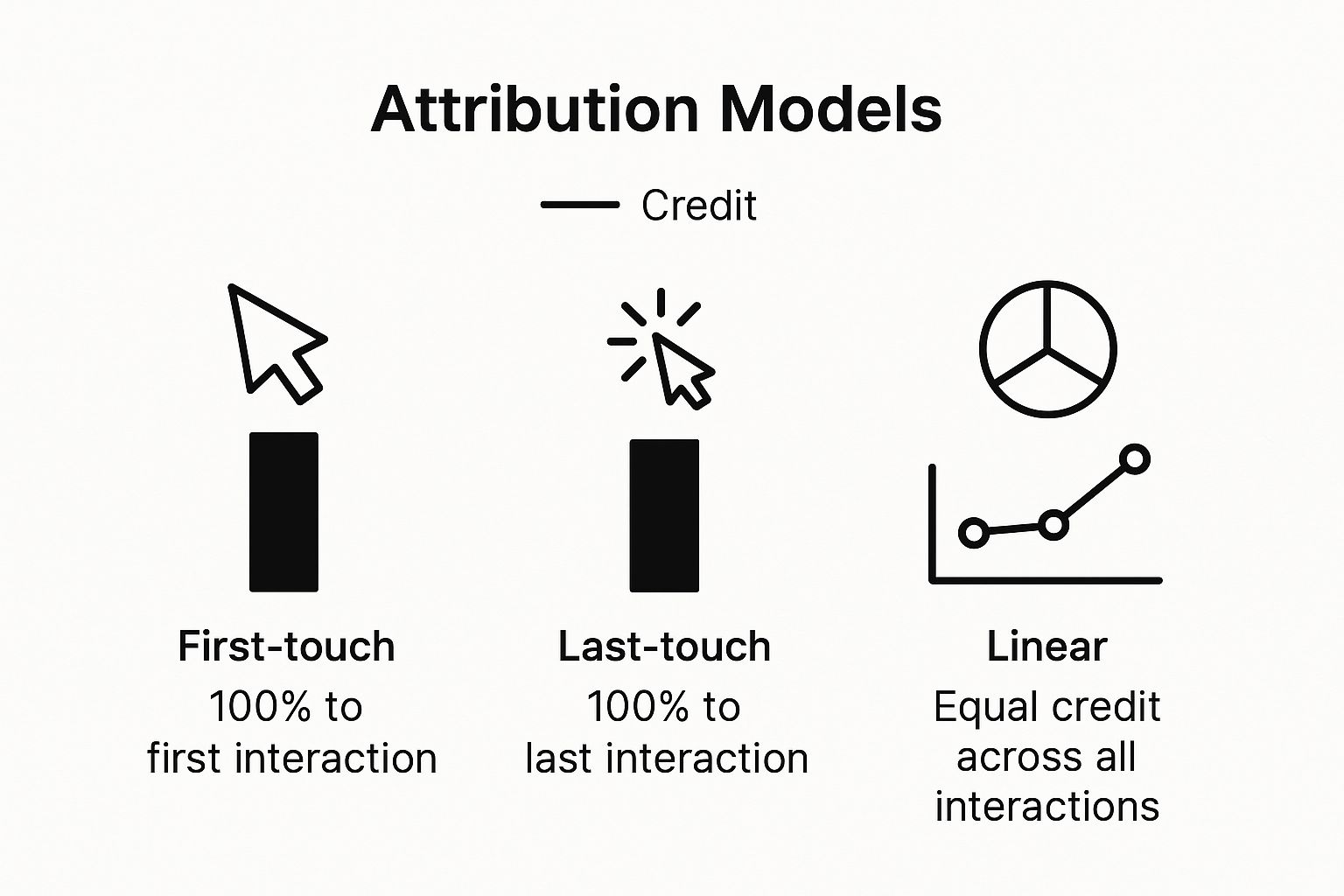
As you can see, sticking to a single-touch model can seriously skew your perception. A multi-touch approach gives you a much fuller, more accurate story.
Multi-Touch Models: Sharing the Credit
This is where things get more interesting. Multi-touch models recognize that it’s rarely just one ad that leads to a sale. Instead, they split the credit across multiple interactions.
Here’s a quick breakdown of the most popular ones to help you see how they stack up.
A Quick Guide to Common Attribution Models
| Attribution Model | How It Works | Primary Bias | Best For |
|---|---|---|---|
| Linear | Spreads credit evenly across every single touchpoint. | Treats all interactions as equally important, which is rarely true. | Getting a simple, baseline understanding of the entire customer path without overcomplicating things. |
| Time-Decay | Gives more credit to touchpoints that happened closer to the sale. | Favors closing channels over awareness-building channels. | Longer sales cycles where recent interactions are more likely to have a bigger impact on the final decision. |
| Position-Based (U-Shaped) | Gives 40% credit to the first touch, 40% to the last touch, and the remaining 20% to all the middle touches. | Emphasizes the first and last interactions, potentially undervaluing the "nurturing" phase. | Businesses that value both the initial discovery and the final conversion steps in the customer journey. |
As you can see, each model tells a slightly different story about what's driving your sales.
Time-decay models, for instance, are a go-to for products with longer consideration periods. The logic is simple: an ad someone saw yesterday is probably more influential than one they saw three weeks ago. These models often use a "half-life" parameter (say, 7 days) to calculate this. An interaction 7 days before a sale might get half the credit of one that happened on the day of the sale. If you want to dig deeper into how these statistical models allocate credit, Aerospike.com has a great explanation.
Unlocking the Power of Data-Driven Attribution

While the models we've covered so far give you a structured way to look at your data, they all operate on a set of assumptions. Data-driven attribution is different. It flips the script entirely by taking the guesswork out of the equation.
Think of it less like a rigid rulebook and more like an AI analyst that’s constantly learning. It doesn't just look at the paths that led to a sale; it also studies all the paths that didn't. By comparing the two, it figures out which touchpoints truly made a difference.
Letting the Data Decide
At its core, the idea is pretty straightforward. The model gives credit to a touchpoint based on how much it actually increased the probability of a customer making a purchase. It sifts through thousands of customer journeys, spotting patterns and rewarding the interactions that consistently nudged people toward the finish line.
This used to be a complex, enterprise-level tool, but platforms like Google Analytics 4 have brought this powerful approach to the masses. Their algorithms dynamically calculate each channel's contribution, painting a much more realistic picture than any static model ever could.
This is, by far, the most statistically sound way to assign conversion credit. In fact, studies show that data-driven attribution can boost marketing return-on-investment by 15-20% compared to last-touch models, simply because it understands how all your touchpoints work together.
A data-driven model doesn't use a generic set of rules. It analyzes your unique customer data to build a custom framework tailored specifically to your business.
This ultimately leads to smarter decisions about where to put your marketing budget. For Amazon sellers, figuring out which off-Amazon ads are actually driving sales is a game-changer. Our guide to Amazon Attribution explains exactly how you can connect your external marketing efforts to your Amazon sales, giving you the clarity you need to optimize your ad spend with confidence.
Why Attribution Modeling Is a Game-Changer for Amazon Sellers
https://www.youtube.com/embed/BfnJwYuFWVM
If you’re an Amazon seller, you know the struggle. You spend time and money on social media ads, influencer marketing, and email campaigns, but it often feels like you’re just throwing spaghetti at the wall.
How do you really know if that TikTok campaign drove actual purchases or just a bunch of views? This is where attribution modeling comes in. For sellers, Amazon Attribution is the key that unlocks this mystery, finally showing you which of your off-Amazon channels are pulling their weight.
See Your Entire Marketing Funnel
Imagine finding out that your Pinterest board is quietly driving 15% of your monthly sales. Or that one specific influencer consistently sends high-value customers straight to your product page. This isn't just cool trivia; it's the kind of insight that directly grows your bottom line.
This level of clarity lets you:
- Confidently shift your budget away from campaigns that are just burning cash and toward the ones delivering a real return.
- Optimize your marketing spend by doubling down on what’s proven to work, whether that's your Google Ads or a partnership with a niche blog.
- Understand the complete customer journey, from the very first click on an external ad to the final "buy now" on Amazon.
With attribution modeling, you stop guessing and start making strategic, data-backed decisions that grow your business. You can finally prove the ROI of your off-Amazon marketing efforts with concrete numbers.
For businesses aiming to get the most out of their ad spend, figuring out how to automate lead generation is a huge step. Attribution modeling gives you the insights to see which of those automated efforts are actually working. This knowledge helps you refine not just your external advertising, but your on-platform strategy, too.
Connecting your external ads to sales is just one piece of the puzzle. To see how this data can supercharge your on-platform efforts, check out our guide on building a successful Amazon PPC marketing strategy. Putting it all together gives you a complete, full-funnel view of what's driving your success.
Making Sense of Your Amazon Attribution Data
Let's be honest, Amazon Attribution gives you a mountain of raw data. But raw data doesn't pay the bills. The real headache for most sellers isn't getting the data; it's wrestling with spreadsheets trying to figure out what it all means and what you're supposed to do with it.
This is exactly why specialized tools exist. A platform like Coral is built to do the heavy lifting for you, connecting the dots between your ad spend on channels like Facebook, Google, and TikTok and the sales they generate on Amazon.
Ditch the Spreadsheets for Clear ROI
Imagine seeing everything in one place. Instead of spending your weekend exporting reports and trying to match them up manually, you get a clean dashboard that shows you what’s actually working.
You can instantly see your true return on ad spend (ROAS) for every single campaign, ad set, and even individual ad creative.
When you automate this connection, you stop guessing. You can finally make quick, confident decisions to scale your winning campaigns and cut the ones that are draining your budget.
This clarity is the key to understanding which marketing efforts are actually growing your business. If you want to dive deeper into how the tracking works, our guide to creating Amazon Attribution links is a great place to start.
Common Questions About Attribution Modeling
As you dive into attribution modeling, you'll probably have a few questions. That's a good thing. Getting these sorted out is the first real step toward making attribution work for your brand.
So, Which Attribution Model Is Best?
This is the big one, but the honest answer is: it depends. There’s no silver bullet model that works for everyone. The best choice really hinges on your business goals and how long it typically takes for a customer to buy from you.
For example, if your main goal is simply getting new people in the door, a First-Touch model might be perfect. But if you have a longer sales cycle, you might care more about what finally convinces someone to buy. In that case, something like Time-Decay could be a much better fit.
Ultimately, the most precise way to go is a data-driven model. This approach looks at your actual performance data to figure out which touchpoints deserve credit, taking the guesswork out of the equation.
How Can I Start Using Attribution?
Getting started is less complicated than it sounds. If you're selling on Amazon, your first move is to set up Amazon Attribution. This tool lets you create special tracking links for all your marketing efforts that happen outside of Amazon, like your social media ads or influencer campaigns.
The most important thing is to just start tracking. Even if you begin with a simple Last-Touch model, you'll finally have a baseline. You can't improve what you don't measure.
This early data is gold. It’s the foundation for understanding how customers really find and buy your products.
Ready to stop guessing and start seeing your true marketing ROI? Coral connects your ad platforms to Amazon, giving you a single dashboard to track performance and make smarter decisions. Get started with Coral today!