Boost Your Conversion Rate Amazon with Proven Strategies
Category: Conversion rate amazon
Let's think about your Amazon product page for a moment. Picture it as a real, brick-and-mortar shop. All the people who click on your listing are shoppers walking through the door. Your Amazon conversion rate is just the percentage of those shoppers who decide to buy something before they leave.
It's a simple idea, but it's incredibly powerful. A higher rate means you're not just getting visitors; you're making sales and showing Amazon that your product is something people want.
What Amazon Conversion Rate Really Means
At its heart, the Amazon conversion rate (CVR) is a direct measure of how convincing your product listing is. If you dive into your Amazon Seller Central reports, you'll see Amazon calls this the Unit Session Percentage.
The math behind it is simple:
(Total Orders ÷ Total Sessions) x 100 = Conversion Rate (%)
This number tells a story. A high CVR means your pricing, product photos, description, and reviews are all hitting the right notes and giving customers the confidence to click "Add to Cart."
Why This Metric Is So Important
A healthy conversion rate is a huge asset on Amazon, and it works for you in two key ways.
First, the obvious one: more sales. If you can get more of your current visitors to buy, your revenue goes up without spending another dime on ads to get more traffic. You're simply doing a better job with the traffic you already have.
Second, and this is the big one, a high CVR is a massive signal to Amazon's A9 search algorithm. When Amazon sees that shoppers who visit your page consistently end up buying, it takes that as a sign of a great customer experience. In return, the algorithm rewards you with better organic search rankings. This leads to more visibility, which brings in more traffic, and kicks off a fantastic cycle of more sales.
The Amazon Advantage In Conversions
When you're selling on Amazon, you have a secret weapon: buyer intent. People don't usually come to Amazon to just browse aimlessly like they might on social media. They're there to shop, often with a credit card in hand and a specific need in mind.
This ready-to-buy mindset is why Amazon CVRs are in a league of their own. While a typical e-commerce site might be happy with a 1-3% conversion rate, Amazon sellers often see rates between 10% and 15%. That's a huge difference.
Let's break down why that is.
Amazon CVR vs Traditional Ecommerce CVR
This quick comparison shows why Amazon is built for high conversion from the ground up.
| Platform | Average Conversion Rate | Primary Reason |
|---|---|---|
| Amazon | 10% - 15% | High buyer intent; trusted platform with Prime shipping. |
| Traditional Ecommerce | 1% - 3% | Broader mix of traffic, from casual browsers to researchers. |
The takeaway is clear: Amazon's entire ecosystem—from its trusted reputation and Prime benefits to the way listings are structured—is designed to turn shoppers into buyers.
Getting a grip on this core concept is the first real step to leveling up your Amazon game. It moves your focus from just getting clicks to actually turning those clicks into customers, which is the foundation for real, sustainable growth.
What a Good Amazon Conversion Rate Looks Like

So, what’s a “good” Amazon conversion rate? It’s a bit like asking how long a piece of string is. The real answer is always: it depends. A single number without context can be seriously misleading.
What works for one product might be a total flop for another. The secret is to understand the factors at play, like your product category, its price, and how fierce the competition is. You can’t set a realistic goal until you get a feel for your specific corner of the Amazon marketplace.
Think about it. A seller with a $15 phone case will almost always have a higher conversion rate than someone selling a $300 professional drone. The phone case is an easy, low-risk impulse buy. The drone? That’s a considered purchase that shoppers will spend time researching.
Establishing Realistic Benchmarks
While there's no universal magic number, looking at general industry averages gives us a solid starting point. Most experienced sellers I know aim to be somewhere in the 10% to 15% range. If you’re hitting that, your listing is probably in pretty good shape and connecting well with customers.
More recent data from mid-2025 shows the average conversion rate across Amazon hovering around 9-10%. For listings that are really dialed in with great reviews and persuasive content, pushing toward that 15% mark is definitely achievable.
Key Takeaway: Don't get hung up on one "good" number. Use the 10-15% range as a general guide, but then tailor your expectations to your product’s price, category, and competition.
How Price Point Shapes Conversion Rates
Price is a huge psychological lever. It can make or break a sale, and it has a direct, predictable impact on your conversion rate.
- Low-Priced Items (Under $30): These are often impulse buys. Shoppers don’t overthink it, which leads to faster decisions and, you guessed it, higher conversion rates.
- Mid-Range Items ($30 - $100): In this zone, customers start to weigh their options. They’ll read a few more reviews and compare your product to a couple of others. Conversion rates are still solid, but a bit more measured.
- High-Priced Items (Over $100): This is investment territory. A customer buying something over $100 will do their homework. They’ll compare features, read everything they can, and might take days or even weeks to pull the trigger. That longer buying cycle naturally leads to lower conversion rates.
Organic vs. Paid Traffic Expectations
It’s also crucial to know where your shoppers are coming from. The conversion rate for someone who found you organically will look very different from someone who clicked on an ad. You can't treat them the same.
Organic visitors typically have high buying intent—they searched for something specific, and your product appeared as a solution. Ad traffic, however, can be a mixed bag. Some people click out of pure curiosity, while others are ready to buy right now. You might also be driving traffic from outside sources, a common strategy in Amazon affiliate marketing for beginners and other brand campaigns.
This is why you have to slice and dice your data. A strong listing might convert organic traffic at 15% but only convert paid traffic at 8%. Both numbers tell you something important—one about your listing's overall appeal, the other about how well your ad campaigns are targeted.
How to Find and Track Your Conversion Rate
Knowing your conversion rate on Amazon is the first step to making it better. So, where do you actually find this all-important number? The good news is Amazon gives you this data right inside Seller Central, but—and this is a big "but"—they don't actually call it "conversion rate."
If you go looking for a column with that exact name, you'll come up empty. Amazon uses its own term: Unit Session Percentage. It’s the exact same concept—it shows you what percentage of unique visitors (or sessions) ended up buying one of your products.
Your Step-by-Step Guide to Finding Your CVR
Once you know what to look for, finding your Unit Session Percentage is simple. It’s tucked away in your Business Reports, which is ground zero for monitoring your product performance.
Here’s exactly where to go:
- Log in to your Amazon Seller Central account.
- Hover over the Reports tab in the top navigation menu.
- Click on Business Reports from the dropdown.
- On the left-hand menu, find and click Detail Page Sales and Traffic By Parent Item.
You'll see a table packed with metrics for your products. The column you're after is labeled Unit Session Percentage. That’s it—that’s your conversion rate for each specific product (ASIN).
Pro Tip: Go ahead and bookmark that page. I recommend checking your conversion rates at least once a week. This simple habit helps you spot problems early, see what’s working, and measure the real impact of your optimization efforts.
By keeping a regular eye on this report, you get a clear, honest look at how well your listings are convincing shoppers to buy. You can also adjust the date range at the top of the page to compare performance over different timeframes, like this week versus last week, to see your progress.
Decoding Key Metrics in Your Business Report
When you land in the Business Reports dashboard, you’ll see more than just the Unit Session Percentage. Understanding how these other numbers play together is crucial for seeing the full picture of your listing’s performance.
Here are the other key metrics you should be watching:
- Sessions: This is the total number of unique shoppers who visited your product page in a given period. Think of it as the number of people who walked through the door of your digital store. One person can visit multiple times, but they still only count as one session.
- Page Views: This tracks the total number of times your product pages were looked at. If that one shopper (one session) comes back to look at your page three separate times, that will count as 1 Session and 3 Page Views. A high number of page views per session often means a customer is very interested but might be hesitating for some reason.
- Units Ordered: This is the finish line. It’s the total number of your products that were actually purchased. This is what all your efforts are driving toward.
These three metrics are the building blocks of your conversion rate. Having a solid grasp of how they influence each other is key. For example, knowing how to track Amazon sales in more detail can give you an even richer understanding of what's driving your business forward. Consistently tracking these numbers is the bedrock of any smart growth strategy.
The Core Elements That Drive Conversions
A high conversion rate on Amazon doesn't just happen by accident. It's the direct result of a finely-tuned product listing where every single piece works together to convince a shopper. Customers make snap judgments, and mastering the key elements they see first is how you turn a casual browser into a committed buyer.
Think of your product page like a well-oiled machine. The title grabs their attention, the images tell a compelling story, the bullet points solve a problem, and the reviews provide the final nudge of confidence. When all these parts sync up perfectly, clicking 'Add to Cart' feels like the most natural next step for the customer.
Crafting the Perfect Product Title
Your product title is your first, and sometimes only, chance to make a good impression. Its job is twofold: catch the eye of a human shopper and satisfy Amazon's search algorithm. A great title strikes a delicate balance between keyword relevance and simple readability, clearly stating what the product is, its main benefit, and essential details like size or quantity.
A classic mistake is "keyword stuffing"—cramming every possible search term into the title until it becomes an unreadable mess. Don't do that. Instead, focus on a structure that flows naturally while still weaving in your most critical keywords. A well-written title builds instant trust and clarity, two absolute must-haves for conversions.
The Power of High-Quality Visuals
People are visual creatures. Long before a shopper reads a single word of your description, they're scrolling through your images and watching your video. This is your moment to make a powerful first impression. In fact, high-quality visuals are non-negotiable for a strong conversion rate amazon strategy.
Your images and videos need to do some heavy lifting:
- Showcase the Product: Use crystal-clear, high-resolution photos from every angle. A 360-degree view can make a customer feel like they’re already holding it.
- Highlight Key Features: Use infographics or text overlays on your secondary images to point out the most important benefits and specs.
- Demonstrate the Product in Use: Lifestyle photos are huge. They show your product in a real-world setting, helping customers picture it in their own lives.
- Tell a Story with Video: A short product video can explain benefits much more effectively than text ever could, often leading to a major spike in conversions.
Writing Benefit-Driven Bullet Points
After a quick scan of your images, a serious buyer's eyes will dart straight to your bullet points. This isn't the time for a dry, boring list of technical specs. You need to translate every feature into a direct benefit for your customer.
For example, don't just say "durable stainless steel." Instead, say "Built with durable stainless steel to resist rust and last for years, saving you money on replacements." This simple shift answers the customer's silent but all-important question: "What's in it for me?" Each bullet point should tackle a potential pain point or desire, framing your product as the perfect solution.
Leveraging A+ Content for Deeper Connection
If you're a brand-registered seller, A+ Content (once known as Enhanced Brand Content) is one of the most powerful tools in your arsenal for boosting your Amazon conversion rate. It lets you swap out the plain-text product description for a visually rich layout with branded images, comparison charts, and storytelling modules.
A+ Content is your chance to go beyond the basics. You can tell your brand's story and forge a real emotional connection with shoppers. By providing richer detail and building confidence, it can increase conversion rates by as much as 10%.
Use this valuable real estate to answer common questions, compare your product to others in your lineup, and hammer home what makes your brand special. It’s your opportunity to create a premium, magazine-style experience right on your product page.
The Deciding Factor: Social Proof and Reviews
At the end of the day, the most convincing voice on your listing isn't yours—it's the collective voice of your past customers. Reviews and ratings are today's word-of-mouth marketing, and they serve as the ultimate social proof. A high star rating and a healthy number of reviews are often the final push a customer needs to click 'buy'.
Actively monitoring and responding to reviews also shows that you're an engaged seller who stands behind your product. This builds a fortress of trust around your brand that is incredibly difficult for competitors to tear down.
This diagram illustrates how a simple A/B test can pinpoint which version of a listing element drives a better conversion rate.
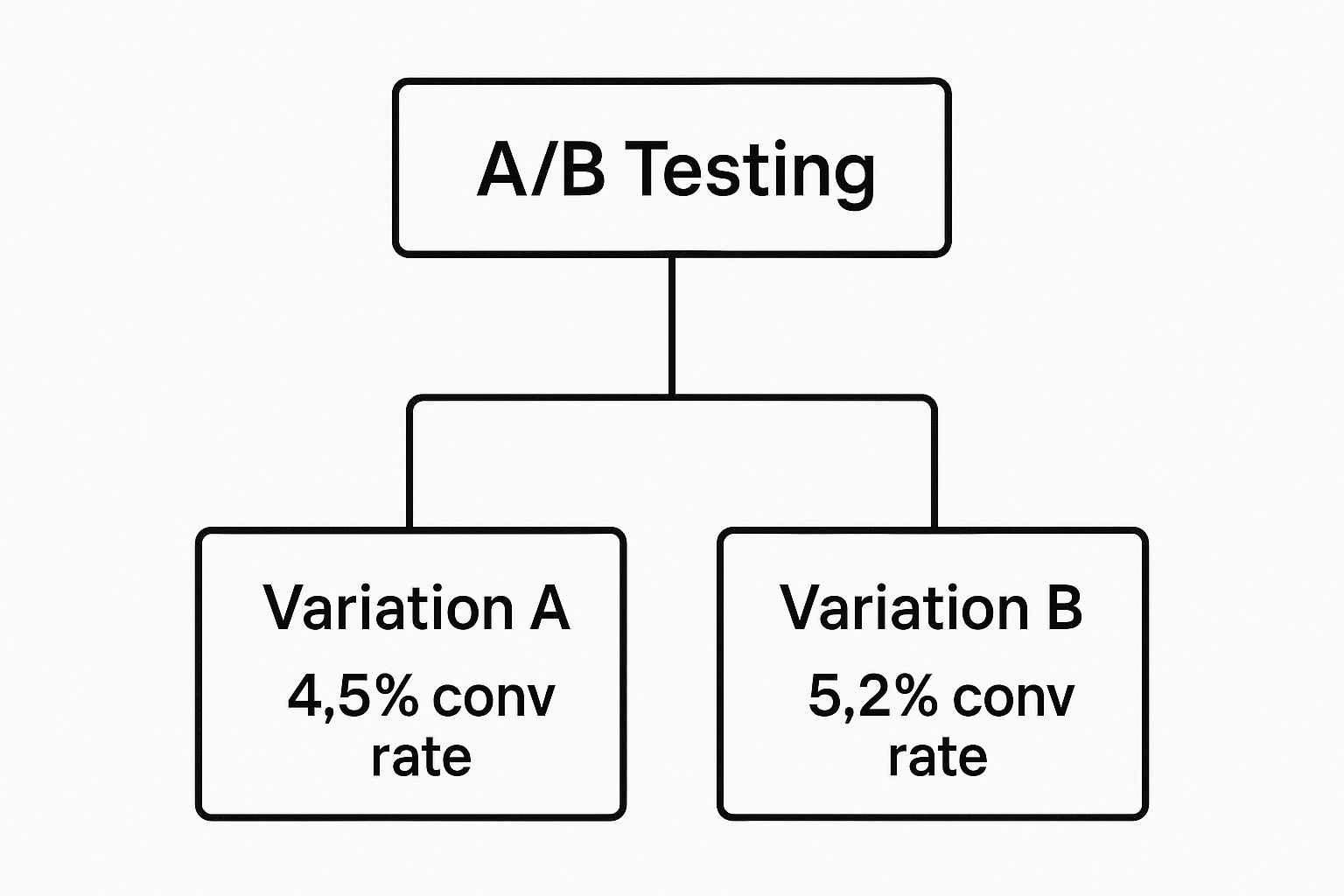
In this example, the simple change in Variation B led to it outperforming Variation A, proving that data-driven decisions are the clearest path to more sales.
Actionable Strategies to Increase Your Conversion Rate
Knowing what goes into a high-converting listing is one thing. Actually putting that knowledge into practice is where the real growth happens. Improving your conversion rate on Amazon isn't about finding one magic bullet; it’s about making a series of smart, targeted adjustments. It's time to roll up your sleeves and turn your product page into a sales powerhouse.
These aren't just theories. These are proven, actionable tactics that top sellers rely on every single day. By systematically testing and refining your approach, you can build a listing that doesn't just attract shoppers but actually convinces them to click "Add to Cart."
Master Your Pricing and Promotions
Price is one of the most powerful levers you can pull. But it's not just about being the cheapest—it’s about signaling incredible value.
A great tactic to try is strategic price testing. Experiment with lowering your price by 5-10% for a week and watch your Unit Session Percentage like a hawk. You might be surprised. A small price drop can often lead to a big jump in sales volume, more than making up for the lower margin and giving your organic rank a nice boost.
Promotions are your other best friend for creating urgency and sealing the deal. Consider using:
- Coupons: That bright orange coupon badge is an instant eye-catcher in crowded search results. It screams "deal!" and can be just the nudge a hesitant shopper needs.
- Lightning Deals: These time-sensitive promotions are fantastic for creating a sense of FOMO (fear of missing out), moving inventory quickly, and generating a powerful spike in sales velocity.
Optimize Your Backend Keywords
Your title, bullet points, and A+ Content are for your customers. Your backend keywords? They’re just for Amazon’s A9 algorithm. This is your private line of communication to tell Amazon exactly what your product is, using all the terms you couldn't squeeze into the customer-facing copy.
Think like a customer. What synonyms, common misspellings, or long-tail phrases would they use? If you sell a "waterproof picnic blanket," your backend terms could include "sandproof beach mat," "outdoor ground cover," or "park throw." Filling this section with relevant terms helps Amazon show your product to more qualified buyers—the people who are actually looking for what you sell.
Proactively Manage Q&As and Reviews
Your customer questions and reviews section is a goldmine. It's overflowing with feedback and is a huge opportunity to build trust. Don't just let it sit there; get in there and manage it.
Responding quickly and helpfully to questions in the Q&A section shows potential buyers that you are an engaged, knowledgeable, and trustworthy seller. It also allows you to address potential objections before they even become a problem for other shoppers.
The same goes for reviews. Always thank customers for positive feedback. More importantly, publicly address negative reviews with a professional and helpful solution. This shows everyone that you stand behind your product and provide excellent customer service, which can give new buyers the confidence they need to purchase.
Drive High-Quality External Traffic
Not all traffic is created equal. While optimizing for shoppers already on Amazon is critical, driving targeted traffic from outside Amazon can give your conversion rate a serious lift. This is where a well-structured Amazon PPC marketing strategy becomes essential for reaching motivated buyers.
For many brands, building an affiliate program with a platform like Coral provides a direct line to these motivated shoppers. Influencers and content creators have already built authentic connections with their audiences. When they recommend your product, their followers arrive on your page with a high degree of trust baked in, making them much more likely to convert.
This is especially true as Amazon's ad ecosystem gets more competitive. For instance, between 2020 and 2022, the median conversion rates for sponsored products showed that the US and UK platforms performed exceptionally well. This data, which you can discover more about on Statista.com, highlights the growing need to use smart advertising and traffic strategies to stay ahead.
Use A/B Testing to Let Data Decide
Why guess what works best when you can know for sure? Amazon's "Manage Your Experiments" tool is a game-changer for any serious seller, letting you A/B test the most critical parts of your listing.
This tool empowers you to test different versions of your:
- Main Image: Does a lifestyle photo convert better than a simple studio shot?
- Product Title: Should you lead with a key feature or the brand name?
- A+ Content: Does a detailed comparison chart outperform a brand story module?
When you run an experiment, Amazon shows one version of your listing to 50% of your visitors and the other version to the other 50%. After a few weeks, it declares a winner based on which version achieved a higher conversion rate on Amazon. This data-driven approach takes the emotion and guesswork out of optimization, allowing you to make small, proven improvements that add up to massive gains over time.
Of course. Here is the rewritten section, designed to sound like it was written by an experienced human expert.
Common Questions About Amazon Conversion Rate
Once you start tracking and trying to improve your listings, you’ll inevitably run into a few tricky questions. Let's tackle some of the most common points of confusion that pop up when sellers really start digging into their conversion rate on Amazon.
These quick answers should help you read your data correctly and make smarter calls for your business. Think of this as your go-to guide for those moments when the numbers just don't seem to add up.
Is a 7% Conversion Rate Good or Bad?
It’s easy to see a number like 7% and feel a little disappointed, especially when you hear people throw around averages of 10-15%. But here’s the truth: a single number without context is meaningless. A 7% conversion rate could be incredible, or it could be a warning sign. It all comes down to your product and your strategy.
For a big-ticket item, like a $500 piece of home gym equipment, a 7% CVR is phenomenal. People take their time with purchases like that, so convincing that many shoppers to buy is a huge win. On the flip side, for a cheap, impulse-buy product like a $10 phone grip, 7% might suggest there’s room to improve your listing.
The real question isn't "Is my CVR good?" It should be "Is my CVR getting better?" Your main competition is your past performance. Focus on beating your own benchmarks, because that's what real growth looks like.
Before you judge your rate, always weigh it against these factors:
- Product Price: Higher prices almost always mean lower conversion rates. It’s just human nature.
- Category Competition: In a crowded market, even a small conversion rate can be a major victory.
- Traffic Source: Are these visitors coming from super-specific organic searches or broader, top-of-funnel PPC ads? The source matters.
Why Is My Amazon Conversion Rate So Low?
A low conversion rate on Amazon can be maddening, particularly when you feel like you’re getting plenty of traffic. The cause usually isn't one single, glaring problem. It’s more often the result of several small points of friction that, when combined, convince a shopper to click away instead of clicking "buy."
I like to think of it as a leaky bucket. One small hole won't lose much water, but a dozen tiny holes will drain your bucket in no time.
Here are some of the most common "leaks" that cause a low CVR:
- Uncompetitive Pricing: You might be priced too high compared to similar products, or your price just doesn't feel like a good value for what you're offering.
- Poor-Quality Visuals: Grainy images, a lack of lifestyle photos, or no product video can instantly erode a shopper's trust.
- Weak Bullet Points: If your bullet points are just a dry list of features, you're failing to answer the customer's most important question: "What's in it for me?"
- Negative or Few Reviews: Social proof is everything. A lack of positive reviews is a huge red flag for shoppers who want to see that other people have bought and loved your product.
- Slow Shipping Times: We live in the age of Prime. Customers expect fast, free shipping. If you're fulfilling orders yourself with long delivery windows, you’re fighting an uphill battle.
What Is an Alarming Conversion Rate?
An "alarming" conversion rate isn't just a low number—it's any rate that is consistently trending downward or is way below your direct competitors. While a CVR that dips below 1-2% is almost always a reason to investigate immediately, the real alarm bell is a negative trend.
If your CVR was 12% last month and has sunk to 8% this month on similar traffic, something has changed for the worse. Maybe a new competitor got aggressive, a few bad reviews came in, or a price change didn't land well. A sudden drop is the market telling you loud and clear that your offer is less appealing than it was before, and you need to figure out why—fast.
Ready to stop guessing and start growing? One of the best ways to drive high-intent traffic that actually converts is by building a network of genuine brand advocates.
With Coral, you can create, manage, and scale your own Amazon affiliate program without the headache. Recruit top creators, track their sales with Amazon Attribution, and turn one-off collaborations into long-term growth. Start your free plan with Coral today and see what a dedicated community can do for your conversion rate.