Do You Need a Trademark for Amazon Brand Registry? Learn More
Category: Do you need a trademark for amazon brand registry
Let's get straight to the point: yes, you absolutely need a trademark for Amazon Brand Registry. This is the key that unlocks all of Amazon's powerful brand protection and growth tools. It's a non-negotiable requirement.
But here's a crucial detail that many sellers miss—one that can save you months of waiting and frustration.
Yes, You Need a Trademark for Brand Registry (But There's a Catch)
A lot of sellers think they need a fully registered trademark certificate in hand before they can even think about applying for Brand Registry. I've seen people wait a year or more, leaving their brand vulnerable, because of this misconception.
Thankfully, the process is much more seller-friendly these days. The important thing to understand is the difference between a pending trademark application and a registered one.
Think of it like getting a driver's license. A pending trademark is like having your learner's permit. You can't do everything a fully licensed driver can, but you're officially in the system and can start driving with some protections in place. A fully registered trademark is your official driver's license—it's confirmed, and you have all the rights and privileges that come with it.
The Power of a Pending Trademark
For a long time, sellers had to endure the entire, often painfully slow, government approval process for their trademark. This could take a year, sometimes even longer! Recognizing this huge headache, Amazon changed its policy for the better.
Amazon now allows brands with a pending trademark application to enroll and get access to many Brand Registry features. This was a complete game-changer, letting new brands protect themselves from day one.
This policy shift means you can get your brand protection tools up and running way sooner. As soon as you receive a serial or application number from one of Amazon's approved trademark offices, you can start the enrollment process.
This is what the Amazon Brand Registry enrollment page looks like, and you can see it emphasizes the need for a trademark from specific government offices.
The page clearly lists which government trademark offices it accepts, which really drives home that a legitimate, verifiable trademark is the foundation of the whole program. For a detailed breakdown, you can check out our comprehensive guide to Amazon Brand Registry requirements.
So, what's the difference between enrolling with a pending trademark versus a registered one? Let's break it down.
Trademark Status for Brand Registry Enrollment
This table shows you what to expect whether your trademark is pending or fully registered.
| Requirement | Pending Trademark | Registered Trademark |
|---|---|---|
| Eligibility | Yes, accepted from specific trademark offices. | Yes, this is the standard requirement. |
| Application Process | Submit your trademark application/serial number. | Submit your trademark registration number. |
| Access to Tools | Immediate access to most brand protection tools. | Full access to all Brand Registry features. |
| Timeline | Enroll in Brand Registry in days or weeks. | Can take 6-18+ months to get registered first. |
| Main Benefit | Get brand protection up and running quickly. | Unlocks all advanced features and legal standing. |
Essentially, using a pending trademark gets you in the door and gives you access to the most critical protection tools right away. Waiting for full registration gives you the complete suite of features, but you're left unprotected in the meantime.
Why This Matters for You
The bottom line? You don't have to wait. Filing for your trademark is the first step, and once you have that application number, you should immediately move on to enrolling in Brand Registry.
This proactive approach means you can start fighting hijackers, controlling your product listings, and using powerful advertising tools while the government trademark office does its thing. It's the smartest way to launch and protect your brand on Amazon.
Why Amazon Makes Trademarks a Non-Negotiable Requirement
So, you might be asking yourself why Amazon is so strict about trademarks for its Brand Registry program. Is it just another hoop to jump through? Honestly, it's the very foundation of the whole system. The trademark requirement is what gives Brand Registry its teeth.
Think of the Amazon marketplace as a huge, bustling city. Without any official ID, chaos would take over. A government-issued trademark is essentially your brand’s official ID card. It proves you are who you say you are, giving you the authority to act as the one and only owner of your brand in this massive digital city.
This whole verification process isn't meant to make your life harder. It’s all about building a trusted environment for everyone involved—sellers, buyers, and Amazon itself. By requiring a legal trademark, Amazon weeds out the fakers and scammers right from the get-go.
Building a Fortress for Your Brand
When you enroll in Brand Registry with a trademark, you’re not just getting a shiny badge. You're being handed the keys to a fortress. This fortress comes packed with powerful tools to protect your intellectual property, and you definitely don't want the wrong people getting their hands on those keys.
Amazon needs a foolproof way to tell the real brand owner from a counterfeiter or a listing hijacker trying to cause trouble. A trademark from a government body like the USPTO is the clearest, most legally sound proof of ownership there is. It removes all the guesswork and allows Amazon to take action on your behalf with confidence.
The core idea is simple: Amazon gives brand owners unprecedented control over their listings, but it must first be certain it's giving that control to the right person. A trademark is the official, undeniable proof of that ownership.
Back when Brand Registry first launched, Amazon only accepted fully registered trademarks. This strict rule had a massive ripple effect—trademark filings by small businesses almost doubled as sellers scrambled to get protected. It really shows you how central the trademark has always been to Amazon's strategy. You can read more about the program's impact on small business filings if you're curious.
The Value Beyond Protection
The trademark requirement does more than just play gatekeeper. It raises the bar for the entire marketplace. It ensures that the brands getting access to all the special tools are legitimate and truly invested in what they're selling. For shoppers, that commitment means a better, more confident buying experience.
So for you, the seller, your trademark really pulls double duty on Amazon:
- It’s a Shield: This is your number one weapon against counterfeiters and hijackers. It gives you access to reporting tools that actually work and get results.
- It’s a Key: It unlocks a whole suite of exclusive marketing and analytics features, like A+ Content, Brand Analytics, and custom Brand Stores, that are off-limits to everyone else.
Take away this non-negotiable requirement, and the Brand Registry program would fall apart. It would be impossible for Amazon to police its own catalog or offer such powerful benefits if brand ownership couldn't be proven without a doubt. Your trademark is your ticket in, and the security and growth it unlocks are worth every penny.
Your Step-by-Step Guide to Getting a Trademark for Amazon
Getting a trademark is your golden ticket to Amazon Brand Registry, but I know the legal side of things can feel a bit overwhelming. Don't sweat it. Let's walk through a clear, no-nonsense roadmap to get your brand protected and registered.
First things first, you need to decide what you're actually trademarking. There are two main flavors: a word mark and a design mark. A word mark protects your actual brand name (think "Nike"), while a design mark protects your logo (the Nike "swoosh"). For Brand Registry, a word mark is usually the smarter, more powerful play because it protects your name no matter how you display it.
Step 1: Do Your Homework with a Thorough Search
Before you even think about filing, you have to do a deep-dive trademark search. This isn't just a quick Google search. You're trying to make absolutely certain your brand name isn't already taken or even close to another one in your category.
Filing for a name that's already in use is the fastest way to get your application tossed out, and you'll lose your filing fees in the process. Start by searching the official trademark database for your country (like the USPTO in the U.S.). Look for different spellings, similar-sounding names, and any variations you can think of. Be thorough.
Step 2: File Your Application
Once you're reasonably sure your name is in the clear, it's time to file. This is where you officially submit all the details about your brand, including what products or services you’re selling (these are called "classes") and a "specimen" that shows your trademark being used in the real world—like on your product packaging.
Pay close attention to every detail here. A simple mistake on the application can cause major headaches and delays down the road.
This process really boils down to three key stages.
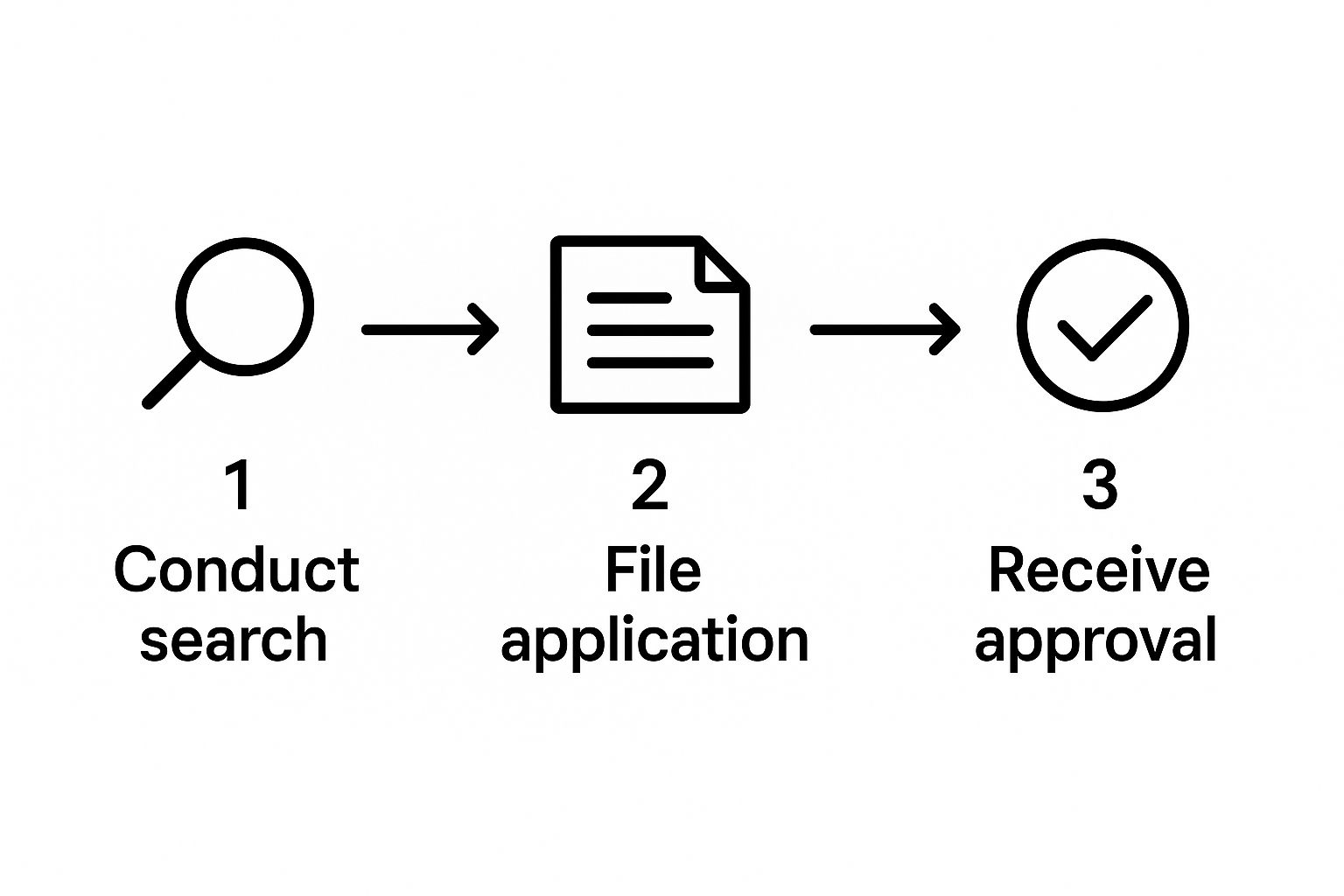
As you can see, it’s a logical path: you start with your due diligence (the search), take official action (filing), and then wait for the final green light (approval).
Pro Tip: Look into Amazon’s IP Accelerator program. Amazon connects you with a curated list of IP law firms that really know their stuff. They can handle the whole process for you at pre-set rates. The biggest perk? Using one of these firms can get you access to Brand Registry while your trademark is still pending, which is a massive head start.
While you're at it, keep in mind that a trademark is just one of the essential legal documents for startups you'll need to build a solid foundation for your business.
Step 3: The Waiting Game (Approval)
After you file, it's time to be patient. This is usually the longest part of the process, and it can easily take several months for the trademark office to get to your application. An examiner will review everything to check for conflicts or other problems.
If all goes well, your trademark gets "published for opposition," which is a fancy way of saying others get a chance to object. If nobody challenges it, you’ll eventually get your official registration certificate. With that certificate in hand, you're officially the owner of the brand and can unlock all the powerful tools inside Amazon Brand Registry.
So, You're in Brand Registry. Now What?
Getting into Amazon Brand Registry is a big deal. Seriously. It’s the moment you stop being just another seller and start being a real brand owner on the platform. But what does that actually mean for your day-to-day? It means you've just been handed a new set of tools for both building your brand and protecting it.
Think of it like this: selling without Brand Registry is like being on a small raft, just trying to stay afloat. Once you're enrolled, Amazon hands you the keys to a battleship. Now you can defend your turf, attract a loyal customer base, and really steer your business toward growth.
Your Brand-Building Toolkit
The first thing you’ll notice is a bunch of new marketing features you couldn't access before. These are all about creating a professional brand experience that turns casual shoppers into repeat buyers.
- A+ Content: This is your chance to ditch boring, text-only product descriptions. A+ Content lets you add high-quality images, detailed comparison charts, and a real brand story right onto your product pages. It transforms a standard listing into something that feels more like a premium landing page.
- Brand Stores: You get to build your own multi-page storefront on Amazon, completely free. This is your brand's dedicated space to show off your full product catalog and tell your story, all without competitor ads cluttering up the view.
- Sponsored Brands: While anyone can run Sponsored Product ads, only brand-registered sellers can use Sponsored Brands. These are those big banner ads at the very top of the search results that feature your logo and a few of your products. It’s prime real estate for grabbing a customer's attention.
These tools all work together to build a strong, consistent brand presence. For sellers doing private labeling on Amazon, Brand Registry is absolutely essential for protecting their investment and scaling their business.
Protecting Your Brand's Perimeter
Let's be honest, the biggest reason most sellers get a trademark is for the defensive tools Brand Registry offers. This is where your trademark really starts to pay for itself, by giving you the power to fight back against hijackers and copycats.
In 2024, Amazon's proactive controls stopped more than 99% of suspected infringing listings before a brand ever saw them. That number alone shows you the power of the automated systems you're tapping into.
Your main defensive tools are:
- Automated Protections: Amazon uses your brand and trademark information to automatically scan for and remove content that infringes on your rights or is just plain inaccurate. The more you "teach" the system about your brand, the better it gets at protecting you.
- Report a Violation Tool: This is your direct line of defense. It's a simple tool that lets you search the Amazon catalog for potential violations and report them yourself. Every accurate report you make not only solves a problem but also helps train Amazon's automated systems to be even more effective.
The table below breaks down some of the most impactful tools you get access to once you're enrolled.
Key Benefits of Amazon Brand Registry
| Feature Category | Specific Tool | Primary Benefit |
|---|---|---|
| Brand Building | A+ Content | Enhance product pages with rich media to increase conversion rates. |
| Brand Building | Amazon Stores | Create a custom, multi-page storefront to showcase your brand and products. |
| Advertising | Sponsored Brands | Gain top-of-search visibility with headline banner ads featuring your logo. |
| Brand Protection | Automated Protections | Proactively block infringing listings and inaccurate content automatically. |
| Brand Protection | Report a Violation | Easily find and report intellectual property violations to Amazon directly. |
Ultimately, enrolling gives you a whole ecosystem of tools designed to help you build and protect your brand. You can learn more about the complete toolkit in this detailed guide to https://coral.ax/blog/amazon-brand-registry-benefits. It’s all about shifting from a reactive mindset—constantly putting out fires—to proactively building a secure and trusted brand on the world's biggest online marketplace.
Common Misconceptions That Can Cost Your Brand
When you're trying to figure out Amazon Brand Registry, it’s easy to get tripped up by some common myths. A lot of sellers stumble here, and these misunderstandings can cost you serious time and money. Let's clear the air and debunk the mistakes I see brands make most often.
One of the biggest blunders is thinking that registering your LLC or business name with the state somehow protects your brand. It doesn't. Think of it this way: your LLC is the official name on your company's filing cabinet, but a trademark is the unique logo stamped on every product inside that cabinet. They’re two completely different things.
An LLC is a legal structure designed to separate your personal assets from your business liabilities. It offers zero protection for your brand name or logo on the marketplace. A registered trademark is what gives you the legal ownership of your brand’s identity, and that’s precisely what Amazon needs to see for Brand Registry.
The IP Trio: Trademark, Copyright, and Patent
It’s incredibly common to mix up the different types of intellectual property (IP). But trying to use a copyright or patent to get into Brand Registry is like trying to open your front door with your car key—it just won't work. Each one protects a very different asset, and Amazon is only looking for one of them.
Here’s a quick and simple way to remember the difference:
- Trademark: This is your brand’s identity. It covers your brand name, logo, and sometimes even a slogan. It’s what tells customers, "This product is from my company."
- Copyright: This protects your original creative work. Think product photos, the copy in your listings, marketing videos, or any books you've written.
- Patent: This is for inventions. A design patent protects a product's unique look, while a utility patent protects how it works or what it does.
When it comes to Brand Registry, Amazon is focused squarely on your trademark. It’s the only IP that proves you own the brand name you’re trying to protect on their platform.
The Pitfall of Rushing to Market
Another costly mistake is launching your products on Amazon before you've done a proper trademark search. That's a huge gamble—like building your dream house on a plot of land you haven't confirmed you actually own. If another company already has a trademark on a similar name in your product category, you could be forced to pull everything, rebrand from scratch, and throw away thousands of dollars in packaging, inventory, and marketing.
A cheap online filing service might seem like a great deal, but this is one area where you don't want to cut corners. Many of these services just file whatever you give them without doing a real legal search. This leaves you wide open to getting your application rejected and losing your filing fees.
Taking the time to do a proper trademark search upfront can save you from a world of financial pain and legal trouble down the road. While there are a few very specific workarounds, the smartest and safest route is to secure your brand’s legal footing first. You can learn more about these exceptions in our guide on approaching Amazon Brand Registry without a trademark.
By steering clear of these common pitfalls, you can build a solid foundation for your brand's long-term success on Amazon.
Frequently Asked Questions About Brand Registry and Trademarks
Once you get the basics of Brand Registry down, the specific "what-ifs" start popping up. It's totally normal. This is where most sellers find themselves wrestling with the finer details of the process.
Let's clear up some of the most common questions that trip people up so you can move forward with confidence.
Approval Timelines and Trademark Rejection
One of the first things everyone wants to know is, "How long will this take?" Getting your brand protected is a priority, and the timeline really depends on the path you choose.
If you go through Amazon's IP Accelerator program, you could get an invite to Brand Registry in just a few weeks. That's by far the fastest route. If you file for a trademark on your own, you'll have to wait for the official government trademark office to give you a serial number. Once you have that and submit it to Amazon, approval usually takes about 10-14 business days, provided everything is in order.
But what happens if your trademark application gets denied?
It's a tough pill to swallow, but if your pending trademark application is ultimately rejected by the government office, Amazon can revoke your Brand Registry access. This is a huge risk, and it underscores why doing a thorough trademark search from the very beginning is so critical. A rejection means you're back at square one.
This potential setback is a powerful argument for getting it right the first time, whether you do the homework yourself or bring in a professional.
Global Trademarks and Program Scope
Sellers operating in multiple countries often ask if a trademark from anywhere will work. The short answer is no.
Amazon has a specific list of government trademark offices it accepts. This includes major players like the United States (USPTO), the United Kingdom (UKIPO), the European Union (EUIPO), and Canada, among others. Always check Amazon's current list of approved offices before you even think about filing.
Here’s the general breakdown:
- It's Marketplace-Specific: You need to enroll in the Brand Registry for the Amazon store tied to your trademark. For example, to protect your brand on Amazon.com, you need a USPTO trademark.
- But It Has Global Reach: The good news is that once you have a trademark from one of these major offices, you can often use it to enroll and protect your brand in many other Amazon marketplaces worldwide.
Many brands also have more granular questions about what can and can't be protected, like whether hashtags can be trademarked. Digging into these details is essential for building a rock-solid protection strategy.
The Reality of Brand Protection
Does Brand Registry create an impenetrable, automatic force field around your brand? Not exactly. While it’s an incredibly powerful program, it’s not a "set it and forget it" magic button.
Brand Registry gives you the tools to report infringement and uses Amazon's own automated systems to do a lot of the heavy lifting. In 2024, these proactive controls stopped over 99% of suspected infringing listings before a brand ever had to find and report them. That's a massive win.
Still, you need to stay involved. Think of Brand Registry as being handed the keys to a fortress. You have the walls, the gates, and the security systems, but you still need to be the one watching for trouble and using the tools to defend your brand.
Ready to turn your brand's followers into a powerful sales force? Coral provides the ultimate affiliate management platform built for Amazon sellers. Set up your program, recruit creators, and track every sale with Amazon Attribution. Stop guessing and start growing with a dedicated affiliate network. Discover how Coral can scale your brand today.