How to Find Instagram Influencers That Fit Your Brand
Category: How to find instagram influencer
Finding the right Instagram influencer isn't about endless scrolling; it's about starting with a clear plan. Your first move should be to build a detailed profile of your ideal creator, zeroing in on their content style, audience demographics, and brand values. Think of this creator brief as your north star—it keeps you from getting lost and ensures you only chase partners who will genuinely click with your customers.
Build Your Ideal Creator Profile Before You Search
Before you even think about finding an influencer, you have to know exactly who you're looking for. I've seen too many brands jump straight into hashtag searches or stalk competitor profiles without a clear vision. It’s a waste of time and usually ends in a partnership that just doesn't hit the mark.
A well-defined creator profile isn’t just about saving time; it focuses your entire search on people who are a true extension of your brand’s mission. This initial planning goes way beyond surface-level numbers. You're essentially building a persona for your perfect collaborator—someone whose audience is a mirror image of your ideal customer and whose personal brand feels like a natural fit for yours.
Define Your Target Audience and Niche
This is the most critical piece of the puzzle: making sure the influencer's audience is your audience. An influencer with a million followers means nothing if none of them are potential customers for your product.
Start by looking at your own customer base. What do they care about? What are their pain points? Where do they hang out online?
Once you've got a solid picture of your customer, you can pinpoint the niche where they spend their time. For example, if your Amazon brand sells sustainable yoga mats, you're not just looking for someone in the "fitness" category. You need to get more specific, targeting creators in niches like "eco-conscious yoga" or "holistic wellness." The more granular you get, the better your results will be.
Key Takeaway: Don't chase follower counts. Chase audience alignment. A micro-influencer with 10,000 highly engaged, niche followers is almost always more valuable than a macro-influencer with 500,000 who don't care about what you sell.
It also helps to remember who’s on the platform. Instagram's user base is predominantly young, with over 60% of its global audience aged between 18 and 34. This group has massive purchasing power and is incredibly open to influencer recommendations, making them a prime target for most brands.
Establish Your Key Performance Indicators
What does a "win" look like for your brand? You need to define your goals and the metrics you'll use to track success before you start your search. This will have a huge impact on the type of influencer you go after.
- Brand Awareness: If you just want to get your name out there, you’ll probably prioritize creators with a large reach and high impression numbers.
- Sales and Conversions: To drive sales, you'll need to find influencers who have a proven history of converting their audience. Look for high engagement rates and authentic testimonials in their past brand deals.
- Content Generation: Maybe your main goal is to get high-quality user-generated content (UGC) for your own marketing channels. In that case, you’ll want creators known for their amazing photography or killer video skills.
Setting these KPIs upfront transforms your evaluation process. You’re no longer just looking for a popular account; you’re searching for a business partner who can deliver tangible results. If you want to dive deeper into how this works, check out our guide on how to find an Instagram influencer for your brand.
Create a Creator Brief
Once you've nailed down your audience and goals, pull it all together into a formal "Creator Brief." This document is your blueprint for the entire search. It should lay out both the hard numbers and the softer, qualitative traits you’re looking for.
This brief should include:
- Follower Count Range: Are you after nano-influencers (1k-10k), micro-influencers (10k-100k), or someone with a bigger following?
- Engagement Rate Target: A good benchmark is 2-5% for micro-influencers and at least 1% for larger accounts.
- Content Aesthetic: Get specific about the visual style. Do you want minimalist, vibrant, professional, or maybe something more rustic?
- Brand Values: What are your non-negotiables? Things like sustainability, inclusivity, or being family-friendly should be on this list.
- Niche Specifics: Clearly state the content categories, like "vegan recipes" or "DIY home decor."
Honestly, this detailed brief is the most powerful tool you have. It turns your search from a random guessing game into a focused, strategic mission to find the perfect advocate for your brand.
Find Hidden Gems with Manual Search Techniques

Sure, there are plenty of powerful tools out there. But sometimes, the best and most authentic creators are the ones you find with a little old-fashioned detective work. Getting your hands dirty with manual searching gives you a real feel for your niche and helps you spot rising stars before they're on every other brand's radar.
When you dive into Instagram yourself, you see how real communities talk to each other. You pick up on the slang, the inside jokes, and the content styles that actually connect with people. This is your chance to find partners who are a perfect cultural fit, not just a match on a spreadsheet.
Master Niche Hashtag Research
Searching hashtags is the obvious first step, but the real magic happens when you go deep. Broad tags like #fitness or #skincare are way too crowded. The goal is to find the smaller, hyper-dedicated communities where your ideal customers—and the influencers they genuinely trust—are hanging out.
Think like your customer. If you sell sustainable yoga mats, you might start with #yogalife, but you should quickly pivot to more specific tags like #ecoconsciousyoga, #mindfulmovement, or #sustainablelivingtips.
Here’s how you can approach it:
- Start with a broad, relevant hashtag.
- Check out the "Top" posts for that tag.
- Look at the other, more specific hashtags those high-quality creators are using.
- Follow that breadcrumb trail into those niche tags and see where it leads.
This little technique will take you down a rabbit hole right into the heart of highly relevant micro-communities. As you explore, keep an eye out for creators who consistently post great content and spark real conversations in the comments. When you're trying to figure out how to find Instagram influencer accounts that truly fit, this method is gold.
Explore Who Your Competitors Are Working With
One of the smartest shortcuts is to see who's already talking about brands in your space. This isn't about stealing influencers; it's about understanding the ecosystem and finding creators who are already passionate about your industry.
First, make a list of your direct competitors and also any complementary brands. For example, if you sell artisanal coffee beans, a complementary brand could be a company that sells high-end espresso machines or beautiful ceramic mugs.
Pro Tip: Don't just look at a brand's "Following" list. The real treasure is in their tagged photos. This shows you every creator who has either tagged them organically or worked with them in the past. It's a direct peek into their entire influencer strategy.
Once you have your list, start digging through their followers and tagged posts. You're on the lookout for people who have a dedicated following and a content style that lines up with your own brand's vibe. This approach is so effective because these creators have already proven they can promote products just like yours.
Use Instagram's Own Discovery Tools
Instagram itself has some surprisingly powerful, and often overlooked, tools for finding people. The platform's algorithm is built to show you things it thinks you'll like, and you can absolutely use this to your advantage.
Found a creator who seems like a great fit? Perfect. Go to their profile and tap the little down-arrow icon next to the "Follow" button. Instagram will pop up a "Suggested for you" list of similar accounts. It's shockingly accurate and can quickly multiply your list of potential partners who share the same audience and content style.
Another great tactic is searching by location. If your Amazon brand is targeting customers in a specific city or region, maybe for a local event or product launch, location tags are a game-changer. Just search for a city, state, or even a specific coffee shop, and browse the top posts to find influential local voices.
As you do all this searching, remember to vet each profile. A quick glance at their bio can tell you a lot. Many creators use it to showcase their work, and a key part of the process is understanding the Instagram link in bio, as it often leads directly to their media kit or contact info. I recommend keeping a simple spreadsheet to track the profiles you find—just note their handle, follower count, and general vibe.
Use Influencer Platforms to Scale Your Search
Spending time manually searching for influencers is a fantastic way to get a real feel for your niche. You learn the language, spot the trends, and understand what resonates. But let's be honest—it’s not a long-term, scalable strategy.
When you're ready to grow your program and find more creators without spending all day scrolling, dedicated influencer platforms are the answer. These tools are built to slice through the endless sea of content, saving you countless hours and giving you data you could never find on your own.
The Power of Granular Filtering
The real magic of these platforms lies in their search filters. They've already done the heavy lifting of indexing millions of creators, and they let you narrow down that massive list with incredible precision. This is a total game-changer when you need to find Instagram influencers who fit a very specific profile.
Instead of being limited to hashtags, you can get incredibly specific. Think about filtering by:
- Audience Demographics: Find creators whose followers live in New York, are 25-34 years old, and are 70% female.
- Engagement Metrics: Filter out anyone with less than a 3% engagement rate or whose videos average fewer than 10,000 views.
- Keywords and Mentions: Pinpoint influencers who have "cruelty-free" in their bio or have mentioned your top competitor in the last six months.
- Past Collaborations: See who has already worked with brands like yours. This tells you they’re open to partnerships and already understand your space.
This kind of detail ensures you’re not just chasing big follower counts. You're finding creators who have the exact audience you want to reach.
This visual shows how a platform helps turn a massive pool of creators into a curated list of ideal partners.
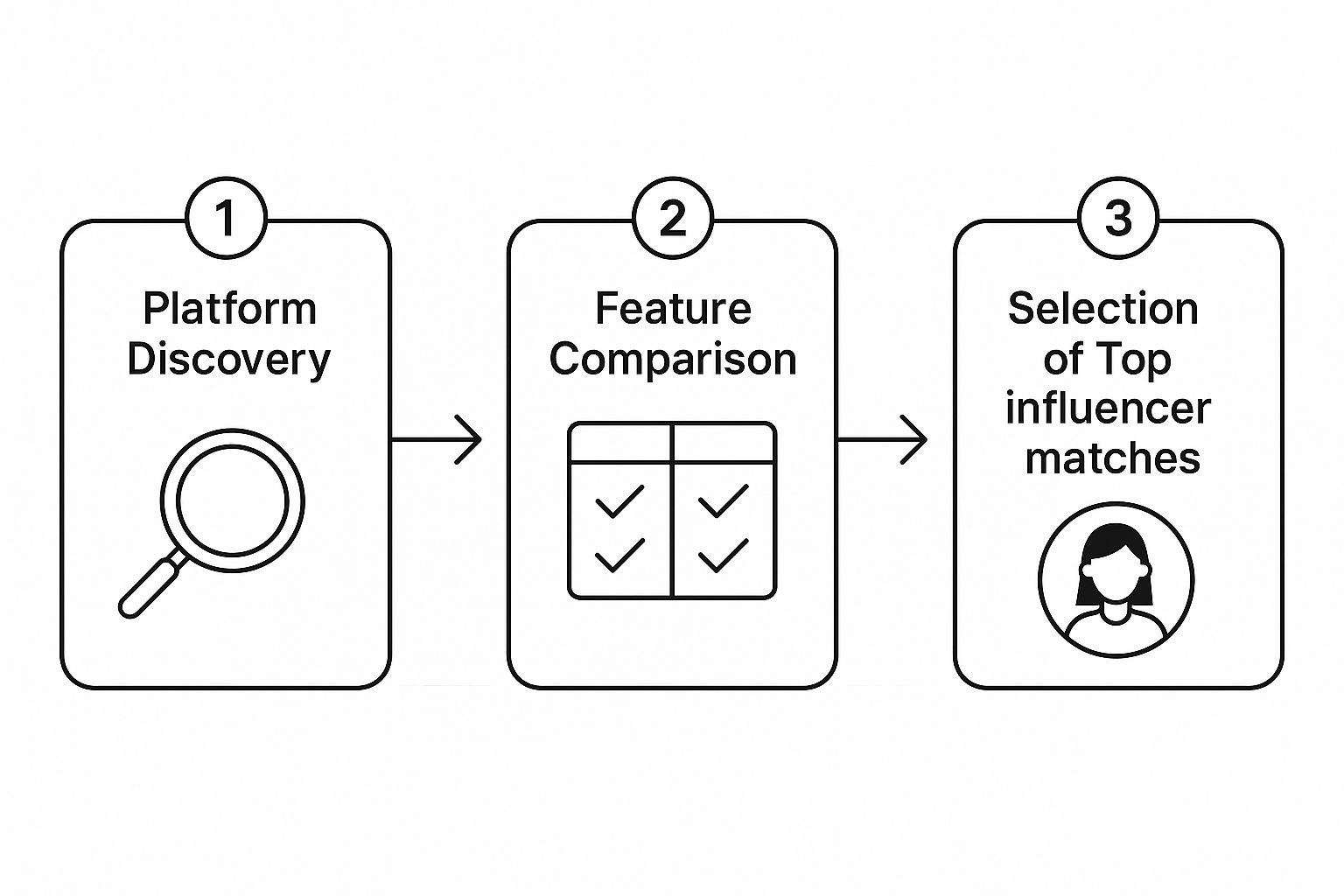
As you can see, it’s a process of layering data. You start broad, apply filters to find relevant creators, analyze their profiles, and end up with a high-quality shortlist.
Choosing the Right Kind of Platform
Not all platforms are built the same. They typically fall into two camps, and picking the right one depends on your budget and how you want to work.
Influencer Marketplaces
Platforms like Aspire or #paid operate a lot like a job board. You create a campaign brief explaining what you're looking for, and influencers who are interested apply to work with you.
- The upside: It’s often cheaper for one-off campaigns and connects you with creators who are actively looking for work.
- The downside: Your reach is limited to the influencers on that specific platform, and you lose the ability to proactively find hidden gems.
SaaS Platforms
These are all-in-one software tools like Grin or Upfluence. You pay a subscription fee (usually annually) for access to a massive, searchable database of creators.
- The upside: The discovery tools are second to none. You get deep analytics on almost any profile, plus tools for managing campaigns, sending payments, and tracking results.
- The downside: They are a serious financial commitment, often costing thousands of dollars a year.
My Take: A marketplace is a great place to start and test the waters. A SaaS platform is what you invest in when you're ready to build a serious, long-term influencer program that drives real growth.
Deciding between manual searching and a platform can be tough. Manual gives you total control but costs you time, while platforms save time but cost money. Here's a quick breakdown to help you compare.
Manual Search vs. Influencer Platforms
| Feature | Manual Search | Influencer Platform |
|---|---|---|
| Cost | Free (but time-intensive) | Subscription-based ($5k - $25k+ per year) |
| Speed & Scale | Slow and difficult to scale | Very fast; find hundreds of candidates in minutes |
| Data & Analytics | Limited to public metrics (likes, comments) | Deep audience demographics, fake follower detection |
| Vetting Process | Entirely manual, relies on observation | Automated data points speed up initial review |
| Workflow | Disorganized (spreadsheets, email, DMs) | Centralized dashboard for communication & management |
Ultimately, platforms are designed to bring order to the chaos. While you still need your human intuition to make the final call, the data they provide makes your decisions smarter and more reliable from the start.
More Than Just a Search Bar
The value of these platforms goes way beyond just finding people. They arm you with crucial data to properly vet creators before you ever reach out.
For instance, a good platform can instantly flag an influencer's audience credibility score, telling you what percentage of their followers might be bots or inactive accounts. It can also break down their audience by city, country, and language—essential information for an Amazon brand targeting specific markets.
And then there's the workflow. The best platforms have built-in tools for outreach, contract negotiation, product shipping, and payments. This gets you out of the messy world of spreadsheets and scattered email threads and into a single, organized dashboard. For a growing brand, that efficiency alone is often worth the price of admission.
How to Vet Influencers and Spot Red Flags
So, you've got a spreadsheet filling up with potential partners. Great start. But finding a creator with a pretty feed is the easy part. The real work is making sure they’re a smart investment for your Amazon brand.
Skipping this step is like buying a car without popping the hood. It might look shiny on the outside, but you could be in for a costly breakdown. This is your chance to look past the vanity metrics and spot red flags—fake followers, sketchy engagement, bad brand alignment—before you send out a single product.
Look Beyond the Follower Count
Everyone’s eyes go straight to the follower count, but honestly, it’s often the least telling number. A huge following can be bought, and bots don’t buy products. What you really need to care about is the quality and consistency of their engagement.
Start by getting a rough idea of their engagement rate. A quick back-of-the-napkin formula is to grab the likes and comments on their last 10-12 posts (skip the most recent one), find the average, divide that by their total followers, and multiply by 100. For a micro-influencer (10k-100k followers), anything in the 2-5% range is a pretty healthy sign. Knowing exactly how to measure social media engagement is critical to weeding out the duds.
It's a big market out there—projected to hit $32.55 billion—and most of it isn't powered by celebrities. Nano-influencers, with their smaller but fiercely loyal audiences, now make up nearly 76% of the entire Instagram influencer landscape. This is a huge shift toward authentic, niche partnerships that brands can really benefit from.
Analyze the Quality of Their Community
The comments section is a goldmine. It tells you everything you need to know about the health of an influencer’s community. Are people having actual conversations? Or is it just a wall of fire emojis and "Great post!" from the same five accounts?
Keep an eye out for these red flags:
- Weirdly irrelevant comments. If the post is about a new pair of hiking boots and the comments are about crypto, you're likely looking at bots.
- The creator never replies. A good influencer is part of their community. If they ignore every question and comment, they aren’t fostering a real connection.
- The same people commenting over and over. This can be a sign of an "engagement pod," where creators team up to artificially inflate their numbers.
A healthy comments section feels alive. You'll see real questions, followers tagging their friends, and the creator jumping in to chat. That's the kind of community that will actually listen when they post about your brand.
Review Their Past Brand Collaborations
An influencer’s track record with other brands speaks volumes. Scroll through their feed and look for posts tagged with #ad or #sponsored. This isn't optional—it's a legal requirement and the mark of a professional. These principles apply across platforms, but if you're specifically targeting Amazon creators, our guide on how to find an Amazon influencer has more tailored advice.
When you find their sponsored content, ask yourself a few key questions:
- Does the partnership feel right? Does the product fit their niche, or does it feel random and forced?
- How did their audience take it? Check the comments on sponsored posts. Are people genuinely curious, or are they complaining about seeing too many ads?
- Is the content actually good? Did they put the same care and creativity into their paid posts as their regular content?
You're looking for a partner who can weave products into their content naturally without losing their audience's trust. If their feed is just a graveyard of low-engagement ads, it’s a clear sign their promotional posts have lost all their power. Move on.
Crafting Outreach That Actually Gets a Reply
So, you've done the digging and have a solid list of potential creators. Fantastic. But now comes the moment of truth—that first message. This is where you either build a real partnership or get lost in a sea of unread DMs.
Let's be real: good influencers get slammed with messages from brands every single day. Most of them are awful, copy-paste templates that basically scream, "I have no idea who you are." If you want to stand out, your approach needs to be personal, respectful, and crystal clear about what's in it for them.
Personalization is Everything
This is the number one thing brands get wrong. Sending a generic, one-size-fits-all message is a one-way ticket to the trash folder. Creators can smell a template from a mile away. Your job is to prove you've actually done your homework and aren't just blasting a list.
Before you even dream of hitting 'send,' go engage with their recent content. A few likes and a genuine comment go a long way. Then, when you write your message, bring that up.
- "I absolutely loved your recent post on sustainable home swaps. The way you broke down the benefits of wool dryer balls was so smart and easy to follow."
- "That Reel you posted last week about your morning coffee ritual was hilarious. The whole team was cracking up!"
It’s a simple move, but it shows you're a real human who sees them as more than just an advertising channel. Trust me, this little bit of effort immediately puts you ahead of 90% of the other brands in their inbox.
Choosing Your Channel: Email vs. Instagram DM
Where you send your message is just as important as what you say.
Most professional creators prefer email for business stuff—it's just cleaner and easier for them to keep track of. You can almost always find their email address right in their Instagram bio. If it's there, that's your cue. Use it.
That said, an Instagram DM can be a great way to break the ice without being too formal. A solid strategy is to lead with a quick, friendly DM.
Example DM: "Hi [Creator Name]! Just wanted to say I'm a huge fan of your content—your recent post about [specific topic] was fantastic. My name is [Your Name] from [Your Brand]. I just sent a quick email your way with a partnership idea I think you'll really like. Hope to connect soon!"
This little two-step is perfect. It’s a warm, personal touch on the platform they live on, but it respectfully points them to the channel they prefer for business.
Instagram is also trying to make this whole process a bit more official with its Creator Marketplace.
This is basically Instagram's attempt to build a dedicated space for brands and creators to connect, cutting through some of the clutter of a typical DM inbox.
How to Structure Your Message
Whether it's an email or a DM, keep it short, clear, and to the point. Nobody wants to read a novel. Think of it as a friendly conversation starter, not a corporate memo.
Here’s a simple framework that works every time:
- The Personalized Hook: Start with that specific, genuine compliment we talked about.
- The Quick Intro: In one sentence, say who you are and what your brand does.
- The "Why You": This is key. Explain why you think they, specifically, are a perfect fit. Connect their vibe, values, or content style directly to your brand.
- The Idea: Briefly outline what you have in mind. Don't drown them in details here. Just give them the gist.
- The Easy Next Step: End with a simple, clear call to action. Ask if they're open to hearing more or if they have 15 minutes for a quick chat next week.
Talking Money: Negotiating Fair Compensation
Once a creator signals they're interested, the conversation will naturally turn to payment. You need to be ready for this and be flexible. The days of just offering free products in exchange for a post are pretty much over, especially for anyone with a real, engaged audience.
Here are the most common ways deals are structured:
- Paid-Per-Post: A flat fee for a specific set of deliverables, like one Reel and a few Stories.
- Product Gifting (Seeding): This is best for smaller, up-and-coming nano-influencers or when you just want to get your product in their hands with no strings attached. There's no guarantee they'll post.
- Affiliate Commission: A performance-based deal where the creator earns a cut of every sale they drive. This is a powerful model for building long-term, results-focused partnerships.
- Hybrid Model: A mix of an upfront flat fee plus an ongoing affiliate commission. This is often the most appealing structure for high-performing creators.
The goal here is to find something that feels like a win for everyone. When you respect their work enough to pay them fairly, you're not just buying a one-off post—you're investing in a relationship. To make sure that investment pays off, you need to be clear on what you're trying to achieve. Knowing which influencer marketing KPIs matter most for your campaign will help you and your creator get on the same page from day one.
Still Have Questions About Finding Influencers?
Even with the best tools and a solid plan, you're going to have questions when you start hunting for the right Instagram influencers. It’s a world with its own rules, and a few quick answers can save you a ton of headaches down the road. Let's clear up some of the most common sticking points.
Getting a handle on these details helps you set expectations, both for yourself and for the creators you want to work with. It's all about knowing what to expect when it comes to cost, performance, and when it might be time to call in for backup.
How Much Does It Cost to Hire an Instagram Influencer?
This is the big one, and the honest answer is always, "it depends." There’s no standard rate card for influencer collaborations. The price can swing dramatically based on everything from follower count and engagement to their industry niche and exactly what you're asking them to create.
- Nano-influencers (1k-10k followers): Many are happy to work in exchange for free products, especially if they’re new to brand deals and genuinely love what you sell.
- Micro-influencers (10k-100k followers): This is where you'll see a wide range. Expect to pay anywhere from $100 to $500+ for a single in-feed post.
- Macro-influencers and celebrities: We're talking big leagues here. Their rates can easily hit thousands, sometimes tens of thousands, for a single campaign.
The key is to think beyond follower count. Negotiate based on the real value and potential return you see, not just a vanity metric.
What’s a Good Engagement Rate for an Influencer?
"Good" is completely relative. As an influencer's audience grows, their engagement rate naturally drops. It’s just the law of large numbers. So, comparing a creator with 10,000 followers to one with 200,000 is like comparing apples and oranges.
Instead of getting hung up on one metric, look for consistency. A creator who pulls in a steady 5% engagement on a super-niche audience of 15,000 is often a much better bet than someone with 1% engagement on a massive, generic audience of 200,000. The first one has a real community; the second might just have a lot of passive followers.
A strong engagement rate signals a healthy, active community that trusts the creator. For micro-influencers, anything from 2-5% is fantastic. For larger accounts with hundreds of thousands of followers, even 1-2% is a solid sign of a connected audience.
Should My Brand Use an Influencer Marketing Agency?
This really boils down to your team's bandwidth and expertise. If you've got the budget but are short on time (or influencer marketing know-how), an agency can be a game-changer.
They handle everything from start to finish: finding and vetting creators, negotiating contracts, managing content approvals, and wrapping it all up with a final report. This is especially helpful if you're trying to launch a huge campaign with dozens of influencers all at once.
But, if you're a smaller brand or really want to build genuine, long-term relationships with your partners, doing it yourself often makes more sense. Managing the process in-house, either manually or with a platform, is more affordable and lets you build that direct connection that leads to the most authentic collaborations.
Ready to build and manage your own network of brand advocates? Coral provides the tools you need to create a professional affiliate program for your Amazon brand. Recruit creators, track sales with Amazon Attribution, and manage payouts all in one place. Turn your best partnerships into a scalable growth engine. Get started with Coral today.