Influencer Marketing KPIs: Key Metrics to Track in 2025
Category: Influencer marketing kpis
Driving ROI with Influencer Marketing: Measuring What Matters
Want to unlock the true potential of your influencer marketing campaigns? You need to track the right metrics. This listicle dives into eight crucial influencer marketing KPIs essential for measuring success in 2025. We'll explore these KPIs, providing clear definitions, formulas, industry benchmarks, and real-world examples. Learn how to effectively measure and optimize your campaigns for maximum ROI.
This guide is essential for anyone working with influencers, including:
- Small and emerging Amazon sellers
- Growing Amazon brands
- Influencers and content creators
- Enterprise-level Amazon sellers
- Ecommerce entrepreneurs with an Amazon store
- DTC brand owners
Understanding these key metrics is crucial for making data-driven decisions and achieving your influencer marketing goals. We'll also show you how Coral can streamline your tracking process. Dive in and discover how to maximize the impact of your influencer partnerships. We'll cover:
- Engagement Rate
- Reach and Impressions
- Click-Through Rate (CTR)
- Conversion Rate
- Brand Mention Sentiment
- Cost Per Acquisition (CPA)
- Earned Media Value (EMV)
- Share of Voice (SOV)
1. Engagement Rate
Engagement rate is a crucial influencer marketing KPI that measures the percentage of an influencer's audience actively interacting with their content. This interaction includes likes, comments, shares, and saves. It's a powerful indicator of the quality of the relationship between an influencer and their followers, revealing how compelling and relevant their content truly is. A high engagement rate suggests an active and invested audience, more likely to be influenced by the creator's recommendations.
Why Engagement Rate Matters
Tracking engagement rate is essential for several reasons. It helps you assess the effectiveness of your influencer campaigns and understand how well the influencer's content resonates with their audience. It's a much better measure of influencer quality than follower count alone, as a large following doesn't necessarily translate to an engaged audience. By focusing on engagement rate, you can identify influencers who genuinely connect with their followers and are more likely to drive meaningful results for your brand.
Examples of Engagement Rate in Action
Several brands have effectively leveraged engagement rate as a key selection criterion for influencer partnerships. Glossier, for example, prioritizes beauty micro-influencers with engagement rates of 3-8% over mega-influencers with lower rates (1-2%). They recognize that higher engagement often signifies a more dedicated and receptive audience. Similarly, Daniel Wellington's success with influencer marketing can be attributed to their focus on partnering with influencers who consistently maintain high engagement rates (5%+). Gymshark, another brand known for its successful influencer campaigns, also prioritizes engagement quality over follower count when selecting fitness influencers.
Tips for Tracking and Interpreting Engagement Rate
Benchmark Against Industry Averages: Understanding typical engagement rates across platforms is crucial. Aim for these benchmarks: Instagram (1-3%), TikTok (5-9%), YouTube (2-3%).
Look for Consistency: One-off viral posts don't tell the whole story. Prioritize influencers with consistently high engagement over those with sporadic spikes.
Analyze Comment Quality: Don't just count comments; assess their quality. Meaningful comments and discussions indicate a truly engaged audience.
Engagement Rate by Reach: For a more accurate measurement, consider engagement rate by reach (the number of unique users who saw the content), rather than just by followers.
The infographic below visualizes average engagement rates across different social media platforms. This data chart uses a bar graph to compare Instagram, TikTok, and YouTube.
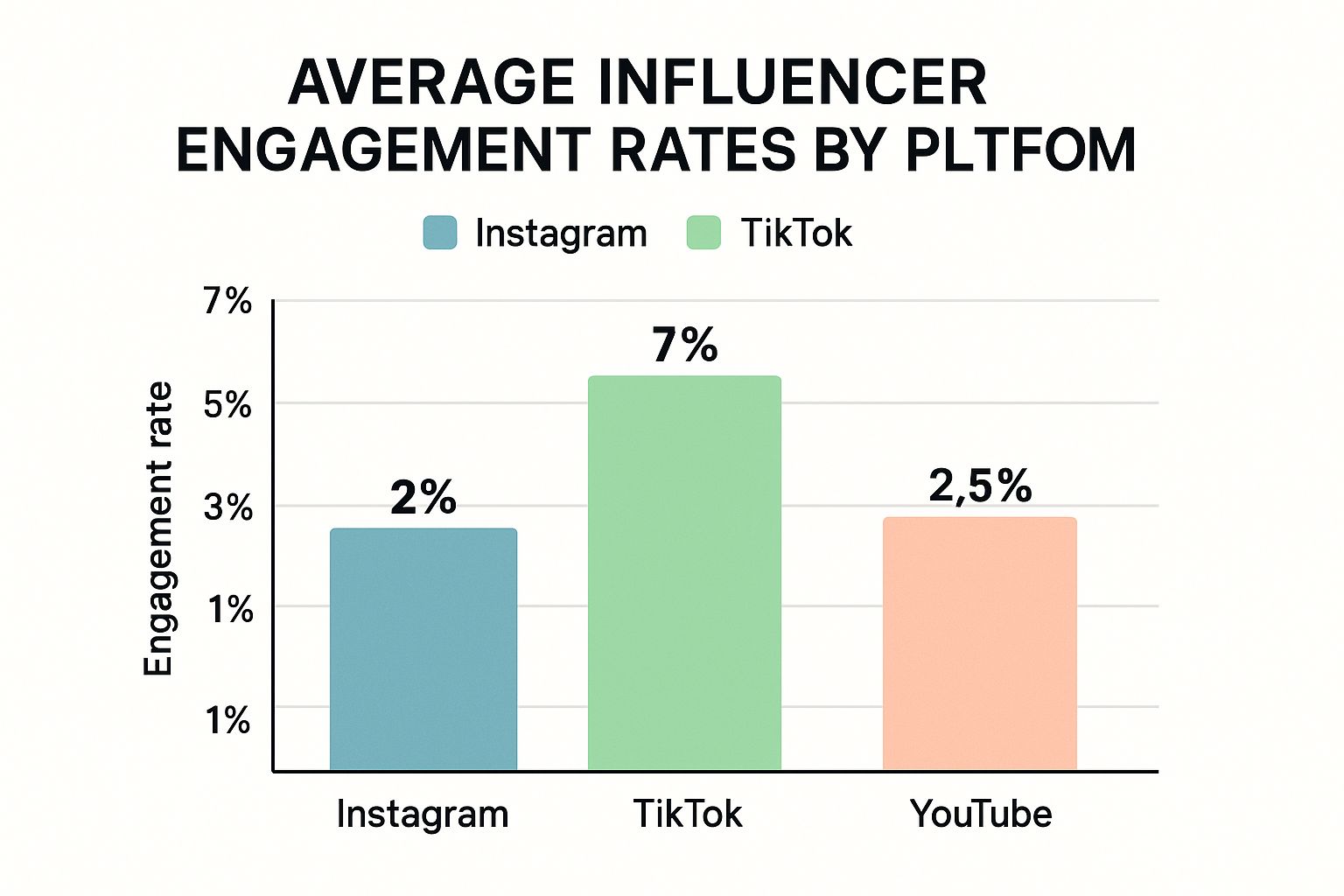
As the chart clearly demonstrates, TikTok boasts significantly higher average engagement rates compared to Instagram and YouTube, making it a potentially valuable platform for influencer marketing campaigns. However, platform choice should align with your target audience and overall marketing strategy. Using engagement rate as an influencer marketing KPI helps ensure your campaigns reach a responsive and engaged audience, ultimately maximizing your return on investment.
2. Reach and Impressions
Reach and impressions are two fundamental influencer marketing KPIs that offer insights into the potential audience size exposed to your brand's message. Reach measures the total number of unique users who have seen an influencer's content. Impressions, on the other hand, count the total number of times the content was displayed, which can include multiple views by the same user. Understanding both metrics is crucial for assessing the visibility of your influencer campaigns.

Why Reach and Impressions Matter
Tracking reach and impressions helps you gauge the potential audience exposed to your brand through influencer marketing. Reach provides a sense of the campaign's breadth, indicating how many individual users encountered the content. Impressions, while not unique, reflect the content's overall visibility and potential for repeated exposure, which can reinforce brand messaging. These KPIs, when used in conjunction with engagement rate, can provide a more complete picture of campaign performance.
Examples of Reach and Impressions in Action
Many successful brands leverage reach and impressions to evaluate influencer marketing campaign performance. Coca-Cola's #ShareACoke campaign, known for its widespread influencer partnerships, reached over 500 million people. Nike frequently collaborates with basketball influencers for Air Jordan releases, generating upwards of 50 million impressions per campaign. Similarly, Sephora's beauty influencer campaigns have seen 200% higher reach compared to traditional advertising, demonstrating the power of influencer marketing for expanding brand visibility.
Tips for Tracking and Interpreting Reach and Impressions
Track Reach-to-Engagement Ratio: A high reach with low engagement might indicate a broad but uninterested audience. Analyze this ratio to assess content quality and audience relevance.
Monitor Reach Consistency: Look for influencers who consistently achieve high reach across multiple posts, rather than relying on one-off viral hits. This signals a more stable and engaged audience base.
Use Platform Analytics: Leverage the built-in analytics tools provided by Instagram, Facebook, and other social media platforms to gather accurate reach and impression data.
Consider Paid Promotion: Amplifying high-performing influencer content with paid promotion can significantly extend its reach and further maximize impact. This is particularly effective for content that has already demonstrated strong organic performance.
3. Click-Through Rate (CTR)
Click-Through Rate (CTR) is a vital influencer marketing KPI that measures the percentage of people who click on a specific link after viewing an influencer's content. This could be a link in their bio, a swipe-up feature in a Story, or a call-to-action within a post. CTR quantifies how effectively influencer content drives traffic to desired destinations, like product pages, websites, or landing pages. It provides a clear picture of how compelling the influencer's content and call-to-action are in motivating their audience to take the next step.
Why Click-Through Rate Matters
Tracking CTR is essential for understanding the effectiveness of your influencer campaigns. It goes beyond engagement and measures the direct impact of influencer content on driving traffic to your desired destination. A high CTR indicates that the influencer is successfully persuading their audience to learn more, visit your site, or explore your product. This directly contributes to your brand's visibility and potential sales conversions. Learn more about measuring CTR and other attribution methods for Amazon sellers here: Learn more about Amazon Attribution Links.
Examples of Click-Through Rate in Action
Many brands have successfully leveraged high CTRs through strategic influencer partnerships. Fashion Nova, known for its collaborations with Instagram influencers, frequently sees CTRs between 8-12% on their Stories campaigns. HelloFresh, a meal kit delivery service, achieves CTRs of 15-20% by partnering with influencers who promote discount codes through compelling CTAs. Even with different strategies, Audible also effectively uses influencer marketing to drive traffic to their audiobook platform, often reaching 5-8% CTR through partnerships with lifestyle influencers promoting specific book titles.
Tips for Tracking and Interpreting Click-Through Rate
Use Clear, Compelling Call-to-Actions: In your influencer briefs, clearly outline the desired action and provide influencers with compelling call-to-actions to encourage clicks.
Implement Unique Tracking Links: Use unique tracking links for each influencer to accurately measure the traffic generated by their specific content. This granular data is essential for assessing individual influencer performance.
Test Different Link Placements: Experiment with various link placements, such as in the bio, Stories, or comments, to optimize for maximum visibility and clicks.
Provide Optimized Landing Pages: Ensure that the landing pages linked from influencer content are optimized for conversions and match the style and tone of the influencer's content for a seamless user experience. This can significantly improve conversion rates from click-throughs.
4. Conversion Rate
Conversion rate is a critical influencer marketing KPI that measures the percentage of users who complete a desired action after interacting with influencer content. These actions could include making a purchase, signing up for a newsletter, or downloading an app. This KPI directly measures the effectiveness of influencer marketing in driving tangible business outcomes, moving beyond awareness and engagement to actual results. Learn more about calculating your influencer marketing ROI with our detailed guide: Learn more about...

Why Conversion Rate Matters
Tracking conversion rate is crucial because it demonstrates the return on investment (ROI) of your influencer marketing campaigns. It shows how effectively influencers are driving desired actions and contributing to your business objectives. By focusing on conversion rate, you can optimize campaigns to maximize sales, leads, and other valuable outcomes. It provides clear data on which influencer partnerships are truly delivering results.
Examples of Conversion Rate in Action
Many brands have successfully leveraged influencers to drive conversions. MVMT Watches, for example, achieved conversion rates of 12-18% by partnering with watch enthusiast influencers. Similarly, Blue Apron's cooking influencer campaigns generated conversion rates of 8-15% by offering first-time subscriber discounts. Warby Parker also saw success, achieving conversion rates of 10-20% through eyewear influencer collaborations featuring virtual try-on features.
Tips for Tracking and Interpreting Conversion Rate
Use Unique Promo Codes: Provide each influencer with a unique promo code to accurately track conversions attributed to their content. This allows for precise measurement and isolates the impact of individual influencers.
Track Conversions Over Time: Track conversions over a 30-90 day window to capture delayed purchases. Consumers may not always convert immediately after seeing influencer content.
Optimize Landing Pages: Create dedicated landing pages optimized for influencer traffic. Ensure the messaging and offer align with the influencer's content for a seamless user experience.
A/B Test Offers: Experiment with different offers and discount percentages to identify what resonates best with the influencer's audience and drives the highest conversion rates. This allows for continuous optimization.
5. Brand Mention Sentiment
Brand mention sentiment is a crucial influencer marketing KPI that analyzes the emotional tone and context surrounding brand mentions within influencer content and the subsequent audience comments. This KPI goes beyond simply counting mentions; it delves into the quality and emotional response they generate, providing valuable insight into brand perception and campaign reception. By understanding sentiment, brands can gauge the true impact of their influencer collaborations.
Why Brand Mention Sentiment Matters
Tracking brand mention sentiment is essential for several reasons. It helps you understand how consumers perceive your brand in the context of influencer content. Positive sentiment indicates a successful campaign resonating well with the target audience, while negative sentiment can highlight areas needing improvement. This KPI offers a deeper understanding of campaign effectiveness than just reach or engagement metrics alone. It reveals the emotional impact of your influencer partnerships.
Examples of Brand Mention Sentiment in Action
Several brands have effectively leveraged sentiment analysis to optimize their influencer campaigns. Patagonia, known for its environmental activism, partners with influencers who generate predominantly positive sentiment (85%+) around their sustainability messaging. Dove's body positivity influencer campaigns consistently achieve 90%+ positive sentiment in comments and shares, reinforcing their brand message. Even when tackling controversial topics, Ben & Jerry's social justice influencer collaborations maintain 80%+ positive brand sentiment, demonstrating their ability to connect with their audience authentically.
Tips for Tracking and Interpreting Brand Mention Sentiment
Monitor Sentiment in Real-time: During campaign launches, real-time sentiment tracking allows for immediate adjustments and response to any negative feedback.
Utilize Sentiment Analysis Tools: Leverage social listening platforms like Brandwatch, Hootsuite Insights, or Sprout Social to automate sentiment tracking and gain comprehensive insights.
Train Influencers on Authentic Brand Messaging: Equipping influencers with clear guidelines and messaging ensures consistent and positive brand representation, thereby improving overall sentiment.
Address Negative Sentiment Quickly and Transparently: Respond to negative comments and concerns promptly and authentically to mitigate potential damage and maintain brand trust. Addressing negative sentiment demonstrates that you value customer feedback.
Using brand mention sentiment as an influencer marketing KPI provides a deeper understanding of the emotional impact your campaigns have on your target audience. It allows you to fine-tune your strategies, strengthen brand perception, and maximize the effectiveness of your influencer partnerships. Tracking sentiment helps you ensure your influencer marketing efforts are not only reaching a wide audience but also resonating positively.
6. Cost Per Acquisition (CPA)
Cost Per Acquisition (CPA) is a vital influencer marketing KPI that measures the total cost of acquiring one customer through your campaigns. It's calculated by dividing the total campaign costs by the number of customers acquired. This metric is essential for determining the profitability and efficiency of your influencer marketing investments compared to other marketing channels. By tracking CPA, you can gain valuable insights into how much you're spending to acquire each new customer through influencer collaborations.
Why CPA Matters
Tracking CPA is crucial for assessing the return on investment (ROI) of your influencer marketing campaigns. It allows you to compare the cost-effectiveness of influencer marketing against other marketing channels like paid advertising or email marketing. Understanding your CPA helps you optimize your budget allocation and ensure that your influencer partnerships are driving profitable customer acquisition. Learn more about how to effectively utilize and calculate your CPA to improve the effectiveness of your influencer marketing strategies. Learn more about...
Examples of CPA in Action
Several brands have successfully leveraged CPA as a key performance indicator for their influencer marketing initiatives. Dollar Shave Club, for example, achieved a CPA of $15-25 through partnerships with male lifestyle influencers, significantly lower than the $45 CPA they experienced with traditional advertising. Casper mattresses also saw success, maintaining a $75-125 CPA through home and lifestyle influencers compared to a $200+ CPA through other channels. Glossier, known for its effective beauty influencer campaigns, achieved a CPA of $8-15 for first-time customers acquired through influencer collaborations.
Tips for Tracking and Interpreting CPA
Track CPA Over Different Time Windows: Analyze CPA over various periods (7, 30, 90 days) to understand short-term and long-term campaign performance.
Include All Associated Costs: Factor in all influencer marketing costs, including influencer fees, content creation costs, and platform fees, to calculate accurate CPA figures.
Compare CPA Against Customer Lifetime Value (CLV): Assess CPA in relation to CLV to ensure that your customer acquisition cost is justified by the long-term value each customer brings to your business.
Optimize Campaigns: Reallocate your budget to influencers and campaigns with the lowest CPA to maximize your return on investment and improve overall campaign efficiency. This allows you to focus resources on the most effective influencer partnerships.
7. Earned Media Value (EMV)
Earned media value (EMV) is a crucial influencer marketing KPI that measures the monetary value of the publicity and exposure gained through influencer content. It estimates what the equivalent advertising spend would cost if purchased through traditional paid media channels. EMV helps brands understand the amplified value of their influencer investments beyond the initial paid partnership. It quantifies the organic reach and engagement generated by influencer activities.
Why Earned Media Value Matters
Tracking EMV is essential for understanding the return on investment (ROI) of your influencer marketing campaigns. It provides a tangible way to assess the value generated by influencer-created content, going beyond simple likes and comments. By calculating EMV, you can justify influencer marketing spend and demonstrate its impact on brand awareness and reach. This metric also helps compare the effectiveness of different influencer campaigns and strategies.
Examples of Earned Media Value in Action
Several brands have witnessed significant returns by leveraging EMV. Airbnb's travel influencer campaigns have generated 4-6 times their initial investment in EMV through user-generated content and increased brand visibility. GoPro's adventure influencer partnerships have achieved 8-12 times EMV through viral content sharing, showcasing the power of authentic storytelling. Starbucks' seasonal campaign influencer content generated $2.3 million in EMV from a $400,000 investment, demonstrating the effectiveness of targeted influencer activations.
Tips for Tracking and Interpreting Earned Media Value
- Use Consistent EMV Calculation Methods: Implement standardized formulas and tools across all campaigns for accurate comparison and analysis. This ensures consistent data interpretation and avoids skewed results.
- Focus on EMV Trends Rather Than Absolute Numbers: Track EMV over time to identify patterns and assess the long-term impact of influencer collaborations. Single data points can be misleading; trends offer a more holistic view.
- Combine EMV with Direct Response Metrics: Pair EMV data with metrics like website traffic, conversions, and sales for a comprehensive understanding of campaign performance. This provides a more nuanced picture of influencer impact.
- Consider Using Multiple EMV Calculation Tools: Employ different tools and compare their outputs to validate your EMV calculations and gain a more accurate assessment. Cross-referencing ensures data reliability.
By incorporating EMV as a key influencer marketing KPI, brands can gain a clearer understanding of the value generated by their influencer partnerships. This metric provides actionable insights for optimizing future campaigns and maximizing the return on investment in influencer marketing. EMV helps demonstrate the effectiveness of these campaigns and justify continued investment.
8. Share of Voice (SOV)
Share of Voice (SOV) is a vital influencer marketing KPI that measures the percentage of online conversations your brand owns within your industry or niche. Driven by influencer marketing campaigns, SOV reveals how much of the online discussion about a product category focuses on your brand compared to competitors. This metric provides valuable insights into your brand's visibility, market positioning, and the effectiveness of your influencer strategies.
Why Share of Voice Matters
Tracking SOV is crucial for understanding your brand's prominence in the digital landscape. It helps assess the impact of your influencer campaigns on brand awareness and market share. A higher SOV suggests greater brand visibility and a stronger influence on consumer perceptions. By monitoring SOV, you can identify opportunities to amplify your brand's message, address competitive challenges, and ultimately drive more sales.
Examples of Share of Voice in Action
Several brands have successfully leveraged influencer marketing to boost their SOV. Nike, for instance, consistently maintains a high SOV (35-45%) in athletic wear discussions through strategic partnerships with athlete influencers. Tesla, largely due to Elon Musk's influence and tech influencer coverage, achieves a dominant SOV (60%+) in electric vehicle conversations. Glossier also leverages micro-influencer partnerships to capture a significant SOV (15-20%) in the beauty industry.
Tips for Tracking and Interpreting Share of Voice
Define Relevant Keywords: Identify the keywords and hashtags relevant to your industry and brand to accurately measure SOV.
Monitor Competitor Activity: Track your competitors' SOV to benchmark your performance and identify areas for improvement.
Analyze Campaign Impact: Measure SOV changes during and after influencer campaigns to assess their effectiveness.
Combine with Sentiment Analysis: Pairing SOV with sentiment analysis provides a holistic view of brand perception and online conversation tone. This combination helps you understand not only how much people are talking about your brand but also how they are talking about it.
Using Share of Voice as an influencer marketing KPI provides valuable insights into your brand's competitive landscape and the effectiveness of your campaigns. By actively monitoring and optimizing SOV, you can strengthen your brand's position in the market and drive meaningful business results. This metric, particularly when used in conjunction with other KPIs like engagement rate and conversions, offers a robust measure of influencer marketing success.
Influencer Marketing KPI Comparison
| KPI | Implementation Complexity 🔄 | Resource Requirements ⚡ | Expected Outcomes 📊 | Ideal Use Cases 💡 | Key Advantages ⭐ |
|---|---|---|---|---|---|
| Engagement Rate | Moderate - requires tracking multi-interactions | Low - basic analytics tools suffice | Quality of audience connection and content relevance | Identifying authentic micro-influencers | Strong indicator of audience authenticity |
| Reach and Impressions | Low - standard platform metrics | Low - available via native analytics | Measurement of content visibility and potential exposure | Brand awareness and visibility campaigns | Easy cross-platform comparison |
| Click-Through Rate (CTR) | Moderate - needs link tracking and UTM setup | Moderate - tracking links and analytics | Effectiveness in driving traffic and audience action | Traffic-driving and direct response campaigns | Direct measurement of audience interest |
| Conversion Rate | High - requires advanced tracking and attribution | High - complex analytics and integration | Business results and revenue generation from campaigns | Sales-driven influencer marketing | Direct correlation to ROI and business goals |
| Brand Mention Sentiment | High - complex NLP tools or manual analysis needed | High - sentiment analysis platforms and expertise | Insights into brand perception and emotional audience response | Brand reputation and PR monitoring | Early warnings for negative feedback and brand health |
| Cost Per Acquisition (CPA) | Moderate to high - needs cost tracking and attribution | Moderate - financial data plus analytics required | Profitability and cost-efficiency of campaigns | Budget allocation and campaign optimization | Clear ROI and cost control |
| Earned Media Value (EMV) | Moderate - varied calculation methods | Moderate - requires engagement and reach data | Monetary value estimate of earned exposure | Budget justification and campaign valuation | Demonstrates amplified value beyond spend |
| Share of Voice (SOV) | High - requires comprehensive social listening setup | High - social monitoring tools and competitive data | Market positioning and brand dominance in conversations | Competitive analysis and market share tracking | Tracks brand visibility relative to competitors |
Optimizing Your Influencer Marketing Strategy with Coral
This article explored eight key influencer marketing KPIs: Engagement Rate, Reach and Impressions, Click-Through Rate (CTR), Conversion Rate, Brand Mention Sentiment, Cost Per Acquisition (CPA), Earned Media Value (EMV), and Share of Voice (SOV). Mastering these metrics is crucial for understanding campaign performance and maximizing your return on investment. By accurately tracking these KPIs, you can identify what's working, what needs improvement, and ultimately, how to optimize your influencer marketing strategy for greater success.
Why These KPIs Matter
These influencer marketing KPIs offer valuable insights into different aspects of your campaigns. They provide a holistic view, from initial brand awareness generation (Reach, Impressions, SOV) to the final purchase (Conversion Rate, CPA). Analyzing sentiment helps you understand public perception, while EMV provides a tangible measure of the value generated by your influencer partnerships. Tracking these KPIs isn't just about collecting numbers; it's about understanding the story behind those numbers and using that knowledge to make data-driven decisions.
Actionable Next Steps
To effectively utilize these KPIs, you need a system for tracking and analysis. This is where having the right tools becomes essential. Start by prioritizing the KPIs most relevant to your specific campaign goals. For example, if your objective is brand awareness, focus on Reach, Impressions, and SOV. If driving sales is your primary goal, prioritize Conversion Rate and CPA.
- Set clear benchmarks: Establish realistic targets for each KPI based on industry averages and your past campaign performance.
- Regularly monitor your progress: Track your KPIs consistently to identify trends and areas for improvement.
- Adapt your strategy: Use the insights gained from your KPI analysis to refine your influencer selection, content strategy, and campaign execution.
The Power of Data-Driven Decisions
By consistently tracking and analyzing your influencer marketing KPIs, you can move beyond guesswork and make informed decisions. This data-driven approach allows you to optimize your campaigns in real-time, identify high-performing influencers, and allocate your budget effectively. Ultimately, mastering these KPIs empowers you to achieve your campaign objectives and maximize the impact of your influencer marketing efforts.
Ready to streamline your influencer marketing KPI tracking and unlock data-driven decision-making? Coral provides a centralized platform to manage your influencer partnerships, track performance in real-time, and generate insightful reports. Visit Coral today to learn how Coral can help you elevate your influencer marketing strategy.