Your Guide to an Influencer Review Program
Category: Influencer review program
Let's break down what an influencer review program actually is. In simple terms, it's a partnership where you give your products to content creators, and in return, they share their honest thoughts and create content about it.
Think of it as the modern version of word-of-mouth marketing, supercharged by people your ideal customers already trust and follow. This is how you get the social proof you desperately need to cut through the noise on a crowded marketplace like Amazon.
What Is an Influencer Review Program, Anyway?

At its heart, an influencer review program is a straightforward value exchange. You get authentic content and get your product in front of a new audience. The influencer gets a free product to try and something new to talk about with their followers.
Imagine sending your newest product to a friend and asking for their real opinion—only this friend has thousands of people listening to their every recommendation. That's the power you're tapping into.
This whole approach sidesteps traditional, polished advertising. Instead of a carefully scripted brand message, you get genuine unboxing videos, real-world tutorials, and honest feedback. For anyone selling on Amazon, this kind of content is gold because it directly influences buying decisions and sends qualified traffic right to your product page.
Key Components of an Influencer Review Program
To help you visualize how these programs are structured, here’s a table breaking down the essential pieces. Understanding these components is the first step toward building a system that consistently generates authentic social proof for your brand.
| Component | Purpose | Example |
|---|---|---|
| Product Gifting | To get the product into the influencer's hands for an authentic, hands-on experience without a script. | Sending your new skincare line to a beauty vlogger to incorporate into their daily routine. |
| Clear Expectations | To outline the collaboration's basic requirements without stifling creativity, ensuring mutual understanding. | "Please tag @OurBrand and use #OurBrand hashtag in your Instagram post." |
| Content Creation | The influencer produces the actual review content for their audience in their unique style. | An Instagram Reel showing an unboxing, a YouTube video demonstrating the product, or a blog post. |
| Performance Tracking | To measure the campaign's impact on brand awareness, engagement, and, most importantly, sales. | Using a unique discount code or an Amazon Attribution link to track clicks and purchases. |
A well-structured program balances clear direction with creative freedom, leading to content that feels genuine and resonates with potential customers.
The real magic of an influencer review program isn't just getting a shout-out; it's about building a library of user-generated content that validates your product's quality and resonates with skeptical buyers.
A Must-Have Strategy for Modern Brands
This isn't some niche tactic anymore; it's a core part of modern marketing. The global influencer marketing industry is on track to hit a staggering $32.55 billion.
It's not just a trend. A solid 85% of marketers are planning to put more money into this area, which tells you that campaigns driven by influencers are here for the long haul.
To get started on the right foot, it’s a good idea to familiarize yourself with the general best practices for influencer marketing that lay the foundation for any successful collaboration.
Finding Influencers Who Actually Fit Your Brand

The success of your influencer review program has very little to do with finding creators with massive follower counts. It’s all about finding the right partners—people whose audience is genuinely a great match for your product.
Think of it like casting a movie. You wouldn't hire a famous action star to play a quiet, introspective character, right? You need the actor who truly fits the role. The same principle applies here.
This is why brand fit is your single most important metric. When there's a real, authentic connection between an influencer and your product, their review feels less like a clunky ad and more like a trusted tip from a friend. That genuine excitement is what builds trust, drives real engagement, and ultimately, leads to sales.
Why Smaller Influencers Often Deliver Bigger Results
It’s easy to get star-struck by mega-influencers, but for most Amazon brands, the real magic happens with nano and micro-influencers. These are creators with smaller, but fiercely loyal, followings in very specific niches.
Their engagement rates are the key. An influencer with 5,000 followers who gets hundreds of thoughtful comments on a post has way more influence than someone with 500,000 followers and a feed full of crickets.
Here's why they're so effective:
- Higher Trust: Their followers see them as peers, not celebrities. A recommendation from them feels more personal and carries more weight.
- Niche Audiences: A micro-influencer who only talks about sustainable home goods is the perfect person to review your new eco-friendly cleaning product. Their audience is your exact target customer.
- Better ROI: They’re much more affordable to work with. This means you can collaborate with a whole portfolio of diverse creators instead of putting all your eggs in one expensive basket.
This focused strategy gets your products reviewed by creators whose followers are already primed to be interested in what you sell.
The goal isn't just to get a review; it's to get the right review in front of the right audience. A glowing recommendation from a perfectly aligned micro-influencer can outperform a lukewarm mention from a celebrity every time.
Actionable Strategies for Discovering Creators
So, how do you find these hidden gems? It takes a bit of digital detective work, but the payoff is huge. Don't just sit back and wait for them to come to you. You need to proactively build your network.
Here’s where to start your search:
Use Platform-Specific Search: Get your hands dirty on Instagram, TikTok, and YouTube. Search for relevant hashtags like #amazonfinds or #founditonamazon, but also get specific to your niche (e.g., #ketosnacks, #toddleressentials). See who’s already talking about products like yours.
Analyze Your Competitors: Check out which influencers are working with other brands in your category. This gives you a pre-vetted list of creators whose audience is already interested in what you offer. Social listening tools can make this process a breeze.
Explore Your Own Community: Your best brand advocates might already be right under your nose. Scour your social media tags and mentions for customers who are already posting about your products organically. These are your superfans, and they can become incredible partners.
For a more detailed playbook on finding partners, check out our guide on how to find Instagram influencers to really sharpen your search. A methodical approach is what separates the brands that get lucky from the ones that build a reliable, high-impact review machine.
Crafting Outreach That Gets a Yes

So, you’ve found the perfect influencers. Now for the tricky part: reaching out. This is where so many brands miss the mark, blasting out generic, copy-paste messages that scream "spam" and get deleted instantly.
Effective outreach is all about personalization. It’s about showing you’ve actually paid attention and aren't just firing off messages into the void.
Your first message needs to be personal and get right to the point. Start by mentioning a specific video or post of theirs you genuinely liked. Then, briefly explain why you think their specific audience and style are a great match for your product. That little bit of effort makes a world of difference and shows you respect their craft.
After that, be crystal clear about what you're offering. Is it a free product for an honest review? Are there other benefits? Laying it all out from the start builds a foundation of trust.
Structuring a Simple but Solid Agreement
While you probably don't need a ten-page legal document for a single product review, you absolutely need a clear, written agreement. This isn't about being difficult; it's about being professional. It protects both you and the creator by making sure everyone is on the same page, preventing headaches later on.
Think of it as a professional handshake that just happens to be in writing. Your agreement should cover a few key points to keep the collaboration running smoothly.
- Content Deliverables: Be specific about what you need. Is it one Instagram post and 3 stories? A dedicated YouTube video? Spell out the exact type and number of posts.
- Usage Rights: This one is huge. Clearly define how and where you can use the content they create. Can you put it on your website? Use it in social media ads? Feature it on your Amazon listing? Get this in writing.
- Disclosure Requirements: Gently remind the influencer about FTC guidelines. They need to be transparent with their audience by using hashtags like #ad or #sponsored. It’s their legal responsibility, but it also protects your brand’s integrity.
This basic framework sets you up for a professional relationship right from the beginning. If you need a starting point, these influencer outreach email templates can give you some great practical examples.
A great partnership is built on mutual respect and clear communication. Your outreach email and agreement are the first steps in demonstrating that you see the influencer as a valuable collaborator, not just a marketing channel.
The Value Proposition Your Pitch Must Have
When an influencer reads your message, they're really only asking one question: "What's in it for me?" And "free product" is rarely enough of an answer. The real value you offer is what makes a creator excited to work with you.
The best pitches aren't just transactional; they propose a genuine collaboration.
This means showing them how your product fits naturally into their content and will actually be interesting to their audience. Frame it as an opportunity for them to create authentic, engaging content that their followers will love. A successful program is built by making every creator feel like a true partner, not just a hired gun.
Running Your Campaign Without Losing Authenticity
So, your outreach worked, and influencers are ready to collaborate. Great! Now the real work starts. Managing the day-to-day of an influencer review program is one thing, but making sure it all feels real and authentic? That’s what separates a good campaign from a great one.
First things first, you've got to nail the basics: shipping products, tracking packages, and just keeping the lines of communication open. A simple spreadsheet can do the trick, or you can use a dedicated platform to see who has what and when their content is due.
Getting this organizational stuff right from the start prevents those little logistical headaches that can ruin a partnership before it even gets going. When things run smoothly, it shows creators you’re a professional and reliable partner they want to work with.
Striking the Right Balance
Here’s the trickiest part: guiding the creator without taking over. You need to find that delicate balance between giving them the info they need and letting their genuine voice shine through. Handing an influencer a rigid script is the quickest way to drain all the life and authenticity out of their content.
Think of your brand guidelines as guardrails on a highway, not a straitjacket. They're there to keep the influencer headed in the right direction, not to control every single turn they make. Give them the key messages, make sure they include the necessary FTC disclosures, and then… take a step back.
When you give creators the freedom to weave your product into their own unique style, the review feels genuine. An unscripted, honest take builds way more trust with an audience than a polished ad ever could.
The most powerful reviews come from genuine experiences. When you give an influencer the space to be creative, their audience sees a recommendation from a trusted source, not a message from a corporate sponsor.
Encouraging Honesty in a Skeptical World
Let's be real: today’s shoppers are smart. They can spot a fake, overly-scripted endorsement from a mile away. This skepticism is exactly why real, honest feedback is more valuable than ever.
The data shows a fascinating paradox. While 61% of consumers trust influencer recommendations more than old-school ads, their confidence in how genuine those endorsements are is starting to slip. Even so, the impact is huge—a staggering 58% of consumers in the United States have bought something based on an influencer’s suggestion. You can dig into more of these trends in this international influencer marketing report.
To build that crucial trust, you have to actively encourage honest feedback, even if it’s not a glowing, five-star rave. Here are a few ways to make it happen:
- Set Clear Expectations Upfront: Tell influencers right away that you value their honest opinion above everything else. Frame the partnership as a search for genuine feedback, not just a hunt for positive press.
- Ask for Constructive Criticism: Treat them like a consultant. Ask what they loved, what they didn't, and what could be better. This not only shows you respect their expertise but can also give you priceless insights to improve your product.
- Focus on the Experience: Don't ask for a "good review." Instead, ask them to share their "experience." This simple change in wording encourages them to tell a story, creating content that’s far more relatable and believable than a sales pitch.
Measuring What Actually Matters for Your Program
So, you’ve launched an influencer review program. The content is live, the likes are rolling in... but is it actually working? It’s tempting to get caught up in flashy numbers like views and shares, but those "vanity metrics" don't pay the bills.
To really get a grip on your program’s impact, you have to look deeper.
Think of it this way: likes are the applause at a concert, but sales are the ticket revenue. The applause feels great, but it’s the revenue that ensures there’s another show tomorrow. You need to draw a clear line from an influencer's post to a real business result.
This means shifting your focus from surface-level stats to the Key Performance Indicators (KPIs) that truly signal value. Are shoppers clicking through to your product page? Are they adding your product to their cart? And the big one: are they actually buying?
The infographic below lays out some of the biggest hurdles brands run into with these programs, which really drives home why having a solid measurement strategy is so critical.
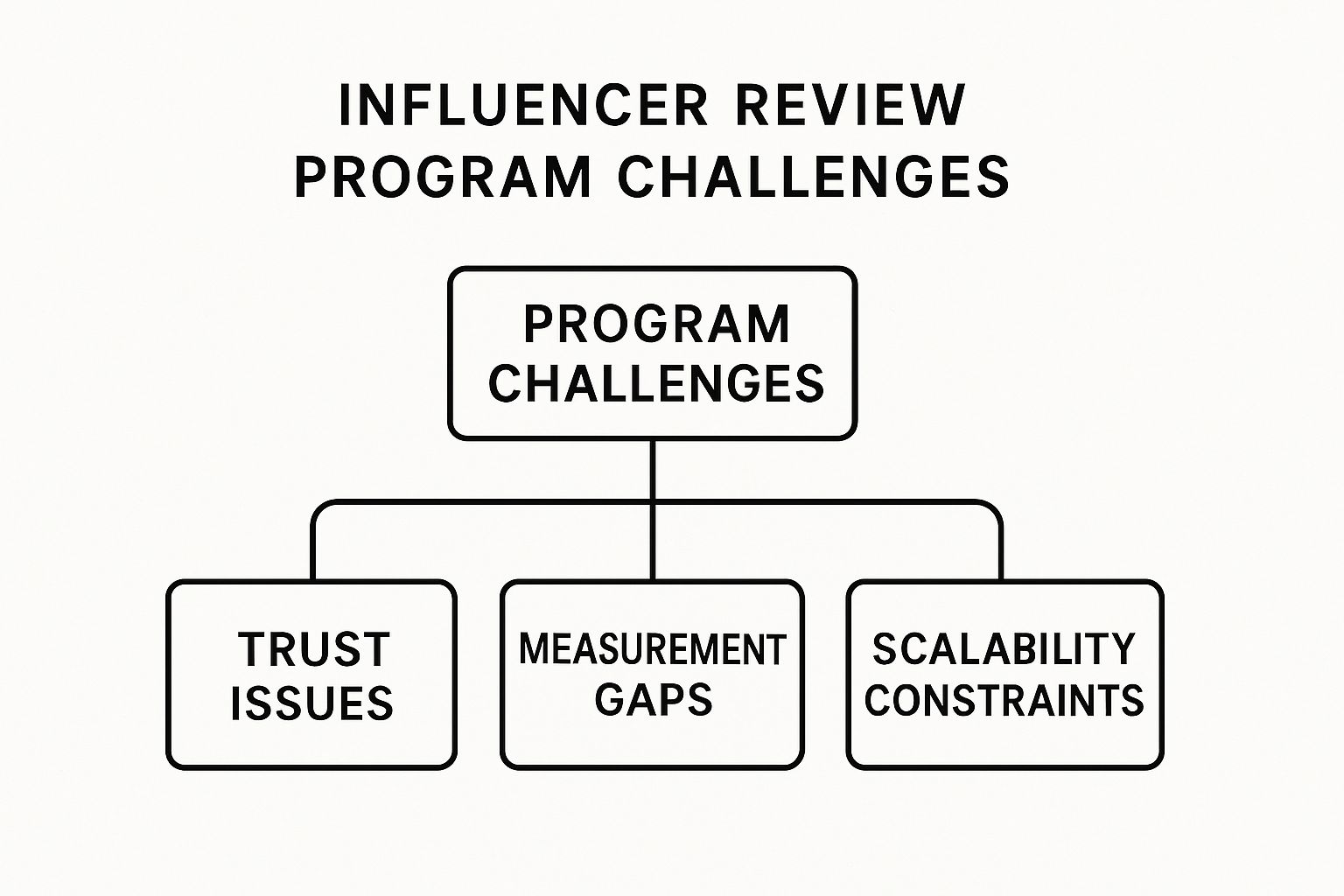
As you can see, figuring out what's working (and what's not) is a major challenge, right up there with building trust and scaling the program itself. That’s why you need a clear plan for tracking from day one.
Tracking The Metrics That Drive Growth
If you want to prove your program's ROI, you absolutely need a clear system for attribution—that is, connecting a specific influencer's effort to a specific sale. Without it, you’re flying blind.
Luckily, you don’t have to guess. There are a few tried-and-true methods for connecting their content directly to your sales data.
- Unique Discount Codes: This is the classic for a reason. Give each influencer their own code, like "SARAH15". It’s one of the simplest and most effective ways to see exactly who is driving sales.
- Affiliate Links with UTM Parameters: These are special, trackable links that add tags to the URL. This lets you see not just who bought something, but also how much traffic they sent, the bounce rate, and other juicy details right inside your analytics.
- Amazon Attribution: If you're selling on Amazon, this is a must-have. It lets you create unique links for your influencers, giving you a direct window into how their content performs on the platform—from clicks to add-to-carts to purchases.
To help you get started, here’s a breakdown of the most important metrics to keep an eye on.
Essential KPIs for Your Influencer Review Program
| Metric (KPI) | What It Measures | Why It's Important |
|---|---|---|
| Click-Through Rate (CTR) | The percentage of people who clicked the influencer's link. | Shows how compelling the influencer's call-to-action is and how interested their audience is in your product. |
| Conversion Rate | The percentage of link-clickers who made a purchase. | This is the bottom line. A high conversion rate means you're partnering with the right influencers whose followers trust their recommendations. |
| Cost Per Acquisition (CPA) | The total cost of the campaign divided by the number of sales. | Tells you exactly how much you're spending to get one customer. The lower, the better. |
| Return on Ad Spend (ROAS) | The total revenue generated for every dollar spent on the campaign. | This is the ultimate measure of profitability. It answers the question: "Are we making more than we're spending?" |
| Engagement Rate | Likes, comments, shares, and saves as a percentage of the influencer's followers. | While not a direct sales metric, it indicates audience health and how much the content resonated. High engagement often leads to better reach. |
Understanding these metrics is the first step. When you’re setting goals, it’s crucial to know how to define success using relevant social media KPIs. For a more detailed roadmap, check out our guide on essential influencer marketing KPIs.
Let Automation Do The Heavy Lifting
Manually tracking every click, code, and sale is a surefire way to get bogged down in spreadsheets, especially as you start working with more influencers. This is where modern tools completely change the game.
Automation and AI are making it possible for brands to run smarter influencer programs. You can scale your campaigns, find the perfect audience, and measure ROI with an accuracy that just wasn't possible before.
The numbers back this up. A full 73% of marketers think influencer marketing can be mostly automated with AI, and 62% are already planning to use it for tasks like performance tracking.
Platforms like Coral are built for this. By integrating directly with Amazon Attribution, the entire tracking process is automated. You can log into your dashboard and see real-time data on the traffic and sales generated by each influencer—no manual data entry required. When technology handles the grunt work, you’re free to focus on what humans do best: building great relationships and making smart, data-driven decisions.
Your Top Influencer Program Questions, Answered
Jumping into an influencer review program can bring up a lot of "what if" scenarios. You know it’s a smart move for your brand, but the practical side of things can feel a little fuzzy at first.
This is your go-to guide for those questions. We're cutting through the noise to give you clear, straight-up answers to the most common things we hear from brands just like you.
Getting the details right—from how you handle payments to what to do about a bad review—is the key to making a program run like a well-oiled machine. Let's get into it.
Do I Have to Pay Influencers for Reviews?
This is the big one, and the short answer is: sometimes. For a lot of creators, especially nano- and micro-influencers, getting a free product is more than enough compensation. This is often called product seeding or gifting, and it’s a fantastic way to get your product into the right hands.
But as you start working with influencers who have a larger, more engaged following, or if you have very specific requests—like a dedicated YouTube tutorial—that's when money usually enters the conversation. The best programs often mix both approaches.
Here’s a quick way to think about it:
- Product Gifting Works Best For: Smaller influencers, building a new relationship, or when you just want them to share their honest thoughts without strict requirements.
- Paid Collaboration is Better For: Established creators with set rates, campaigns with specific content needs (e.g., three Instagram Reels), or when you're working on a tight timeline.
The most important thing? Be upfront about compensation in your very first message. Honesty builds a solid, professional foundation from day one.
What if They Don’t Like My Product?
It’s a totally normal fear, but trust me, this is where the magic happens. A true professional won't just blast your product online. They’ll come to you first, privately, to share their feedback and concerns. That kind of feedback is priceless for making your product even better.
Think of your influencer program as more than just a marketing channel. It's a direct line to honest feedback from the very people you want to reach. Handling a critical review with grace can build more trust than a dozen 5-star posts.
If an influencer has a less-than-perfect experience, here's how to turn it into a win:
- Start by thanking them for their honesty.
- Ask questions to really understand the problem.
- See if you can solve it. Maybe they need a replacement part or a quick tutorial.
- If it's just not a good fit, you can both agree they won't post about it.
This turns a potential negative into a positive, professional exchange. You protect your brand’s reputation, keep a good relationship with the creator, and show that you care more about genuine feedback than just getting praise.
Are There Any Legal Rules I Need to Know?
Yes, and this one is non-negotiable. The Federal Trade Commission (FTC) has clear rules about this. Any influencer you work with must disclose that they have a relationship with your brand. Simply put, their audience needs to know they got the product for free or were paid to talk about it.
This isn't a suggestion—it's the law. And it's all about maintaining trust with the people watching.
The easiest way to follow the rules is by using clear hashtags like #ad, #sponsored, or #BrandPartner right at the beginning of their caption. A simple "Thank you, [Your Brand], for the free product!" also works. Just make sure your agreement with them clearly states they need to follow these FTC guidelines.
Ready to stop guessing and start tracking your influencer program's real impact? Coral integrates directly with Amazon Attribution to give you crystal-clear data on traffic and sales from every single creator. Build your network of passionate brand advocates with Coral today.