What Is a Marketplace Maker?
Category: Marketplace maker
A modern marketplace maker is much more than just another place to sell your products. Think of it as a complete ecosystem you build, control, and use to scale your brand. For savvy Amazon sellers, it's the next logical step—a strategic move from depending on a single platform to building a diversified and much more resilient business.
What a Modern Marketplace Maker Actually Is
Let's cut through the buzzwords. If you’ve found success on Amazon, you’ve probably hit the same wall many sellers do: how do I grow beyond this one channel without everything becoming a logistical nightmare? How do I diversify my income and take back control of my brand? A marketplace maker is built to solve precisely this problem.
It’s a platform that gives you the tools, integrations, and strategic framework to not just survive but thrive beyond a single point of sale. Instead of just playing in Amazon's sandbox, you become the architect of your own interconnected sales world. This is where a platform like Coral steps in, providing the ultimate Amazon marketplace management platform to build that ecosystem without the friction.
Moving Beyond Traditional Limits
The global e-commerce market is enormous. It was valued at roughly $25.93 trillion in 2023 and is expected to skyrocket to $83.26 trillion by 2030. That’s incredible growth, but it also means more competition and a greater risk of being lost in the crowd. A marketplace maker helps you claim a bigger piece of that pie, but on your own terms.
This image really highlights the difference between the old way of doing things and the agility you get with a marketplace maker.
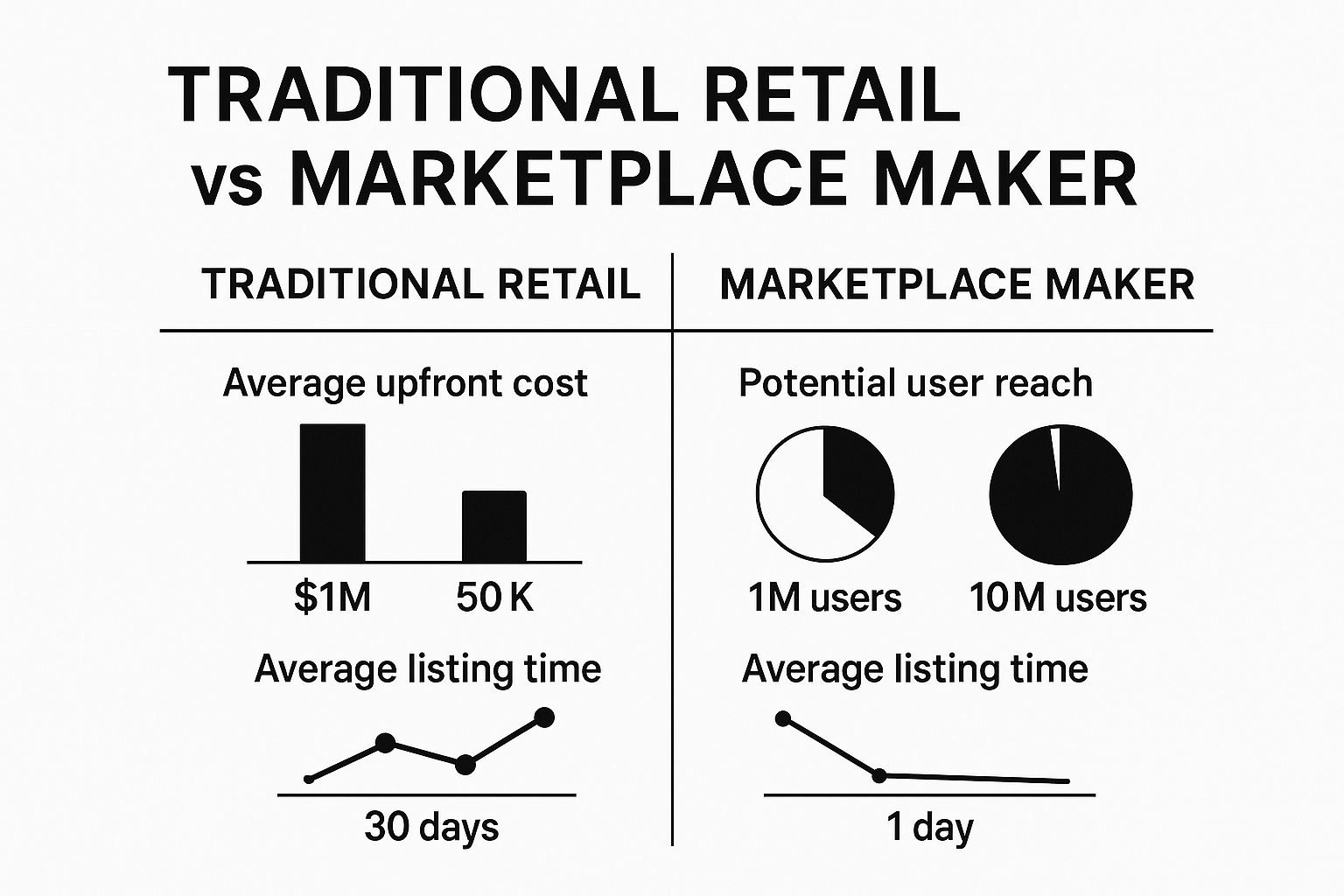
The numbers don't lie. A marketplace maker approach significantly lowers the barriers to entry while expanding your potential reach and speeding up your operations.
To see how this shift plays out in real terms, let's compare the old model with the new.
Traditional Marketplace vs Modern Marketplace Maker
This table gives a quick snapshot of how the game has changed, moving from a simple sales channel to a full-blown growth engine.
| Capability | Traditional Marketplace (e.g., Early Amazon) | Modern Marketplace Maker (e.g., Coral) |
|---|---|---|
| Primary Goal | Transactional sales | Brand building & ecosystem control |
| Seller Control | Limited; bound by platform rules | High; you set the rules for your brand |
| Customer Data | Platform-owned, minimal access | Seller-owned, direct access for marketing |
| Revenue Streams | Single channel, platform-dependent | Multi-channel (D2C, B2B, affiliates) |
| Technology | Closed, one-size-fits-all system | Open, integrated with your existing tools |
| Scalability | Dependent on platform's algorithm | Self-directed, based on your strategy |
The takeaway is clear: while traditional marketplaces were about selling, modern marketplace makers are about building.
Ultimately, these platforms provide proven strategies for boosting your marketplace for success by giving you the tools to optimize every part of your business. You can seamlessly integrate your existing Amazon store while launching and managing new revenue streams—like a direct-to-consumer site or an affiliate program—all from a single, central hub.
What Makes a Great Marketplace Maker?

So, what really separates a top-tier marketplace maker from just another e-commerce tool? It all boils down to a specific set of features built for one thing: scaling your business. For brands that grew up on Amazon, these are the tools that help you bust through growth ceilings and build a more resilient company.
The absolute must-have feature is a clean, seamless integration with your Amazon store. A good marketplace maker doesn't ask you to ditch what’s already working; it makes it better. For example, platforms like Coral plug right into your Amazon account, creating a single, reliable hub for your entire business. This means you can finally stop jumping between different systems and manage everything from one spot.
Centralized Command and Control
Once you're all connected, the real magic happens in the centralized dashboard. Just think about the headache of managing inventory for your Amazon store and a new D2C site separately. It’s a recipe for overselling, stockouts, and missed shipping deadlines.
A true marketplace maker eliminates that chaos by unifying all your operational data. This gives you the power to:
- Sync inventory across every sales channel in real time.
- Track sales performance from Amazon, your own website, and any other channels, all on one screen.
- See the full picture of your customer data to make smarter marketing and product choices.
This kind of control makes expanding your brand feel achievable, not overwhelming. It turns what was once a complex, multi-channel mess into a straightforward, manageable process.
Tools to Build Fresh Revenue Streams
Beyond just streamlining what you already do, a powerful marketplace maker gives you the tools to forge new income channels. This is where you graduate from being just another seller and start becoming a true brand builder. One of the best examples of this is the ability to launch and run your own affiliate marketing program.
By building your own affiliate network, you’re essentially creating a dedicated sales force of brand advocates who earn a commission for every sale they drive. It’s a powerful shift away from relying solely on paid ads and toward a more organic, performance-based marketing engine.
Platforms like Coral are designed specifically for this. They let you bring on affiliates, customize commission rates, and track every single sale they generate for your Amazon store. With the top 100 online marketplaces projected to hit a staggering $3.832 trillion in GMV by the end of 2024, building your own network is a smart way to claim your piece of the pie.
You can learn more about the explosive growth of online marketplaces at Digital Commerce 360. It’s also worth exploring different affiliate marketing platforms to see what's out there and get ideas for creating an effective affiliate commission structure that truly motivates your partners.
How a Marketplace Maker Transforms Your Amazon Business
Let's get one thing straight: a true marketplace maker is about amplifying your success, not replacing what already works. The goal isn't to ditch your Amazon store. It’s about turning that store into the solid foundation of a much larger, more resilient business.
Platforms like Coral are built to plug right into your existing marketplace presence. From there, they give you the tools to build out new, independent revenue channels that you fully control.
Imagine logging into one central hub and seeing everything at a glance: your latest Amazon sales figures, orders from your own direct-to-consumer (D2C) site, and your affiliate program’s performance, all side-by-side. You can finally stop juggling a dozen browser tabs and trying to make sense of conflicting spreadsheets. This unified view is where you start making smarter, faster decisions for your brand.
From Chaos to Clarity: A Before-and-After Scenario
Let’s paint a picture of a typical, growing Amazon brand. Before they bring in a marketplace maker, their day-to-day operations are often a complete mess.
- Before: The team is using one tool for Amazon inventory, a totally separate one for their Shopify site, and a manually updated spreadsheet to track influencer payouts. They waste hours every week just trying to match which affiliate drove which sale, leading to late payments and frustrated partners.
Then, they plug in a platform like Coral. The change is immediate.
- After: Their Amazon store syncs directly, creating a single source of truth for all their sales data. They can launch and manage an affiliate program where every single sale is automatically tracked back to the right person. The result? No more operational headaches, consistently accurate payouts, and more time to focus on growth instead of putting out fires.
This shift from a patchwork of separate tools to one unified system is the core transformation. It’s how you finally break free from the operational drag that keeps so many Amazon brands from scaling into true multi-channel businesses.
Integrating and Managing Multiple Revenue Streams
A core job of a marketplace maker is to make managing different income sources feel simple. With the ultimate Amazon marketplace management platform like Coral, you're not just managing sales anymore; you're effectively managing partnerships and multiple revenue streams.
You can launch a full-blown affiliate program, see exactly who is performing, and handle commissions without the usual manual work. This is a game-changer for scaling, because managing brand advocates requires a totally different skill set than managing inventory. For a deeper dive, check out our guide on https://coral.ax/blog/affiliate-marketing-for-amazon.
On top of that, these platforms act as a crucial safety net. If your primary sales channel ever goes down, some marketplace makers can connect you with specialized Amazon seller account reinstatement services to help you get back online as quickly as possible.
Unlocking New Revenue Streams Beyond Amazon
Relying entirely on Amazon feels a lot like building your house on rented land. One unexpected algorithm change or a sudden policy update can throw your whole business into a tailspin. This is where a true marketplace maker like Coral becomes your best defense: genuine diversification. By helping you build and manage new income sources, you create a far more stable and resilient brand.
The most direct way to do this? Launch your own direct-to-consumer (D2C) channel. This isn't about abandoning Amazon. Think of it as opening a flagship store right next to your spot in the world's biggest mall. You get a direct line to your customers, full control over the experience, and a brand asset you actually own.
With Coral, you can manage both your Amazon presence and your new D2C site from a single dashboard. It pulls everything together, so you're not juggling a dozen different systems just to keep the lights on.
Launching a Powerful Affiliate Marketing Program
Once your D2C store is up and running, you need to get people there. One of the best ways to drive consistent, high-quality traffic is by building your own affiliate marketing program. You're not just paying for clicks; you're building a real sales force of creators and influencers who are genuinely invested in your brand's success.
A platform like Coral is built for exactly this. It gives you all the tools you need to:
- Recruit and onboard partners with a clean, professional landing page.
- Set competitive commission rates that attract the best affiliates in your niche.
- Track every click and sale so you know exactly who is driving results.
This turns one-off shoutouts into profitable, long-term partnerships. To get a feel for what works, it’s worth checking out expert guidance on the top affiliate marketing platforms and learning how to design an attractive affiliate commission structure.
The Power of Platform-Based Growth
Look around modern e-commerce—it’s all about platforms. This isn't just for physical goods, either. The global market for data marketplace platforms, valued at $1.49 billion in 2024, is expected to soar to $5.73 billion by 2030. Platforms drive over 62% of that revenue, proving just how valuable a centralized ecosystem is. You can discover insights on the growth of data marketplaces from Grand View Research to see this trend in action.
For an Amazon seller, the lesson here is huge. A platform-based marketplace maker like Coral lets you build your own scalable ecosystem. It gives you one central place to manage what you’re already doing while easily plugging in new channels, like an affiliate program.
When everything is managed in one place, you can finally see the complete picture. For example, you can track which affiliates are sending sales straight to your Amazon listings. We break this down in our guide on using Amazon Attribution with your affiliate program. This kind of integrated approach is what really unlocks sustainable, multi-channel growth.
Building Your Growth Engine with Coral

It’s one thing to talk about these strategies, but it’s another to actually put them to work. So, let's get practical and see how you can apply these marketplace maker ideas using a platform like Coral, which was built specifically for Amazon sellers looking to grow beyond a single channel.
Think of this as your playbook for creating a more diverse, scalable business.
The first step couldn't be simpler: just connect your existing Amazon account. This isn't about starting over; it's about amplifying what you've already built. Once you're plugged in, Coral acts as your command center, pulling all your sales data into one spot. This gives you a clear, single view of your entire operation and sets the stage for managing multiple revenue streams without the usual chaos.
Firing Up New Growth Channels
Once your Amazon store is synced, you can start expanding your footprint. Launching a D2C storefront or an affiliate program often sounds like a massive headache involving multiple systems and a lot of technical work. With Coral, it’s not. The platform walks you through everything, from creating a sharp-looking, branded landing page to setting up your commission rules.
Let’s look at a real-world example. Say you want to start an affiliate program to send more buyers to both your D2C site and your Amazon product pages.
Using Coral, you can:
- Onboard new partners with a simple, branded portal that makes you look professional from day one.
- Create unique tracking links for every affiliate, so you know exactly where your sales are coming from.
- Set custom commission rates—maybe you want to give your top performers a bigger cut.
The real magic happens when you see all that data in one dashboard. You can instantly tell which affiliates are crushing it on Amazon and which ones are driving sales to your D2C store. This lets you shift your strategy and budget on the fly to back your winners.
Having this centralized view takes all the guesswork out of scaling. By giving you the tools to manage different sales channels from a single hub, Coral becomes the perfect marketplace maker for any Amazon brand that's serious about building a more resilient business.
You can see how it all comes together by exploring the Coral platform for yourself.
Common Questions About Marketplace Maker Platforms
Making a big shift in your Amazon strategy is bound to bring up some questions. It’s a smart move to be cautious. Let’s walk through some of the most common concerns we hear about using a marketplace maker and show how a platform like Coral is built to help you grow, not add more complexity to your plate.
"Will This Force Me to Leave Amazon?"
Not at all. In fact, it's the opposite. A real marketplace maker like Coral is designed to plug directly into your existing Amazon FBA operations. It doesn't replace what's already working; it adds powerful new channels on top of it.
The whole point is to bring everything under one roof. You’ll manage your Amazon sales, your new D2C website, and a high-powered affiliate program from a single dashboard. Think of it less as leaving Amazon and more as building your own brand ecosystem around it, using your Amazon success as the foundation.
"How Do I Juggle All These New Revenue Streams?"
This is where the magic happens. A marketplace maker provides the backbone infrastructure to run multiple income channels without the usual headache.
You can finally stop jumping between a dozen different software tools. Instead, you can:
- Process sales directly from your own branded website.
- Manage affiliate and influencer payouts automatically.
- Pull in and analyze your Amazon sales data.
Everything lives in one spot. This turns what was once a tangled mess of revenue streams into a clear, unified system you can actually manage.
The real power here is turning a bunch of scattered data points into a single, cohesive growth strategy. You can finally see exactly how that influencer campaign you’re running on TikTok is directly impacting your sales on Amazon.
"Isn't Setting Up an Affiliate Program a Huge Hassle?"
It used to be, but not anymore. Forget the days of messy spreadsheets and trying to manually track who drove which sale. That’s a recipe for disaster.
Modern platforms like Coral have these tools built right in. You can set up your program in minutes, create custom tracking links for each partner, decide on commission rates, and watch the performance data roll in automatically. It handles all the technical heavy lifting, so you can focus on finding great partners who will shout about your brand from the rooftops.
Ready to turn your Amazon store into a true multi-channel brand? With Coral, you get the platform you need to build, manage, and scale your business on your own terms. Explore how Coral can build your growth engine today.