A Guide to PPC for Amazon and Beyond
Category: Ppc for amazon
Gone are the days when PPC for Amazon was just another advertising channel you could dabble in. Now, it's a core investment, the very engine that powers your organic ranking. It’s no longer just a side tactic; it's a non-negotiable part of building a successful brand on the platform. The whole conversation has shifted from simply tracking ad efficiency to truly understanding how your ads impact the overall health of your business.
Why Amazon PPC Is No Longer Optional
Trying to make sense of your Amazon sales data can feel like you're looking at a puzzle with half the pieces missing. You pour money into ads, obsess over your Advertising Cost of Sales (ACoS), and cross your fingers. But what if you’re missing the bigger picture? Succeeding on Amazon today requires a completely different way of thinking.
Pay-Per-Click (PPC) advertising has grown up. It's not just about getting a few extra sales anymore. A well-executed PPC campaign triggers a powerful "flywheel effect." The sales generated from your ads increase your sales velocity, which in turn signals to Amazon's algorithm that your product is popular, pushing you higher up the organic search results. This is precisely why the old metrics and mindsets just don't cut it anymore.
The Critical Shift From ACoS to TACOS
For years, everyone in the Amazon world was laser-focused on ACoS. This metric is great for one thing: measuring the direct efficiency of an ad campaign. It tells you exactly how much you spent on ads to get a sale from that ad. It's a useful metric for campaign management, but it gives you a very narrow, isolated view of performance.
Enter the modern, far more powerful metric: Total Advertising Cost of Sales (TACOS). This is the number that reveals the real story. TACOS measures the impact of your ad spend on your entire Amazon business by dividing your total ad spend by your total revenue (both from ads and organic sales). It answers the most important question: "Is my advertising making my whole brand stronger?"
When you see your TACOS trending down over time, it’s a clear sign that your ads are successfully lifting your organic sales—and that's the ultimate goal. For a more detailed look at the fundamentals, check out our comprehensive guide on Amazon PPC marketing.
The table below breaks down the key differences between these two crucial metrics.
ACoS vs TACOS A Strategic Comparison
| Metric | What It Measures | Formula | Primary Focus | Strategic Insight |
|---|---|---|---|---|
| ACoS | Ad spend efficiency | (Ad Spend ÷ Ad Revenue) | Micro-level | Answers "Is my campaign profitable?" |
| TACOS | Overall marketing impact | (Ad Spend ÷ Total Revenue) | Macro-level | Answers "Are my ads growing my brand?" |
Ultimately, ACoS is a tactical metric for tweaking individual campaigns, while TACOS provides the strategic overview you need to gauge the long-term health and growth of your brand on Amazon.
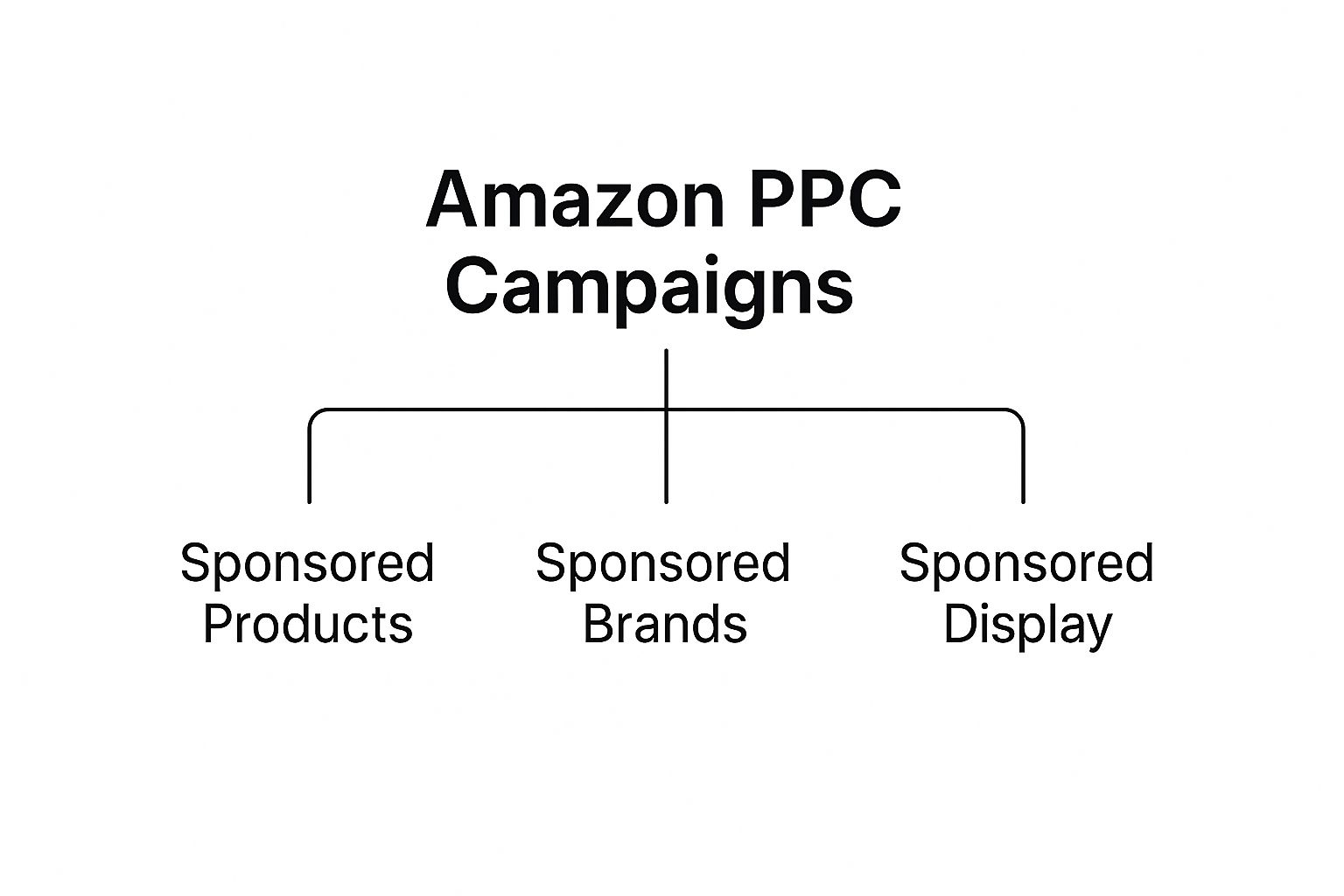
Getting a firm grasp on these three ad types—Sponsored Products, Sponsored Brands, and Sponsored Display—is your first step. It's how you start building a holistic strategy that influences every part of your Amazon presence, both paid and organic.
Beyond the Budget Limitations of PPC
As powerful as PPC is, relying on it alone has its limits. Ad costs are always on the rise, and your growth is ultimately capped by how much money you can afford to pour into the advertising auction. This is where you need to think bigger and start building a strategy that goes beyond just bidding on keywords.
The opportunity to build a side-by-side affiliate program is immense. While nearly every brand uses Amazon's native advertising, very few implement a dedicated affiliate marketing program to reward external creators.
Think about it. There's a massive world of influencers, bloggers, YouTubers, and TikTok creators out there with audiences that already trust them. Instead of just paying Amazon for a click, you can partner with these creators and give them a commission for every sale they drive. It’s a performance-based model that can scale your sales far beyond what a fixed PPC budget could ever achieve. Given how well Amazon converts, traffic coming from a trusted creator is often pure gold, allowing you to grow your brand in ways PPC alone simply can't.
Alright, let's get your first campaign off the ground. It can feel a little daunting at first, but I'll break down the essentials into simple, actionable steps. Think of this as your starter guide for building profitable campaigns that don't just get you quick sales, but also help your products rank better organically over time.
We'll walk through the three main ad types—Sponsored Products, Sponsored Brands, and Sponsored Display—and I'll explain exactly when and how to use each one. My goal here is to give you the confidence to start without falling into the common traps that waste money.
The world of PPC for Amazon is no joke. The competition is fierce. In the wider advertising world, Amazon is a giant, pulling in about 22.3% of all U.S. paid search ad spending, which puts it right up there with Google. With U.S. companies expected to drop a staggering $140.06 billion on paid search ads this year, it’s clear that brands are scrambling to get in front of Amazon's ready-to-buy shoppers. If you want to dive deeper into the numbers, you can explore more insights on PPC statistics to see just how big this playground is.
Understanding the Three Core Ad Types
First things first, you need to know your tools. Amazon gives you three main ad formats, and each one has a specific job to do. When you learn to use them together, you can build a really powerful, full-funnel strategy.
- Sponsored Products: These are the ads you see everywhere on Amazon. They pop up in search results and on product pages, pushing a single product. They are absolutely perfect for driving sales for your most important items.
- Sponsored Brands: Think of the big banner ads at the very top of the search results. That's them. They show off your brand logo, a custom headline, and a few of your products. They’re fantastic for building brand awareness and getting people to your Amazon Storefront.
- Sponsored Display: This is your retargeting tool. It lets you show ads to shoppers who’ve looked at your products but didn’t buy, following them around on and off Amazon. It's an incredibly effective way to stay top-of-mind and bring interested shoppers back.
I like to use a fishing analogy. Sponsored Products are your main lure—designed to catch the customers who are already biting. Sponsored Brands are like chumming the water, drawing a whole school of potential buyers to your spot. And Sponsored Display? That's like casting a net to scoop up the ones that nibbled but got away, giving you a second chance to reel them in.
Automatic vs. Manual Targeting: A Tale of Two Strategies
Once you've picked an ad type, you have to decide how you'll target your audience. Amazon basically gives you two choices: let the algorithm do the heavy lifting, or grab the steering wheel yourself.
Automatic Targeting: With this, you're telling Amazon, "You figure it out." Its algorithm will show your ads against search terms and products it thinks are relevant. This is an amazing starting point for any new campaign because it's a discovery tool—it will uncover high-performing keywords you'd never have thought of on your own.
Manual Targeting: This is where you take control. You give Amazon a specific list of keywords or products that you want your ad to show up for. It gives you way more control over where your money goes, but it definitely requires more upfront research and ongoing tweaks.
Honestly, the best approach is to run both at the same time. Use an automatic campaign for keyword discovery. Then, check your reports and "harvest" the search terms that are actually making you money. You can then plug those proven winners into a manual campaign and bid more aggressively to really maximize your sales.
Your First Steps to Launching a Campaign
Now that you've got a handle on the ad types and targeting options, you're ready to build. Don't try to make it perfect from day one. Just follow these simple, foundational steps to get started on the right foot.
- Conduct Basic Keyword Research: Put yourself in your customer's shoes. What would you type into the Amazon search bar to find your product? Start there. Use the auto-complete suggestions in the search bar to get even more ideas.
- Set a Smart Initial Budget: You don't need to spend a fortune to get started. A modest daily budget, maybe $10-$20 per day, is plenty. The goal right now isn't to break the bank; it's to gather data.
- Implement a Simple Bidding Strategy: Amazon offers a few bidding options. For your very first campaign, stick with "Dynamic bids - down only." It’s the safest bet. It just means Amazon will lower your bid if it thinks a click is unlikely to lead to a sale, which helps protect you from overspending.
- Launch and Monitor: Get the campaign live and then… walk away. Let it run for at least a week or two to collect enough data. Fight the urge to make changes every single day. Patience is key here. Let the data tell you what to do next.
Thinking Beyond ACoS to Master TACOS
If you only look at your Advertising Cost of Sales (ACoS), you're missing the big picture. It’s like judging a football game by looking at just one team's passing yards—it ignores the running game, the defense, and most importantly, the final score. To really build a sustainable brand on Amazon, you need to shift your focus to a much more powerful metric: Total Advertising Cost of Sales (TACOS). This is the North Star that guides long-term growth.
It’s easy to get scared off by a high ACoS on a few campaigns, but that can be a smart, strategic play. Think about it: a deliberately "high" ACoS on broader, top-of-funnel keywords can actually drive your overall TACOS down over time. How? By investing in these terms, you're doing more than just buying a click; you're feeding your organic sales engine. Every sale you get from an ad pushes your sales velocity up, which in turn helps you rank higher organically for those same valuable keywords.
This is how you build a competitive moat. While your rivals are obsessing over low-ACoS keywords and pinching pennies, you’re busy building brand recognition and snatching up market share. It’s a direct investment in your product's future on the platform.
Analyzing Your TACOS for Strategic Growth
Keeping an eye on your TACOS trends is how you make smarter decisions. It tells you when to ramp up ad spend, how to best support a new product launch, or when it's time to play defense against an aggressive new competitor.
The ultimate sign of a healthy strategy? A consistently decreasing TACOS. It’s proof that your ad spend is creating a flywheel effect, lifting your organic sales and making your brand stronger and less reliant on ads over the long haul.
This holistic view is even more powerful when you remember just how effective Amazon ads are. The average conversion rate for Amazon PPC ads hovers around 10.33%. That’s incredible. It means for every 100 ad clicks, you can expect about 10 sales, which highlights the high buyer intent on Amazon compared to almost any other ad platform.
Beyond PPC: Creator-Driven Growth
Even with the best PPC strategy, you'll eventually hit a wall—your budget. As competition grows, ad costs go up, and you can only spend so much chasing sales. This is the point where you need to think outside the box and tap into a growth channel that isn't limited by your ad budget.
The real opportunity lies in rewarding content creators who are already excited to promote your product. Instead of just paying for a click, you can pay a commission for a confirmed sale, scaling your brand in a way your PPC budget never could.
Imagine having an army of YouTubers, bloggers, TikTok creators, and Instagram influencers promoting your products. These creators have built loyal audiences who trust their recommendations. When they feature your product, they drive highly qualified traffic directly to your Amazon listing—traffic that is primed to convert. It's a performance-based model where everyone wins.
This approach works perfectly alongside your PPC efforts. Your ads capture the demand that already exists on Amazon, while your network of creators builds new demand from the outside. This one-two punch creates a powerful and scalable sales machine that doesn't live or die by the ever-increasing costs of PPC auctions.
The Growth Engine Most Brands Overlook
Let's be honest. Relying only on PPC for Amazon can feel like running on a treadmill. You keep pumping more money in just to keep your spot, all while fighting off tougher competition and watching ad costs climb. At some point, your growth hits a ceiling—the one set by your budget.
But what if you could step off that treadmill? What if you could build a sales channel that actually grows with you, one that isn't chained to the daily bidding war? It’s time to look past Amazon's native ad tools and embrace a powerful growth engine many brands ignore: affiliate marketing, specifically with content creators. This is your way around PPC’s biggest weakness: its finite budget.
From Paying for Clicks to Paying for Sales
The real magic here is in how you spend your money. With PPC, you’re paying for a chance at a sale. You bid on a keyword, cross your fingers, and hope that click turns into a customer. A creator-led affiliate program flips that model on its head. You only pay a commission when a confirmed sale comes through.
This performance-based approach is a game-changer. It takes the financial risk off your shoulders. Instead of throwing money at an auction and hoping for the best, you’re rewarding creators for driving actual, measurable revenue. This puts you and your creator partners on the same team. They’re motivated to make great, authentic content because their income is directly tied to the sales they generate for you.
Why Creator Partnerships Just Work on Amazon
This strategy is especially powerful on Amazon for one simple reason: sky-high conversion rates. People don't go to Amazon to browse; they go there to buy. When a customer lands on your product page from a trusted source—like a YouTube review, a detailed blog post, or a quick TikTok video—they’re already warmed up and ready to hit "Add to Cart."
When you work with creators, you're not just buying traffic. You're building an army of advocates. These are real people who are financially motivated to champion your brand, helping you break through the growth ceiling that a fixed PPC budget inevitably creates.
As a bonus, all this external traffic sends fantastic signals to Amazon’s A9 algorithm. A surge in sales from outside sources boosts your sales velocity, which can improve your organic rankings over time. It’s a virtuous cycle that perfectly complements your on-platform PPC efforts.
A Look at Budget and Risk
To really see the difference, it helps to compare the financial models side-by-side. Think of PPC for Amazon as a fixed cost with an uncertain outcome, while a creator affiliate program is a variable cost tied directly to success.
This table breaks down that crucial distinction.
Amazon PPC vs. Affiliate Marketing: A Budget Allocation Perspective
| Factor | Amazon PPC | Affiliate Marketing (with Creators) |
|---|---|---|
| Cost Model | Pay-Per-Click: You pay every time someone clicks your ad, whether they buy or not. | Pay-Per-Sale: You pay a commission only after a confirmed purchase is made. |
| Budgeting | Budget-Capped: Your campaign stops when the daily or monthly budget runs out. | Performance-Based: The budget scales with sales. The more you sell, the more you pay—a good problem to have. |
| Risk | Higher Risk: You carry the financial risk of non-converting clicks. | Low Risk: You only pay for proven results, minimizing wasted ad spend. |
| Growth Potential | Limited: Capped by your budget and the rising costs of keywords. | Highly Scalable: Your growth is limited only by the size and effectiveness of your creator network. |
Ultimately, PPC is fantastic for capturing the demand that already exists on Amazon. But an affiliate program is your key to creating new demand off Amazon. It gives you a way to reward people who genuinely love and want to promote your products, scaling your sales in a way that simply isn't possible by just upping your PPC budget. This is how you build a more resilient, multi-channel growth strategy for the long haul.
Building Your Creator-Powered Sales Machine
Alright, let's get practical. Setting up a network of content creators to promote your Amazon product isn't just a neat alternative to dumping money into PPC for Amazon; it’s a living, breathing sales asset. Forget one-off influencer posts. We're talking about building a scalable, performance-based system that drives real, authentic growth.
This is your roadmap for getting it done, from finding the right people to setting up deals where everyone wins. The whole point is to let creators do what they do best: tell your product's story and drive sales in a way a simple ad never could.
Identifying and Vetting the Right Creators
First things first: you aren't just looking for creators with huge followings. You need the right ones. It's all about authenticity and making sure they genuinely fit your brand. A micro-creator with a small but super-engaged audience in your niche is often way more valuable than a huge influencer with millions of followers who couldn't care less.
Start digging around on Instagram, TikTok, and YouTube using hashtags relevant to your product. Look for creators whose style, tone, and audience feel like a natural match for your brand. If you find someone who already loves and uses products like yours, you’ve hit the jackpot.
Once you have a list of potential partners, it's time to vet them properly:
- Engagement Rate: Don't just look at follower counts. Are people actually commenting and sharing their posts? That shows a real connection.
- Content Quality: Is their work professional and well-made? Remember, their content will be a direct reflection of your brand.
- Audience Trust: Read the comments. Do their followers seem to trust their recommendations, or does their feed just look like one long advertisement?
Structuring Commissions and Building Partnerships
Once you've found your ideal creators, you need to give them a compelling reason to work with you. This is where you ditch the old flat-fee model and embrace a performance-based structure. Instead of paying a fixed price for a single post, you offer a commission on every sale they drive.
This setup puts you and the creator on the same team. The more they sell, the more they earn, which motivates them to create fantastic content that actually converts. When you're figuring out commission rates, look at your profit margins, but don't be stingy. A generous commission can attract the best talent.
A successful creator program is built on relationships. Treat your creators like real business partners, not just hired help. Send them free products, give them the inside scoop on new launches, and create custom discount codes for their audience.
This is a world away from the cold, impersonal nature of PPC auctions. The constant rise in PPC for Amazon costs is a direct result of this intense competition. The average cost-per-click (CPC) recently climbed to around $0.98, a jump of over 10% in a single year. A performance-based creator program offers a much more stable—and often more profitable—path to growth.
Outreach and Long-Term Relationship Management
When you reach out, make it personal. Ditch the copy-paste templates. Mention a specific post or video of theirs you enjoyed and explain exactly why you think your product would be a perfect fit for their audience. A little personalization goes a long way and shows you've actually done your homework.
Building these partnerships is an ongoing effort. Keep in touch regularly, share performance data so they can see their impact, and celebrate their successes with them. When creators feel valued, they stop being collaborators and start being true brand advocates.
While Amazon's Creator Connections program can help you find people, managing these relationships effectively requires a solid system. To get a better handle on how it all works, you can learn more about the Amazon Creator Connections program in our guide. By putting in the effort to build these connections, you'll create a loyal team that's genuinely invested in helping your brand win.
Frequently Asked Questions
Got questions about mixing PPC for Amazon with an affiliate program? You're not alone. Here are some quick, no-nonsense answers to the most common things sellers ask.
What Is a Good TACOS for My Amazon Product?
There's no magic number here. A "good" Total Advertising Cost of Sales (TACOS) really depends on your product's profit margins and where it is in its lifecycle.
If you're launching a brand-new product, a TACOS between 20-40% is often necessary. You're investing heavily to get those first crucial sales and build momentum. For a more mature product, you’ll want to see that number settle down, ideally below 15%.
The most important thing isn't a specific number, but the trend. Is your TACOS steadily going down over time? That’s the real sign of a healthy brand where your organic sales are starting to pull their own weight.
Should I Focus on High ACoS or Low ACoS Keywords?
The smartest move is to use a mix of both. Think of your keywords as having two different jobs.
- Low-ACoS Keywords: These are your reliable workhorses. They’re efficient, bring in profitable sales, and keep your campaigns in the green.
- High-ACoS Keywords: These are your growth investments. They're often broader terms that help you get your brand name out there, swipe market share from competitors, and improve your organic rank for high-value searches down the line.
A good rule of thumb is to dedicate most of your budget to the profitable, low-ACoS workhorses while carving out a smaller portion for those high-ACoS investment keywords. This way, you stay profitable today while planting the seeds for organic growth tomorrow.
Can I Run My Own Affiliate Program Alongside Amazon Associates?
Yes, and you absolutely should. The Amazon Associates program is a fine, passive option, but it gives you almost no control. Running your own program puts you in the driver's seat.
By managing your own program, you can offer higher, more motivating commissions, build direct relationships with top creators, provide them with custom discount codes, and track their performance with precision. It’s the difference between waiting for sales to happen and actively building a team of advocates to create them for you.
How Do I Measure an Affiliate Program's Impact on TACOS?
To get the full picture, you just need to tweak your TACOS calculation a bit. Simply add your total affiliate payouts to your PPC ad spend.
Your new formula looks like this: (PPC Ad Spend + Affiliate Commissions) / Total Sales. When your affiliate program is working well, you'll see your total sales climb much faster than your combined marketing costs. This keeps your TACOS stable or even lowers it as you grow, proving your creator partnerships are driving efficient, sustainable sales.
Ready to move beyond the limits of your PPC budget and build a scalable creator-powered sales machine? Coral provides the tools you need to launch, manage, and track your own affiliate program for your Amazon brand. Stop paying for clicks and start rewarding real sales.
Get started with Coral today and turn your best fans into your most powerful sales channel.