What Is Amazon Affiliate Program a Guide to Earning
Category: Amazon affiliate program
The Amazon Affiliate Program, which Amazon officially calls Amazon Associates, is a pretty straightforward partnership: you earn money by recommending products you like. Think of yourself as a virtual salesperson for the biggest online store on the planet. When someone clicks one of your special links and buys something, Amazon pays you a commission. It's as simple as that.
What Is the Amazon Affiliate Program
At its heart, the Amazon Affiliate Program is all about performance. It gives content creators, bloggers, and influencers a way to make money from their traffic by promoting any of the millions of products sold on Amazon.com. All you have to do is sign up, find products that fit your niche, and share them using unique links that Amazon gives you.
This setup is a classic win-win-win situation:
- You (the affiliate) get to earn an income by making genuine recommendations to your audience.
- Amazon gets new customers and sales it might not have otherwise reached.
- Your audience finds cool, useful products from someone they already trust—you.
The whole thing works because of those special affiliate links. Each link has a unique tracking ID that tells Amazon, "Hey, this person sent the customer our way!" When someone makes a purchase through your link within a certain window (typically 24 hours), the sale gets credited to your account, and you earn a slice of the pie.
It's hard to overstate just how big this program is. The Amazon Associates program is the largest affiliate network in the world, holding a massive market share of about 46%. Its dominance comes from Amazon's endless product catalog and its rock-solid brand reputation, which is why it's a first stop for so many creators. You can dig into more affiliate marketing statistics to see how it stacks up against others.

The beauty of this program is its simplicity and scale. You don't need to handle inventory, shipping, or customer service. Your sole focus is on creating valuable content and guiding your audience to the right products.
To make this even clearer, here’s a quick breakdown of the program's key parts.
Amazon Associates at a Glance
This table sums up the core components of the Amazon Affiliate Program for easy reference.
| Component | Description |
|---|---|
| Official Name | Amazon Associates Program |
| Business Model | Performance-based affiliate marketing |
| Primary Role | Earn commissions by promoting Amazon products |
| Key Tool | Unique, trackable affiliate links |
| Commission Window | Typically a 24-hour cookie duration after a link click |
| Market Position | The world's largest affiliate network with ~46% market share |
Essentially, the program provides a low-barrier entry into affiliate marketing, letting you tap into Amazon's massive ecosystem without any upfront cost.
How the Amazon Affiliate Model Actually Works
So, how do you go from a simple product recommendation to actual cash in your bank account? It's a surprisingly straightforward process once you're an approved Amazon Associate. You simply browse Amazon for products your audience would love and create special affiliate links for them.
These links are unique to you—they have your personal Associate ID embedded in them, which is how Amazon knows you sent the customer their way. You can then weave these links into your content, whether that's a blog post reviewing a new gadget, a "Top 10" list, or in the description of a YouTube video.
The 24-Hour Tracking Cookie
When someone clicks one of your affiliate links, a small file called a cookie gets stored on their browser. Think of this cookie as a digital breadcrumb that traces the sale back to you.
This cookie has a 24-hour lifespan. If your visitor adds an item to their cart within that 24-hour window, you still get credit for the sale as long as they complete the checkout within 90 days. It’s designed to reward you for sparking that initial buying impulse.
Here’s a step-by-step look at how it all comes together:
- You create a link: Using Amazon's tools (like SiteStripe), you generate a unique affiliate link for a product.
- A visitor clicks: Someone reads your review, watches your video, and clicks the link to see the product on Amazon.
- The cookie is set: The moment they land on Amazon, the 24-hour tracking cookie is activated on their device.
- They make a purchase: If they buy something within that 24-hour window, you earn a commission. And here's the best part: you get a cut of any qualifying items they purchase in that session, not just the specific product you linked to.
- You get credited: Amazon’s system sees your Associate ID in the cookie and automatically credits your account with the commission.
The customer never notices a thing; for them, it's just a normal shopping trip on Amazon. Behind the scenes, your affiliate dashboard tracks all the clicks, sales, and commissions you've earned.
If you really want to get into the nitty-gritty, our guide on how Amazon's affiliate program works covers every detail.
Understanding How You Get Paid with Amazon
Let's get down to the most important part: how you actually make money with Amazon Associates. Your earnings all come down to the program's commission structure, and it's not a one-size-fits-all deal.
Different product categories carry very different commission rates. This is a crucial detail. Promoting a 'Luxury Beauty' product will net you a much healthier percentage than, say, something from 'Home Improvement.' Knowing where the money is helps you build a smarter, more profitable strategy from day one.
Navigating Commission Rates
One thing to know about Amazon's commission rates is that they're not set in stone. They can, and do, change based on what's happening in the market and what Amazon's business goals are at the moment.
We've seen this happen over the years. Between 2019 and 2025, for example, categories like Furniture, Home, and Outdoors saw their commission rates drop from around 8% all the way down to 3%. On the flip side, Amazon keeps rates high for categories it wants to grow. Luxury Beauty holds strong at a 10% commission, and newer ventures like Amazon Games and Amazon Haul offer very attractive rates of 20% and 7%, respectively. If you're curious, you can dig deeper into these commission trends on Flywheel Digital.
This quick visual shows you the path from a reader's click to you earning cash.
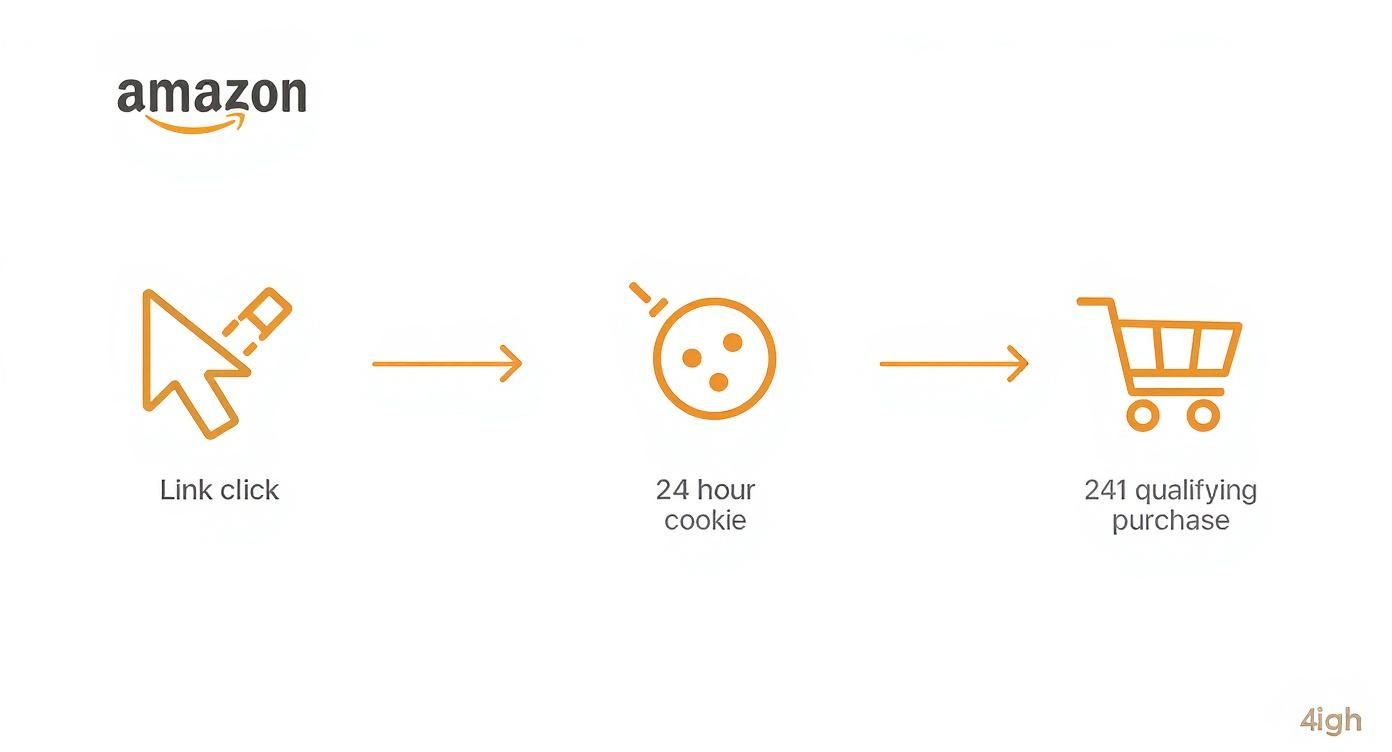
As the graphic shows, that 24-hour cookie window is everything. It really highlights how important it is to convince your audience to act quickly.
Receiving Your Earnings
Earning commissions is the first step, but getting that money into your bank account is the goal. Before Amazon sends you a payout, you have to hit their payment threshold. Think of it as a minimum balance you need to reach.
You must have a balance of at least $10 for direct deposit or Amazon.com gift cards. If you opt for payment by check, the threshold is higher at $100, and a $15 processing fee will be deducted.
Getting a handle on these financial details is key to setting realistic expectations for your affiliate hustle.
Once you start making sales, you'll be able to see all your stats—performance reports, earnings, and payout schedules—right in your dashboard. To get comfortable with the numbers, check out our guide on navigating the Amazon affiliate dashboard. It'll help you make sense of the data and figure out what’s truly working.
Is the Amazon Affiliate Program Right for You?
Deciding whether to jump into the Amazon Affiliate Program is a big step. It can be a game-changer for some creators, but it’s definitely not a one-size-fits-all solution. To figure out if it’s the right move for you, we need to get real about its biggest strengths and its most frustrating weaknesses.
https://www.youtube.com/embed/d0d7iqWTP9k
Let's start with the good stuff. The sheer scale of Amazon is its biggest draw. You have a virtually limitless catalog at your fingertips, making it easy to find products that genuinely fit your niche, whatever that might be. Plus, you’re piggybacking on one of the most trusted brands on the planet. That built-in trust can do wonders for convincing your audience to actually click "buy."
But it's not all smooth sailing. The program has some serious drawbacks that you need to be aware of from day one. The most glaring issue is the incredibly short 24-hour cookie duration. This means if someone clicks your link but waits a day and a half to buy, you get nothing. It’s a system that heavily favors content designed to make people buy right now.
Weighing the Pros and Cons of Amazon Associates
To really break it down, a side-by-side look can help you see where Amazon Associates shines and where it falls short. Think of this as your cheat sheet for deciding if the program aligns with your long-term goals.
| Pros | Cons |
|---|---|
| Vast Product Selection | Short 24-Hour Cookie |
| High Brand Trust | Low Commission Rates in Many Categories |
| Low Barrier to Entry | Strict Operating Agreement & Rules |
| Universal Appeal | Strong Competition from Other Affiliates |
Looking at that list, another major hurdle is Amazon’s notoriously strict operating agreement. It's long, it's complicated, and if you accidentally break a rule—even one you didn't know existed—you risk getting your account shut down and losing your earnings. It’s a real risk you have to manage.
If you’re just getting started, our guide on how to become an Amazon affiliate is a great resource to help you navigate the initial setup and avoid those common pitfalls.
Ultimately, Amazon Associates is often the perfect launchpad for new affiliates. It gets you in the game. But as you grow, you might find that the low commissions and restrictive terms start to feel a bit limiting, pushing you to explore other options.
Modern Strategies for Affiliate Success

To really succeed with the Amazon Affiliate Program today, you have to think beyond just dropping links everywhere and hoping for the best. The top earners have shifted their focus from quick wins to building a real business founded on authority and trust. It's all about creating content that genuinely helps people solve a problem.
Instead of a simple product mention, think bigger. Create in-depth comparison guides, "best of" lists for very specific use cases, or detailed tutorials that actually show a product in action. When you create this kind of high-value content, you stop being just another affiliate and become a trusted resource. That trust is what convinces your audience to act on your recommendations.
One of the most interesting evolutions in this space is the move toward building direct relationships with brands. A growing trend is direct affiliate partnerships, where brands selling on Amazon can offer you bonus commissions on top of the standard Amazon rate. This can make promoting their products significantly more profitable. You can dig deeper into these new-age Amazon affiliate strategies to see how they're shaking things up.
Diversifying Your Affiliate Traffic
Putting all your eggs in one basket is a recipe for disaster. A single algorithm change could tank your entire business overnight. A truly resilient affiliate strategy is built on multiple traffic sources, each reaching a different part of your audience in a way that feels natural to the platform.
Think about creating a presence across a few key channels:
- A Niche Blog: This is your home base. It’s the perfect place for detailed, SEO-friendly reviews, in-depth guides, and building that all-important email list.
- A YouTube Channel: Video is incredibly powerful. It lets you unbox and demonstrate products, build a real connection with viewers, and place affiliate links right in your video descriptions.
- Targeted Social Media: Platforms like Instagram, TikTok, or Pinterest are fantastic for sharing eye-catching content, running quick promotions, and driving immediate clicks to your affiliate offers.
By building out this kind of content ecosystem, you give your audience multiple ways to find you and your recommendations. It's how you build a solid foundation for your affiliate marketing efforts that can weather the inevitable ups and downs.
Common Questions About the Amazon Affiliate Program
Diving into affiliate marketing for the first time? You've probably got questions. It's totally normal. Let's tackle some of the most common ones I hear about the Amazon Associates program so you can figure out if it's the right fit for you.
How Much Does It Cost to Join?
This is usually the first question people ask, and the answer is one of the best things about the program: it costs nothing. Joining Amazon Associates is completely free. There are no application fees or sneaky startup costs to worry about.
That zero-cost entry point is a huge deal. It means pretty much anyone with a decent online presence can give it a shot without putting any money on the line. Your only real investment is the time and creativity you pour into your content.
The fact that it's free to join removes a massive barrier to entry. It's a fantastic, low-risk way for new creators to start earning money from their work.
Think of it as a sandbox. You get to play around, see what resonates with your audience, and learn the ropes of affiliate marketing before you even think about investing in more advanced tools or strategies.
Can I Be an Affiliate Without a Website?
Absolutely. The days when affiliate marketing was just for bloggers are long gone. Amazon knows that a ton of influence now lives on social media, so they've opened the doors to creators on all kinds of platforms.
You can definitely get approved for the Amazon Associates program with just a strong social media account. They're looking for an established presence on channels like:
- YouTube: A natural fit for video reviews, how-to guides, and unboxing new gear.
- Instagram: Perfect for showcasing products visually in posts, Stories, and Reels.
- Facebook: Great if you've built a tight-knit community in a group or on a page.
- TikTok: A powerhouse for viral, short-form videos that show products in a fun, authentic way.
The main thing Amazon cares about is that you have a real, engaged audience. It’s not just about follower count; it’s about having a quality platform where people trust your recommendations.
What Are the Initial Sales Requirements?
Okay, so once you're in, there's a small catch. You have to make at least three qualifying sales within your first 180 days to keep your account from being closed.
Don't let that scare you. This isn't some impossible hurdle. It’s really just Amazon’s way of making sure you're serious about being a partner. It gives you a little push to get started right away, creating content and placing links that genuinely help your audience. Hitting that target proves to Amazon that you’re an active and valuable part of their program.
If you're an Amazon brand, managing these affiliate relationships can be complex. Coral simplifies the entire process, letting you launch a direct affiliate program, set custom commissions, and track performance with Amazon Attribution—all in one place. Learn how Coral can help you build and scale profitable creator partnerships.