Choosing the Best Affiliate Marketing Tools
Category: Affiliate marketing tools
At its core, an affiliate marketing tool is a software platform designed to run and automate your entire affiliate program. Think of it as the central nervous system for your partnerships. It handles everything from tracking sales and commissions to managing relationships with your affiliates, replacing the chaos of manual spreadsheets with a clean, scalable system.
Why Affiliate Marketing Tools Are Essential for Growth

Trying to manage an affiliate program with spreadsheets and manual payouts is a fast track to disaster. It’s not just a time-sink; it leads directly to tracking errors, commission disputes, and frustrated partners. As your program picks up steam, these homegrown methods fall apart, forcing you to spend more time on admin than on actual growth.
The right affiliate marketing tool is the engine that drives scalable revenue. By automating the most tedious tasks, it frees you up to focus on what really matters: finding great partners and growing your sales.
The Shift from Manual to Automated Management
The real magic happens when you swap out human error for automated precision. Making this switch pays off almost immediately.
- Spot-on Performance Analytics: You get a crystal-clear view of which partners and campaigns are actually making you money, so you can make decisions based on real data, not guesswork.
- Automatic Commission Payouts: Affiliates get paid accurately and on time, every time. This builds trust and keeps your best partners motivated to promote your brand.
- Built-in Fraud Prevention: Smart algorithms sniff out and block sketchy clicks and fake sales, making sure your marketing budget isn't wasted on bad actors.
- A Central Hub for Partners: Everything you need to communicate with, support, and manage your affiliates is in one dashboard. No more scattered emails and lost messages.
This move toward automation isn't just a trend; it's a fundamental shift. The global market for these platforms is expected to jump from USD 14.5 billion in 2024 to USD 37.6 billion by 2033, all because brands need more precision and efficiency.
Building a Foundation for Scalable Partnerships
When it comes down to it, the right toolset turns your affiliate program from a manual headache into a powerful, automated sales channel. If you're looking to get a better handle on the big picture, exploring comprehensive topics on affiliate marketing can give you a solid footing.
A good platform gives you the infrastructure to scale your partnerships with confidence. As your program gets bigger, your ability to manage it grows right along with it. This isn't just a convenience—it's a serious competitive edge that delivers a real return on your investment. You can dig deeper into this topic in our guide on affiliate marketing for ecommerce.
What Makes a Great Affiliate Platform? The Core Features That Matter

So, what separates a decent affiliate marketing tool from a truly great one? It comes down to a handful of core features that are the bedrock of any successful program. These aren't just nice-to-haves on a checklist; they are what will make or break your ability to operate efficiently, build trust with your partners, and actually scale your efforts.
The best affiliate tools are built on four pillars: rock-solid tracking, smart automation, easy creator management, and deep analytics. If any one of these is weak, your program will eventually get bogged down by manual work, data errors, and frustrated partners. Picking a platform with these features isn't just about convenience—it's a strategic move for long-term growth.
Precision Tracking and Attribution
Let's start with the absolute dealbreaker: unwavering accuracy in tracking and attribution. If your partners can't trust that they'll get credit for every single sale they drive, your program is dead in the water. Top-tier platforms deliver reliable, real-time tracking that correctly attributes conversions, even when a customer jumps from their phone to their laptop.
This level of precision is the foundation of trust. It guarantees affiliates are paid fairly for their hard work, which keeps them motivated. It also gives you clean, reliable data to work with, which is essential for making smart decisions about where to invest your time and money. To dive deeper into the nuts and bolts, check out our guide on the essentials of affiliate link tracking.
Automation and Creator Management
Once tracking is locked in, the next big thing is efficiency. The right platform should handle the tedious, repetitive tasks for you, freeing you up to focus on strategy and relationships.
- Automated Commission Payouts: Imagine scheduling and sending payments to all your affiliates in just a few clicks. This eliminates the risk of human error and ensures everyone gets paid on time, every time.
- Centralized Creator Dashboard: A single hub to manage all your affiliates and creators is a game-changer. You can onboard new partners, send out program updates, and give them the resources they need without juggling spreadsheets and email chains.
- Creative Asset Libraries: Keep your brand looking sharp by providing pre-approved assets. A good platform lets you upload banners, logos, and product photos for partners to easily grab and use in their promotions.
This is where an all-in-one solution like Coral really shines. It brings these essential affiliate marketing tools together with top-notch creator partnership features. Instead of duct-taping multiple systems together, you get a single source of truth for all your performance partnerships.
Analytics and Reporting
Finally, a powerful platform has to give you insights you can actually use. Technology is moving fast here, with AI and automation becoming standard for optimization. By 2025, AI is expected to shape more than half of all digital marketing strategies, as platforms use it for better targeting and real-time analysis. At the same time, good old SEO is still a powerhouse, with 69% of affiliate marketers relying on it for traffic.
This is why robust analytics are so crucial. You need to see exactly which partners and strategies are delivering the best ROI. Good reporting helps you double down on what’s working and cut what isn't, constantly refining your approach to get the best possible results.
A Look at the Top Affiliate Marketing Tools
Trying to pick the right affiliate marketing tool can make your head spin. So many platforms look the same on the surface, but they’re often built for very different types of businesses—from massive SaaS companies to small e-commerce brands. The secret is to look past the marketing fluff and understand the subtle differences in tracking, automation, and how they handle partner management.
A simple feature checklist won't cut it. What really matters is how a tool’s core design fits your specific goals. For instance, a platform that's brilliant at managing a thousand traditional bloggers might be completely wrong for a program built around TikTok creators.
Tools for Enterprise and SaaS Programs
Big affiliate programs, especially in the SaaS world, have a unique set of needs. They demand rock-solid tracking, deep integrations with other business software, and the ability to handle complex commission models, like paying out recurring commissions on subscriptions.
- Impact.com: This is one of the giants in the space. Impact is known for its massive partner marketplace and powerful automation. It’s a great fit for established brands that need to manage a whole spectrum of partners, from major media outlets to niche bloggers, and dig deep into performance data.
- PartnerStack: Built specifically for B2B SaaS, PartnerStack shines when you're managing reseller and referral programs in addition to standard affiliate partnerships. Its real strength is managing channel partners who are actively selling your product, not just linking to it.
Networks for E-commerce and Retail
For e-commerce brands, getting your products in front of the right affiliates is half the battle. This is where affiliate networks come in. They act as a massive marketplace, connecting you with thousands of publishers who are actively looking for products to promote.
- ShareASale: As one of the oldest and most popular networks, ShareASale is a go-to for sellers of both physical and digital goods. Its interface is relatively straightforward, making it a good entry point for merchants new to the affiliate world. The main draw here is its huge, ready-made pool of potential partners.
- CJ Affiliate (formerly Commission Junction): CJ tends to cater to larger, more established retail brands. It offers more sophisticated tools for finding the right partners and optimizing campaigns. If you already have strong brand recognition and want to connect with high-authority publishers, CJ is often the platform of choice.
The All-in-One Solution for Creator Partnerships
Traditional tools are great at tracking links and paying publishers, but a new type of platform is cropping up to meet modern demands. These all-in-one solutions blend the core functions of affiliate tracking software with the specific tools needed to manage today’s creator and influencer campaigns.
We built Coral to be that unified hub. It merges traditional affiliate management with everything you need for creator partnerships. Instead of juggling one system for affiliates and another for content creators, Coral gives you a single platform to find, manage, track, and pay every performance partner you have.
This integrated model solves a huge headache for brands working with a mix of partner types. You no longer have to deal with disconnected data, and you get a much clearer picture of how each channel is actually driving growth.
If you want to explore more options, check out our deep-dive analysis of the best affiliate marketing platform for different scenarios. We see Coral as more than just a tool—it's the command center for your entire partnership ecosystem.
How to Choose the Right Affiliate Management Software
Picking the right affiliate marketing tools is a huge decision that will set the course for your entire program. It's a lot like how marketers carefully vet the best AI SEO tools that actually drive results—you need to dig into the features that will actually move the needle on performance. The goal isn't just to find something that works today, but a platform that can grow right alongside your brand.
First things first, think about scale and integration benefits. A tool that manages 10 affiliates just fine might completely fall apart when you hit 100. You need to be sure the platform can handle your future growth without breaking a sweat. In the same way, it has to play nice with the tools you already use, like Shopify or HubSpot. Smooth integration is a must-have if you want to avoid data headaches and tedious manual work.
Key Tool Selection Criteria
Beyond the technical stuff, think about the user experience—not just for your team, but for your partners, too. A clunky, hard-to-navigate interface is a surefire way to scare off top-tier affiliates. Look for a clean dashboard, reports that make sense, and simple tools for grabbing tracking links and creative assets.
Here are the big things to keep in mind:
- Tracking and Attribution: Can you trust its tracking across different devices? Does it let you use different attribution models to see what’s really driving sales?
- Automation Capabilities: Can it automate tasks like commission payouts, onboarding new partners, and sending out performance updates? This is a huge time-saver.
- Creator Management: Does it give you the tools you need to build relationships, group partners into different tiers, and communicate with them easily?
- Analytics and Reporting: Do the reports give you real, actionable information? You need to know what's working and, just as importantly, what isn't.
This decision tree can help you start asking the right questions to narrow down the field.
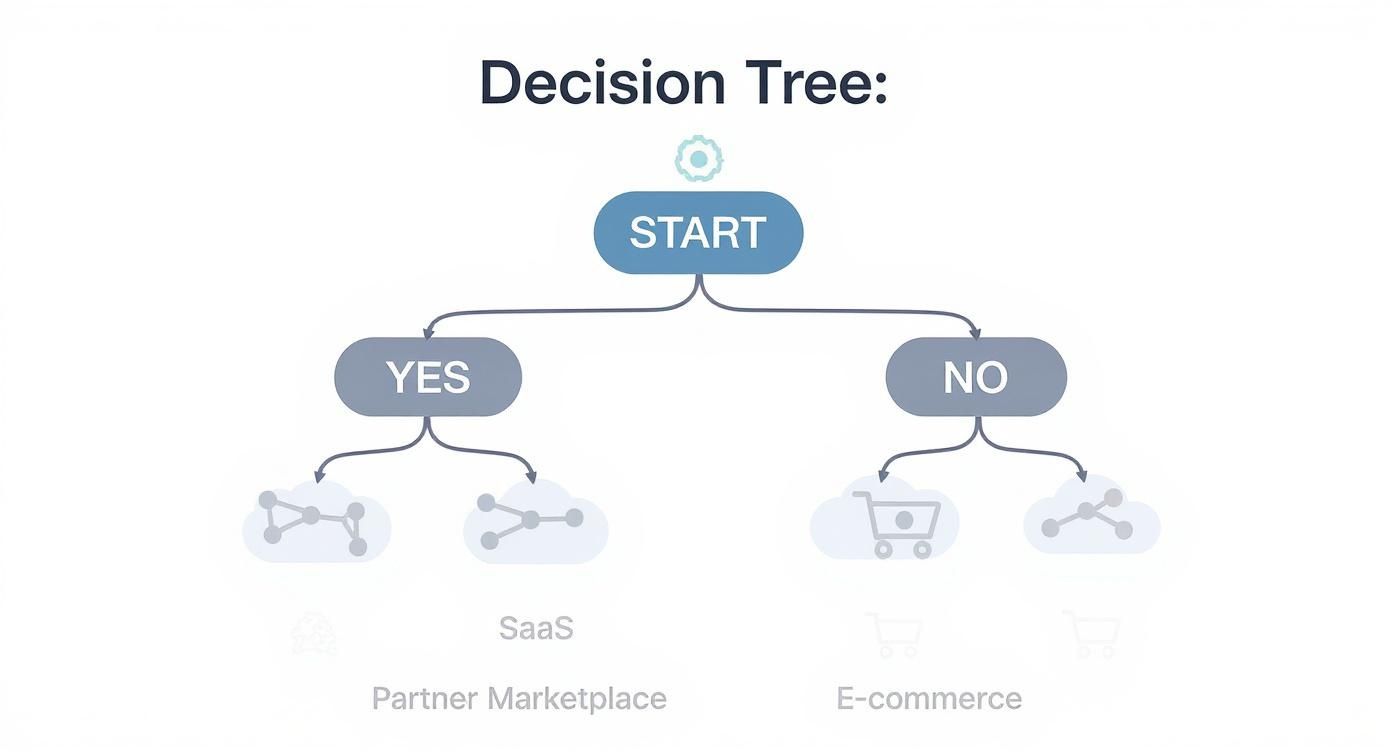
As you can see, your business model is the first major fork in the road. Whether you're a SaaS company needing direct partnerships or an e-commerce brand that could benefit from a large network will point you toward entirely different types of tools.
Finding an All-in-One Solution
At the end of the day, the right choice really comes down to your specific goals. Affiliate marketing is a serious revenue driver, accounting for a massive 16% of all online orders in the US and Canada. If you want to dive deeper into the different platforms out there, check out our guide on finding the right affiliate program software for your business.
An all-in-one solution like Coral is built to close the gap between standard affiliate tools and true creator partnership management. By bringing everything under one roof, you get rid of the hassle of juggling multiple systems and have one clear view of all your performance marketing.
Unifying Affiliate and Creator Partnerships with Coral
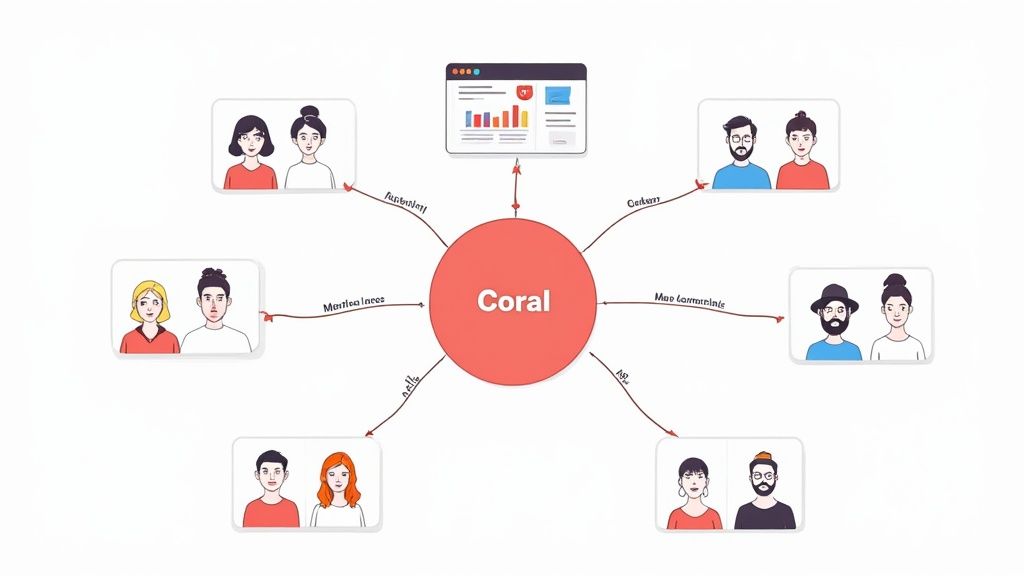
Let's be honest: most brands are juggling way too many systems to manage their partnerships. You've got one affiliate marketing tool for the coupon sites and bloggers, and then a totally separate platform for your Instagram and YouTube creator collaborations. This messy, disconnected approach leads to data silos, making it a real headache to figure out what's actually working.
This is precisely the problem Coral was designed to fix. It breaks down the walls between traditional affiliate programs and modern creator partnerships. Instead of duct-taping different tools together, you get one central hub to manage every single performance-based partner you work with.
Beyond Standard Affiliate Tracking
Solid affiliate tracking software is non-negotiable—it's the bedrock of any program. But today’s marketing mix is far more complex. You need a system that understands the nuances of creator collaborations, where the relationship is about more than just a final click and conversion.
Coral is the all-in-one solution that combines essential affiliate marketing tools with superior creator partnership capabilities. It blends core affiliate management with the specific features needed to run creator campaigns, saving you from administrative chaos.
- Holistic Performance Analytics: Finally, you can see how your bloggers, influencers, and brand ambassadors stack up against each other, all in one dashboard.
- Multi-Channel Campaign Management: Run campaigns across any platform—a blog post, a TikTok video, an Instagram story—without switching between systems.
- Streamlined Partner Onboarding: Offer a single, branded portal where every type of partner can sign up, grab their links, and watch their earnings grow.
This unified view gives you the full picture. You can finally understand the total impact of your partner marketing and start making smarter decisions based on real data, not guesswork.
A Single Platform for All Performance Partners
The biggest win here is efficiency. When all your performance-based partnerships live in one place, you save a ton of time, cut down on manual errors, and gain much clearer insights into what actually moves the needle for your brand.
Think about an Amazon seller using Coral. They can manage a big network of bloggers who write detailed product reviews while also collaborating with a hand-picked group of TikTok creators making short-form videos. Both groups are managed in the same system, and their performance is tracked on the same dashboard. This lets the brand directly compare the ROI of a blog post versus a video, giving them the data to double down on what works.
For more on this, check out our guide to finding and working with Amazon influencers.
Coral is built to be the command center for your entire partnership strategy. It takes the best parts of an affiliate management platform and adds specialized tools for creators, so you can stop wrestling with disconnected systems and get a clear, consolidated view of your program's success.
This approach doesn't just make your life easier; it creates a much better experience for your partners. When creators and affiliates have a single, easy-to-use platform, they're more likely to stay engaged and keep promoting your products.
Frequently Asked Questions About Affiliate Tools
Jumping into the world of affiliate marketing tools can feel like learning a new language. You've got questions, and you need clear, straightforward answers to make the right call for your brand. Let's break down some of the most common ones.
What Is the Difference Between an Affiliate Network and Affiliate Tracking Software?
Think of an affiliate network (like ShareASale or CJ Affiliate) as a massive digital marketplace. They connect brands with a huge pool of publishers and handle the heavy lifting like tracking and payments. The trade-off? You often give up a slice of control and pay them a percentage of your affiliate commissions.
On the other hand, affiliate tracking software lets you build your own private, in-house program. This gives you direct relationships with your partners and total control over commission rules. The catch is that you're in charge of finding and recruiting those partners yourself. If you're weighing these options, our guide to the best affiliate marketing tools offers a much deeper dive.
Some platforms, like Coral, are creating a middle ground. They give you the direct control of private software but add powerful features specifically for managing creator partnerships, offering a more modern, hybrid approach.
How Much Should I Expect to Pay for an Affiliate Marketing Tool?
Costs can be all over the map, and it really depends on what you need. Entry-level tools might start around $50 to $100 per month, but they usually cap the number of partners you can have or limit key features.
As your program grows, you'll likely look at mid-tier solutions, which typically run between $200 and $500 per month. These pack more punch with better analytics and automation. Enterprise-level platforms can easily climb into the thousands.
It's also crucial to watch out for hidden fees. Some networks charge for setup and then take a cut of every single commission you pay. All-in-one platforms usually have tiered subscription plans, which makes your costs much more predictable as you scale.
Can I Manage an Affiliate Program Without a Dedicated Tool?
Technically, yes, you could try juggling a few affiliates with a spreadsheet. But I’ll be honest—it’s a terrible idea. It’s incredibly inefficient and a recipe for disaster.
Manual tracking is filled with errors, which almost always leads to payment arguments and erodes the trust you have with your partners. It's simply not a scalable or professional way to operate.
A dedicated tool isn't a luxury; it's the foundation of a serious affiliate program. It handles the tedious work of tracking, payments, and reporting with precision. This frees you up to focus on what actually grows the program: building great relationships with your partners.
Without a proper system, you're flying blind. You can't see what's working, who your top performers are, or where to invest your energy. High-quality affiliates want to work with brands that have their act together, and a solid platform shows you mean business.
How Do Affiliate Marketing Tools Prevent Fraud?
Good question. Modern platforms have gotten pretty sophisticated at sniffing out bad actors. They’re constantly looking for red flags like weird click patterns, traffic coming from known bots, or a sudden spike in duplicate transactions that just don't look like real customer behavior. This is all about protecting your budget and keeping your data clean.
Many of the top tools now use AI to spot potentially fraudulent activity as it happens. This means you can block shady sources before they waste your ad spend, ensuring you only pay for real sales generated by legitimate partners.
Ready to bring your affiliate and creator partnerships under one roof? With Coral, you can manage every performance-based partner from a single dashboard, simplify payments, and get the clear analytics you need to grow. Start for free with Coral and build the partnership program your Amazon brand deserves.