Choosing Your Amazon PPC Management Software
Category: Amazon ppc management software
At its core, Amazon PPC management software is a specialized toolkit built to automate and fine-tune your advertising campaigns. These platforms are designed to help you save time, slash wasted ad spend, and ultimately get a better return on your investment. As the Amazon marketplace gets more crowded, using one of these tools is pretty much essential for scaling your business without pulling your hair out.
Why Do You Really Need Amazon PPC Management Software?
Let's be honest: trying to manage Amazon ad campaigns by hand is a losing battle for any serious seller these days. The sheer amount of data, constant bid adjustments, and keyword research can easily bury even the most organized person. This is where dedicated software becomes your best friend, stepping in to do the heavy lifting.
If you’ve ever found yourself lost in a sea of spreadsheets, you know it’s not just tedious—it’s a recipe for mistakes. To get a real sense of what's involved, check out a performance-first guide to Amazon PPC management. It quickly becomes clear that manual methods just can't keep up.

Solving the Day-to-Day Advertising Headaches
PPC software is built to solve the biggest problems sellers run into. It takes over repetitive tasks like adjusting bids and discovering new keywords, which frees you up to think about the big picture and overall strategy. This automation is what keeps you competitive.
These platforms are designed to tackle a few key challenges:
- Getting Rid of Tedious Manual Work: Instead of wrestling with spreadsheets, you get automated workflows that keep your campaigns optimized based on what's happening right now.
- Stopping Wasted Ad Spend: The software automatically finds and gets rid of search terms that don't lead to sales, so your budget isn't wasted on clicks that go nowhere.
- Delivering Clear, Actionable Insights: You get access to powerful analytics that show you exactly what’s working and what isn't, helping you make smarter decisions to improve your Return on Ad Spend (ROAS).
Think of it this way: these tools bring efficiency and strategic focus to your advertising. They turn a time-draining chore into a real engine for growth, making them a must-have for any brand serious about scaling on Amazon.
The Strategic Edge You Get With Automation
The real magic of PPC software is its ability to crunch massive amounts of data and execute complex bidding strategies faster and more accurately than any human ever could. A tool can adjust your bids hundreds of times a day based on performance, what competitors are doing, or even the time of day. That’s just not possible to do manually across dozens of campaigns.
This level of automation lets you move from just "running ads" to building a smart, cohesive advertising strategy. If you're looking to go even deeper, it's helpful to understand what a professional brings to the table. Our guide on what an Amazon PPC manager does shows how they use these very tools to get results.
Ultimately, this kind of software isn't just a nice-to-have. It’s a core part of any modern Amazon selling strategy.
Where Standalone PPC Tools Fall Short
While a dedicated Amazon PPC management tool is a huge leap from wrestling with campaigns manually, it often works in a vacuum. This creates some serious blind spots in your overall marketing plan. These tools are fantastic for optimizing metrics like your Advertising Cost of Sales (ACoS) and Return on Ad Spend (ROAS), but their view is intentionally narrow. They track how your paid ads perform on Amazon, but they can't give you the full picture of why a customer decided to buy.
This limited perspective makes it almost impossible to map out the complete customer journey. A typical standalone tool can tell you a shopper clicked a Sponsored Product ad and bought something. What it can't tell you is that this same person first discovered your product a week ago through an influencer's affiliate link, read a few of their blog posts, and then later searched for your brand on Amazon before clicking that final ad.
The Problem with Disconnected Data
This fragmented view leads to a common, and expensive, issue: misattribution. When your PPC software is the only thing tracking conversions, it naturally claims 100% of the credit for any sale it was the last to touch. This skews your understanding of what's actually working and leads you to make poor budget decisions across all your marketing channels.
- A PPC-Only Worldview: A sale gets chalked up entirely to the final ad click, completely ignoring the influence of affiliates, social media, or email campaigns that happened earlier.
- The Integration Headache: Trying to piece together data from different platforms by hand is a nightmare. You end up trying to connect dots in messy spreadsheets instead of making fast, smart decisions.
- Budget Blunders: If you think PPC is the sole driver of your sales, you're likely to pour more money into ads while cutting back on the very affiliate channels that are building initial awareness and trust.
Without a single source of truth, you're basically giving all the credit to the player who scored the goal, not the team that passed them the ball. You miss the vital connection between all your marketing efforts.
The Coral Advantage: A Unified View
This is exactly where an integrated platform like Coral flips the script. By bringing affiliate and PPC management under one roof, Coral gives you a unified dashboard that breaks down those data silos for good. You finally get a complete, cross-channel look at how your marketing is working, from the very first touchpoint to the final sale.
For instance, instead of just seeing a PPC conversion, Coral's analytics can show you the entire customer path:
- Discovery: A customer clicks an affiliate link from a creator they trust.
- Consideration: They land on your Amazon product page and check it out.
- Conversion: A few days later, a retargeting ad jogs their memory, and they make the purchase.
With that kind of clarity, you achieve true attribution. You can accurately see the impact of both your affiliate partners and your ad campaigns, finally understanding how they work in tandem to grow your business. This lets you optimize your entire marketing funnel, not just a single slice of it. For a closer look at the nuts and bolts, our guide on PPC on Amazon breaks down how these campaigns really work.
Coral provides the complete picture by merging the worlds of affiliate tracking software and PPC management. It gets you past the limitations of single-purpose tools to deliver the holistic insights you need to maximize your true marketing ROI. You can finally see which channels introduce new customers and which ones seal the deal, letting you invest your budget with total confidence.
Comparing Standalone vs. Integrated PPC Platforms
Choosing the right Amazon PPC software is a big decision, and it goes way beyond just tweaking ad campaigns. You're essentially picking the engine that will drive your marketing strategy. The market really offers two main paths: you can go with a traditional, standalone tool that just does PPC, or you can opt for an integrated platform like Coral that brings your PPC and affiliate marketing together.
Understanding the difference is key, especially when you consider how much sellers are relying on these tools. The global market for pay-per-click software hit $12.58 billion back in 2019 and is on track to smash $22.31 billion by 2025. That explosion in growth tells you one thing: serious sellers are using sophisticated software to get ahead. You can see the full research on PPC software growth here to get a sense of the scale.
The Problem with Data Silos
Traditional PPC management tools are fantastic at one specific job: optimizing your Amazon ads. They give you incredibly detailed control over bids, keywords, and campaign setups to help you nail that ACoS. The problem? They operate in a bubble, completely walled off from your other marketing efforts like your affiliate or influencer programs.
This separation forces you into a manual, messy workflow. To see the full picture, you have to pull data from your PPC tool, then from your affiliate platform, and again from Seller Central. Then comes the fun part: trying to stitch it all together in a massive spreadsheet. It’s not just a time-sink; it’s a recipe for costly mistakes.
A single copy-paste error or a broken formula can completely skew your analysis. Before you know it, you're pouring money into the wrong channel based on bad data, all because your tools don't talk to each other.
A Single Dashboard Changes Everything
This is exactly the headache that an integrated platform like Coral was built to solve. By putting affiliate tracking and powerful PPC management tools under one roof, you get a single, unified dashboard. Suddenly, your entire marketing funnel is visible in one place—no more data exports or spreadsheet nightmares.
Instead of jumping between different logins and reports, you have one clear view. You can instantly see how your PPC campaigns are interacting with your affiliate partnerships and how both contribute to your bottom line. This consolidated view lets you make smarter, faster decisions about where your marketing budget should go.
The infographic below breaks down the core functions—automation, analytics, and bid management—that a solid Amazon PPC tool should handle.
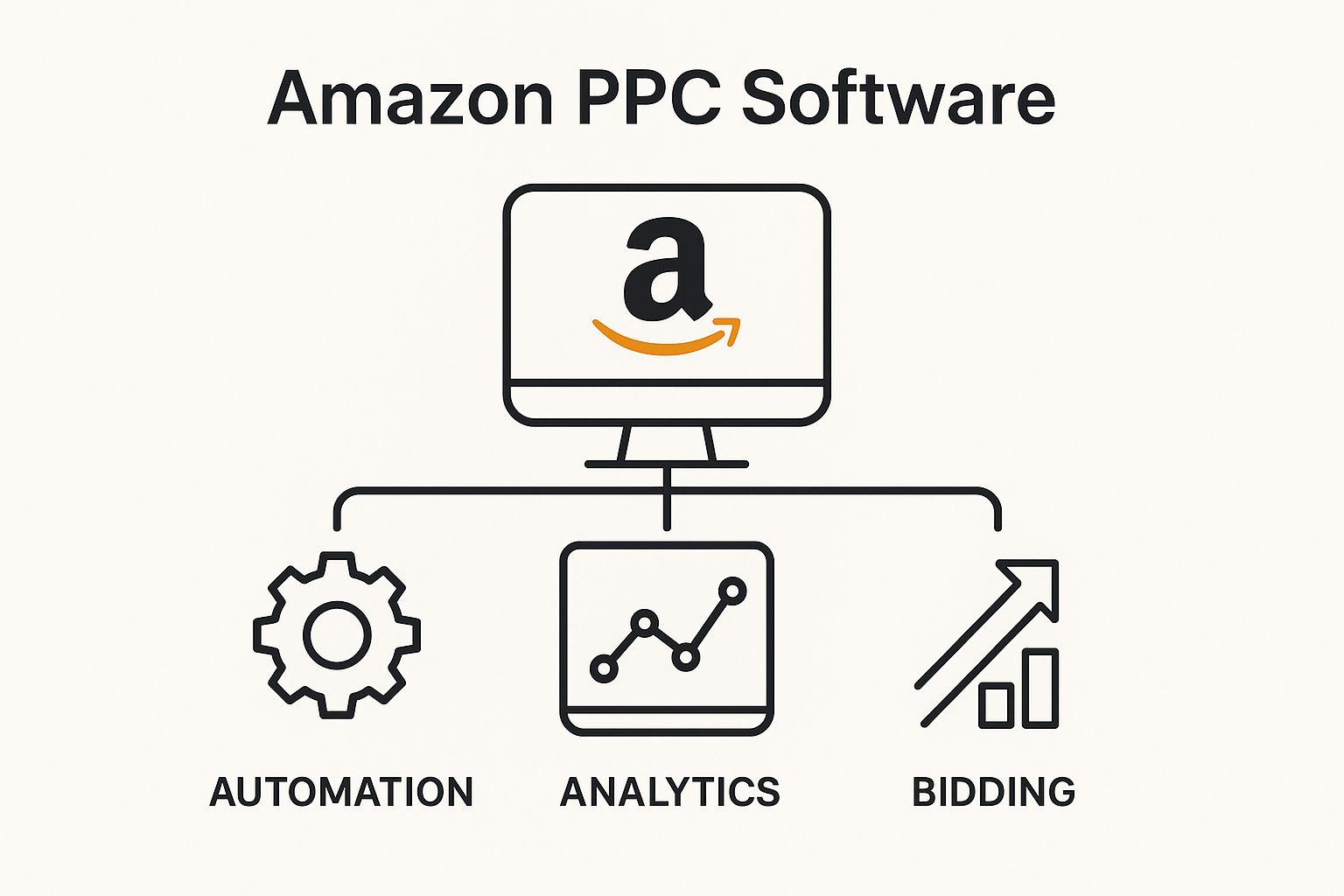
While any good tool centralizes these PPC functions, an integrated system takes it a huge step further by layering affiliate data on top, giving you the complete performance story.
To make the differences crystal clear, let's break down how a traditional tool stacks up against an integrated platform like Coral.
Standalone PPC Software vs Integrated Platform (Coral)
| Feature/Capability | Traditional PPC Software | Coral (Integrated Platform) |
|---|---|---|
| Data Scope | Focused exclusively on PPC metrics (ACoS, CPC, Impressions). | Combines PPC data with affiliate/influencer marketing data. |
| Attribution Model | Last-click only. Gives 100% of the credit to the final ad click. | Multi-touch attribution. Shows the full customer journey. |
| Analytics | Tactical, campaign-level insights for ad optimization. | Strategic, cross-channel insights for budget allocation. |
| Workflow | Requires manual data exports and merging in spreadsheets. | Unified dashboard with all data in one place. No manual merging. |
| Strategic Insight | Answers "How can I lower my ACoS?" | Answers "Which marketing channel gives me the best ROI?" |
This table really highlights the core difference: one is a tool for a specific task, while the other is a platform for your entire growth strategy.
Seeing the Full Customer Journey with Better Attribution
One of the biggest blind spots with standalone PPC tools is their reliance on last-click attribution. They can only tell you about the very last ad a customer clicked before buying. This model is way too simplistic and completely misses how other channels warm up a customer.
Think about it. A shopper might see your product in an influencer’s review video, browse your storefront, and then, a few days later, click a Sponsored Product ad to finally buy. A traditional tool gives 100% of the credit to that final ad click, making the influencer’s critical contribution completely invisible.
Coral’s integrated approach fixes this by tracking the entire journey. It sees the first touchpoint from an affiliate link all the way to the final conversion from a PPC ad.
This multi-touch view reveals how your channels work in tandem:
- Affiliates Drive Discovery: You can pinpoint which influencers are genuinely bringing new eyeballs to your brand.
- PPC Closes the Deal: You can see which ad campaigns are most effective at converting shoppers who are already familiar with you.
Grasping this interplay helps you build a much smarter strategy where affiliates create awareness and your PPC campaigns efficiently capture that demand.
From Tactical Tweaks to Strategic Decisions
Ultimately, your choice boils down to the kind of insights you need. Standalone tools provide tactical analytics—ACoS, CPC, impression share. These are great for day-to-day campaign management, but they don't help you answer the big-picture business questions.
Coral, on the other hand, delivers comprehensive, cross-channel analytics. You can put your top affiliate’s performance right next to your best-performing ad campaign and see which is truly more effective. This allows you to answer the tough strategic questions that siloed tools can't touch:
- Is it cheaper to acquire a new customer through an influencer or a Sponsored Brands ad?
- Do customers who come from our affiliates have a higher lifetime value?
- How can we time our affiliate promotions to support our biggest PPC pushes?
By delivering these kinds of deep, strategic insights, an integrated platform becomes more than just software. It’s a complete growth engine. For brands that want to maximize these capabilities, partnering with a top Amazon PPC agency can be a game-changer, combining powerful technology with expert human strategy.
Unlocking True Marketing ROI with Unified Analytics
The real magic of an integrated platform isn't just mashing tools together; it's about painting a complete, unified picture of your marketing performance. When you merge data from your PPC on Amazon, affiliate marketing, and other channels into one dashboard, you can finally stop guessing and start seeing the entire customer journey, from first click to final sale.
This holistic approach breaks down the data silos that so many sellers struggle with. Instead of trying to piece together how your different marketing channels are interacting, you get a clear, data-driven view of every single touchpoint that led to a purchase. Platforms like Coral are designed to move past simplistic attribution models and show you the full story behind every conversion.
The Power of Multi-Touch Attribution
Most traditional Amazon PPC management software still leans on last-click attribution. In simple terms, this model gives 100% of the credit for a sale to the very last ad a customer clicked. It's straightforward, sure, but it's also deeply flawed because it completely ignores all the earlier interactions that built brand awareness and nudged the customer along.
An integrated platform gives you a much more realistic multi-touch attribution view. You get to see the complex, winding path that real customers take before they decide to buy. Understanding the ROI of adopting AI-powered analytics tools is key here, as they are what power these deeper insights.
Let's walk through a common scenario that a standalone tool would get completely wrong.
Customer Journey Example
- Initial Discovery: A shopper first stumbles upon your product in a YouTube review from an influencer they trust. They click the affiliate link to your Amazon page but aren't quite ready to pull the trigger.
- Brand Recall: A week goes by. While scrolling through social media, they see a Sponsored Display ad for that same product, which jogs their memory.
- Final Conversion: The next day, they search for your brand on Amazon, click your Sponsored Product ad right at the top, and make the purchase.
A basic PPC tool only registers that third step, giving all the credit to the Sponsored Product ad. But the reality is, the influencer's affiliate link was the crucial first touch that brought a brand-new customer into your world.
Making Smarter Budget Decisions with a Single Source of Truth
With Coral's integrated analytics, you see this entire sequence laid out perfectly. You can properly credit the initial discovery to your affiliate tracking software and the final conversion to your PPC campaign. This clarity is an absolute game-changer for your budget.
Instead of over-investing in bottom-of-funnel ads and neglecting top-of-funnel awareness, you can confidently fund both. You know precisely which influencers are driving valuable new traffic and which ads are most effective at closing sales.
This level of insight empowers you to build a cohesive marketing strategy where every channel helps the others. You can sync up your affiliate promotions with your PPC campaigns to get the biggest bang for your buck, knowing exactly how each one contributes to your bottom line.
From Vague Metrics to True ROI
At the end of the day, a unified platform completely changes how you define success. You stop obsessing over isolated metrics like ACoS and start focusing on what really matters: your total marketing ROI. You can finally answer the big-picture business questions that are impossible to tackle with siloed data:
- Which channels bring in customers with the highest lifetime value?
- What is our true new customer acquisition cost when we account for every marketing touchpoint?
- How does launching a new affiliate partnership affect our PPC campaign performance?
By giving you a single source of truth, Coral delivers the comprehensive analytics you need to put your budget where it will have the greatest impact. Seeing the whole picture isn't just a nice-to-have; it's essential for building sustainable, profitable growth on Amazon. For a deeper look at this, check out our guide on how to measure marketing ROI.
How Coral Provides a Complete Growth Solution
Most Amazon PPC management software is built to do one thing: optimize your ad campaigns. And they're good at it. They'll help you lower your ACoS and tweak your bids, but they do it in a vacuum, totally cut off from the rest of your marketing. This leaves you with messy data gaps and the frustrating task of patching together reports to get a real sense of what's working.
We built Coral to fix that. It's not just another PPC tool. It's an integrated growth platform that brings powerful ad management and advanced affiliate tracking under one roof. By connecting these two essential channels, Coral gets rid of the blind spots and gives you a single source of truth for all your marketing. You can finally stop guessing how one initiative impacts another.
Beyond Silos to a Unified Dashboard
The biggest problem with standalone software is the fractured picture it paints. You might see an ad campaign crushing it, but you have no idea that an affiliate or influencer partnership was what first introduced that customer to your brand. This leads to bad attribution, where the last ad click gets all the glory while the crucial work done at the top of the funnel is completely ignored.
Coral’s unified dashboard pulls everything together. In one clean interface, you see your PPC metrics right alongside your affiliate performance, letting you trace the customer's entire path. It means you can finally see how your affiliate program and ad campaigns are working in tandem to drive sales.
By breaking down these data silos, Coral helps you shift from making small tactical campaign adjustments to smart, strategic, cross-channel budget decisions. You’re no longer just optimizing ads; you’re optimizing your entire growth engine.
Comprehensive Analytics for True Attribution
Coral gives you the deep analytics you need to understand every touchpoint. Instead of getting stuck on a simplistic last-click model, our platform reveals the full path to conversion, giving credit where credit is due.
- Holistic Performance View: See exactly how an influencer campaign sparks initial interest that your targeted PPC ads later capture.
- Accurate ROI Calculation: Understand your true marketing ROI by seeing the combined impact of all your efforts, not just the results of one isolated campaign.
- Synergistic Strategy: Take insights from your best-performing affiliates and use them to shape your PPC keyword strategy, creating a powerful feedback loop for growth.
By combining the features of an affiliate tracking software with a robust PPC management toolkit, Coral offers insights that standalone tools just can't match. This helps you build smarter, more effective strategies from the ground up.
Creating a Synergistic Growth Strategy
Once you have a complete view of your marketing funnel, you can start building strategies where your channels actually help each other. Imagine coordinating a product launch with your top influencers to create a huge initial buzz. Then, you can amplify that momentum with targeted Sponsored Brands campaigns to capture all the new search traffic. This kind of coordination is next to impossible when your data is spread all over the place.
The Amazon marketplace is getting more competitive by the day. Recent data shows the average ad conversion rate hovers around 10.33% for well-optimized listings, with the best campaigns reaching over 15%. In an environment that precise, having a complete dataset is a serious competitive edge. To dig into these numbers further, you can explore more Amazon advertising stats here.
Coral gives you the power to see which influencers are sending high-intent buyers who later convert through your ads—not just who’s driving clicks. You can learn more about building these valuable partnerships in our guide to working with Amazon influencers. At the end of the day, Coral isn't just a piece of software; it's the central hub for your brand's growth on Amazon, making sure every marketing dollar is spent with clarity and confidence.
Frequently Asked Questions

Here are answers to some of the most common questions sellers have when picking the right tools for their Amazon business. The goal is to give you clear guidance so you can make a smart decision and see the real value of connecting all your marketing efforts.
What Are the Biggest Limitations of Traditional PPC Software?
Most traditional Amazon PPC management software is fantastic at one thing: optimizing ad campaigns. The problem is, that’s all they do. Their biggest weakness is this narrow focus, which means they operate in a data silo, completely cut off from your other marketing channels like affiliate or influencer programs.
This siloed view creates some serious blind spots. For instance, these tools can't tell you if a customer first found your product through an affiliate's blog review before clicking a PPC ad a week later to buy it. This leads to bad attribution, where the final ad click gets 100% of the credit, and you never see the full customer journey. You end up undervaluing the channels that were actually responsible for building that initial awareness.
How Does an Integrated Platform Overcome Integration Challenges?
An integrated platform like Coral is designed from the very beginning to eliminate these integration headaches. Forget about manually exporting data from different tools and trying to piece it all together in a spreadsheet. Coral brings your affiliate tracking software and PPC management into one cohesive dashboard, giving you a single source of truth for all your marketing.
This native connection gets rid of manual data-entry errors and saves a ton of time. You can see the direct relationship between your affiliate promotions and PPC results, all in one place. It lets you make smarter, faster decisions about where to put your budget and how to adjust your strategy because you can finally see the complete picture, not just isolated fragments.
The real power of an integrated platform is getting a single, unified view of your marketing. You stop making small, channel-specific tweaks and start making strategic decisions based on how your entire sales funnel actually works.
What Are the Attribution Benefits of a Unified Dashboard?
A unified dashboard is the key to accurate, multi-touch attribution. Standalone tools almost always use a simplistic last-click model, but an integrated platform can track every single touchpoint a customer has with your brand—from their very first discovery to the final purchase.
This means you can actually follow the entire path a customer takes. For example, a tool like Coral can show you:
- A shopper first clicks an influencer's affiliate link to check out your product.
- A week later, they see a retargeting ad on social media that reminds them about it.
- Finally, they search directly for your product on Amazon and buy it through a Sponsored Brands ad.
With this level of clarity, you can give proper credit to each channel for the role it played. You start to understand which channels are great for introducing new people to your brand and which ones are best at closing the deal. This insight is crucial for optimizing your total marketing ROI and building a more balanced, effective strategy.
How Can Comprehensive Analytics Improve My PPC Strategy on Amazon?
When you have comprehensive, cross-channel analytics, you can build a much smarter PPC on Amazon strategy. Seeing how your affiliate marketing directly impacts your ad performance lets you create powerful synergies between the two. For example, you might notice a particular affiliate is driving high-intent traffic, so you can use that insight to sharpen your PPC keyword targeting and ad copy.
This unified data helps you answer the big-picture questions that siloed tools simply can't:
- Is it cheaper to acquire a new customer through an influencer campaign or a specific PPC ad?
- Do customers who come from affiliate channels end up having a higher lifetime value?
- How can we time our affiliate promotions to line up with our PPC campaigns for maximum impact?
By looking beyond basic metrics like ACoS and ROAS, you can optimize your entire marketing ecosystem. You can finally make sure every dollar you spend is working as hard as possible to grow your brand.
Ready to break down your data silos and see the full picture of your marketing performance? Coral provides the integrated platform you need to manage both your affiliate and PPC strategies from a single, unified dashboard. Get the clarity to drive real growth. Start for free at https://coral.ax.