What Does an Amazon PPC Manager Actually Do?
Category: Amazon ppc manager
So, what exactly is an Amazon PPC manager? Put simply, they're the person who strategizes, runs, and fine-tunes your paid ad campaigns on Amazon. Think of them as the captain of your advertising ship, making sure every dollar you spend is used effectively to boost sales and profit. Their main job is to put your products in front of the right shoppers at the right moment.
Your Strategic Partner in the Amazon Marketplace

Let's use an analogy. Imagine your Amazon ad budget is fuel for a high-performance race car. Without an expert driver, you could easily burn through all that fuel and never even finish the race, let alone win it. A great Amazon PPC manager is that expert driver. They know how to navigate the twists and turns of Amazon’s ad platform to get you across the finish line first.
Their core mission is to turn clicks into sales while keeping your costs in check, paving the way for sustainable growth. They aren't just button-pushers; they're your strategic partners. This role is a specialized form of paid search management, but one that's deeply rooted in the unique quirks of the Amazon ecosystem—its algorithms, ad formats, and cutthroat competition.
Core Functions at a Glance
A manager’s day-to-day work is much more than just launching a few ads and hoping for the best. It's a constant cycle of digging into the data, making adjustments, and reporting back to ensure your ad spend is actually making you money. Their work has a direct, tangible impact on your business's bottom line.
An effective manager doesn't just spend your ad budget—they invest it. The goal is always to hit a profitable Advertising Cost of Sales (ACoS) and improve your Total Advertising Cost of Sales (TACoS), a key metric that shows how your ad spend is lifting all your sales, both paid and organic.
To give you a clearer picture, here's a quick breakdown of what a skilled PPC manager focuses on.
Amazon PPC Manager Core Functions at a Glance
| Responsibility Area | Primary Goal |
|---|---|
| Keyword Research & Targeting | Uncover the high-intent keywords real shoppers are using to find products like yours. |
| Campaign Structuring | Build logical, scalable ad campaigns (Sponsored Products, Brands, Display) that are easy to manage and optimize. |
| Bid Management | Strategically adjust bids to win valuable ad placements without blowing the budget. |
| Performance Analysis | Constantly monitor key metrics like CTR, conversion rate, and ACoS to make smart, data-backed decisions. |
By mastering these areas, an Amazon PPC manager can take your advertising from being just another business expense and turn it into one of your most powerful engines for growth.
A Look Inside Their Daily Toolkit

So, what does an Amazon PPC manager actually do all day? It's definitely not a "set it and forget it" kind of job. Their work is a constant juggle of big-picture strategy and nitty-gritty details, a cycle of testing, analyzing, and tweaking to outsmart competitors and keep up with Amazon's ever-changing algorithm.
Let’s say you're launching a new, innovative kitchen gadget. The manager's first job is to get inside the mind of your ideal customer through deep keyword research. They won't just target broad terms like "kitchen gadget." They'll dig for the gold: specific, long-tail keywords like "ergonomic vegetable peeler for arthritis" that signal someone is ready to buy.
Structuring Campaigns for Maximum Impact
Once they have a solid list of keywords, it's time to build the campaigns. This is where the real architecture of a successful ad account comes into play. A savvy manager won't just dump all the keywords into one campaign; they build a logical structure to control the budget and get crystal-clear data.
A smart campaign structure often looks something like this:
- Automatic Campaigns: These are for discovery. You let Amazon’s algorithm find new search terms you might have missed.
- Manual Campaigns: This is where you target the keywords you know work, setting precise bids for each one.
- Brand Defense Campaigns: Essential for protecting your own brand name from competitors trying to steal your customers.
- Competitor Targeting Campaigns: A more aggressive strategy to get your ads showing up on your rivals' product pages.
This methodical setup means every penny of your ad spend has a purpose. It stops you from wasting money on clicks that don't convert and dramatically improves the health of your account.
The Never-Ending Cycle of Bidding and Analysis
With the campaigns live, the real fun begins. A PPC manager is constantly in the data, watching performance like a hawk and making smart bid adjustments. If a keyword is a superstar and driving sales, they’ll probably increase the bid to get even more traffic. But if another term is just eating up the budget with clicks and no sales, they'll slash the bid or add it as a negative keyword to stop showing up for it entirely.
This relentless optimization is what separates a great manager from a good one. The goal is simple: get maximum visibility on the keywords that make you money and cut your losses on the ones that don't.
Ultimately, it all comes down to the conversion rate—the percentage of people who click your ad and actually buy something. A skilled manager lives and breathes this number, always looking for ways to push it higher.
On Amazon, the average conversion rate for PPC ads hovers around 10.33%. To put that in perspective, that's miles ahead of the typical 1-2% you see on other e-commerce platforms. This just goes to show how powerful Amazon is for reaching shoppers with high purchase intent, a fact an expert manager knows how to capitalize on every single day. You can see more fascinating Amazon advertising statistics on AdBadger.com. This whole process also ties into understanding the complete customer journey, and you can learn how to track sales from different channels using Amazon Attribution in our detailed guide.
How a Pro Optimizes Your Ad Campaigns
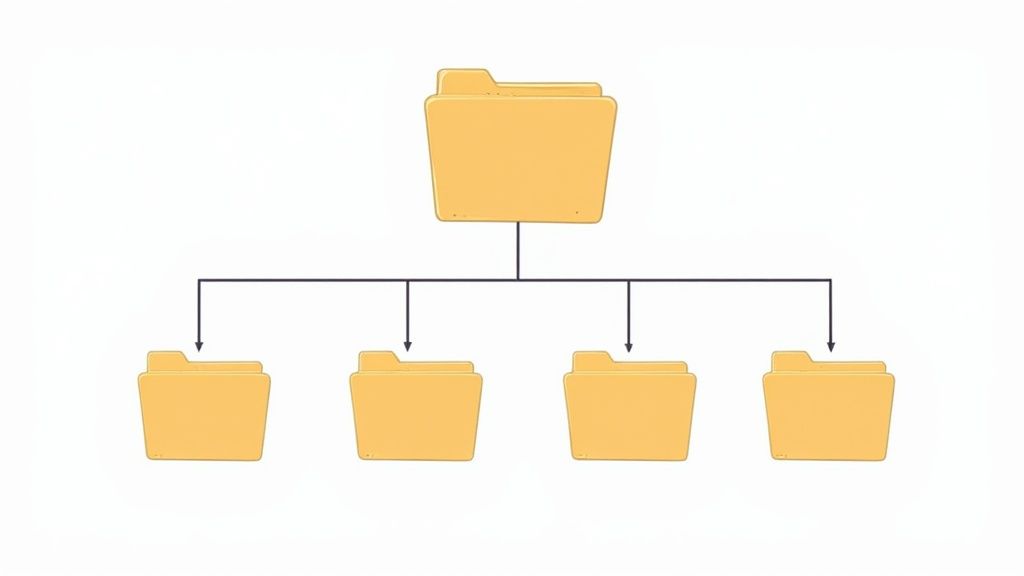
While setting up a solid campaign is the first step, the real magic happens in the day-to-day optimization. This is where a great Amazon PPC manager truly earns their stripes and drives your profitability sky-high.
Think of them as a gardener tending to a prize-winning plant. They don't just plant the seed and hope for the best. They’re constantly pruning away the dead branches so the healthy ones can flourish and produce fruit.
In the Amazon PPC world, "pruning" means systematically cutting out wasted ad spend. The goal is to funnel your budget directly into the keywords and campaigns that are actually making you money. This isn’t about making huge, dramatic changes once a month. Instead, it’s a process of making small, smart adjustments every single day that compound into a massive advantage over your competitors.
Mastering Keyword and Traffic Control
One of the most powerful tools in any manager’s toolkit is the smart use of negative keywords. This is basically a "do not enter" list for your ads. For instance, if you're selling high-end leather wallets, the last thing you want is to pay for clicks from people searching for "cheap fabric wallets."
A seasoned manager will proactively add terms like "cheap," "fabric," and "vinyl" to your negative keyword list. This one simple move stops your ads from showing up in irrelevant searches, which immediately saves you money and makes your campaigns more effective.
Optimization is not a one-time task; it's a constant feedback loop. A manager analyzes performance data, identifies waste, takes corrective action, and then measures the impact, repeating the cycle to refine campaign efficiency.
They also become masters of keyword match types, which dictate how much control you have over who sees your ads.
- Broad Match: This casts the widest net possible. It’s perfect for the early stages when you're trying to discover how real customers search for your product.
- Phrase Match: This gives you more control. Your ad will show up for searches that include your exact keyword phrase, but maybe with other words before or after it.
- Exact Match: This is your sniper rifle. It gives you maximum precision, targeting only shoppers who type in your specific keyword and nothing else.
By skillfully juggling these match types, a manager can direct high-intent buyers straight to your products while using broader matches for ongoing research and discovery.
Refining Ads Through A/B Testing
Great optimization goes beyond just keywords. A true pro is always testing the ads themselves. They'll run A/B tests to find out what really connects with customers. This means testing different main images, headlines, and even the first few lines of your product description.
Does a photo of your product in use (a lifestyle shot) get more clicks than a clean product-on-white photo? Does adding "Free Shipping" to the headline actually boost sales?
This data-first approach takes all the guesswork out of creating compelling ads. These constant tests lead to ads that speak directly to your ideal customer, which in turn boosts your Click-Through Rate (CTR) and, most importantly, your conversion rate. Truly understanding the fundamentals of PPC on Amazon is what allows a manager to pull these advanced levers effectively. It’s this cycle of persistent refinement that ensures your campaigns are always getting better.
The Metrics That Matter for Success
Diving into Amazon PPC data can feel like trying to drink from a firehose. There's just so much information. A seasoned PPC manager knows how to ignore the noise and zero in on the numbers that actually tell you what's working.
Think of it like a pilot in a cockpit. There are dozens of dials and gauges, but only a few—altitude, speed, fuel—are critical for keeping the plane in the air. For Amazon ads, a manager focuses on a similar core set of metrics to steer your campaigns toward profitability.
Understanding Your Core Performance Indicators
The metric everyone talks about first is ACoS (Advertising Cost of Sales). It’s a straightforward but vital percentage that shows how much you’re spending on ads for every dollar of sales you get from those ads.
For example, if you spend $30 on ads and that results in $100 in sales, your ACoS is 30%. It’s the clearest measure of how efficient your ad spend is.
Then there’s ROAS (Return on Ad Spend), which is just another way of looking at the same data. It tells you how many dollars you earn for every dollar you spend. So, a ROAS of 3x means you’re bringing in $3 in revenue for every $1 in ad spend.
Here's a peek at the Amazon Ads dashboard where a manager keeps a close eye on these stats.
This dashboard gives you that quick, high-level view of spend, sales, and ACoS, so you can see if things are on track in a matter of seconds.
But before you can even get a sale, you need a click. That's where CTR (Click-Through Rate) comes into play. This is the percentage of shoppers who see your ad and are compelled enough to click on it. A high CTR is a great sign that your product image, title, and price are hitting the mark.
The Big Picture Metric: Total ACoS
A truly great PPC manager doesn't just stop at the immediate ad results. They look at the bigger picture with TACoS (Total Advertising Cost of Sales). This metric is a game-changer because it compares your ad spend to your total sales revenue, including organic sales.
Why does this matter? Because a falling TACoS over time is the ultimate sign of success. It means your ads aren't just driving sales directly—they're also boosting your organic ranking, which creates a powerful growth flywheel. This holistic view is how a manager turns a simple ad campaign into a long-term, sustainable growth engine for your brand.
The Modern PPC Manager's Playbook
The role of an Amazon PPC manager is changing, and it's changing fast. The old days of poring over keyword spreadsheets and manually tweaking bids are just about over. Today's best managers are more like strategic conductors, orchestrating a symphony of sophisticated tools and advanced ad types to get ahead.
Instead of getting bogged down in the daily grind, the modern manager is all about the big picture. This shift is happening because powerful AI-driven automation tools have entered the scene. These platforms can handle the heavy lifting—like real-time bidding and finding new keywords—freeing up the manager to focus on what actually drives growth. Their value isn't in clicking buttons anymore; it's in setting the right direction and making sense of complex data.
Going Beyond the Basics with Advanced Ad Platforms
A huge part of this new playbook involves moving beyond the standard Sponsored Products ads everyone uses. Expert managers are now tapping into the more advanced tools in Amazon's arsenal to build out complete sales funnels and really grow a brand.
One of the most powerful tools in this kit is Amazon's Demand-Side Platform (DSP). Think of it as your way to reach shoppers whether they're on Amazon or browsing elsewhere on the web.
A skilled manager uses DSP to:
- Bring back lost shoppers: Show ads to people who checked out your product but didn't pull the trigger.
- Find new customers: Target audiences based on their lifestyle, interests, and what they've shopped for in the past.
- Build your brand's story: Use eye-catching display and video ads to introduce your brand to a wider audience.
This is how a manager builds a true full-funnel strategy, guiding a customer from the moment they first hear about you all the way through to making a purchase.
At its heart, modern Amazon PPC management is all about smart data analytics, automation, and strategic scaling. With millions of shoppers on the platform every day, managers use AI tools and deep data analysis to nail their ad placements, focus on high-margin products, and slash wasted spend.
This reliance on technology is what separates the old from the new. Tools like Amazon Marketing Stream and DSP offer incredibly detailed audience targeting that just wasn't possible before. It means a manager can fine-tune campaigns with surgical precision, making sure every single ad dollar is working as hard as it possibly can.
You can learn more about the best approaches to Amazon PPC on estorefactory.com. By embracing these tools, an Amazon PPC manager stops being a simple campaign operator and becomes a true driver of strategic growth.
Deciding Between In-House vs Agency Help
Sooner or later, every growing Amazon seller hits a crossroads: do you hire someone to manage your ads in-house, or do you bring in an outside agency? It’s a huge decision, and frankly, there's no magic answer. The right choice really boils down to your business size, your budget, and where you see yourself in a year or two.
Bringing an in-house Amazon PPC manager onto your payroll means you get a dedicated expert who is 100% focused on your brand. This person will live and breathe your products, get to know your profit margins inside and out, and become part of your company culture. That level of deep integration is their superpower—they can walk over to the inventory team or brainstorm with marketing on the fly.
On the flip side, hiring a PPC agency gives you access to an entire team of specialists, often for a price similar to one senior employee's salary. These agencies have seen it all because they work with dozens of accounts across different industries. They spot market trends you'd miss and come armed with powerful, expensive software that would be tough to justify for a single business.
Weighing Your Options
It really comes down to a classic trade-off: deep, singular focus versus broad, diverse expertise. An in-house manager gives you a true brand champion, while an agency offers a deep well of collective knowledge and battle-tested resources. If you're leaning toward an agency, it’s critical to understand how to choose a PPC agency that won't just burn through your ad spend.
Ask yourself this: Do I need one person who is completely obsessed with my brand's success, or do I need a team of pros who can pull from a wider range of industry experience?
No matter which path you take, you need to grasp the basics of campaign strategy. For instance, any manager you work with will have a strong opinion on manual versus automatic campaigns. This infographic gives a quick snapshot of how they often stack up.
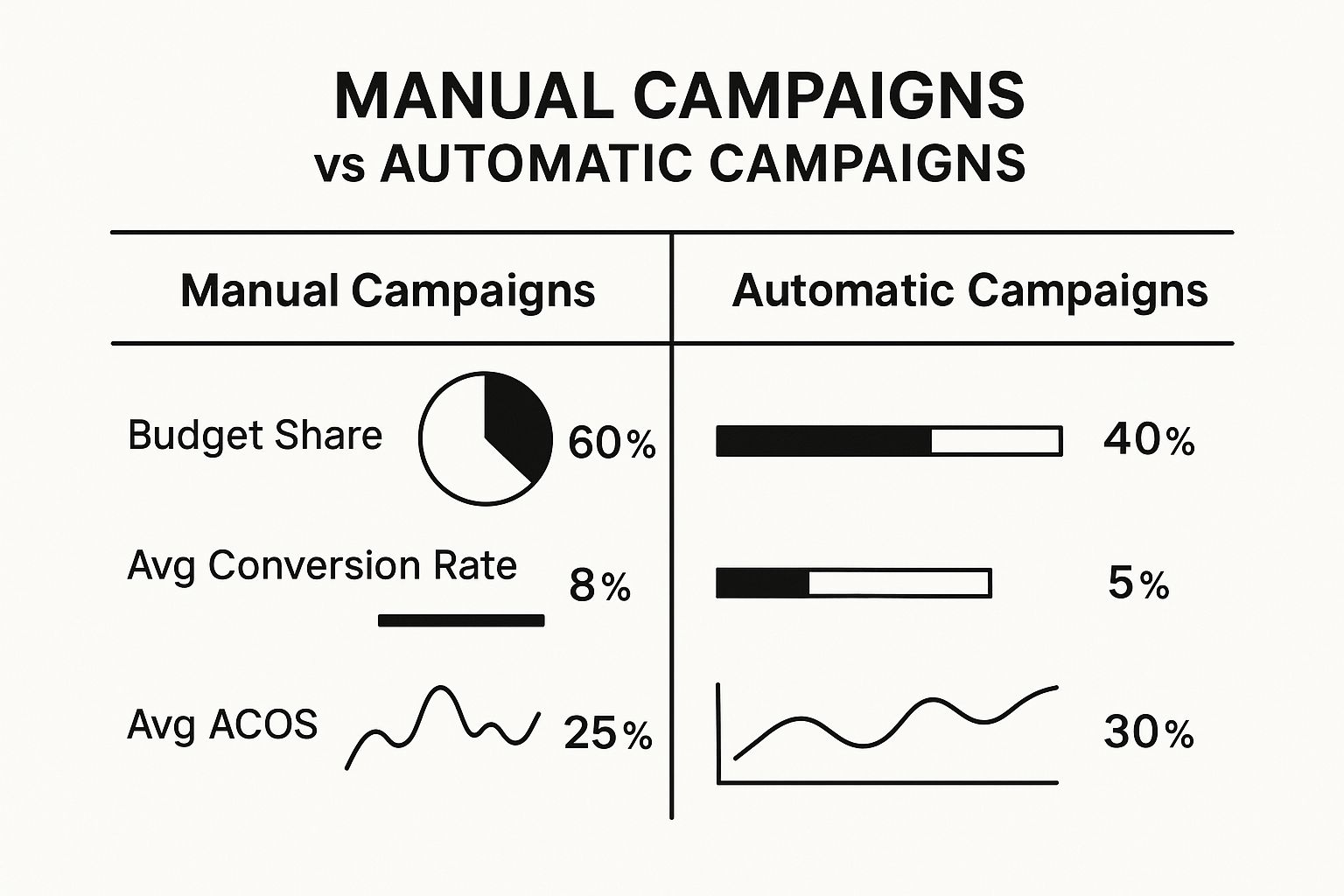
As you can see, manual campaigns typically deliver better conversion rates and a lower ACOS. But they take real skill to manage effectively, which is exactly why expert oversight is so valuable.
Comparing In-House vs. Agency PPC Management
To help you visualize the pros and cons, let's break down the key differences between hiring an employee and partnering with an agency.
| Factor | In-House Manager | PPC Agency |
|---|---|---|
| Focus & Dedication | 100% dedicated to your brand and products. Deeply integrated with your team. | Manages multiple clients, so focus is divided. |
| Expertise | Expertise is limited to one person's experience and ongoing training. | Access to a diverse team with varied skills and broad industry knowledge. |
| Cost | Full-time salary, benefits, training, and overhead. Can be a significant fixed cost. | Often a monthly retainer or performance-based fee. Predictable expenses. |
| Resources & Tools | You must purchase and license all necessary software, which can be expensive. | Comes with a full suite of premium tools and software included in their fee. |
| Scalability | Scaling up can be slow, requiring new hires and extensive training. | Can easily scale services up or down based on your needs and budget. |
| Onboarding | Requires time to train them on your brand, products, and internal processes. | Quicker ramp-up time as they are already experts in the field. |
Ultimately, there’s no universally "better" option—only the one that’s a better fit for your current situation. An in-house manager might be perfect for a large brand that needs someone deeply embedded in its operations, while an agency is often the ideal partner for a growing business that needs expert results without the overhead.
To make the best choice, you need to know what to look for. Diving into our complete guide to Amazon PPC marketing will arm you with the right questions to ask, whether you're sitting across from a job candidate or an agency representative.
Got Questions? We've Got Answers
Stepping into the world of Amazon advertising often brings up more questions than answers. Let's tackle some of the most common ones that sellers have when they're thinking about getting expert help for their campaigns.
How Much Does an Amazon PPC Manager Cost?
This is the big question, and the honest answer is: it depends. The cost can swing pretty widely based on who you hire and how they structure their fees.
An agency, for example, might have a monthly retainer that starts at a few hundred dollars and can go up to several thousand, usually tied to how much you're spending on ads. Others prefer a percentage-based model, typically charging between 10% and 20% of your ad spend.
Freelancers and full-time employees are a different story. A freelancer might work on an hourly rate or a set monthly fee. If you bring someone in-house, a full-time salary can range from $40,000 to over $70,000 a year, depending on their experience. The trick is to figure out which model fits your budget and what you’re trying to achieve.
What Kind of Results Should I Realistically Expect?
Patience is key here. The results you'll see depend on your product, how fierce the competition is, and where your campaigns are starting from. In the beginning, a good manager is focused on two things: gathering clean data and plugging the leaks where you're wasting money. So, the first thing you'll likely notice is your Advertising Cost of Sales (ACoS) getting better.
A good rule of thumb for seeing significant, game-changing results is about 90 days.
Think of it like this: The first month is all about cleanup and getting your campaigns organized. By the end of month three, you should be seeing a clear, positive trend—better efficiency, a lower ACoS, and a real lift in your total sales as the ads start boosting your organic ranking.
What Are the Red Flags That I Need to Hire a Manager?
Not sure if it's time to call in a pro? If any of these sound painfully familiar, it's probably time.
- Your ACoS is through the roof: You’re constantly spending way too much on ads for the sales you're getting, and it’s eating into your profits.
- You have zero time: You’re so wrapped up in sourcing, shipping, and everything else that your ad campaigns are getting neglected.
- Your sales have hit a wall: What used to work isn't working anymore, and you can't seem to get your sales climbing again.
- You're drowning in data: You look at the reports and just see a bunch of numbers, with no idea what to do next.
If you're nodding your head to any of these, bringing in an expert isn't just an expense—it's a strategic investment to push your business to the next level.
Ready to turn your influencer collaborations into a powerful, scalable sales channel? Coral provides the tools you need to build and manage a high-performing affiliate network directly on Amazon. Start for free and see how easy it is to drive consistent, profitable growth. Get started today at coral.ax.