Automate Affiliate Marketing for Amazon Sellers
Category: Automate affiliate marketing
Automating your affiliate marketing is all about using software to take over the repetitive, soul-crushing tasks—things like tracking sales, managing partners, and handling payouts. It’s a game-changer. This simple shift moves you from being a spreadsheet jockey to a strategist focused on building relationships and actually growing your program.
Think of it this way: you can either spend your days manually checking every sale in a dozen different spreadsheets, or you can have a system do it all for you, instantly and accurately.
Why Manual Affiliate Marketing Is Holding You Back

For too many Amazon sellers, the term "affiliate marketing" brings up a chaotic mental image: a messy collection of spreadsheets, complex payment calculations, and an inbox overflowing with back-and-forth emails. It feels like you're being productive, but in reality, you've hit a hard ceiling on your growth. You're trying to catch rain in a bucket—sure, you'll get a little, but you’re missing the entire storm.
The real price you pay isn't just your time; it's the missed opportunities. A single missed payment can ruin a great relationship with a high-performing influencer. Inconsistent tracking means you might be paying for traffic that never converts or, even worse, failing to reward the affiliates who are driving real sales. This manual grind is simply unsustainable.
The True Cost of Inefficiency
The affiliate marketing world is growing fast, and it won't wait for anyone. The global market is on track to hit a staggering $31.7 billion by 2031, with automation being a key reason for that growth. In fact, platforms using smart automation tools have seen conversion rates jump by an average of 28%. The link between technology and results is crystal clear.
When you're stuck managing your program by hand, you run into the same roadblocks over and over again:
- You Can't Scale: You can only personally manage so many affiliates before communication starts to break down and things get messy.
- Payments Are a Nightmare: Manual calculations are just asking for mistakes. This leads to overpayments that hurt your bottom line or underpayments that destroy trust.
- You're Flying Blind: Without real-time data, you're always making decisions based on old information instead of what’s happening right now.
To give you a clearer picture, let's break down the differences.
Manual vs Automated Affiliate Marketing
| Aspect | Manual Approach | Automated Approach with Coral |
|---|---|---|
| Tracking | Relies on manual spreadsheet updates and screenshots. Prone to errors. | Direct Amazon Attribution integration. 100% accurate, real-time tracking. |
| Payments | Involves complex manual calculations and individual payment processing. | Automated commission calculations and streamlined bulk payouts. |
| Scalability | Limited to the number of partners you can personally manage. | Virtually limitless. Onboard and manage hundreds of affiliates with ease. |
| Data & Insights | Based on outdated, manually compiled data. | Live performance dashboards to make informed, strategic decisions. |
| Time Investment | Hours per week spent on administrative tasks. | Minutes per week. Frees you up to focus on strategy and growth. |
As you can see, the difference is night and day. One path leads to burnout, the other to growth.
The biggest problem with the manual approach is that it forces you to work in your affiliate program, not on it. You're so buried in admin work that you never have time for high-impact strategy.
This is exactly where a platform like Coral comes into play. It was built specifically to solve these problems for Amazon sellers. It handles all the tracking, management, and payments so you can finally step back and focus on the big picture.
By connecting directly to Amazon Attribution, Coral ensures every single sale is credited accurately, taking all the guesswork out of the equation. While it’s helpful to understand all the tools out there, including the official Amazon Associates app, a dedicated platform offers a more complete solution. Automation isn’t just about saving time—it’s about building a reliable, scalable, and profitable affiliate program that can actually compete.
Preparing Your Amazon Store for Automated Success
Jumping straight into automation software without a solid foundation is like building a house on sand. Before you can get the most out of a tool like Coral, your Amazon store itself needs to be primed and ready to convert. It's not just about having products listed; it’s about making them irresistible to both customers and the affiliates you want to attract.
Think of your product listings as the final destination for all that affiliate traffic. If the landing page—your product page—is weak, even the world's best affiliate can't make a sale. Your listings have to be ‘affiliate-ready,’ meaning they are professionally polished and optimized to turn those clicks into purchases.
Optimize Your Listings to Be Affiliate-Ready
The first thing on your to-do list should be a serious audit of your product pages. High-quality affiliates are picky, and for good reason. They won't risk their reputation sending their hard-earned audience to a listing that looks unprofessional or unconvincing.
Start with your visuals. Are your product photos high-resolution and well-lit? Do they show the product from every important angle? You absolutely need lifestyle images or even short videos that show your product in action. Visuals are the first impression, and they count for a lot.
Next, sharpen your copy. Your title needs to be crystal clear and packed with the right keywords so people know exactly what they're looking at. The bullet points are your sales pitch—focus on the benefits, not just a dry list of features. You have to answer the customer's silent question: "How does this make my life better?"
- Persuasive Copy: Write like you're talking to one person, addressing their specific problems and desires.
- High-Quality Images: Don't skimp here. Professional photos and helpful infographics are an investment that pays off.
- Customer Reviews: A healthy number of positive reviews is non-negotiable. This social proof is what gives new buyers the confidence to click "Add to Cart."
A great product listing does most of the selling for your affiliates. When they see a page that’s already a conversion machine, they’ll be much more excited and confident about promoting it.
Define Your Campaign Goals
Once your listings are in top shape, it's time to get clear on what you actually want to accomplish. Firing up automation without a clear goal is just making noise. Your objectives will guide every decision you make when setting up your campaigns in Coral and tracking what works.
Are you about to launch a brand-new product? Your main goal is probably to generate a ton of initial buzz and land those first crucial reviews. For a launch, you might offer a higher, limited-time commission to get affiliates pushing hard right out of the gate.
On the other hand, maybe you want to drive steady, long-term sales for an existing bestseller. Here, your goal is all about sustained momentum. This calls for a more standard commission rate, but perhaps with performance bonuses for top affiliates who consistently hit their numbers.
Figuring this out upfront is the key to seeing a real return on your efforts. To see how different goals require different tools, take a look at our guide on choosing the right Amazon affiliate marketing platform.
Getting Your First Automated Campaign Running with Coral
Alright, you’ve prepped your Amazon store and have a clear goal in mind. Now for the fun part: seeing how to automate your affiliate marketing. This is where all that initial prep work really starts to pay off. We'll walk through setting up your first campaign in Coral, using a practical example to keep things grounded.
Let's say you're about to launch a brand-new smart kitchen scale. Your main objective is to drive those critical first sales and get some reviews rolling in. Affiliates are perfect for this job, but you need a system that just works from the moment you go live. That journey starts by connecting your accounts and picking the right products for the job.
This simple breakdown shows the key steps you should have handled before you even open up your automation software.
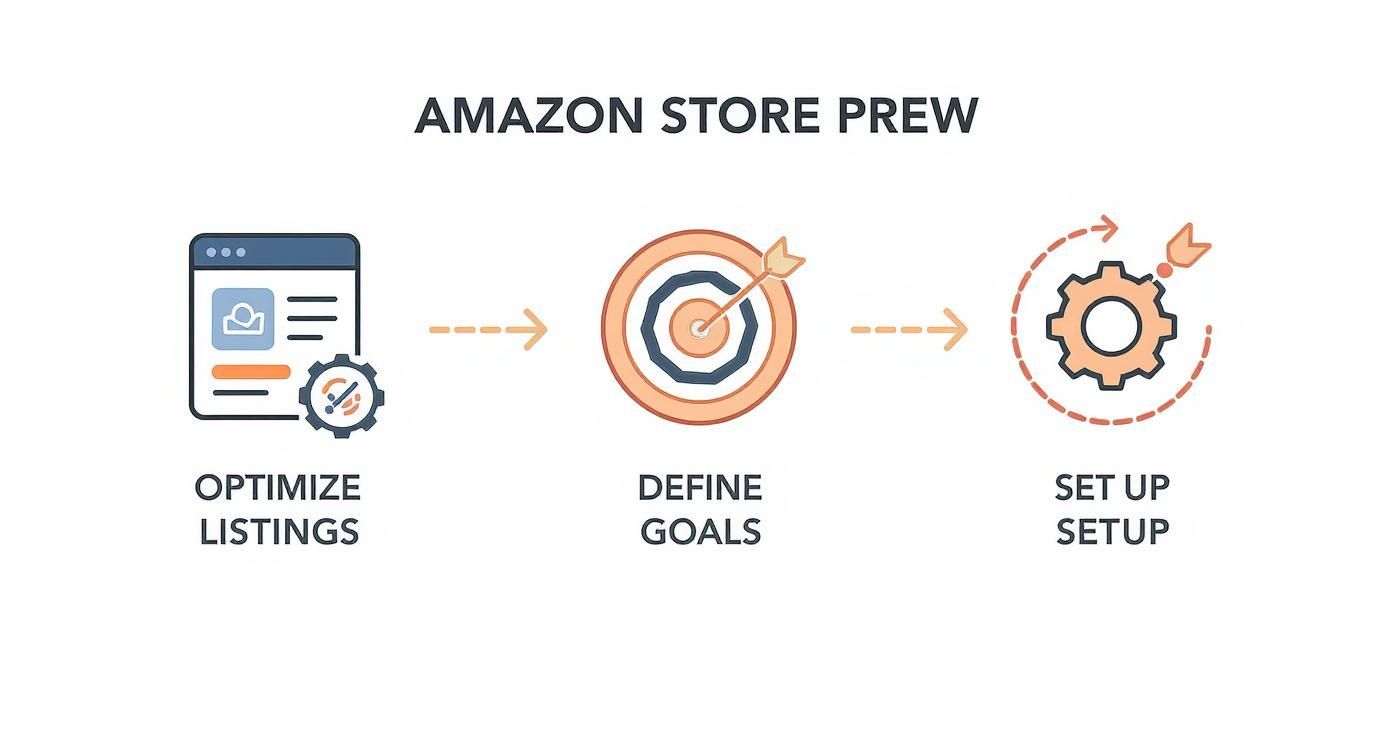
As you can see, great automation isn't just about the tool—it's built on a solid foundation of a well-optimized product and crystal-clear goals.
Connect Your Store and Choose Your Products
First things first, you need to link your Amazon Seller account to Coral. This integration is the backbone of the whole operation. It lets Coral pull in your product catalog and—most importantly—accurately track every sale through Amazon Attribution. No more manual data entry or second-guessing your numbers.
Once connected, your entire product lineup will appear. For our kitchen scale launch, you wouldn't want affiliates promoting your whole catalog. The smart move is to select only the new scale for this specific campaign. This laser focus ensures your partners are all pushing the one product that matters right now.
Design Commission Tiers That Actually Motivate
With your product selected, it's time to talk commissions. Don't just pull a number out of thin air; this is a strategic move. A flat, generic commission rate probably won't generate the buzz needed for a successful launch of our new kitchen scale.
This is where you can get creative inside Coral and set up a tiered structure that gets affiliates excited:
- Launch Bonus: Kick things off with a higher commission, maybe 15%, for the first 30 days. This creates a real sense of urgency.
- Standard Rate: After that initial push, the rate can automatically settle back to your standard, sustainable 10%.
- Performance Kicker: Want to reward your top performers? Add a rule that bumps an affiliate's rate up to 18% if they drive over 50 sales in a single month.
This kind of flexible setup turns your affiliate program from just another passive option into an exciting, competitive opportunity for your partners.
The real magic of automation is setting up rules that work for you around the clock. You can build incentives that drive specific actions, like a big product launch push, without manually tracking or adjusting payments for every single affiliate.
Generate and Share Your Tracking Links
The last piece of this setup is the tracking link. It’s the unique URL that tells Coral and Amazon exactly which affiliate sent which customer. Generating these links in Coral is dead simple. You just choose the campaign (our kitchen scale launch) and the affiliate you're bringing on board, and the platform creates a unique link just for them.
The best part is the reliability. These aren't just any old links; they are official Amazon Attribution links, the gold standard for tracking traffic that comes from outside of Amazon. If you want to get into the nitty-gritty, we have a complete guide on how to generate Amazon affiliate links that guarantee you get credit for every sale. Automation here eliminates the human error that’s so common with messy spreadsheets, ensuring affiliates get paid correctly and you get clean, trustworthy data.
Using an optimized, automated system like this has a huge impact. Affiliate marketing is already a powerhouse, driving 16% of all ecommerce sales. We've seen firsthand how a smart link optimizer can boost earnings per click by as much as 34%. It's clear financial proof that moving beyond basic manual methods is well worth the effort.
Taking Your Affiliate Program to the Next Level
So, you’ve got your first campaign running. That’s a huge first step. But the real magic of automation isn’t just about saving a few hours here and there. It’s about building a system that can grow your entire affiliate program without you having to work ten times harder. This is where we shift from just launching something to scaling it smartly.
Think of automation as the engine of your affiliate program. You’ve turned it on, and now it’s time to give it some gas. We can start bringing in better partners, fine-tuning your commission strategy, and expanding your reach—all without getting swamped by manual tasks.
Finding and Onboarding the Right Partners
Let's be honest, hunting down good affiliates one by one is a soul-crushing time suck. To really grow, you need a system. This is where Coral comes in handy by letting you set up a branded affiliate landing page. Instead of sending countless one-off emails, you can just share a single, professional link where potential partners can learn about your program and sign up.
This simple step automates that whole initial recruitment and screening dance. You can even set up auto-approval for partners you already trust or just quickly scan new applications right from your dashboard.
The name of the game is making it dead simple to get started. The easier it is for a high-quality affiliate to join your program and start promoting, the faster you’ll see results. A clunky, manual sign-up process is a huge red flag for top-tier creators.
Segmenting Affiliates for Smarter Commissions
All affiliates are not created equal, so why would you pay them all the same? A flat-rate commission is easy, but it leaves a ton of money on the table. An Instagram influencer with 100,000 followers driving brand new customers is a world away from a simple coupon site.
This is where segmenting your partners becomes a game-changer. With a tool like Coral, you can group your affiliates and create different commission rules for each.
Here's a simple way to think about it:
- Influencer Tier: For your top creators producing amazing original content, offer a premium rate, maybe 15%.
- Blogger Tier: For partners writing detailed product reviews and how-to guides, a solid 10% is a great incentive.
- Deal Site Tier: For affiliates focused on discount codes, a lower rate like 5% makes more sense, as they're often catching customers at the very end of their buying journey.
This tiered approach not only rewards your most valuable partners but also protects your margins. You’re strategically investing your money where it will deliver the best returns. If you want to go deeper, our guide on effective affiliate program management has a lot more on optimizing these relationships.
Using Data to Double Down on What Works
Once your program is humming along, your data becomes pure gold. The Coral dashboard isn't just for looking at sales numbers; it’s a treasure map for finding your star performers—both affiliates and products.
Start looking for patterns. Is one affiliate absolutely crushing it and driving a huge chunk of your sales? It’s probably time to send them a personal note and offer an exclusive, higher commission rate to lock in that relationship. Are tons of your affiliates having great success with one specific product? That’s your cue to make that product the star of your recruitment materials.
As you expand, implementing solid marketing automation strategies is crucial for growth. This great resource on 9 Marketing Automation Best Practices for 2025 offers some excellent ideas to help you scale effectively. By spotting these winners early, you can focus your time and budget on what’s already proven to work, paving the way for profitable, long-term growth for your Amazon business.
Using Data to Optimize Your Affiliate ROI

If you really want to make automated affiliate marketing work for you, you have to treat data as your guide, not just a report card. The numbers sitting in your Coral dashboard tell a story—what's resonating, what's falling flat, and where your biggest opportunities are hiding.
The real goal is to get past just tracking sales and start making sharp, informed decisions that actually boost your return on investment (ROI).
Don’t get bogged down in a sea of metrics. At first, just zero in on two big ones: Conversion Rate and Cost Per Acquisition (CPA). A high conversion rate tells you an affiliate's audience is a perfect match for your product. A low CPA means you're bringing in new customers without breaking the bank.
These two numbers are the bedrock of your optimization strategy.
Interpreting Your Campaign Performance
Let’s walk through a real-world example. Say you're running a campaign for your flagship Amazon product. You log in and see that Affiliate A has a 5% conversion rate with a $5 CPA. Awesome. But then you see Affiliate B is sitting at a 1% conversion rate with a $25 CPA.
The data is telling a very clear story here: Affiliate A is crushing it for you.
But that doesn't mean you should immediately cut ties with Affiliate B. Think of it as a signal to dig deeper. Is their content getting a little stale? Are they highlighting the wrong product features? This is your chance to turn a lagging partner into a heavy hitter.
Your dashboard isn't just a place to check on commissions. It's a diagnostic tool. Use it to catch problems early and, just as importantly, to identify your champions so you can double down on what’s working.
A Framework for Actionable Decisions
When you find a campaign that’s not pulling its weight, don’t just let it coast. You need a simple framework to take action and protect your bottom line.
Adjust Commissions: For a star performer like Affiliate A, why not offer a commission bump? It’s a great way to reward their success, strengthen the relationship, and give them a reason to push your products even harder.
Update Creative Assets: For Affiliate B, a little help can go a long way. Reach out with fresh product photos, new talking points, or a quick demo video. Often, poor performance is just a symptom of outdated promotional material.
Pause the Partnership: If you’ve provided new assets and offered support but the numbers still aren't improving, it might be time to press pause. This frees up your budget to invest in affiliates who are delivering a much stronger ROI.
Understanding these metrics also connects back to how you give credit for sales. You can get a much clearer picture of the customer journey by exploring different types of attribution modeling—check out this guide on what is attribution modeling to learn more. And to really get a handle on all this, it's crucial to think about choosing the right ecommerce analytics software for your brand's unique needs.
By consistently checking in on your data and making these kinds of smart tweaks, your automated program won’t just run on its own—it will grow and become more profitable over time.
Common Questions About Automating Affiliate Marketing
Jumping into any new system always comes with a few questions. When it comes to automating your affiliate marketing, Amazon sellers are rightfully curious about the real-world costs, benefits, and things to watch out for. Getting straight answers is the best way to move forward with confidence.
Let's break down some of the most common questions we hear from sellers thinking about making the switch from manual busywork to a smarter, automated setup.
How Much Does It Cost to Start?
The price for automation tools can be all over the map. Platforms like Coral typically have pricing that scales with your business, often based on things like your monthly sales or how many affiliates you have on board. The key is to stop thinking of it as a cost and start seeing it as an investment.
The right platform quickly pays for itself, not just in higher sales but in the sheer amount of time you get back. Always check a provider’s pricing page for the latest details, and see if they offer a free trial. It's the best way to see the value for yourself before you commit.
With companies reporting returns as high as 15:1 from their automated affiliate programs, the initial fee often looks tiny compared to the potential upside. It's all about the ROI, not just the monthly bill.
Can Automation Actually Help Me Find New Affiliates?
Yes, absolutely. This is one of the biggest wins. Most modern platforms have features built specifically to help you discover and recruit new partners. Coral, for instance, lets you set up a professional-looking affiliate sign-up page in minutes. Instead of endless outreach emails, you just share one simple link where potential affiliates can apply.
This is where automating your affiliate marketing really shines—it helps you build and scale your network of partners without all the manual grunt work. What used to be a time-consuming grind becomes a smooth, hands-off process.
What’s the Biggest Mistake I Should Avoid?
The most common trap is falling into a "set it and forget it" mindset. Automation is brilliant at handling the repetitive, day-to-day tasks like tracking sales and sending out payments, but it doesn't replace your brain. You're still the one steering the ship.
You need to keep an eye on how your campaigns are performing, dig into the data, and make smart adjustments. For example, if a certain product just isn't getting traction with your affiliates, maybe the listing needs a refresh or the commission isn't quite right.
Automation frees you up to focus on that big-picture strategy. The tool is there to execute your vision, not create it for you.
Ready to stop wasting time on spreadsheets and start scaling your Amazon affiliate program? Coral gives you the tools to manage, track, and pay your affiliates seamlessly. Get started for free today!