Competitive Advantage of Amazon: Key Strategies Unveiled
Category: Competitive advantage of amazon
If you ask what Amazon's biggest competitive advantage is, you won't get a single answer. That's because it’s not just one thing—it’s a powerful, self-feeding system built on customer obsession, massive scale, and operational excellence. It’s a "flywheel" where vast selection, low prices, and fast delivery all push each other forward, creating a loop that's incredibly tough for anyone else to copy.
Deconstructing Amazon's Dominant Position
What really makes Amazon a titan is how all its strengths are woven together. Don't think of it as a checklist of features, but more like a complex engine where every part depends on the others. When one piece, like its logistics network, gets better, it gives a boost to another, like the value of a Prime membership. This, in turn, pulls in more customers and sellers, and the cycle continues, widening Amazon's lead.
At the heart of it all is a simple, guiding principle: make the customer’s life easier. From one-click ordering to its scarily accurate recommendation engine, every move is designed to serve that mission. The outcome is a deeply ingrained shopping habit for millions of people who prioritize convenience and trust above everything else.
To give you a clearer picture, let's take a quick look at the core strategies that make Amazon so dominant. This table provides a high-level overview before we dive into the details of each.
Amazon's Key Competitive Pillars at a Glance
| Advantage Pillar | Core Driver | Impact on Market Position |
|---|---|---|
| Supply Chain & Logistics | Operational efficiency and scale | Creates an unbeatable delivery speed and reliability standard. |
| Customer-Centric Innovation | Data-driven personalization | Fosters deep loyalty and drives repeat purchases. |
| AWS Cloud Leadership | Profitable, scalable infrastructure | Funds bold experiments and innovation in its core retail business. |
These interconnected pillars work in concert, creating a competitive moat that is both wide and deep. Now, let's unpack these foundational advantages.
The Pillars of Amazon's Advantage
To really get what makes Amazon tick, you have to look at the pillars it’s built on. These are the areas where the company has spent decades investing relentlessly to build a lead that feels almost impossible to catch.
- Supply Chain and Logistics: Amazon turned fulfillment from a boring operational cost into a competitive weapon. Its worldwide network of warehouses and delivery services gets products to customers faster and more reliably than almost anyone.
- Customer-Centric Innovation: The company's masterful use of customer data allows it to personalize the shopping experience for millions of people at once, predicting what they want and keeping them coming back.
- AWS Cloud Leadership: It might not seem directly related to retail, but Amazon Web Services (AWS) is a cash-cow that provides the financial foundation for the company to innovate and take big swings in its e-commerce business.
This image really helps visualize how these core pillars connect to build Amazon's overall strategy.
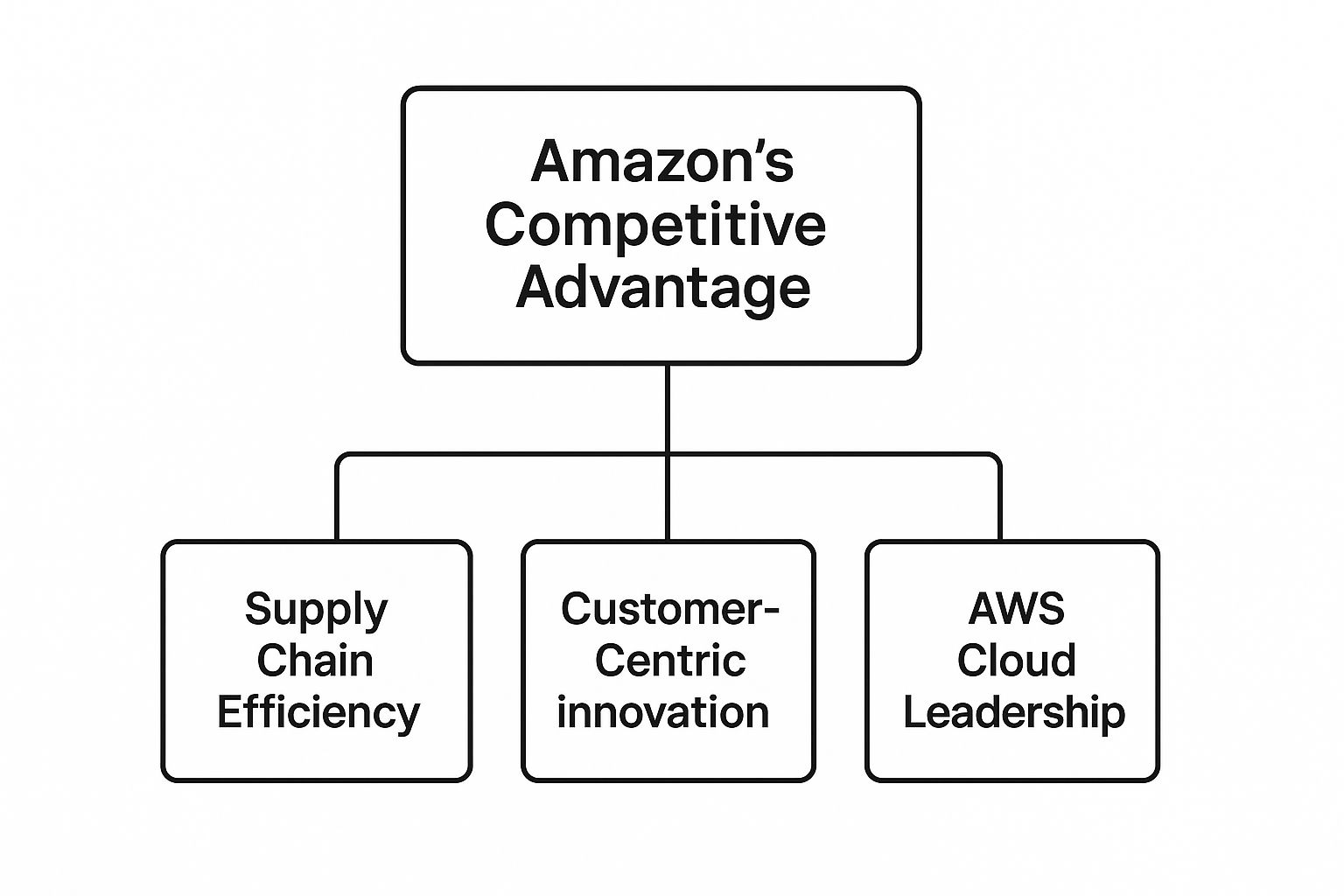
Looking at it this way, you can see that Amazon's market dominance is no accident—it's the result of a deliberate, multi-layered plan. This is especially true for the massive ecosystem of third-party sellers, which you can learn more about in our guide to launching an Amazon private label brand.
The Unbeatable Power of a Network Effect

At the very core of Amazon’s empire lies its most powerful weapon: the network effect. It’s a beautifully simple concept. Imagine a small town market. As more shoppers show up, more vendors are eager to set up a stall. The wider variety of stalls then attracts even more shoppers.
This is precisely how Amazon's marketplace works. It’s a self-feeding loop where every new person who joins—whether they're buying or selling—makes the whole platform more valuable for everyone else. It creates a kind of gravitational pull that’s incredibly hard for any competitor to escape.
Once that cycle really gets going, it builds a massive wall around the business. A newcomer would have to somehow convince millions of buyers and sellers to join their platform at the exact same time just to be in the same ballpark.
The Two Sides of Amazon's Marketplace
Amazon is a master at nurturing both sides of its marketplace, keeping this growth engine humming. One side can't exist without the other; they're locked in a powerful, continuous cycle.
- The Buyer Side: Millions of us flock to Amazon because we know we’ll find almost anything, usually at a good price, with lightning-fast shipping. Our presence is the bait that attracts the sellers.
- The Seller Side: A colossal number of third-party sellers set up shop on Amazon to get in front of that massive, ready-to-buy audience. They bring an incredible depth of products, which fuels the selection and competitive pricing we love.
This isn’t just a smart business model; it's the foundation of the competitive advantage of amazon. The scale is just mind-boggling. As of mid-2025, Amazon has over 310 million active users across the globe, with around 9.7 million registered sellers all vying for their business. What’s really telling is that third-party sellers now account for over 60% of Amazon’s gross merchandise sales. This stat, which you can dig into further in this in-depth statistical report on SalesDuo.com, proves just how crucial the marketplace is.
This perfect partnership creates a serious lock-in effect. Buyers stick around for the unmatched selection, and sellers stay because that’s where all the customers are.
How Trust Fuels the Flywheel
A huge network is one thing, but Amazon strengthens it with an element that’s just as vital: trust. We feel safe clicking "Buy Now" because the platform has systems in place that make the whole process feel less risky.
Just think about the review system. When a product has thousands of positive reviews, it gives us the social proof we need to feel good about our purchase. This trust is the grease that keeps the wheels turning, especially for items sold by sellers we've never heard of.
Key Insight: Amazon's network isn't just about size. It’s built on a foundation of trust created through transparent reviews, the reliable A-to-z Guarantee, and fulfillment services that just work.
This trust machine is a massive perk for third-party sellers. A brand-new business can instantly borrow Amazon's credibility, gaining a foothold much faster than they ever could on their own website.
This multi-layered approach makes Amazon’s network incredibly tough to beat. It’s not just about having the most people; it's about creating a place where those people feel confident enough to do business with each other.
The Irresistible Pull of a Mature Network
As a network like Amazon's grows, its advantages start to compound, creating what experts call a "deep moat" around the business. It becomes outrageously expensive and complicated for anyone else to even think about building a similar one.
Here’s a look at how that value snowballs:
- More Data: Every single search, click, and purchase feeds Amazon’s data machine. They use this information to sharpen their recommendation engine, personalize our shopping experience, and make their logistics even more efficient.
- Increased Efficiency: Selling more stuff allows Amazon to strike better deals with suppliers and fine-tune its fulfillment centers, which drives down its operating costs.
- Better Prices: A portion of those savings gets passed on to us as lower prices, which in turn pulls even more buyers onto the platform.
This cycle—more users, more data, better service, lower prices—is the network effect in action. It's an e-commerce perpetual motion machine that keeps widening the gap between Amazon and everyone else. The lesson for other brands is clear: start building your own community, no matter how small.
How Global Logistics Became a Strategic Weapon

While a powerful network effect draws people in, it's Amazon's mastery of the physical world that truly keeps them hooked. They didn't just stumble into this; they spent decades and billions of dollars transforming logistics from a boring business cost into a razor-sharp competitive weapon.
Most retailers see shipping as the final, mundane step in a sale. For Amazon, it’s a central part of the experience—a key driver of customer loyalty. By meticulously building a global nervous system of fulfillment centers, delivery fleets, and sorting hubs, they control the entire journey from their warehouse shelf straight to your front door.
This level of control has completely changed our expectations as shoppers. Waiting a week for an online order now feels like a relic from a bygone era. Fast, reliable, and often free shipping is the new normal, and Amazon set that standard.
The Fulfillment by Amazon (FBA) Masterstroke
At the very core of this logistical dominance is the Fulfillment by Amazon (FBA) program. It's a brilliant piece of strategy that helps everyone involved while simultaneously tightening Amazon’s grip on the entire e-commerce world.
For third-party sellers, FBA is a total game-changer.
Instead of drowning in the complexities of warehousing, packing, and shipping, sellers can just send their inventory to an Amazon fulfillment center. From there, Amazon handles everything—picking, packing, shipping, and even customer service and returns.
This single move empowers small businesses to offer world-class logistics without needing millions in capital. Suddenly, a one-person brand can provide the same delivery speed as a massive corporation, instantly leveling the playing field. It's no surprise that over 80% of sellers on Amazon use FBA; it’s a critical edge that slashes delivery times and costs.
Of course, this isn't just charity. FBA is incredibly valuable for Amazon, too:
- Massive Selection: By making it easy for sellers to join, FBA ensures the marketplace is flooded with a vast array of Prime-eligible products.
- A Sticky Ecosystem: Once a seller's inventory is sitting in Amazon's warehouses and their operations are built around FBA, it becomes very difficult for them to leave.
- New Revenue Streams: Amazon earns fees for storage, fulfillment, and other services, creating a huge and reliable income stream.
Building an Unbeatable Operational Moat
The sheer scale of Amazon's logistics network has created an economic moat that competitors find almost impossible to cross. Just imagine trying to build a comparable infrastructure from scratch—it would require staggering amounts of capital and years of grueling operational work.
And Amazon isn't standing still. They are constantly investing to stay ahead, with average total compensation for their US fulfillment employees now topping $29 per hour as part of a massive push for operational excellence.
The Real Advantage: Amazon’s logistics network isn't just about moving boxes. It's a data-rich system that predicts demand, optimizes inventory placement, and routes packages with incredible efficiency, ultimately lowering costs and improving speed.
This relentless focus on efficiency is a masterclass in operations. They are always looking for ways to lower expenses. For any brand hoping to build a similar advantage, understanding various strategies for reducing production costs is a great first step toward building a more competitive supply chain.
By owning the "last mile" of delivery, Amazon also controls the final, critical touchpoint with the customer. This reinforces their brand and allows them to gather invaluable data with every single delivery. To see how this data translates into a powerful sales advantage, you can explore our guide on https://coral.ax/blog/brand-analytics-amazon. In the end, this operational dominance isn't just a side project; it's a core reason for Amazon's market power, turning a logistical nightmare into a source of unbreakable customer loyalty.
Turning Data Into a Personal Shopping Experience
If Amazon's logistics network is its body, then its data is the brain. The company has masterfully turned customer information into one of its most powerful competitive weapons, creating a shopping experience that feels incredibly personal, even at its enormous scale.
It's like having a personal shopper who remembers every single thing you’ve ever looked at or bought. Every click, search, and purchase gives Amazon another clue to anticipate what you might need next, sometimes even before you do.
This is the real magic behind the competitive advantage of amazon. They’ve managed to make a massive, faceless marketplace feel like it was designed specifically for you. That deep level of personalization builds a genuine connection and keeps shoppers coming back for more.
The Recommendation Engine: Amazon’s Ultimate Salesperson
The most obvious place you see this in action is with Amazon's famous recommendation engine. Those "Customers who bought this also bought" and "Frequently bought together" sections aren't just lucky guesses. They're the product of sophisticated algorithms crunching vast amounts of shopping data.
This engine is a sales powerhouse. It does more than just upsell you; it introduces you to things you didn't even know you wanted, making product discovery feel effortless and often surprisingly helpful. It's essentially the digital version of a great store clerk who knows your style inside and out.
By analyzing buying patterns, for example, Amazon can group items that people often purchase at the same time. This not only increases the average order value but also makes the shopping trip more convenient for you.
The Core Principle: Amazon's primary goal is to make buying as easy as possible. By showing you the right products at the right moment, it cuts down the time it takes to find what you need and converts casual browsing into sales with stunning efficiency.
It’s More Than Just Showing You Products
Amazon's use of data doesn't stop at the homepage. The insights they gather from user behavior influence major business decisions across the entire organization, creating a flywheel of constant improvement.
This data-fueled feedback loop impacts almost everything they do:
- Smarter Inventory: By looking at regional search trends and buying habits, Amazon can predict what people will want to buy with uncanny accuracy. This means they can stock the right products in the right warehouses, which leads to faster shipping and fewer "out of stock" notices.
- Creating New Products: When Amazon sees that thousands of people are searching for something that doesn't exist, it's basically a free product idea. This is how many of their own private-label brands, like Amazon Essentials, decide what to make next.
- Targeted Marketing: The emails you get from Amazon aren't random. They're built around your browsing history, wish lists, and past purchases to ensure you only see things you're actually likely to be interested in.
This all-encompassing approach creates a powerful, self-improving system. Better personalization drives more sales, which generates more data, which in turn leads to even better personalization.
Personalization Makes the Platform "Sticky"
When it's all said and done, this relentless fine-tuning makes shopping on Amazon an incredibly "sticky" habit. When a platform consistently shows you things you actually want, it saves you time and brainpower. Over time, that convenience becomes a powerful habit that competitors find nearly impossible to break.
Why would you start from scratch on another site when Amazon already has a curated list of suggestions waiting for you? To learn more about how this works, you can dig into advanced personalization techniques in marketing that are becoming standard practice.
The lesson for other brands is clear. You don't need Amazon's resources to start using data more intelligently. Simply by paying closer attention to what your customers do and using those insights to shape your messaging and product offerings, you can start building that same kind of loyalty and connection—one personalized interaction at a time.
Building an Unbreakable Bond with Prime
Amazon Prime started with a simple, brilliant idea: get rid of the pain of shipping costs. We’ve all been there—you fill your cart, head to checkout, and then hesitate when you see that extra fee. Prime was Amazon’s answer.
But the real magic isn’t just about free two-day shipping. It's how Amazon transformed a delivery perk into an all-encompassing membership that customers can't imagine living without. Prime isn’t just a service; it's an exclusive club that weaves itself into your daily life. Canceling feels like a genuine step down, which is the cornerstone of the competitive advantage of amazon.
More Than Just a Membership
Amazon figured out early on that true loyalty isn't built on a single transaction. It’s about creating an entire ecosystem. They bundled a whole suite of services into Prime, making the membership valuable for far more than just shopping.
This strategy keeps you connected to the Amazon brand constantly, whether you're shopping, watching a movie, or listening to music.
- Prime Video: Suddenly, your Prime membership gives you a massive library of movies and TV shows. It competes head-to-head with other streaming giants and gives you a reason to open an Amazon app every single day.
- Prime Music: Need a playlist for your workout? Access to millions of songs keeps you inside the Amazon world for your audio needs, too.
- Prime Reading: For book lovers, a rotating library of free ebooks and magazines is another fantastic perk that adds value.
- Exclusive Deals: Events like Prime Day aren't just sales; they create a feeling of exclusivity and reward you for being a member.
By packaging all of this together, Amazon makes the annual fee feel like an absolute steal. You might join for the fast shipping, but you stay for the streaming. This creates a powerful "lock-in" effect that makes you far less likely to even bother looking at other online stores.
Fueling the Innovation Engine
Think about the subscription fees from millions of Prime members. That creates a steady, predictable stream of cash that acts as Amazon's innovation fund. It gives them the financial stability to make massive, long-term bets that smaller competitors with tighter margins could never dream of.
This reliable income allows Amazon to keep adding more perks and benefits to Prime, making it even harder to leave. More value attracts more members, which generates more revenue to fund the next big thing. It's a self-feeding loop of growth that puts more and more distance between Amazon and everyone else.
The Prime Flywheel: The annual fees from millions of members provide the capital for Amazon to improve its services and add new benefits, which in turn attracts more members and deepens the loyalty of existing ones.
Trying to copy this model is a monumental task. You wouldn't just need to match Amazon's incredible logistics for fast shipping; you'd also have to build or buy entire entertainment platforms to offer anything close to the same value.
The Power of a Locked-In Customer Base
The Prime ecosystem does something amazing: it completely changes how its members shop. Prime subscribers spend a lot more on Amazon than non-members do, and they're not nearly as sensitive to price. Once that annual fee is paid, the mental barrier to clicking "Buy Now" is practically gone.
This creates an incredibly loyal and predictable customer base. Amazon Prime has become a global force, with its subscriber count expected to blow past 240 million by mid-2025. This membership is a sales juggernaut—just look at Prime Day 2024, when Amazon raked in $14.2 billion in U.S. sales alone, an 11.8% jump from the year before. You can read the full report on Amazon trends at Webinterpret.com to see just how massive this has become.
At the end of the day, Prime is the glue that holds all of Amazon's advantages together. It supercharges the network effect with a dedicated army of buyers, makes the logistics network more valuable with its promise of speed, and feeds the data machine with a constant flow of information from its most engaged users. It's the gold standard for building a truly unbreakable bond with your customers.
Applying Amazon's Lessons to Your Business
Looking at Amazon’s massive competitive advantages can feel a little intimidating. It’s like studying a distant star—impressive, but how do you actually reach it? The good news is, you don't have to. The goal isn't to build a clone of the retail giant. It’s about adapting its core principles to carve out your own defensible niche.
You don’t need a global logistics empire to deliver an amazing customer experience. The real takeaway here is to understand the thinking behind Amazon's strategies and apply it to your own business. It's about building your own powerful flywheel, just on a different scale.
Cultivate Your Own Mini Network Effect
Amazon’s marketplace thrives on a massive network effect, but that same magic can work wonders within a focused community. Instead of trying to be everything to everyone, concentrate on creating a go-to spot for a specific group of passionate customers.
- Build a Community Hub: Give your customers a place to connect with each other and with you. This could be a private social media group, a dedicated forum, or even an exclusive Discord server. It builds loyalty that goes way beyond just the next transaction.
- Encourage User-Generated Content: Let your customers do the talking. Feature their reviews, photos, and stories front and center. This kind of social proof builds a ton of trust and helps new buyers feel confident hitting that "add to cart" button, just like Amazon’s review system does.
- Reward Advocacy: Why not turn your biggest fans into your best marketers? An affiliate program is perfect for this, letting you reward people who bring new customers into your world. You can learn more about how to get a system like this up and running by reading up on how to start an Amazon affiliate program with the right software.
This creates a powerful loop. Your engaged customers attract more people just like them, making your brand’s gravitational pull stronger and stronger within your niche.
Forge Relationships Through Data and Personalization
Okay, so you might not have Amazon's mountains of data, but you absolutely have enough to create a deeply personal experience for your customers. The trick is using the information you do have to show them you're paying attention and that you value their business.
Start by collecting meaningful data—things like purchase history and customer preferences. Then, use that info to segment your audience and customize your communication. Even something as simple as a personalized thank-you email after an order or a product recommendation based on what they bought last time can make a huge difference.
The lesson from Amazon is clear: data's true value lies in its ability to make customers feel seen and understood. A personalized touch builds loyalty that price matching can never defeat.
Design an Unforgettable Brand Experience
Finally, think beyond just the product. Amazon wins on price and sheer convenience, but smaller brands can win on creating a unique, memorable experience that builds a real emotional connection. This is your chance to offer something Amazon simply can’t.
This could be anything from exceptional, human-to-human customer service to beautiful, sustainable packaging that makes unboxing a joy. It could also be exclusive content that genuinely adds value to your customers' lives. To free up your team for these high-touch activities, it's smart to look into small business automation tools that drive competitive advantage and handle the routine stuff for you.
By focusing on these three pillars—community, personalization, and experience—you can take the best pages from Amazon's playbook to build a business that isn't just competitive, but truly resilient.
Got Questions? We’ve Got Answers.
Here are a few quick answers to some of the most common questions people have about Amazon's dominance.
What Is Amazon's Single Greatest Competitive Advantage?
So many people point to Prime or its massive warehouses, but the real secret is Amazon's self-reinforcing business model. It's less of a single advantage and more of a powerful, interconnected loop—a flywheel.
Imagine a wheel where each part pushes the next. More sellers join, creating a massive selection. That huge selection pulls in more buyers. More buyers mean more sales, which lets Amazon pour money into faster logistics. Faster, cheaper shipping makes customers happier, locking them in with Prime. It's a cycle that feeds itself, and it's incredibly difficult for anyone to copy from a standstill.
How Does Amazon Web Services Contribute to Its Success?
Amazon Web Services (AWS) is the company’s cloud computing arm, but it’s also the financial powerhouse funding the entire retail empire. While most people see AWS and the online store as separate businesses, they're deeply connected. AWS is wildly profitable, generating a tidal wave of cash.
Amazon then uses that cash to fuel its e-commerce growth. This funding allows them to:
- Take losses on the retail side to crush competitors on price.
- Bankroll huge projects, like building out their one-day delivery network.
- Bet on long-shot ideas that don't need to pay off right away.
In short, AWS gives the retail business the freedom to focus purely on growth and customer obsession, not short-term profits. That's a luxury almost no other retailer has.
The bottom line: AWS is the high-margin engine that allows Amazon’s low-margin retail business to run full throttle, prioritizing market share over everything else.
Can Small Businesses Still Succeed on Amazon?
Yes, absolutely. It’s a crowded playground, but small businesses can do more than just survive—they can thrive. Think about it: Amazon gives you instant access to a global audience of eager buyers, something that would cost a fortune and take years to build on your own.
The key is to find your niche and own it. Use tools like Fulfillment by Amazon (FBA) to offer the same lightning-fast shipping that customers expect. If you focus on creating fantastic product pages, providing top-notch customer service, and building a real brand within the Amazon ecosystem, you can carve out a very profitable space for yourself.
Ready to build a loyal network of advocates, just like Amazon did? With Coral, you can find, manage, and track creators and influencers who genuinely love your brand and want to drive sales. Start your own affiliate program today and turn your biggest fans into your best marketing channel.