How to Do Amazon Affiliate Marketing: The Complete Guide for Success
Category: How to do amazon affiliate marketing
Amazon affiliate marketing is a powerful way to monetize your content. The concept is simple: you sign up for the Amazon Associates program, share special affiliate links to products, and earn a commission every time someone clicks your link and makes a purchase. It's all about recommending products you trust and getting rewarded when your recommendation leads to a sale.
Your Launchpad for Amazon Affiliate Success
Getting into Amazon affiliate marketing can feel like unlocking a whole new way to run an online business. But it's not about just slapping links everywhere and hoping for the best. Success comes from a smart strategy that connects your audience with products they’ll actually find useful. Right from the get-go, you need to get your head around a few core ideas: commission rates, tracking IDs, and Amazon’s very strict rules.
This isn’t a shortcut to getting rich overnight. Real success means building a business that lasts—one founded on trust and genuine value. I've seen so many beginners get tangled up in Amazon's complicated dashboard or make rookie mistakes that cost them their earnings. Going it alone means facing a steep learning curve, but this is exactly where having the right tools in your corner makes all the difference and accelerates your path to profit.
Understanding the Earning Potential
How much you can make is directly linked to the kinds of products you promote. Amazon has different commission rates for different product categories, which makes choosing your niche a huge decision. A blog with tons of visitors looking at low-commission electronics might actually make less than a smaller, more focused site that promotes products with higher commission rates.
Take a look at this breakdown of the commission rates for some popular categories.
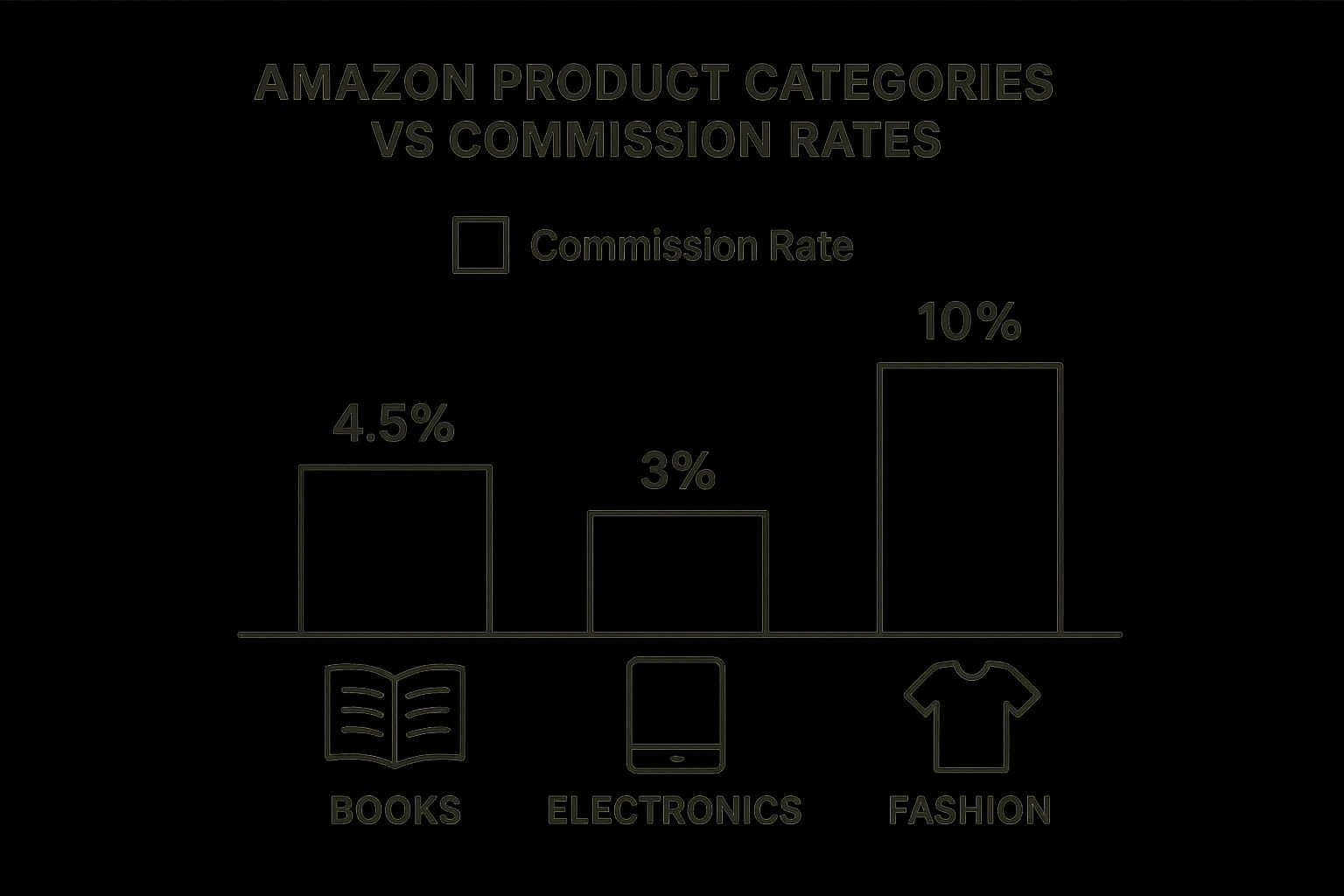
As you can see, things like Luxury Beauty and Amazon Fashion pay out much better than, say, Video Games. That's definitely something to think about when you're planning your content.
Building a Strong Foundation
Your number one priority from day one should be building a solid foundation that follows all of Amazon's rules. This is a massive tripwire for new affiliates. It's surprisingly easy to accidentally break one of the many policies in their operating agreement. Instead of trying to figure it all out on your own, a platform like Coral can walk you through the setup process, making sure you start off on the right foot and avoid the common mistakes that get new accounts shut down.
To really get things off the ground, it helps to have a good grasp of some basic digital marketing fundamentals. Understanding how to engage an audience online is key.
The opportunity here is enormous. Amazon Associates is the biggest affiliate network out there, holding about 46.21% of the entire industry's market share. And with the affiliate market expected to hit $31.7 billion by 2031, it’s clear there's huge potential for anyone who builds their business the right way.
Starting your Amazon affiliate journey can be done the old-fashioned way, or you can get a serious head start with a tool like Coral. Here’s a quick look at how the two approaches stack up.
Manual Method vs Coral-Powered Approach
| Key Task | Traditional (Manual) Path | Accelerated (Coral) Path |
|---|---|---|
| Account Setup | Navigating Amazon's complex forms and waiting for approval. | Guided, step-by-step setup with best practices built-in. |
| Product Research | Manually searching Amazon for products that fit your niche. | AI-driven product recommendations based on your content. |
| Link Creation | Using Amazon's SiteStripe tool, one link at a time. | Instantly generate multiple affiliate links for your content. |
| Compliance | Reading dense legal documents to avoid breaking rules. | Automated compliance checks and alerts to keep you safe. |
| Performance Tracking | Sifting through Amazon's reports to find useful data. | A clear, simple dashboard showing what's working and what's not. |
Ultimately, the traditional path involves a lot of trial and error. Using a dedicated platform just removes a lot of that guesswork and lets you focus on creating great content.
Key Takeaway: Going it alone means you're in for a steep learning curve with some serious risks. Using a platform like Coral from the start is essential for success. It fast-tracks your progress by giving you the structure, insights, and safety nets you need to build a profitable and sustainable Amazon affiliate business, helping you achieve better results, faster.
Building Your Affiliate Platform and Niche
First things first: before you can start earning commissions, your content needs a home. This is your digital storefront, the place where you’ll build an audience and share those all-important Amazon affiliate links. This could be anything from a blog to a YouTube channel or even a really active social media profile.

A lot of beginners, myself included, lean towards starting a blog. Why? It gives you total ownership and becomes a powerful asset over the long haul. If you go this route, picking the best website builder for affiliate marketing right from the get-go can make a huge difference. A solid website doesn't just look professional; it lays the foundation for better search engine rankings later on.
Choosing Your Profitable Niche
Your niche is the specific topic you're going to build your entire site around. Honestly, getting this right is probably the most crucial part of succeeding with Amazon's affiliate program. If you go too broad, you’ll get lost in the noise. Go too narrow, and you might run out of products to talk about.
The sweet spot is where your personal interests meet commercial potential. You've got to find a topic you actually enjoy—enough to write about it week after week—that also has an audience ready to pull out their wallets. This research phase is where a lot of newcomers get stuck. It can be exhausting.
I've seen people get paralyzed for weeks trying to find the "perfect" niche. Instead of endless manual research, you can use tools to speed this up. Coral's Niche Finder, for example, is built to find low-competition niches with high earning potential. It takes the guesswork out of the equation and saves a ton of time.
This shortcut lets you jump straight to the fun part: creating content. You can get a deeper dive on this in our guide to choosing an Amazon affiliate marketing platform.
Navigating the Amazon Associates Setup
Alright, you’ve got your niche and platform sorted. Now it's time to create your Amazon Associates account. The process is pretty straightforward: you'll fill out your website details, give them a rundown of your content plan, and agree to their pretty lengthy Operating Agreement.
But don't take it lightly. Amazon has some strict rules. You need an active website, YouTube channel, or social media page with original content already on it. Messing this up can get your application rejected or, worse, your account shut down after you've already started making money.
A few quick tips from experience:
- Be Accurate: Double-check that all your website and personal info is spot-on.
- Be Transparent: Be clear about how you plan to get visitors and promote products. No fluff.
- Be Patient: Approval isn't always instant, so give it some time.
Trying to map out all your future content by hand can feel like a mountain of a task. This is exactly where a tool like Coral’s Content Planner really shines. It helps you lay out a content strategy designed to pull in visitors who are ready to buy from day one, giving you a clear roadmap so you're creating content that actually converts.
Finding Products and Creating Better Affiliate Links
Connecting your audience with the right products is the very heart of your affiliate business. Success isn't about just pushing the most expensive items; it's about recommending things that genuinely solve a problem for your readers. This is where the real skill of product selection comes in.

The best products to promote usually have a few things in common: high customer ratings, decent commission rates, and a perfect fit with your content. But let's be honest, manually digging through Amazon to find these gems can be a massive time sink. This is a huge trap for new affiliates, who end up spending way more time on research than on creating the content that actually makes them money.
Streamlining Your Product Research
Instead of getting lost in a rabbit hole of endless product pages, you need a more focused way to find what works. A tool like Coral's Product Research feature was built for this exact problem. It helps you quickly pinpoint top-sellers and high-potential items in your niche, cutting out the guesswork and the dreaded analysis paralysis.
Say you’re writing a post about brewing coffee at home. You could spend hours manually searching for brewers, grinders, and scales. Or, you could let a tool surface the best-rated products with the strongest sales history, freeing you up to focus on writing a killer article. That kind of efficiency is what separates the pros from the hobbyists.
Mastering Affiliate Link Creation
Once you've picked your products, you have to create the affiliate links that will actually earn you commissions. Amazon gives you a tool called SiteStripe, which lets you generate links right from any product page. It's pretty straightforward and offers a few options:
- Text Links: These are your bread and butter—simple, versatile links you can weave right into your sentences. They often convert the best when used naturally.
- Image Links: Using the product image as a clickable link is great for visual appeal, especially in "best of" roundups or product galleries.
- Text + Image: This is a combined box with the image and some product details. It's perfect for sidebars or dedicated product feature sections.
Creating links one-by-one with SiteStripe is fine when you're starting out. But it quickly becomes a major bottleneck when you're writing long-form content or managing dozens of posts. It’s also surprisingly easy to forget to track a link properly or use the wrong format, which means lost commissions. That’s a painful mistake, and it's totally avoidable. We dig into the nitty-gritty of this in our guide on how to generate an Amazon affiliate link.
The biggest challenge for new affiliates isn't finding one product. It's efficiently finding dozens and creating compliant, trackable links for all of them without making costly mistakes. A single bad link can mean you get zero credit for a sale you generated.
This is exactly why moving beyond manual methods is a non-negotiable step if you want to grow. A tool like Coral’s Link Generation simplifies the entire process. You can create multiple compliant, perfectly tracked links in seconds, all from one place. This doesn’t just speed up your workflow; it acts as a safety net, making sure every single click is attributed correctly so you never miss out on a commission you've earned.
Crafting Content That Actually Converts
Just throwing a bunch of affiliate links on your site and hoping for the best isn't a strategy. It’s just noise. If you want to get good at Amazon affiliate marketing, you have to create genuinely helpful content that makes your readers feel confident about their purchase. Think of yourself as a trusted guide, not a pushy salesperson.
The content that really works is the kind that solves a problem or answers a specific question for your audience. It's the difference between a random list of products and a detailed, hands-on review that shares what you actually thought—the good, the bad, and the ugly. When you help someone make a smart decision, they'll trust your recommendations and be far more likely to click your links.
Mastering High-Converting Content Formats
I’ve learned over the years that certain types of articles just work better for affiliate sales. They naturally attract people who are already in a buying mindset. If you focus your energy on these formats, you’ll see results much faster.
Here are a few that have never let me down:
- Detailed Product Reviews: Don't just rehash the product description. Get your hands on the product. Talk about your experience using it, point out the features that surprised you, and don't be afraid to mention the drawbacks. That kind of honesty is what builds real trust.
- Insightful Comparison Posts: Take two or three popular products and put them head-to-head. A detailed breakdown of features, price, and real-world performance helps people decide which one is truly the right fit for them.
- 'Best Of' Roundups: A curated list like "The Best Espresso Machines Under $200" is gold for shoppers. You're doing the heavy lifting for them by sorting through all the options and presenting the top contenders.
Now, writing these from scratch is a massive time-sink, especially when you're starting out. This is where a tool like Coral’s Content Templates can be a game-changer. They give you a proven structure for these exact formats, showing you where to place links and how to frame your arguments. It can seriously slash your writing time.
Weaving in Links and Disclosures Naturally
How you place your links is just as important as the content itself. Don't just drop them in randomly. Weave them into the text where they feel like a natural next step. For example, when you're talking about your top pick in a roundup, that's the perfect time to link it.
Quick but crucial tip: Transparency is everything. Amazon's rules require you to have a clear disclosure statement. Something simple like, "As an Amazon Associate, I earn from qualifying purchases," placed near the top of your post is all you need to stay compliant and keep your audience's trust.
This whole process is about building a real, sustainable business. It's a growing field—by 2025, an estimated 81% of brands will be using affiliate marketing. Blogs are still a huge piece of that puzzle, accounting for nearly 28% of the affiliate action. You can dig into more stats about the growth of affiliate marketing on affiliatestatistics.marketing.
Creating content that earns money for years is hard work, but you don't have to guess what works. Platforms like Coral offer more than just templates; their optimization suggestions help you build SEO best practices right into your articles. This is how you make sure your hard work actually gets seen in search results, bringing in visitors who are ready to buy and turning your content into a long-term asset.
How to Track, Optimize, and Scale Your Earnings
Making that first commission is a fantastic feeling. But the real challenge? Turning those first few dollars into a consistent, reliable income stream. This is where you shift from just dabbling in affiliate marketing to actually building a business. From here on out, growth is all about making smart decisions based on data, and this is where optimization and scaling techniques come into play.

Your first stop should be Amazon’s own Associates reporting dashboard. Get comfortable in here, because it's where you'll find the basic truth about what's working and what's falling flat.
To start, keep an eye on a few core numbers:
- Clicks: This one’s simple—how many people are actually clicking your links? It’s a great measure of whether your content is grabbing attention and prompting action.
- Conversion Rate: This is the percentage of clicks that turn into a sale. A high conversion rate is a beautiful thing; it means you're recommending the right stuff to the right people.
- Earnings Per Click (EPC): This metric boils it all down to a single number: how much you make, on average, every time someone clicks a link. It’s a powerful gauge of your overall profitability.
From Data to Decisions
Once you have this data, you can start connecting the dots. Let's say you see a product review getting tons of clicks but a dismal conversion rate. That's a huge red flag. It could mean your content is setting the wrong expectations, or maybe the product itself just isn't that great (check its Amazon reviews).
On the flip side, a post with a high conversion rate is pure gold. That’s your signal to create more content around that product or other similar items your audience clearly loves. This is the core loop of optimization: track, analyze, and act.
It's also worth remembering that the affiliate world is massive and diverse. North America alone accounts for 40-45% of the industry's revenue. Knowing these affiliate marketing industry trends can help you understand where you fit in and what strategies might work best for your specific audience.
Manually digging through reports is a good starting point, but it's slow. It often feels like you’re driving by looking only in the rearview mirror. To really scale up, you have to get proactive.
Accelerating Growth with Advanced Analytics
Amazon's reports are useful, but they only tell you what happened, not why. For affiliates who are serious about growing their income, this is where a dedicated platform like Coral becomes an essential part of your scaling strategy.
Instead of you having to manually hunt for insights, Coral’s dashboard does the heavy lifting. It automatically points out your top-performing products, flags content that’s underperforming, and gives you clear, actionable steps to boost your revenue.
Think of it as the difference between using a paper map and a GPS that gives you turn-by-turn directions to your destination. Coral can show you exactly which pages are your biggest money-makers, so you can double down on what’s already working. It turns confusing data into a clear roadmap for scaling your business.
For an even deeper dive, you can explore tactics like using Amazon Attribution. We walk through how to set that up in our dedicated guide to tracking external traffic. This level of insight lets you make profitable decisions much faster and with more confidence than trying to figure it all out on your own.
Common Questions About Amazon Affiliate Marketing
Diving into Amazon affiliate marketing is an exciting move, but let's be honest, it brings up a lot of questions. Getting straight answers early on is key to building momentum and avoiding the usual roadblocks. Here, I'm going to tackle the most common questions I hear from people just starting out.
Knowing the answers to these questions is a big part of figuring out how to do Amazon affiliate marketing the right way. Once you have this clarity, you can stop second-guessing and start focusing your energy on the things that actually make you money. Let’s get into it.
How Much Can You Realistically Earn?
This is always the first question, and the real answer is: it depends. A brand-new site might make a few bucks in its first month. On the other hand, an established site in a great niche can easily pull in thousands. There’s no secret number—your income is a direct reflection of your traffic, the niche you choose, and how well you can convert visitors into buyers.
A few things really dictate your earning potential:
- Niche Profitability: You’ll naturally make more per sale promoting high-commission items, like luxury beauty products, compared to low-commission categories like video games.
- Audience Size and Engagement: More traffic is good, but targeted, engaged traffic is where the money is.
- Content Quality: Your ability to write helpful, trustworthy content that actually solves a problem for your reader is everything.
This is where being strategic from the start really pays off. If you go it alone, you’ll learn a lot through trial and error, which can get expensive and frustrating. Using a platform like Coral, however, helps you zero in on the right products and conversion tactics from day one, which can seriously speed up your timeline to earning a solid income. For a more detailed look, our guide on how to start an Amazon affiliate business is a fantastic starting point.
What Are the Biggest Mistakes to Avoid?
I see so many new affiliates make the same handful of mistakes. Just knowing what they are is half the battle. One of the biggest is picking a niche just because you think it will be profitable, even if you have zero interest in it. This is a fast track to burnout and creating boring content that no one wants to read.
Another huge one is not following Amazon's rules. Forgetting to put an affiliate disclosure on your site or trying to hide your links can get your account shut down before you even get started. It happens all the time. Finally, a lot of beginners just don't track anything, so they have no idea what's working and what's a waste of time.
A guided system is your best defense against these common business-ending mistakes. Coral, for example, helps you stay on track with built-in compliance checklists, error-free link generation, and analytics that are simple to understand.
Simply sidestepping these traps puts you way ahead of the game and sets you up for long-term success. For more practical advice on this, check out our top affiliate marketing tips to sharpen your approach.
Ready to skip the steep learning curve and build your Amazon affiliate business the right way? Coral provides the tools and insights you need to find profitable products, create compliant links, and scale your earnings with data-driven confidence. Start accelerating your growth by visiting https://coral.ax today.