How to Find an Instagram Influencer That Drives Results
Category: How to find an instagram influencer
Before you even think about searching for an influencer, let's get one thing straight. The best, most profitable partnerships aren’t found by endlessly scrolling through your feed. They’re built on a solid foundation. You need to know exactly what you’re trying to accomplish and who your ideal partner is long before you type a single name into the search bar.
Laying the Groundwork for a Winning Partnership
Diving into an influencer search without a plan is a classic mistake. It's like setting off on a road trip with no map—you’ll get somewhere, sure, but probably not where you intended. I’ve seen it time and time again: the most successful campaigns are won before the first outreach email is even drafted.
This initial prep work is what separates a truly impactful collaboration from one that just fizzles out. It's the difference between finding a genuine brand advocate and just paying for a temporary billboard.
Define Your Campaign Goals
First things first: what does a "win" actually look like for your brand? Are you trying to drive sales for a new skincare line? Or is your primary goal to get your brand name known in a new city? The answer will completely change how you approach finding an Instagram influencer.
Your goals might be to:
- Drive Sales: Tying influencer posts directly to product purchases.
- Boost Brand Awareness: Introducing your brand to a fresh, relevant audience.
- Generate Leads: Gathering emails for a newsletter or a special discount.
- Promote an Event: Selling tickets or getting sign-ups for a webinar.
A Quick Tip From Experience: "More engagement" is not a goal; it's a wish. Get specific. A real goal sounds like this: "Increase comments on our brand's posts by 20% this quarter by working with micro-influencers known for their highly engaged communities."
Build Your Ideal Influencer Persona
Once you know your destination, you need to picture your ideal travel companion. Forget about follower counts for a minute and create a detailed profile of the perfect partner. It's just like creating a customer persona, but for an influencer. Think about their content, their personality, and most importantly, their audience.
This is where audience demographics are everything. For example, knowing that 61.3% of Instagram users are aged 18-34 is huge if you're trying to reach Millennials and Gen Z. If that's your crowd, you absolutely need an influencer whose followers match that profile. You can dig deeper into Instagram user data to get even more specific.
Ask yourself these questions:
- Content Vibe: Does their aesthetic—their colors, editing style, and overall feel—match your brand?
- Audience Fit: Do their followers actually line up with your target customers in terms of age, location, and interests?
- Values Alignment: Do they seem like they would genuinely use and believe in a product like yours?
Doing this homework upfront is non-negotiable. It ensures you find collaborators who will feel like a natural fit, leading to partnerships that are authentic, believable, and deliver real results.
Alright, you've got your goals and your ideal influencer profile sketched out. Now for the fun part: the actual hunt. This is where we move from planning to action, diving into Instagram to find the people who will truly connect with your audience.
The best way to do this? A mix of old-school manual searching and the power of modern tools. This two-pronged approach helps you build a solid, well-vetted list of potential partners.
It’s no secret that influencer marketing has exploded. We’re talking about a global industry projected to be worth $32.55 billion. And Instagram is the undisputed king, with its slice of the pie expected to hit over $22 billion by 2025. That’s a massive opportunity, but it also means there are a lot of creators to sift through.
Start With Smart Manual Searches
Before you spend a dime on software, it’s time to roll up your sleeves. Searching directly on Instagram gives you a gut feeling for an influencer’s content, personality, and community—something raw data can never fully capture.
Here are a few ways I like to start my manual searches:
- Dig into Niche Hashtags: Forget generic tags like
#ad. Think like your customer. If you’re a brand selling sustainable yoga wear, you'll find gold by exploring hashtags like#ecoyogalifeor#mindfulmovement. This leads you straight to creators who are already living and breathing your brand’s values. - See Who Your Competitors Are Working With: A little friendly recon never hurts. Check out which influencers your competitors are partnering with. It’s a great way to identify proven creators in your space and benchmark the kind of content that’s already working.
- Use Location, Location, Location: If your business is local, like a new coffee shop in Austin, geotags are your best friend. Searching for posts tagged at popular local haunts can uncover micro-influencers with a strong, genuine connection to your city. For a deeper dive, our guide covers more on https://coral.ax/blog/how-to-find-influencer-on-instagram.
Manually digging around helps you develop an intuition for what works. You start to recognize the difference between genuine engagement and vanity metrics, which is a skill that will serve you well.
Bring in the Big Guns: Influencer Marketing Platforms
Manual searching is fantastic for getting a feel for the landscape, but it can eat up a lot of time. When you need to find more people, faster, influencer marketing platforms are a huge help. These tools let you filter through millions of creators using specific criteria like niche, engagement rate, or even the age and location of their followers.
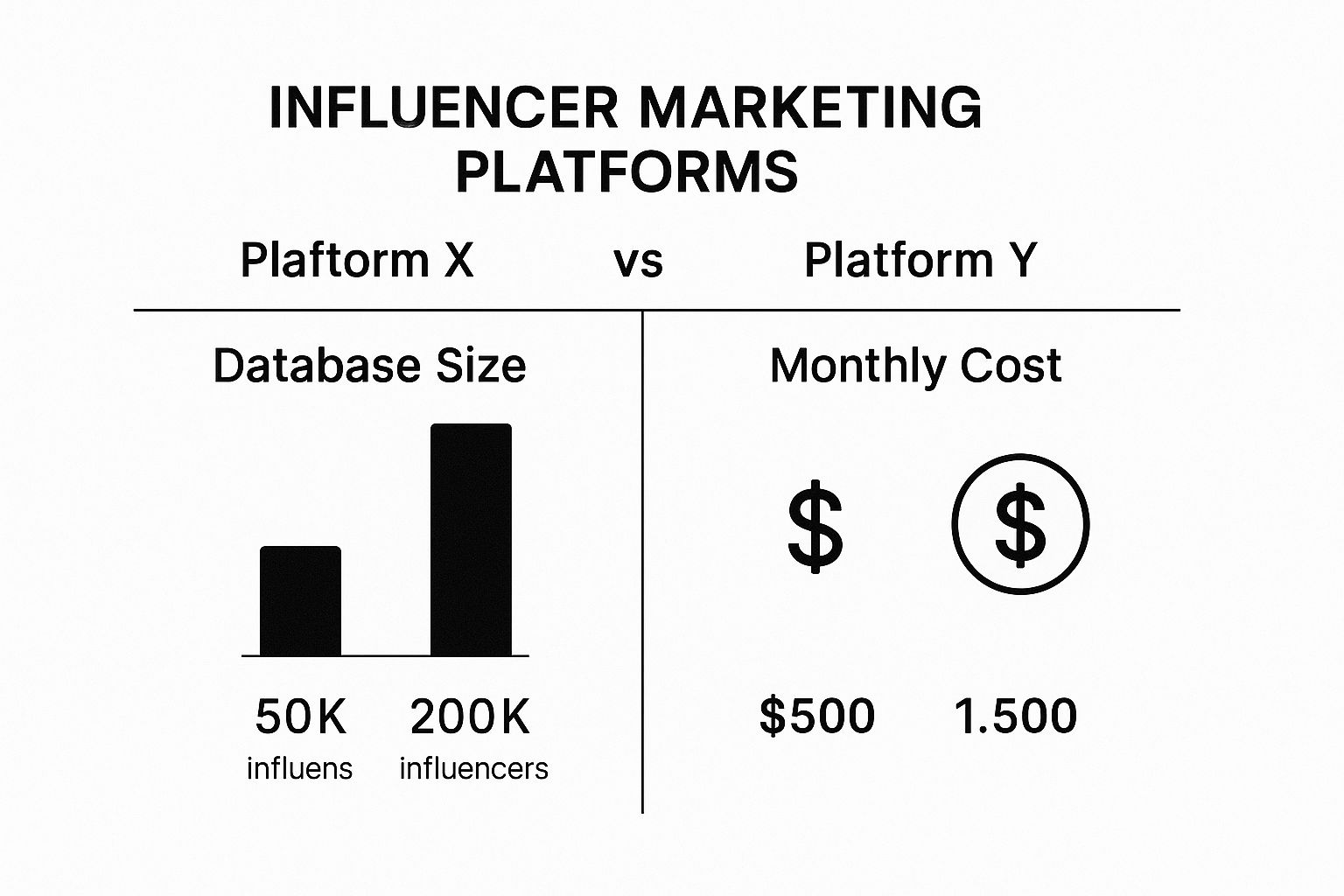
As you can see, platforms vary. Some offer massive databases for a higher price, while others are more focused and budget-friendly. It’s all about balancing what you need with what you can spend.
To help you decide which route to take, here’s a quick breakdown of how these two methods stack up.
Comparing Influencer Search Methods
| Search Method | Pros | Cons | Best For |
|---|---|---|---|
| Manual Searching | Authentic feel for content. Free to start. Uncovers hidden gems. | Time-consuming. Hard to scale. Limited data. | Initial research, finding local influencers, and developing your "eye" for good partners. |
| Influencer Platforms | Fast and efficient. Detailed audience data. Advanced filtering options. | Can be expensive. May feel less personal. Risk of information overload. | Scaling your efforts, finding influencers for specific campaigns, and data-driven decisions. |
Ultimately, there's no single "best" way.
Using a platform can turn hours of scrolling into minutes of targeted searching. But don’t rely on tools alone. To build a truly effective campaign, it’s worth exploring proven strategies on how to find influencers who fit your brand. The most successful brands I’ve seen combine the efficiency of platforms with the authentic insights from manual searching.
Vetting Influencers to Ensure a Perfect Fit
So, you've got a list of promising influencers. Now the real work starts. A profile can look amazing on the surface, but a big follower count doesn't always tell the whole story. This is the stage where you dig in, protect your investment, and make sure you're partnering with someone who can build a real connection for your brand, not just rent you a temporary audience.
It's all about looking past the shiny vanity metrics to see what's really going on with an influencer's community. This is how you find someone who will genuinely deliver for your brand.
Look Beyond the Follower Count
A huge follower count is worthless if the audience isn't real or paying attention. The first thing you absolutely have to do is check for red flags. An influencer with one million followers but only a few hundred likes on their posts? That's a major warning sign.
Here are a few tell-tale signs of fake followers or bot activity:
- A Low Engagement Rate: Healthy engagement—your likes and comments divided by the follower count—usually sits somewhere between 1% and 3%. If it's way lower, you're likely looking at a lot of inactive or fake accounts.
- Generic Comments: Take a scroll through the comments on their posts. Are people having actual conversations, or is it just a wall of fire emojis and one-word replies like "Nice!" or "Great post!"? The latter often points to bots.
- Sudden Spikes in Followers: You can use a third-party analytics tool to look at their follower growth over time. If you see huge, unnatural jumps, it’s a good bet they bought those followers.
An authentic influencer has a community, not just an audience. Their followers trust them, and that trust is built on genuine interaction. Protect your brand by partnering with creators who have earned that trust.
Analyze Their Content and Brand Voice
Remember, your chosen influencer is about to become a voice for your brand. Their content quality, style, and tone have to feel like a natural extension of your own. Scroll back through their feed—I’m talking at least a few months—to get a real feel for their consistency.
Does their visual style match yours? If you have a bright, clean aesthetic, an influencer with a dark, moody feed probably isn't the right fit, no matter how great their stats are. Also, look at what they promote. If it seems like they’re pushing a new, random product every other day, their audience might not find their recommendations very credible.
This same principle applies no matter the platform. For example, when you're looking for partners for other channels, content alignment is just as important, as we cover in our guide on how to find an Amazon influencer: https://coral.ax/blog/how-to-find-amazon-influencer.
Dig Into Their Audience and Past Work
The final, critical piece of the puzzle is making sure their audience is your audience. Don't be shy about asking potential partners for their media kit or a screenshot of their Instagram Insights. This gives you priceless data on their follower demographics, like age, gender, and top locations. If you're a US-based brand, an influencer whose audience is 70% based in Brazil isn't going to move the needle for you.
Looking at their past collaborations will also show you how professional and effective they are. Check out their previous sponsored posts. Did they weave the brand into their content in a way that felt authentic, or did it stick out like a sore thumb? Getting a grip on their past performance is a huge part of picking a winner. In fact, learning how to use analytics to drive real social media growth will give you a serious advantage here.
Crafting Outreach That Actually Gets a Reply
So you've done the hard work of searching and vetting. You have a solid list of potential partners who feel like a perfect fit for your brand. Now for the make-or-break moment: your first message.
This is where so many brands get it wrong. A generic, copy-and-paste email is a one-way ticket to the trash folder. Trust me, top-tier influencers get dozens of those every single day.
Your outreach needs to do more than just ask for a post. The real goal is to start a genuine conversation that could blossom into a long-term, valuable partnership.
Make Your Pitch Personal
This is the golden rule, and it's non-negotiable. You have to show you've actually done your homework. Don't just compliment their follower count; that’s lazy. Reference something specific that proves you understand and genuinely appreciate their work.
For example, skip the bland "I love your feed!" Instead, try something with substance: "Your recent post about the farmers market in Boulder was fantastic. The way you captured the morning light on the produce really stood out." See the difference? One is a template; the other is a real compliment that shows you’re paying attention.
This level of detail is critical. With 93% of marketers now using Instagram for their campaigns, the competition for an influencer's attention is fierce. You have to find a way to stand out. You can learn more about what's working in influencer marketing on PR Newswire.
Create a Clear and Compelling Offer
After you've made that personal connection, it's time to get down to business. Don't beat around the bush. Your initial message should be concise, clear, and lay out exactly what you're proposing and what's in it for them.
Vague offers don't work. Influencers are running a business, and they need to know immediately if an opportunity is worth their time.
Your outreach email should hit these key points:
- Who You Are: A quick, one-sentence intro to your brand.
- What You Love: The specific, personalized compliment you came up with earlier.
- The Ask: State exactly what you're hoping to collaborate on. Is it one in-feed post? A set of five Stories? A Reel? Be specific.
- The Value: What are you offering in return? Be upfront about compensation, whether it’s a flat fee, a free product, a commission, or something else.
Your outreach should feel less like a cold transaction and more like a warm invitation. Frame it as a true partnership. Instead of saying, "We want you to post for us," try something like, "We think your audience would love our product, and we'd be excited to explore how we could work together."
The Art of the Follow-Up
Didn't get a reply right away? Don't panic. Influencers have chaotic inboxes, just like the rest of us. It's completely fine—and often necessary—to send a polite follow-up a week or so later.
Keep it short and friendly. A simple, "Just wanted to bring this back to the top of your inbox and see if this partnership is something you might be interested in" is all you need. If you still don't hear back after a second friendly nudge, it’s probably best to move on.
At its core, great influencer marketing is all about building great relationships. It starts with that first thoughtful message and grows with every interaction. This approach won't just boost your reply rate; it will lay the foundation for authentic, effective collaborations that actually deliver results.
Sidestepping Common Pitfalls in Your Influencer Search
Finding the right Instagram influencer can feel like a game-changer for your brand. But let's be honest, the path is full of potential missteps that can waste your time and money. I've seen brands make the same mistakes over and over, so let's walk through how you can avoid them.
The biggest trap? Getting star-struck by a massive follower count. It’s easy to see a profile with 200,000 followers and think you've hit the jackpot. But that number means next to nothing if the audience isn't paying attention or, even worse, isn't the right fit for what you're selling.
Think about it this way: An influencer with 15,000 die-hard fans in your specific niche will almost always deliver better results than someone with a huge, passive audience. It's about finding real connection, not just broadcasting to a crowd.
Forgetting to Check for a Real Pulse
Another classic mistake is skipping the deep dive into an influencer's audience quality. You get excited about a potential partner and just assume their following is legitimate. Big mistake. This can lead you right into a partnership with someone whose audience is padded with bots and fake accounts.
So, how do you spot the fakes? Start by actually reading the comments. Are people having real conversations, or is it just a wall of fire emojis and generic "Great post!" comments? You can also use an analytics tool to look for suspicious activity, like a sudden, massive jump in followers overnight. That's usually a red flag that they've bought their audience.
A healthy influencer profile is built on a genuine community, not just a number. Their audience trusts them because they've put in the work to build real connections. When you partner with them, you're tapping into that earned trust.
Taking the time to verify this is non-negotiable. It's how you protect your brand and your investment.
Sending Cold, Copy-Paste Outreach
Alright, so you’ve found someone who looks perfect. Now it's time to connect. The quickest way to get your message sent straight to the trash? A generic, copy-and-paste DM. Experienced creators can smell a template from a mile away, and it instantly tells them you haven’t bothered to get to know their work.
Make your first impression count. Your message needs to show you've actually paid attention.
- Mention a specific post you loved. "Your recent Reel about hiking in the Dolomites was incredible!"
- Reference a personal detail they shared. "I saw on your Stories you just adopted a puppy—congrats!"
- Connect their content to your brand. "The way you talk about sustainable living is exactly what our brand is all about."
This small touch shows them you see them as a creative partner, not just a number on your spreadsheet.
Skipping the Handshake Agreement
This one is huge. Never, ever start a collaboration based on a verbal agreement or a casual chat in the DMs. It might feel easier in the moment, but it's a recipe for disaster. This is a business deal, and it needs a formal contract to protect both you and the influencer.
A solid agreement doesn't have to be complicated, but it absolutely must spell out the essentials:
- Deliverables: Exactly what are they creating? (e.g., 1 Instagram Reel, 3 Stories with a link sticker).
- Timeline: Clear deadlines for drafts and go-live dates.
- Compensation: The exact payment, how it will be sent, and when.
- Content Rights: Who owns the content after the campaign? Can you reuse it on your own social channels or in ads?
Dodging these common mistakes will make your entire influencer marketing process smoother and far more effective. You'll build better, more authentic relationships and, ultimately, get the results you're looking for.
Got Questions About Finding Influencers? We've Got Answers.
When you're diving into the world of Instagram partnerships, questions are going to pop up. It's totally normal. Whether you're figuring out how to find an Instagram influencer for the first time or just looking to sharpen your approach, a little guidance can go a long way. Let's tackle some of the most common questions we hear from brands just like yours.
What's the Going Rate for an Instagram Influencer?
This is the million-dollar question, isn't it? The honest answer is: it depends. There’s no simple rate card because pricing is a mix of art and science. It's influenced by everything from their follower count and engagement rate to your specific industry and exactly what you're asking them to do.
A micro-influencer with 20,000 followers who have a super-engaged community might quote you anywhere from $250 to $750 for a single post. On the other hand, a macro-influencer with 200,000 followers could easily charge a few thousand dollars for that same post. The real trick is to look past the sticker price and focus on the potential value they bring to your brand.
My Two Cents: Don't be afraid to negotiate. See their first offer as the start of a conversation, not the final word. Talk openly about your budget, what you need, and the possibility of working together long-term. The best deals happen when both you and the creator feel like you're winning.
Should I Go for Micro or Macro Influencers?
This one comes down to your campaign goals. There's no single "better" option; the right choice is the one that directly supports what you're trying to accomplish.
Macro-Influencers (100k+ followers): If your main goal is massive brand awareness, these creators are your ticket. They can get your name in front of a huge audience, fast. Think of it as the digital equivalent of a billboard in Times Square.
Micro-Influencers (10k-100k followers): These folks are the kings and queens of connection. They usually have incredibly high engagement and a tight-knit, niche audience that trusts their recommendations implicitly. If you want to drive actual sales and build genuine trust, micro-influencers are often the way to go.
Honestly, the smartest brands I’ve seen mix it up. They use a few macro-influencers to create a big splash and then work with a whole team of micro-influencers to drive that message home with authenticity.
What's the One Metric I Should Obsess Over?
It’s so easy to get fixated on follower count, but if you only look at one thing, make it the engagement rate. This simple metric—found by dividing a post's total likes and comments by the influencer's follower count—tells you the real story of how connected they are with their audience.
A high engagement rate is a great sign, but you have to dig deeper. Look at the quality of that engagement. Are the comments just a bunch of fire emojis and one-word replies, or are people having real, thoughtful conversations? Genuine interaction is the hallmark of a healthy community. To truly measure your success, you need to be familiar with all the key influencer marketing KPIs that paint the full picture.
Ready to build and manage your own powerhouse team of brand advocates? Coral provides the tools you need to recruit, track, and pay your affiliates, turning one-off collaborations into long-term partnerships that drive real growth. Get started and build your network at https://coral.ax.