How to Increase Customer Lifetime Value
Category: Customer lifetime value
When we talk about increasing customer lifetime value, what we're really talking about is a mindset shift. It's about moving away from the frantic chase for one-time sales and instead focusing on building genuine, profitable relationships with the customers you already have.
The goal is simple: deliver so much value through great experiences, thoughtful outreach, and smart incentives that people want to stick around and buy from you again. This doesn't just bump up your revenue; it creates a much more stable and predictable foundation for your business.
Why Customer Lifetime Value Is Your Most Important Metric
It's easy to get caught up in the acquisition game, constantly chasing new customers. But focusing only on bringing new people in the door is like trying to fill a leaky bucket. The real magic happens when you plug the leaks by keeping your existing customers happy, engaged, and coming back for more.
This is where Customer Lifetime Value (CLV) becomes your secret weapon.
CLV isn’t just some fancy metric to put on a slide; it's a direct reflection of your company's health. It tells you exactly how much revenue you can expect from a single customer over the entire course of their relationship with you. A high CLV is one of the clearest signs that you're getting things right.
The Shift From Transaction To Relationship
Let's look at a real-world example. Imagine two direct-to-consumer (DTC) coffee brands.
Brand A throws a ton of money at flashy ads to get new buyers. They see a lot of first-time orders, but that's where the journey ends. There’s no follow-up, no real connection. Customers buy once and forget about them.
Brand B also runs ads, but they put just as much effort into what happens after the first purchase. They send personalized brewing tips based on the beans someone bought, offer a nice discount for subscribing, and create a loyalty program that gives repeat buyers early access to new roasts.
While Brand A is stuck on an expensive acquisition treadmill, Brand B is building a loyal community. Their customers feel seen, stick around for years, and become brand advocates. This relationship-first approach leads to a much higher CLV, which means more predictable revenue and lower marketing costs in the long run. It's a strategy that helps a modern DTC brand not just survive, but thrive.
Key Metrics That Define CLV
If you want to improve your CLV, you have to know what goes into it. It’s about more than just total sales—it’s about profitability.
Calculating CLV means looking at metrics like gross margin lifetime (GML) and the all-important lifetime value to customer acquisition cost (LTV:CAC) ratio. A healthy LTV:CAC ratio is generally considered to be around 3:1. This tells you that for every dollar you spend acquiring a customer, you're getting three dollars back over their lifetime. That's a profitable relationship.
For a deeper dive into the numbers and strategies, this expert guide on how to increase customer lifetime value is a fantastic resource.
Here’s a quick overview of the essential metrics you’ll want to track.
Key CLV Metrics at a Glance
| Metric | What It Measures | Why It's Important |
|---|---|---|
| Average Purchase Value (APV) | The average dollar amount a customer spends per transaction. | A higher APV directly increases the value of each customer visit. |
| Purchase Frequency (PF) | How often the average customer makes a purchase in a given period. | Increasing how often customers buy is a powerful way to boost CLV. |
| Customer Lifetime (CL) | The average length of time a customer continues to buy from you. | This measures loyalty and the duration of your customer relationship. |
| LTV:CAC Ratio | Compares lifetime value to the cost of acquiring that customer. | It's the ultimate measure of marketing ROI and business sustainability. |
Understanding these numbers is the first step toward making smarter decisions that will actively boost your CLV over time.
The impact of nurturing these relationships is staggering. Highly engaged customers can see their CLV increase by as much as 300-500%, demonstrating that engagement and retention are the most powerful levers for boosting lifetime value. Discover more insights on calculating customer value at owox.com.
When you start prioritizing CLV, it forces you to make better decisions everywhere else in the business. Suddenly, you have a real incentive to:
- Improve Product Quality: Make things people actually want to buy again and again.
- Enhance Customer Service: Your support team becomes your retention team.
- Personalize Marketing: Talk to customers like you actually know them.
Ultimately, a business that obsesses over CLV doesn't just build a customer base—it builds a community. And that foundation of trust and loyalty is what separates the brands that fade away from the ones that last a lifetime.
Using Smart Segmentation to Find Your Best Customers
If you're treating every customer the same, you're leaving money on the table. A generic, one-size-fits-all message just gets ignored. The secret to building real, lasting relationships—and boosting CLV—is realizing you’re not talking to a faceless crowd. You're talking to individuals with different needs, habits, and motivations.
This is exactly where smart segmentation comes in. It’s all about moving past basic demographics and digging into what really makes your customers tick. When you know who your best customers are, you can double down on keeping them happy and start finding more people just like them.
Going Deeper Than Demographics
Traditional segmentation barely scratches the surface. To get real insight, you need to look at how people actually interact with your brand. The goal is to group customers based on their actions and attitudes, which paints a much clearer picture of their long-term value.
Here are a few powerful ways to slice up your audience:
- Behavioral Segmentation: This is all about actions. Group customers by their purchase history, how they use your products, and how they engage with your marketing. For instance, you can easily separate customers who only buy during flash sales from those who eagerly purchase new arrivals at full price.
- Psychographic Segmentation: This gets into your customers' heads, focusing on their lifestyles, values, and interests. Do they care about sustainability? Are they always the first to try new tech? Understanding these motivations helps you craft messages that truly connect.
- Geographic Segmentation: While it seems basic, geography can be surprisingly powerful when you layer it with other data. A customer living in Alaska has very different seasonal needs than someone in Florida, and your marketing should reflect that.
This visual gives a simple breakdown of how to think about grouping customers into different value tiers based on what they spend.
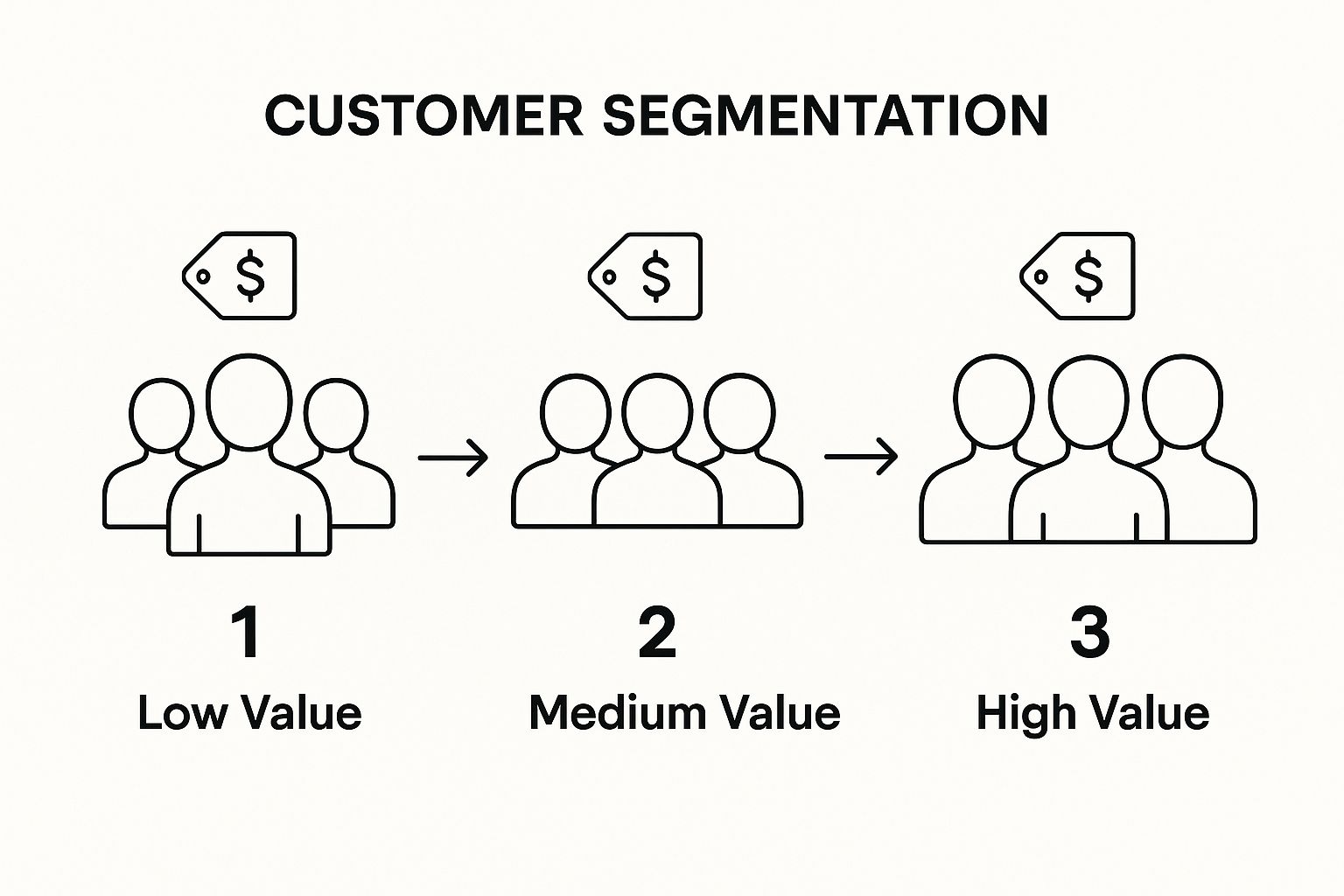
By separating your customers into groups like this, you can be much smarter about where you spend your marketing budget and who gets your team's attention.
Unlocking Value with RFM Analysis
One of the most effective tools in the e-commerce playbook is Recency, Frequency, Monetary (RFM) analysis. It's brilliant in its simplicity and gives you a direct, actionable way to spot your VIPs.
RFM analysis scores every single customer on three things:
- Recency: How recently did they buy from you? Someone who bought last week is worlds away from a customer whose last purchase was a year ago.
- Frequency: How often do they come back? Your frequent flyers are usually your most loyal and valuable fans.
- Monetary Value: How much do they spend when they shop? This helps you identify the big spenders who really move the needle.
Combining these three scores lets you create incredibly specific customer groups. A customer with high scores across the board is a "Champion"—the person you want to clone. You should be rolling out the red carpet for them with exclusive perks and early access. On the flip side, a once-great customer whose recency score is slipping is "At-Risk." That's your signal to launch a targeted win-back campaign before they're gone for good.
Keeping an eye on this data is critical, much like how sellers use tools like Amazon Brand Analytics to constantly monitor their performance.
Putting Your Segments into Action
Okay, so you've identified these groups. Now the real work begins. The magic isn't just in making the lists; it's in using them to create a personalized experience that feels like you're speaking directly to each customer.
You can craft marketing messages that feel like they were written just for them. It's what people want—a recent survey found that 53.9% of customers actually appreciate it when brands recommend products based on what they've bought before.
Here’s how you could put this into practice right now:
- For Your Champions (High RFM): Don't just thank them, show them. Send a surprise VIP gift, invite them to an exclusive online event, or grant them early access to new collections. Make them feel like the insiders they truly are.
- For New Customers with High Potential (High Monetary, Low Frequency): Their first big purchase is a fantastic sign. Nurture them with a personalized welcome series that tells your brand's story and offers tips on getting the most out of their new product.
- For At-Risk Customers (Low Recency): Don't let them drift away. A simple "We miss you!" email with a compelling, personalized offer based on their past favorites can be all it takes to reignite their interest.
When you segment your audience and tailor your outreach, you're showing customers that you're paying attention. That's how you build the kind of loyalty that pays dividends in customer lifetime value.
Create a Customer Experience They Won't Forget
Segmenting your customers tells you who your best people are. But the real magic happens when you use that knowledge to create an experience that shows them you're paying attention. This is where you graduate from just making sales to building real, human connections. A killer customer experience is the engine that drives loyalty and turns a first-time buyer into a fan for life.
Think about it this way: your product might get them in the door, but the experience makes them want to kick off their shoes and stay. It’s every single touchpoint, from the first ad they see to the email they get a week after their purchase. A smooth, positive journey is non-negotiable if you want to boost CLV.
Turn Support from a Cost Center into a Retention Engine
For far too long, customer support was seen as just a cost of doing business—the team you call when something breaks. In today's world, that mindset is a one-way ticket to obscurity. Your support team is on the front lines, holding the power to either make someone's day or lose their business forever.
When a customer reaches out with a problem, it’s not a ticket to be closed. It's a golden opportunity to strengthen your relationship. A fast, empathetic, and truly helpful response can turn a frustrating moment into a reason they tell their friends about you. I've seen it happen time and time again; a customer who has a problem solved well often becomes more loyal than one who never had a problem at all.
This isn't just a fluffy idea; it's how the best companies are winning. Projections show that by 2025, a staggering 89% of businesses expect to compete mainly on customer experience, blowing past old benchmarks like price and features. You can dig into more of the data on how customer experience is reshaping business at onramp.us.
An exceptional customer experience isn't a "nice-to-have" anymore—it's a core growth strategy. When customers feel seen and valued, 82.5% are more likely to buy from you again.
That means your support team isn't just putting out fires; they're actively retaining revenue. Every great interaction is another reason for a customer to stick around.
Get Ahead of Problems with Proactive Support
The best kind of customer service is the kind your customers never have to ask for. Instead of waiting for the complaint emails to roll in, proactive support means you anticipate their needs and solve issues before they even know there's a problem. It shows you're looking out for them, and that builds incredible trust.
Here are a few ways to put this into practice:
- Own Shipping Delays: A big storm is hitting your primary shipping route? Don't wait for the "Where's my order?" emails. Send a quick, friendly heads-up letting folks know there might be a delay and that you're on top of it.
- Offer Help on Tricky Pages: Use live chat triggers on pages where people tend to get stuck, like a complex checkout process or a product customization tool. A simple pop-up that says, "Building a custom order? Let me know if you need a hand!" can be the difference between a sale and an abandoned cart.
- Deliver Post-Purchase Guidance: Someone just bought a product that needs a little setup? Don't make them hunt for instructions. Send an immediate follow-up email with a "getting started" video or a simple care guide. You're helping them get value from their purchase right away.
These small, thoughtful actions make customers feel cared for and can slash the number of support tickets your team has to field.
Personalize the Post-Purchase Journey
The moments right after a customer clicks "buy" are pure gold. They're excited, but they're also looking for a little nod of reassurance that they made the right call. This is your chance to really shine with personalized follow-ups that seal the deal on your relationship.
Let's be honest, a generic "Thank You for Your Order" email is a massive missed opportunity. You can do so much better.
A Personalized Follow-up in Action
Imagine someone just bought a high-end espresso machine from your online store. Instead of the standard confirmation, they get an email with the subject line, "Welcome to the Club, Barista!"
Inside, there's a quick video from your founder on pulling the perfect first shot. Below that is a link to a blog post on the best coffee beans for that specific machine, plus a small discount on their first bag of beans.
This simple, thoughtful email accomplishes a few key things:
- It Reinforces Their Decision: They feel smart for choosing you.
- It Adds Instant Value: They can start enjoying their new gadget immediately.
- It Plants the Seed for the Next Sale: It guides them naturally toward a relevant next purchase.
By tailoring the experience to what the customer actually bought, you show them you're not just another faceless online store. This level of personalization is what separates brands that just sell stuff from brands that build communities.
Designing Loyalty Programs That Actually Build Loyalty
A great customer experience is one thing. It makes people happy. But a well-designed loyalty program? That gives them a concrete reason to turn that happiness into repeat business.
Let's be honest, though. A generic "buy ten, get one free" punch card isn't going to move the needle anymore. Customers today expect more than a simple transaction. They want to feel seen, appreciated, and like they're part of something special.
A truly effective loyalty program isn't just about handing out discounts. It’s about recognition, exclusivity, and delivering value that goes far beyond the price tag. When you nail this, it becomes one of the most powerful tools you have for boosting customer lifetime value. In fact, research shows that companies with strong loyalty programs grow their revenues 2.5 times faster than their competitors.
Go Beyond Simple Points and Discounts
The classic points-for-purchases model isn't dead, but it’s the bare minimum. To build real, sticky loyalty, you have to think bigger. Your goal should be to create a system that feels genuinely rewarding and makes your customers feel special for choosing you.
Here are a few modern approaches I've seen work wonders:
- Tiered Programs: These are brilliant for making your best customers feel like VIPs. As they spend more, they unlock new tiers with better perks—think free shipping, early access to new products, or maybe even a dedicated support line. It gamifies the experience and gives people a clear incentive to spend more to reach that next level.
- Value-Based Programs: This is a powerful way to connect on a deeper level. Instead of just rewarding spending, you can align the program with your customers' values. Maybe for every purchase, you donate to a specific charity or plant a tree. This builds an emotional bond that a simple discount never could.
- Paid Loyalty Programs: Think Amazon Prime. Customers pay an upfront fee for a bundle of premium benefits. This model is a home run for brands with a dedicated following, as it creates a strong psychological push for members to shop more often to “get their money’s worth.”
The Power of Exclusivity and Community
One of the most effective ways I've seen to build loyalty is to make customers feel like insiders. People love being part of an exclusive club, and your program is the perfect way to create that feeling.
Sephora's Beauty Insider program is a masterclass in this. It’s not just about points; it’s about access. Members get early looks at new products, invites to exclusive events, and a community forum to connect with other makeup lovers. That sense of belonging is what keeps them coming back, purchase after purchase.
A recent report found that 80% of companies with a loyalty program saw a positive ROI. On average, their revenue increased 4.9 times more than what they spent on the program. The takeaway is clear: investing in loyalty pays off.
Choosing the Right Program for Your Business
The best loyalty program is one that fits your business model and what your customers actually want. What works for a local coffee shop won't work for a B2B software company.
Here’s a simple way to think about it:
| Business Type | Recommended Program Type | Why It Works |
|---|---|---|
| High-Frequency E-commerce | Tiered or Points-Based | Every small purchase feels like progress toward a reward, encouraging frequent visits. |
| Subscription Service | Paid or Value-Based | Adds extra value on top of the subscription, reducing churn by offering exclusive perks or community access. |
| High-End Retail | Tiered or Community-Based | Rewards big spenders with the exclusivity and recognition they crave, making them feel like true VIPs. |
For example, imagine a subscription box for pet supplies. A tiered program could be perfect. Maybe top-tier members get to vote on upcoming products or receive a free "bonus toy" in every box. It's a small touch, but it adds a layer of personalization and engagement that builds a much stronger bond than a 10% off coupon ever could.
Ultimately, you want to design a program that does more than just offer deals. It needs to provide real value, foster a sense of community, and make your customers feel genuinely appreciated. Get that right, and you're not just creating a loyalty program—you're building a powerful engine for long-term growth.
Driving Engagement with an Omnichannel Strategy
Your customers don't live in silos, and your marketing shouldn't either. They might see your product on Instagram, click over to your site during a lunch break, and then get a promotional email later that day. If each of those moments feels disconnected, you're creating friction and missing a massive opportunity to build a real relationship.
This is exactly where an omnichannel strategy comes into play, and it’s a non-negotiable for anyone serious about how to increase customer lifetime value. It’s about creating one unified customer journey where every touchpoint feels like a continuation of the same conversation. It’s the difference between shouting from different rooms and having a coherent, one-on-one chat.
The goal is simple: make your brand feel consistently helpful and personal, no matter where a customer bumps into you.
Unifying the Customer Journey
A true omnichannel approach is more than just having a profile on every social platform. It means all those platforms are talking to each other, sharing data to create a smarter experience for the customer.
Think about it. A customer adds a pair of running shoes to their cart on their desktop but gets pulled away before checking out. An hour later, a push notification pops up on their phone—not a generic ad, but a specific reminder about the exact shoes in their cart, maybe with a link to a helpful review.
That’s a connected system in action. The experience feels helpful, not fragmented. To get this right, your brand needs to act as a single, cohesive entity, delivering a consistent message, tone, and quality of service across the board.
Practical Steps to an Omnichannel Experience
Building a fully integrated system is a marathon, not a sprint. But you can start with small, impactful steps that make a huge difference in how customers perceive you. The first move is always to break down the walls between your marketing, sales, and support teams.
Here are a few actionable ideas to get the ball rolling:
- Integrate Your CRM and E-commerce Data: Make sure your customer relationship management (CRM) system is synced with your sales platform. This gives you a 360-degree view of every customer—what they’ve bought, browsed, and any support tickets they’ve filed—all in one place.
- Create Consistent Cross-Channel Messaging: The voice you use on social media should feel like it's coming from the same brand that writes your emails and website copy. A consistent personality builds trust and makes your company feel familiar.
- Enable Cross-Channel Support: Let a customer start a conversation on live chat and switch to email without having to repeat their entire story. This small convenience shows you value their time and makes getting help painless.
A strong omnichannel strategy isn't just about convenience; it’s about profitability. Investing in retention is just smart business—existing customers spend 67% more than new ones. By creating a unified experience, businesses can see a significant boost in customer lifetime value.
Personalization at Every Touchpoint
The data you collect from an omnichannel approach is a goldmine for personalization. When you understand a customer's entire journey, you can deliver experiences that are incredibly relevant, strengthening their loyalty over time.
For instance, if you’re selling products on your own website and a marketplace, your strategy has to be cohesive. For a deep dive into bridging that gap, our guide on the Amazon and Shopify integration has some great insights.
Here’s what that next-level personalization looks like in the real world:
| Channel | Standard Approach | Omnichannel Approach |
|---|---|---|
| Sending a generic weekly newsletter to everyone. | Sending product recommendations based on what a customer just browsed on your app. | |
| Website | Showing the same homepage to every single visitor. | Displaying a personalized "Welcome Back" banner with items related to their last purchase. |
| Social Media Ads | Retargeting everyone who visited your site with the same ad. | Showing an ad for a complementary product to someone who just made a specific purchase. |
By weaving these channels together, you create an experience that feels intelligent and attentive. You’re showing customers you get them and are there to help, which is the ultimate foundation for increasing CLV and building a brand they’ll stick with for years.
Common Questions About Customer Lifetime Value
Once you start digging into CLV, a few questions tend to pop up again and again. It's totally normal. Getting these fundamentals straight will help you put everything you've learned into practice with a lot more confidence. Let's walk through some of the most common ones.
What Is a Good Customer Lifetime Value?
This is the million-dollar question, but the answer isn't a specific number. A "good" CLV is all about how it stacks up against your Customer Acquisition Cost (CAC).
The magic ratio most businesses strive for is 3:1. In simple terms, this means for every dollar you spend to get a new customer, you should be making three dollars back over the course of their relationship with you.
If your ratio is below 1:1, you're actually losing money with every new customer—a clear sign something needs to change, and fast. On the flip side, a ratio of 5:1 or higher sounds amazing, but it might mean you're not spending enough on marketing. You could be leaving growth on the table. Aiming for that 3:1 sweet spot is the key to healthy, sustainable growth.
How Often Should I Calculate CLV?
There's no one-size-fits-all answer here; it really comes down to your sales cycle.
For a fast-moving e-commerce business, calculating CLV monthly or even quarterly is a good idea. It lets you see the impact of your marketing campaigns and retention efforts almost in real-time.
But if you're in a business with a much longer sales cycle, like B2B software, checking in annually or semi-annually probably makes more sense. What matters most is consistency. You should always recalculate CLV after any major shift—like a pricing update or a new loyalty program—to see how it moved the needle.
Remember, CLV is not a "set it and forget it" metric. It’s a living number that reflects the health of your customer relationships and the effectiveness of your retention strategies.
Can Small Businesses Effectively Increase CLV?
Absolutely. In fact, small businesses have an advantage the big guys can only dream of: the personal touch. You don't need a huge budget or a complex tech stack to make your customers feel special.
Here are a few simple but powerful tactics that work wonders:
- Personal Follow-Ups: Think about the last time you got a handwritten thank-you note or a personal email from a founder. It stands out because it's so rare, and it builds a genuine connection.
- Remembering Preferences: When a customer returns and you remember their go-to order or a detail from a past conversation, you're doing more than just making a sale. You're showing them they matter.
- Direct Engagement: Jumping into your social media comments to answer questions and thank people for their support shows you’re listening and that you value your community.
If you’re looking to go even deeper on this, there’s a comprehensive guide on increasing customer lifetime value that's packed with more ideas. It's a great reminder that focusing on the human side of business is what really builds loyalty, no matter your size.