How to Start an Affiliate Program for Amazon Brands
Category: How to start an affiliate program
Starting an affiliate program isn't something you can just jump into. You've got to lay the groundwork first by defining clear goals, picking the right management platform, creating a commission structure that actually motivates people, and finding partners who are a perfect fit for your brand. The entire thing really comes down to building a solid foundation from day one. That means knowing exactly what success looks like for your Amazon brand before you even think about sending that first outreach email.
Building Your Affiliate Program Foundation
Launching an affiliate program is so much more than just another marketing box to check. You're essentially creating a powerful, scalable sales channel powered by authentic voices who already have an audience. For Amazon brands, this is a golden opportunity to tap into the creator economy and drive targeted, high-intent traffic straight to your product listings. The best part? It's a performance-based model—you only pay for actual results, like sales.
And this isn't some niche strategy anymore. Affiliate marketing has blown up, with spending expected to top $10 billion by 2025 and the global industry hitting $18.5 billion in 2024. This boom is happening because more and more brands are catching on—a whopping 81% of companies now run affiliate programs to grow their reach. With brands typically earning $15 for every $1 spent, the potential return is huge. You can discover more insights about these affiliate marketing trends and see just how big this is getting.
Define Your Program Goals
Before you get lost in software demos or start DMing creators, you need to nail down what you’re trying to accomplish. A fuzzy goal like "increase sales" just won't cut it. Your goals are the North Star that will guide every other decision, from the commission rates you set to the kind of creators you bring on board.
What should you be aiming for? Here are a few common objectives:
- Driving Incremental Revenue: This is the big one. The goal is to generate sales you wouldn't have otherwise gotten, adding a brand-new revenue stream to your business.
- Boosting Product Discovery: Affiliates can introduce your products to fresh, engaged audiences on platforms like TikTok and Instagram, seriously upping your visibility and brand awareness.
- Increasing Market Share: By teaming up with influential voices in your niche, you can strategically pull in sales that might have otherwise gone to your competitors.
- Supporting a New Product Launch: Imagine having a dedicated crew of affiliate partners ready to create major buzz and drive that crucial initial sales velocity for a new product. That's how you climb the Amazon rankings.
Set Your Key Performance Indicators
Once your goals are set, you need a way to track your progress. That’s where Key Performance Indicators (KPIs) come in. These are the specific, measurable numbers that tell you if you’re actually hitting your targets. They turn your abstract goals into something concrete.
Pro Tip: Don't go overboard with KPIs right out of the gate. Stick to a few core metrics that tie directly back to your main goal. You can always get more granular as your program grows and you have more data to play with.
For an Amazon-focused affiliate program, these KPIs are essential:
- Click-Through Rate (CTR): What percentage of people are actually clicking your affiliates' links?
- Conversion Rate: Of those clicks, how many turn into a sale?
- Total Affiliate-Driven Revenue: The total dollar amount of sales generated by your program.
- Return on Ad Spend (ROAS): How much revenue are you making for every dollar you pay out in commissions?
This visual breaks down that foundational workflow. It all starts with clear goals, which lead to measurable KPIs, and from there, you build out the rest of your strategy.
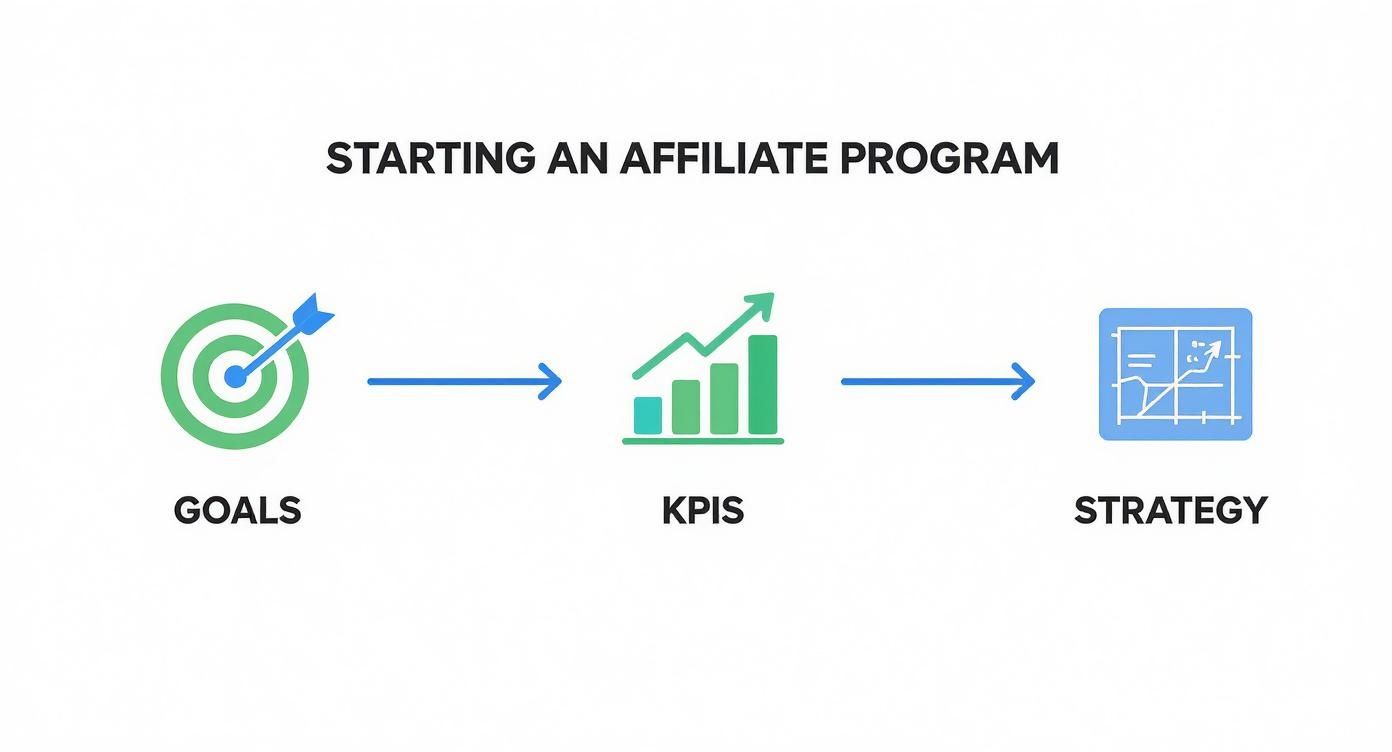
Following this process ensures you're building your affiliate program on a solid, strategic framework from the very beginning—not just winging it.
Choosing the Right Tech Stack for Your Program
Getting the technical side of your affiliate program sorted can feel like a huge hurdle. But honestly, picking the right platform is more straightforward than you might think, especially with tools designed specifically for Amazon brands. Good software is more than just a sales tracker; it's the command center for your entire program—the place you'll manage relationships, automate the boring stuff, and actually scale your efforts.
Think of it this way: your tech stack is the engine. The right one makes everything run smoothly. The wrong one will have you drowning in spreadsheets and manual data entry, which is the fastest way to kill your program's momentum before it even starts. You need something that simplifies the process, not complicates it.
Core Features Your Platform Must Have
When you start comparing software, it's easy to get sidetracked by flashy features you'll never use. For an Amazon brand, what really matters are the core functions that manage the entire affiliate lifecycle, from finding a creator to paying them.
Let's cut through the noise. Here’s what you absolutely need:
- Automated Creator Onboarding: You need a clean, self-serve portal where creators can apply, get approved, and grab their unique tracking links without a ton of back-and-forth emails.
- Simplified Payouts: Look for tools that automatically calculate commissions and integrate with payment systems like PayPal or direct deposit. This ensures everyone gets paid correctly and on time, which is crucial for building trust.
- Rock-Solid Tracking & Attribution: The platform must connect directly with Amazon Attribution. This is non-negotiable. It’s the only way to get reliable data on which partners and content are actually driving sales.
- Direct Amazon Integration: The software should plug right into your Amazon Seller Central account, pulling in your product info and syncing sales data automatically.
A good platform, like Coral, gives you a clean dashboard that shows the health of your program at a glance. You shouldn't have to be a data scientist to understand what's working.

See how simple that is? Clicks, sales, revenue—all right there. That clarity is what you're looking for.
Leveraging the Amazon Brand Referral Bonus
Okay, this is the real secret weapon for Amazon sellers. The Amazon Brand Referral Bonus is a complete game-changer. Why? Because Amazon literally pays you a bonus—usually around 10% of the sale price—for driving external traffic that converts.
Think about that for a second. If you pay a creator a 10% commission and Amazon gives you a 10% bonus, you’ve just acquired a new customer for a net cost of zero. This is how you can afford to offer competitive rates and attract top-tier creators.
Your affiliate platform should be built to make the most of this bonus. By generating Amazon Attribution links for every affiliate, every sale is properly credited, meaning you capture every single bonus dollar you're owed. This one feature turns a marketing expense into a nearly self-funding growth engine. If you want to go deeper, you can learn more about choosing the best affiliate program software and its key features.
Initial Platform Configuration
Once you've picked your software, the initial setup is usually pretty quick—we're talking minutes, not days. It's all about connecting your accounts and setting the basic rules of the road for your program.
Here’s a quick rundown of what that usually involves:
- Connect Your Amazon Seller Account: First, you'll securely authorize the platform to access your product catalog and sales data.
- Set Up Amazon Attribution: Next, you grant permission for the software to create and manage your Attribution links. This is the magic behind the tracking and the bonus.
- Import Your Product Catalog: The platform will then automatically pull in all your product listings, letting you easily select which ones are part of the program.
- Establish Your Base Commission Rate: Finally, you'll decide on a default commission percentage for new affiliates. You can always set up custom rates for VIP partners or special promotions later on.
With those four steps done, your affiliate program is officially live and ready for business. The right tech stack handles all this foundational work so you can get to the part that really matters: building great relationships with great creators.
Crafting a Commission Structure That Actually Motivates
Think of your commission structure as the engine of your entire affiliate program. It’s not just a line item on a spreadsheet; it's the core incentive that gets top-tier creators excited to work with you. A great structure feels like a true partnership, making it profitable for everyone involved.
Get it wrong, and you'll struggle. Set your rate too low, and you'll have a hard time attracting quality partners. Go too high, and you could be giving away your margins for no good reason.
The goal is to find that perfect balance. Affiliate marketing is a massive channel—spending is set to hit nearly $12 billion in the US by 2025. This isn't just noise; affiliates are responsible for driving a whopping 16% of all online orders in the US and Canada. When the best campaigns can pull in an ROI of up to 1400%, you can see why nailing your commission model is so critical.
Why a Simple Flat Rate Isn't Always Enough
It’s tempting to just set a simple flat-rate commission—say, 10% on every sale—and call it a day. It’s easy, sure, but it’s a one-size-fits-all approach in a world where your partners and products are anything but uniform.
A flat rate doesn’t give your best performers any reason to push harder, nor does it encourage anyone to focus on the products that are most profitable for you. To build a program that truly scales, you need to think more dynamically.
Getting Creative with Dynamic Commission Models
Dynamic structures are where the magic happens. They create a clear path for affiliates to earn more as they sell more, which in turn drives more revenue for your brand. It’s a classic win-win.
Here are a few of the most effective models I've seen work for Amazon brands:
- Tiered Commissions: This is my favorite way to reward top performers. You set sales goals that unlock higher commission rates. For example, an affiliate could earn 10% on their first $1,000 in monthly sales, but once they cross that, they jump to 12% on sales up to $5,000, and maybe even 15% for anything beyond. It turns selling into a game and gives your best partners a powerful reason to keep growing.
- Product-Specific Rates: Not all of your products have the same margin, so why should they have the same commission? It makes perfect sense to offer a juicy 15-20% on a new product you’re launching or a high-margin item, while keeping your standard 8-10% on lower-margin, high-volume products. This lets you steer your affiliates’ efforts exactly where you want them.
- Bonus Incentives: Need to generate some quick buzz? Temporary bonuses are fantastic for this. You could run a contest offering a $100 cash bonus for the first 10 affiliates to drive 50 sales, or you could double commissions for everyone during a huge sales event like Black Friday.
A well-crafted commission structure does more than just pay for sales; it communicates value. By rewarding top performance and strategic alignment, you show your partners that you're invested in their success, transforming them from simple affiliates into genuine brand advocates.
To help you figure out the best starting point, here’s a quick breakdown of the most common models.
Comparing Affiliate Commission Models for Amazon Brands
A comparison of common commission structures to help you choose the best fit for your program, balancing affiliate motivation with business profitability.
| Model Type | How It Works | Best For | Potential Drawback |
|---|---|---|---|
| Flat Rate | A single, fixed percentage for all sales. | Simplicity and programs where product margins are very similar. | Can fail to motivate top performers or drive high-volume sales. |
| Tiered Rate | The commission percentage increases as sales volume grows. | Motivating your highest-performing affiliates and scaling revenue. | Requires a bit more tracking and management to monitor the tiers. |
| Product-Specific Rate | Different commission rates are set for different products. | Promoting high-margin items or clearing out specific inventory. | Can get complex if you have a massive, constantly changing product catalog. |
| Bonus Incentives | One-time cash or percentage bonuses for hitting specific goals. | Driving short-term campaigns, new product launches, or seasonal pushes. | If you use them too often, affiliates might start expecting them all the time. |
Each of these models has its place, and the best programs often mix and match. Don’t be afraid to start with one and evolve as you learn what resonates with your partners. For an even deeper dive with more real-world examples, check out our complete guide on affiliate commission structures.
Finding and Partnering With the Right Creators
Your affiliate program is only as strong as its partners. Once the tech stack is sorted and your commission structure is in place, the real work begins: finding creators who genuinely connect with your brand and can drive authentic sales.
This isn't about chasing massive follower counts. It’s about identifying partners whose audience actually trusts their recommendations. A creator with 10,000 highly engaged followers in your niche is infinitely more valuable than a celebrity with a million generic ones. Authenticity is the real currency here, and your job is to find those true-to-brand voices.
Where to Find Your Ideal Affiliates
The best creators are probably already talking about products like yours. You just need to know where to look. Platforms like TikTok, Instagram, and YouTube are absolute goldmines for discovering potential partners.
Start by digging into keywords and hashtags that are relevant to your products. If you sell high-end coffee accessories, you should be living in hashtags like #specialtycoffee, #homebarista, and #coffeerecipes.
As you search, keep an eye on a few key signals:
- Real Engagement: Go beyond likes. Are people commenting, saving, and sharing the content? A high engagement rate points to an active, loyal community that hangs on the creator's every word.
- Audience-Market Fit: Does their audience look like your ideal customer? Don’t be afraid to ask for a media kit; many creators will happily share their audience demographics.
- Brand Vibe: Does their content style and personal brand feel like a natural extension of yours? You're aiming for a long-term partnership, so this alignment is non-negotiable.
Crafting Outreach That Actually Gets a Response
Creators get spammed with generic, copy-paste outreach emails every single day. If you want to stand out, you have to personalize your approach and prove you've actually done your homework. A little effort here goes a long way.
Keep your initial message short, personal, and focused on the value you offer. Mention a specific post or video of theirs you loved and explain why you think a partnership would be a fantastic fit for their audience. Clearly state your proposed commission rate and mention other perks, like free products.
Pro Tip: Frame your pitch as a true partnership, not just another transaction. Emphasize how working together will bring genuine value to their followers—a creator’s number one priority. This flips the script from "what can you do for me?" to "what can we build together?"
Streamlining Your Onboarding Process
So, a creator said yes—congratulations! Now you need to nail the onboarding. A smooth, professional process is your chance to make a killer first impression and set them up for success right away. A clunky, disorganized experience can drain their enthusiasm before they ever generate their first affiliate link.
The goal is simple: give them everything they need to start promoting your products confidently and effectively. A well-structured welcome packet or a dedicated onboarding page is the best way to do this. For a deeper dive, our guide on how to recruit affiliates breaks down the entire process from start to finish.
A solid onboarding flow should cover all the essentials.
The Essential Affiliate Onboarding Checklist
- Welcome & Brand Intro: A personal welcome message and a quick rundown of your brand's story, mission, and what makes your products special.
- Program Terms & Conditions: A clear, easy-to-read document covering commission rates, cookie duration, payout schedules, and any content rules. No legalese.
- Brand & Style Guidelines: Share your logos, color palettes, and guidance on tone of voice so their promotions feel on-brand.
- Access to Marketing Assets: A link to a shared folder (like Google Drive or Dropbox) with high-quality product photos, videos, and key messaging points.
- Technical Setup Guide: Simple, step-by-step instructions on how to log into their affiliate dashboard, generate tracking links, and see their stats.
- Payout Information: A straightforward form to collect their payment details (like a PayPal email or bank info) so you can pay them on time, every time.
- Your Contact Info: A dedicated point of contact for any questions or support they might need.
By handing over all this information from the get-go, you empower your new affiliates to hit the ground running and build a strong, productive partnership from day one.
Measuring Performance to Optimize and Scale
Getting your affiliate program off the ground is one thing, but the real growth happens when you start digging into the data. You need to know what's working, who your star players are, and where you can make improvements. Without clear performance metrics, you're just guessing. You can't tell the difference between a partner who needs a little coaching and one who deserves a VIP commission rate.
Think of data as the engine for your program. It’s what turns a simple marketing tactic into a reliable, scalable revenue channel for your Amazon brand.

Why Amazon Attribution is Non-Negotiable
For any Amazon seller, your single most important measurement tool is Amazon Attribution. This isn't optional; it's essential. It’s a free tool from Amazon that lets you create unique tracking links for each affiliate, giving you a crystal-clear picture of the traffic and sales they send to your listings.
If you're not using it, you're leaving money and data on the table. Here’s why it’s so critical:
- Proof of Performance: It provides undeniable proof of which affiliates, campaigns, and even specific social media posts are actually driving sales. No more guesswork.
- Unlocking Your Brand Referral Bonus: To claim that average 10% bonus from Amazon, you must use Attribution links. This is how Amazon verifies the sale came from your off-Amazon marketing efforts.
- Deeper Customer Insights: You see more than just final sales. Attribution shows you valuable data points like Add to Carts, Detail Page Views, and purchase rates, giving you a much richer understanding of the customer's journey.
A good affiliate platform, like Coral, will automatically generate these Attribution links for every partner, so the whole process runs smoothly in the background.
Building Your Performance Dashboard
You don’t need a data scientist or a complex analytics suite to make smart decisions. A simple, well-organized dashboard is all it takes to see what's going on at a glance. Just focus on tracking the key metrics that tie directly back to the goals you set in the first place.
Your Essential Affiliate KPIs
- Total Clicks: This is your top-of-funnel metric. It shows the raw number of people your affiliates are sending your way, indicating their reach.
- Conversion Rate (CVR): What percentage of those clicks turn into a sale? This is a huge indicator of traffic quality and how persuasive a creator is.
- Affiliate-Driven Revenue: The bottom line. This is the total dollar value of sales generated by your program.
- Return on Ad Spend (ROAS): For every dollar you spend on commissions, how many dollars in revenue do you get back? A 10:1 ROAS means you're making $10 for every $1 spent—a fantastic return.
By keeping a close eye on these core metrics, you can spot trends immediately. Got an affiliate driving a ton of clicks but zero sales? Their audience probably isn't the right fit. Found someone converting at an incredibly high rate? It's time to figure out what they're doing right and maybe offer them a bonus.
Practical Ways to Optimize and Grow
With this data in your hands, you can stop guessing and start making strategic moves. Optimization isn't a one-and-done task; it’s a continuous cycle of analysis and action. The affiliate world is always changing, with trends like AI-powered campaigns and a bigger focus on micro-influencers shaping strategies for 2025. Staying on your toes means using data to adapt. You can discover more insights about these emerging affiliate marketing trends to keep your program ahead of the curve.
Here are two simple, actionable strategies you can implement right away:
Help Your Underperformers. Take a look at partners with high clicks but low conversion rates. Don't just kick them out of the program. Reach out personally. They might just need better marketing materials, more information about the product, or some tips on your brand's key selling points. A little bit of support can often turn a struggling partner into a solid performer.
Reward Your Superstars. Identify your top 10-20% of affiliates—the ones who consistently drive the most revenue with a great ROAS. These are your VIPs, so treat them like it. Offer them a higher commission rate, exclusive performance bonuses, or early access to new products. This not only keeps them motivated but also makes your program far more appealing to other top-tier creators.
Managing Payouts and Navigating Compliance
https://www.youtube.com/embed/e19oDK9EqAY
Getting your operational workflow dialed in is just as important as finding killer partners. Two of the trickiest—and most critical—pieces of the puzzle are handling affiliate payouts and navigating legal compliance. Nail these, and you'll build serious trust with your creators and keep your brand protected.
Think about it: if a creator can't rely on you for consistent, on-time payments, they're not going to stick around for long. A solid payment system is the bedrock of any healthy partnership. Your process needs to be transparent, predictable, and as hands-off as possible to prevent headaches and delays.
Establishing a Reliable Payout Workflow
The secret to a smooth payout system is simple: clarity and consistency. Your partners should never have to guess when or how their money is coming. This is where a good affiliate management platform really earns its keep by taking care of the commission tracking and payment processing for you.
Here’s how we recommend setting up a workflow that gives creators peace of mind:
- Set a Clear Payment Schedule: Pick a consistent day and stick to it, like the 15th of every month. This is often called a Net-15 schedule—commissions earned in January get paid out on February 15th. It’s a standard, predictable model that creators understand.
- Establish a Payment Threshold: To avoid cutting a check for $2.50, set a minimum payout threshold, like $50. This just means an affiliate needs to hit that amount in commissions before a payment is sent, which cuts down on your administrative busywork.
- Automate Everything You Can: Your affiliate platform should plug directly into payment processors like PayPal or Wise. Automation is your best friend here—it slashes the risk of human error and makes sure everyone gets paid on schedule, without you lifting a finger.
This kind of structured approach takes all the guesswork out of getting paid. Your affiliates know exactly what to expect, so they can focus on what they do best: creating awesome content that drives sales.
Understanding FTC Compliance and Disclosures
Beyond just paying people, you've got to cover your legal bases. The Federal Trade Commission (FTC) has some very clear rules to protect consumers, and they boil down to one word: transparency. Your affiliates are legally required to disclose their relationship with your brand anytime they promote your products.
This isn't optional—it's the law. If your partners fail to make proper disclosures, both they and you can face serious penalties. As the program manager, it's on you to make sure your affiliates know the rules.
The disclosure has to be "clear and conspicuous." That means it can't be buried at the bottom of a caption, hidden in a sea of hashtags, or tucked away on a different page. It needs to be front and center.
Here are some of the most common and accepted disclosures:
- #ad
- #sponsored
- #promotion
For video content on platforms like YouTube or TikTok, the disclosure should be mentioned out loud and included in the description. On an Instagram post, it needs to be visible right away, not hidden behind that "see more" link.
The best way to handle this? Make compliance a mandatory part of your onboarding. Educate your partners from day one to protect your brand, your creators, and your customers.
Answering Your Top Amazon Affiliate Program Questions
Jumping into the affiliate world for the first time? You've probably got questions. Let's tackle some of the most common ones I hear from Amazon brands so you can get started with confidence.
How Much Will This Actually Cost Me?
Your main costs are pretty straightforward: the monthly fee for your management platform and the commissions you pay out on sales. Platform fees can run anywhere from $50 to over $500 a month, depending on the features you need. Then, of course, you have your affiliate commissions.
But here's the game-changer for Amazon sellers: the Brand Referral Bonus. Amazon literally pays you back an average of 10% on sales that come from your off-Amazon marketing. This bonus can dramatically reduce your commission expenses, sometimes even covering them completely.
What’s a Good Commission Rate for an Amazon Product?
This is a big one, and getting it right is key to attracting the best partners. For physical goods on Amazon, a commission in the 5% to 15% range is usually competitive.
To nail down your number, you'll want to look at a few things:
- What are your actual profit margins?
- What are your direct competitors offering? A little research goes a long way.
- What's the lifetime value of a new customer? An affiliate isn't just bringing you one sale, but potentially a long-term fan.
Don't forget that the Amazon Brand Referral Bonus gives you a cushion. It frees up margin, allowing you to offer a more tempting commission rate without taking a hit on your profits.
A killer strategy is to set a solid base commission but also create performance tiers. Offer a higher percentage or one-off bonuses to your top affiliates. It’s a powerful way to reward your best partners and keep them focused on your brand.
When Will I Actually See Results?
This isn't an overnight thing, so patience is your best friend here. You might get a trickle of sales in the first month, but you should plan for about three to six months before you start seeing real, consistent momentum.
That initial period is crucial for recruiting a good group of creators and giving their content—whether it's a blog post, a YouTube video, or a TikTok—time to find its audience and start ranking. The work you put into building relationships and managing the program during these early months is what truly builds the foundation for long-term growth.
Ready to get your affiliate program off the ground in minutes and start growing your Amazon sales? Coral is the all-in-one platform built specifically for Amazon brands and creators. Start your free trial today and see how easy it can be.