How to Build Micro Influencer Programs to Grow Your Amazon Brand
Category: Micro influencer programs
What are micro influencer programs? They aren't about chasing huge follower counts. Instead, they are strategic partnerships between an Amazon brand and creators who have smaller, incredibly engaged audiences—typically in the 10,000 to 50,000 follower range. For brand owners selling on Amazon US, the goal is to prioritize authentic connection over raw reach, driving credible recommendations that actually lead to sales.
What are micro influencer programs?
For Amazon brand owners, a micro influencer program is a way to cut through the noise. It’s a targeted strategy to build trust and generate sales through voices that genuinely connect with your ideal customers. These creators have spent time building a real community that listens to their advice, which makes their endorsement feel less like a paid ad and more like a recommendation from a trusted friend.
This approach is especially powerful for sending high-intent traffic directly to your Amazon US listings from visual platforms like TikTok and Instagram. And unlike their mega-famous counterparts, micro-influencers consistently deliver far better engagement.
The numbers don't lie. On Instagram, micro-influencers hit an average engagement rate of 3.86%. Compare that to just 1.21% for mega-influencers. Their smaller, niche audiences aren't just scrolling by; they're actively involved and ready to trust.
That higher level of interaction is exactly why Amazon brands see such a strong return on their investment. These aren't just vanity metrics; they're the engine of real sales.
How do different influencer tiers compare for Amazon brands?
To really see why micro-influencers are such a smart move for Amazon brands, it helps to put them side-by-side with the bigger players. Each tier offers something different, but for driving sales in a specific niche, the advantages of going small are pretty clear.
| Attribute | Micro-Influencer (10k-50k) | Macro-Influencer (500k-1M) | Celebrity Influencer (1M+) |
|---|---|---|---|
| Engagement Rate | Highest (Often 3-6%) | Moderate (Typically 1-2%) | Lowest (Often <1%) |
| Audience Trust | Very High (Feels like a friend) | Medium (Seen as an entertainer) | Low (Seen as a paid spokesperson) |
| Cost | Low (Affordable for most brands) | High (Thousands per post) | Extremely High (Six figures+) |
| Niche Authority | Strong (Expert in a specific area) | Broad (General lifestyle focus) | Very Broad (Mass-market appeal) |
| ROI Potential | Excellent (High engagement, low cost) | Varies (Can be hard to track) | Unpredictable (High risk, high cost) |
This comparison makes it obvious: if your goal is to drive authentic, high-converting traffic to your Amazon US listings without breaking the bank, micro-influencers are your best bet.
Why does engagement matter more than reach for Amazon sales?
A smaller, dedicated following almost always wins. When a micro-influencer shares your product, their audience listens because the content is a natural fit for what they already care about. This leads to much higher-quality traffic and a better chance of conversion once they hit your Amazon page.
Here’s why it works so well for your brand:
- Authentic Connection: They have a real, personal relationship with their followers. That builds a level of trust that big-name influencers just can't replicate.
- Niche Authority: They're seen as the go-to experts in their specific lane, whether that's vegan skincare or high-end kitchen gadgets. That credibility instantly transfers to your product.
- Cost-Effectiveness: Working with micro-influencers is way more affordable. You can partner with a whole squad of them for the same price as a single campaign with one macro-influencer, diversifying your reach and testing different audiences.
To get a better handle on the entire landscape, this guide to modern influencer marketing is a fantastic resource. Successful programs often blend elements of influencer programs for micro influencers with long-term brand ambassador programs to maximize impact.
How do brands structure micro influencer programs?
Getting the structure of your micro influencer program right from the start is the key to making it a success. For Amazon brands, the goal is always the same: create a simple, motivating framework for creators that ties directly back to sales. There are two proven models that stand out for their clarity and effectiveness.
First, you have brand ambassador programs. This is all about building long-term relationships and getting consistent content. Ambassadors become genuine advocates for your brand, and you'll typically compensate them with free products and sometimes a small monthly fee. Imagine a new skincare line on Amazon running a 3-month ambassador campaign where creators get the full product set and are asked to create weekly content showing off their routine.
The second model—and the one that’s far more scalable for Amazon brands—is a performance-based affiliate program.
Why are affiliate programs a great structure for Amazon brands?
Affiliate programs are beautifully simple because they're driven purely by results. Creators get a commission for every single sale they drive using their unique Amazon Attribution links. This approach is perfect for an evergreen program promoting something like kitchen gadgets, where sales can stay steady all year. It minimizes your upfront risk while giving creators a powerful incentive to drive actual conversions.
This performance model aligns your goals perfectly with the influencer's. The ROI can be exceptional, with brands often generating approximately $5.78 in revenue for every $1 spent on influencer marketing. You can dig into more of these powerful financial returns—and see how nano-influencers are converting sales at more than double the rate of macro-influencers—over on goviralglobal.com.
Whichever path you choose, having a clear and simple agreement is non-negotiable. This document should spell out the goals, content expectations, compensation, and usage rights, making sure both you and your partners are on the same page from day one.
How can brands simplify program management and tracking?
As your program grows, manually managing unique links, tracking sales, and calculating payouts will quickly become a massive headache. This is where a dedicated platform like Coral isn't just nice to have—it's essential for any Amazon brand owner.
Coral was built to simplify this entire process. It handles the heavy lifting by:
- Automating Link Generation: Instantly create unique Amazon Attribution links for every single influencer.
- Tracking Sales Accurately: See exactly which partners are driving sales and attribute every dollar of revenue correctly.
- Streamlining Payouts: Make sure your partners are paid the right commission on time, every time.
Using Coral turns a complex administrative task into a smooth, manageable workflow, freeing you to focus on building great relationships and scaling your program. If you want to dive deeper, check out our guide on how to start an affiliate program for a full step-by-step walkthrough.
What commission rates work best for micro influencer programs?
Getting the compensation right is probably the most critical piece of building a successful micro influencer program. You need a structure that attracts high-quality creators but also makes sense for your bottom line.
For Amazon US brands, your offer has to be competitive, profitable, and simple to understand. While every brand's margins are different, a few proven compensation models work exceptionally well.
The most common approaches are:
- Commission-Only (Affiliate Style): This is your classic performance-based model. Influencers earn a percentage of the sales they drive. It's incredibly low-risk for your brand and scales beautifully.
- Product Gifting: A great way to kick off a relationship. You send free products in exchange for content. It's perfect for new brands, but it won't motivate long-term, consistent promotion on its own.
- Hybrid Models: This is the sweet spot for many Amazon brands. It's a mix of free products plus a commission rate. The creator gets some upfront value, and you get the performance incentive.
How do I calculate a fair commission rate?
Your commission rate needs to find that perfect balance—attractive enough for influencers to get excited, but sustainable for your business. The best place to start is by figuring out your product's actual profit margin on Amazon. From there, you can decide on your target customer acquisition cost (CAC).
For most brands selling on Amazon US, a commission between 10% and 20% is a fantastic starting point.
This is a huge step up from the standard Amazon Associates program, which makes your offer feel exclusive and far more appealing to the kind of creators you actually want to work with. And the ROI potential is massive when you tie compensation directly to sales.
Tying your investment directly to sales is just a smarter way to grow your brand on Amazon. For a deeper dive into structuring your own rates, check out these detailed commission structure examples you can adapt for your own program.
Example Commission Structures for Amazon Product Categories
Here’s a look at how you might set rates based on typical product categories sold on Amazon US.
| Product Category | Typical Profit Margin | Suggested Commission Rate | Compensation Notes |
|---|---|---|---|
| Supplements & Wellness | 40% - 60% | 15% - 25% | High margins allow for generous, motivating commissions to stand out. |
| Beauty & Skincare | 50% - 70% | 15% - 20% | Very competitive space. A strong commission is key to attracting top talent. |
| Home & Kitchen | 25% - 40% | 10% - 15% | Margins are tighter, so balance the rate with product gifting to add value. |
| Electronics & Accessories | 15% - 30% | 8% - 12% | Lower margins are standard. Highlight the appeal of your product and brand story. |
| Apparel & Fashion | 30% - 50% | 12% - 18% | A competitive rate combined with free products works best to get consistent promotion. |
Ultimately, you're aiming for a true win-win. Your influencers should feel valued and motivated to share your products, and your brand should be acquiring new customers at a profitable rate. This is where a platform like Coral makes life so much easier. You can set custom commission rates, track every single sale with Amazon Attribution, and manage all your payouts in one place.
How do you recruit micro influencers for your program?
Finding the right partners for your micro influencer program can feel overwhelming, but it's simpler when you know where to look. The goal isn't just to find creators; it's to find creators who have already built the exact audience you want to reach on Amazon.

Start your hunt where your customers are already scrolling: TikTok and Instagram. Dive deep into the hashtags relevant to your niche. Don't just stick to the obvious ones like #amazonfinds. Get specific with tags like #kitchengadgets or #cleanskincare to uncover creators making authentic content for engaged communities.
Another powerful tactic for Amazon brands is to check out who’s tagging your competitors. This is a goldmine, giving you a direct line of sight to influencers who are already active in your space and whose audiences are primed for products just like yours.
How should you vet potential partners?
Once you've got a list of potential partners, the real work begins. You have to vet them for genuine engagement and brand alignment. A big follower count can be a vanity metric; what really moves the needle is the quality of their community.
Here’s what to look for:
- Thoughtful Comments: Are people asking legit questions and sharing their own stories? Or is it just a wall of generic "Great post!" comments and fire emojis?
- Consistent Content Quality: Does the creator consistently put out high-quality, engaging content that actually fits your brand’s vibe and values?
- Audience Demographics: Does their audience profile line up with your ideal customer? Don't be shy about asking creators for a breakdown of their audience analytics. Most are happy to share.
Go beyond the basics. Look for creators who just get it—people who know how to make content that connects. To get a better feel for what separates the good from the great, it’s worth exploring some strategies for creating highly engaging or viral videos.
How do you craft your initial outreach?
Your first message is everything. It's your shot to make a great impression, so don't blow it with a generic, copy-paste template. Personalize it. Show them you’ve actually watched their videos and that you understand their audience.
Our complete guide on how to find Amazon influencers has a simple, customizable outreach template designed to kick off a real conversation, not just a cold pitch.
Pro-Tip: Make your outreach about them, not just you. Clearly and concisely explain why a partnership with your Amazon brand is a win for their community. Talk up your competitive commission rates, the quality of your products, and how you can help them deliver real value to their followers. This simple shift turns your pitch into an exciting opportunity.
Let's Be Honest: Spreadsheets Won't Cut It for Long
Once your micro-influencer program starts to gain some traction, you'll hit a wall. Fast. Trying to manage everything with spreadsheets and manual tracking isn't just a headache; it's a surefire way to kill your momentum. This is the exact moment when dedicated software like Coral becomes a non-negotiable for any Amazon brand owner serious about scaling.
Think about it. You're juggling unique affiliate links, trying to make sense of Amazon Attribution data, and handling commission payouts. As your program grows from five partners to fifty, these tasks become a massive time-suck, and the risk of making costly mistakes skyrockets.
How does automation help you scale your program?
A solid management tool is the backbone of a successful program. It’s not just about convenience; it’s about automating all those repetitive tasks that eat up your day. This frees you up to focus on what really matters: building genuine relationships with your influencers.
Coral handles the heavy lifting for you:
- Effortless Link Generation: Instantly create unique Amazon Attribution links and custom coupon codes for every single partner.
- Accurate Sales Tracking: Automatically tie every sale back to the specific influencer who drove it, so you know exactly who your top performers are.
- Simplified Payouts: Make sure your partners are paid the right commission, on time, every single time. This builds trust and keeps them motivated.
A clean, centralized dashboard, like this one from Coral, lets you see creators, links, and performance all in one spot.
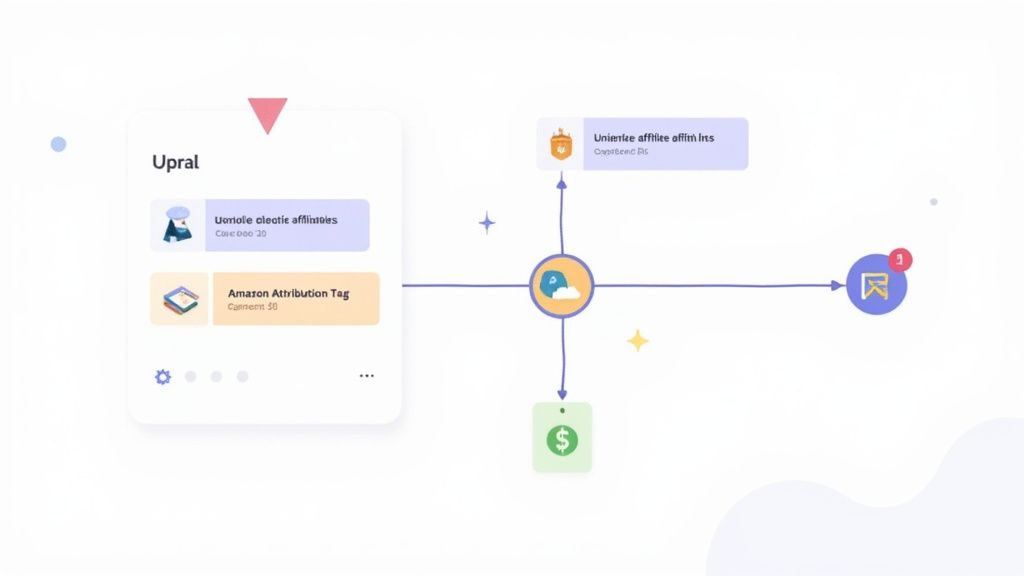
When you can see everything in one place, you get a crystal-clear, real-time view of your program's ROI without having to piece together ten different reports. A streamlined system doesn't just save you countless hours; it creates a professional and reliable experience for your influencers. Tools like Coral were built from the ground up to solve these exact headaches for Amazon brands.
Unpacking the Big Questions
Stepping into the world of micro-influencer programs can bring up a few questions, even with a solid plan in place. Let's tackle some of the most common ones that Amazon brand owners ask so you can move forward with total confidence.
Can I Start Without Dedicated Software?
Yes, you absolutely can. When you're just starting out, a simple spreadsheet is all you need to keep track of your first few influencers and their unique Amazon Attribution links.
But let's be realistic. That manual approach gets messy, fast. As soon as you bring on more than a handful of partners, tracking becomes a time-consuming nightmare. Trying to scale a manual system is practically impossible.
This is exactly why platforms like Coral were built. They automate the tedious stuff—like tracking, reporting, and payouts—which frees you up to focus on building relationships and growing your program.
How Do I Measure ROI on Amazon?
This is the most important question, and thankfully, the answer is straightforward: Amazon Attribution.
This is your source of truth. By giving every single partner their own unique Attribution link, you can see exactly how many clicks, add-to-carts, and sales they're driving, all directly inside your Amazon account.
Calculating your ROI is then just simple math. Divide the total revenue your program generated by what you spent on it (commissions, product costs, etc.). This gives you a crystal-clear, data-backed picture of your program's profitability.
Ambassador vs. Affiliate: What Is the Difference?
You'll hear these terms thrown around a lot, and while they're often used interchangeably, there’s a subtle but important difference for your brand's strategy.
A brand ambassador is usually in it for the long haul. They have a deeper partnership focused on living your brand values and creating consistent content. They're often compensated with a mix of free products and sometimes a flat fee.
An affiliate, on the other hand, is purely performance-driven. Their main goal is to drive sales, and they earn a commission on every single one.
The most successful programs for Amazon brands create a hybrid model. They blend the relationship-building of an ambassador program with the performance incentives of an affiliate structure to create profitable, long-term partnerships.
The influencer marketing space is absolutely booming, and it's projected to hit $32.55 billion in 2025. With a staggering 84% of brands already seeing it as an effective strategy, a well-run program is no longer a "nice-to-have"—it's a must. You can dive deeper into these trends in this influencer marketing benchmark report.
Coral takes the guesswork out of running your Amazon affiliate program. From generating tracked links to automating payouts, we handle the details so you can focus on growth. Start your free trial today and see how easy it can be.