Navigating UGC Marketplace Fees: How to Maximize Your Earnings
Category: Ugc marketplace fees
Ever wondered why the payout that hits your bank account is always less than what the brand paid for your awesome UGC? The answer is UGC marketplace fees.
These are the commissions and service charges that platforms deduct from your earnings, and they can range anywhere from a modest 10% to a staggering 50% on each project. Understanding these fees is the first step, but minimizing them is how you truly maximize your creator ROI.
Why You Can’t Afford to Ignore UGC Marketplace Fees
Jumping into the world of User-Generated Content is a blast, but the money side of things can get confusing fast. The biggest headache for most creators is the lack of transparency. Hidden fees and complicated commission models make it nearly impossible to figure out your actual take-home pay. This guide is here to be your financial roadmap, showing you not just what you're being charged, but how to strategically reduce that impact.
The UGC market is exploding—it’s projected to hit over $7.6 billion globally in 2025, which is a massive 69% jump from 2024. But here's the catch: even with all that growth, the average pay for a single piece of UGC has dipped to around $198. This trend makes it crystal clear: you have to be smart about your money to stay profitable. If you want to dive deeper into the numbers, check out this comprehensive UGC statistics report.
From Confusion to Clarity
Most creators run into the same frustrations when it comes to UGC marketplace fees:
- Sneaky Hidden Costs: Things like withdrawal fees, currency conversion charges, and even fees for "boosting" your profile can pop up and take a bite out of your earnings when you least expect it.
- All Kinds of Fee Structures: Some platforms keep it simple with a flat percentage. Others use confusing tiered systems or even require a monthly subscription just to play the game.
- Guessing Your ROI: Without knowing the real numbers, how can you tell which platforms are worth your time? It’s impossible to know where you’re actually making the most money.
This is exactly why tools built for financial tracking, like Coral, are becoming the ROI-maximizing solution for creators. Instead of juggling spreadsheets, Coral lets you see all your commissions and fees from every platform in one clean dashboard, providing transparent tracking to help you understand and minimize costs.
Here’s a peek at how Coral gives you a bird's-eye view of your earnings and the fees you're paying.
The dashboard lays it all out—your gross income versus what you actually keep. This simple visualization instantly highlights the impact of marketplace fees, helping you make smarter, data-backed decisions to boost your bottom line. When you bring this kind of clarity to your finances, you can stop guessing and start building a truly sustainable business as a creator.
Cracking the Code on Marketplace Commission Models
Trying to figure out UGC marketplace fees can feel like learning a new language. Each platform has its own way of doing things, and if you don't understand the lingo, your profits can take a serious hit. Think of it like a toll road: some charge by the mile, some have a flat fee to get on, and others make you buy a monthly pass.
The most common setup you'll run into is the percentage-based commission. Here, the platform takes a cut of every single deal you close. This slice can be anywhere from a modest 10% to a hefty 50% of your earnings. It’s simple, sure, but it also means the more successful you are, the more you end up paying them.
A Look at the Common Fee Structures
Beyond a simple percentage, platforms get creative with how they charge you. Each model has its upsides and downsides, and they all directly affect how much money actually ends up in your pocket.
- Fixed Transaction Fees: Some marketplaces charge a flat rate on every project, no matter how big or small. It's predictable, but a flat fee can really sting on your smaller, quick-win jobs.
- Subscription Fees: This is your classic "pay-to-play" model. You pay a monthly or yearly fee just for the privilege of being on the platform and seeing opportunities. It’s like a gym membership—you pay the fee whether you land one project or twenty.
- Hybrid Models: This is where things can get complicated. Many platforms mix and match, charging you a subscription plus a commission on your projects. Keeping track of your real earnings can quickly become a headache.
This visual gives you a good breakdown of the main types of fees you'll come across.
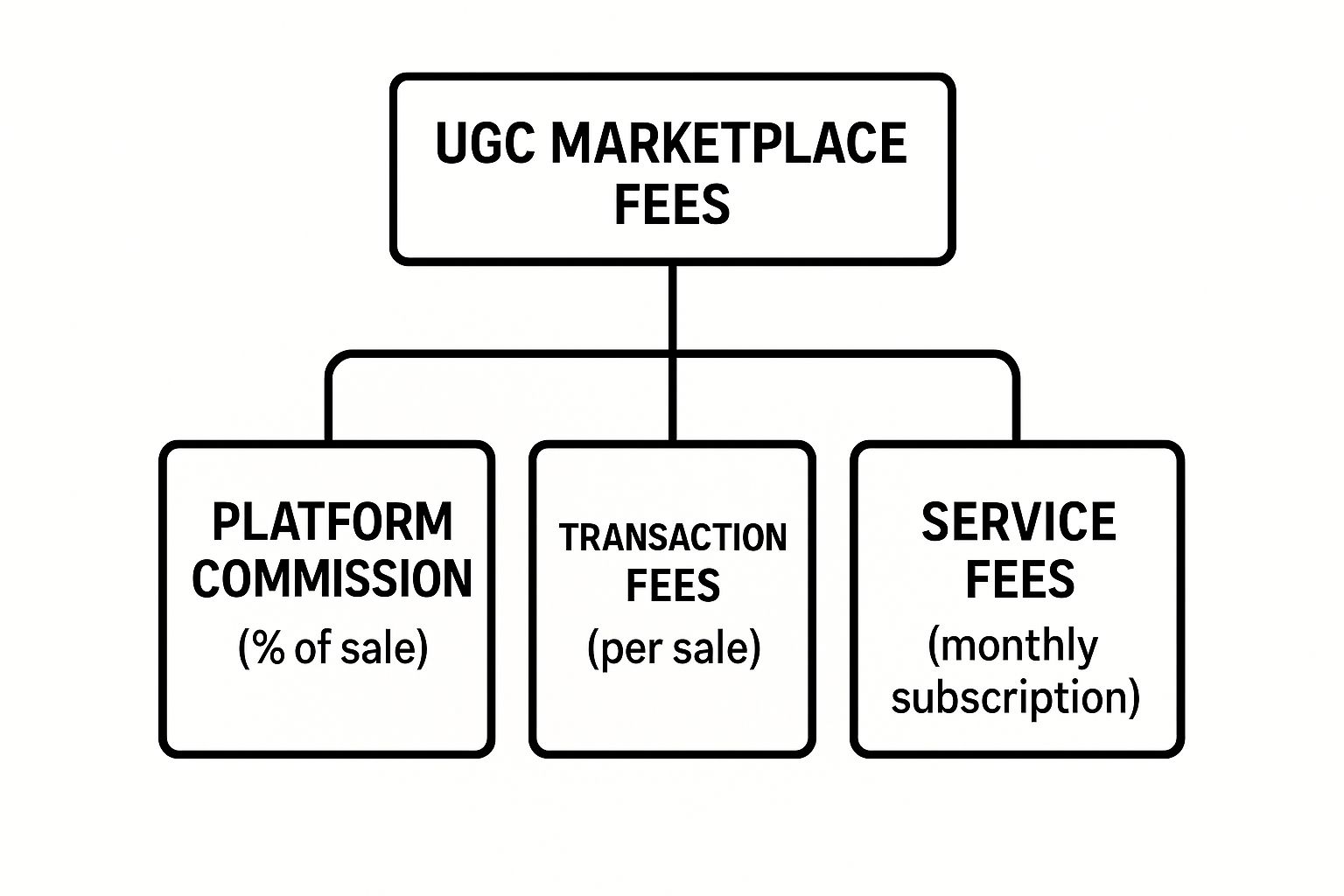
As you can see, platforms often layer different charges. It's not just about the commission; it's the service fees, transaction costs, and other little things that add up.
The Hidden Costs They Don't Advertise
That big, bold commission rate you see on the homepage? That’s just the start. So many creators get blindsided by the less obvious fees that chip away at their income. These "hidden" ugc marketplace fees often pop up as:
- Withdrawal Charges: Yep, some platforms charge you just to move your own money to your bank account.
- Currency Conversion Fees: If you're working with international brands, you might lose a chunk of your payment just for converting the currency.
- Profile "Boosting" Fees: Want more eyeballs on your profile? Some platforms let you pay extra to get featured, which is another cost to factor in.
The real problem for creators isn’t just the fees themselves. It's the fact that there's no easy way to see how all these different costs from all these different platforms are actually impacting your bottom line.
This is exactly why a tool like Coral is such a game-changer. Instead of juggling a messy spreadsheet and trying to remember who charges what, Coral gives you a clear, all-in-one dashboard. It automatically tracks and deducts all the different fees for you, so you can see the true return on every single project and compare different commission structure examples side-by-side. This reveals Coral’s cost-saving benefits: you can easily identify which platforms are the most profitable for your business. That kind of clarity means you can focus your energy where it counts and make sure you’re keeping more of the money you work so hard to earn.
Don't Forget About Licensing and Usage Rights
After you've accounted for the platform's cut, the biggest thing that will affect your take-home pay is often buried in the fine print: licensing and usage rights.
These terms dictate exactly how, where, and for how long a brand can use your content. If you don't get a handle on this, you're practically guaranteed to leave money on the table.
Think of it this way: your base rate pays for you to create the video. Licensing pays for what that video does for the brand. A video used for a single organic social media post just doesn't have the same reach as one that’s a core part of a massive paid ad campaign. Each way the brand uses your content has a different value, and you need to get paid for that value.
How Licensing Turns a Small Deal Into a Big One
The nitty-gritty of a licensing agreement can completely change the final payout for a project. There are a few key factors that act as multipliers on your base rate, and as UGC marketplace fees become more standardized, understanding these terms is how you really get ahead.
Here are the big ones that move the needle on your price:
- Exclusivity: Can you sell this same content to another brand? If the brand wants it all to themselves (especially locking out competitors), that exclusivity is worth a premium.
- Duration: How long can they use it? A standard license might be for three or six months. If a brand wants "perpetual" (forever) rights, that's a whole different ballgame and should cost a lot more.
- Channel: Where will it appear? Rights for organic social posts are pretty standard. But using it on their website, in email newsletters, or especially in paid ads? Each of those is a separate add-on that you should charge for.
This is how a simple project can suddenly triple in value. Let's say you charge a $200 base rate for one video. Adding a six-month license for paid advertising could be another $200, and including website usage might add another $200 on top of that. Just like that, your $200 project is now a $600 deal.
These details are everything. Getting your licensing right can easily double or triple your fee. For a closer look at what the going rates are, you can explore how top creators price their content.
When you don't charge separately for usage rights, you are basically giving away free advertising to the brand. Figuring out which licensing packages make you the most money is crucial for growing your business.
Keeping It All Straight with Coral
This is where a tool like Coral is a lifesaver. Trying to juggle different licensing terms across multiple platforms and dozens of brand deals gets messy, fast. Without a good system, you have no real way of knowing which deals are actually your most profitable.
Coral gives you a clear, simple way to track your earnings and tie them directly to specific campaigns and their licensing agreements. By laying all this data out, you can instantly see which add-ons—like paid ad rights or longer durations—are consistently making you the most money.
This knowledge gives you the confidence to negotiate smarter deals, create standard packages based on what you know sells, and make sure every piece of content is priced to reflect its true value. It shifts your mindset from just making videos to strategically managing a portfolio of high-value assets.
How Coral Maximizes Your Creator ROI
So, after digging through all the confusing commission models and licensing rights, one thing becomes crystal clear: you need a way to juggle all this without getting lost in a sea of spreadsheets. Trying to guess what you’ll actually make from UGC marketplace fees isn't just a headache—it’s actively eating into your profits. This is the point where Coral, as a dedicated financial tool, stops being a "nice-to-have" and becomes the essential ROI-maximizing solution for your business.
Think of Coral as your financial command center, built specifically to cut through the chaos. Instead of manually trying to track what you've earned from five different platforms, Coral’s dashboard brings all your income streams together in one clean, simple view. It automatically figures out and subtracts the specific fees for every single project, giving you a real-time, accurate picture of your net income.
It’s like having an automated financial advisor. Coral ignores the vanity metric of "gross earnings" and shows you the only number that really matters: your take-home pay.
Turning Data Into Actionable Insights
But real financial control isn't just about knowing where your money went. It's about using that knowledge to make smarter choices for the future. That’s exactly what Coral's optimization tools are designed for. The platform digs into your past earnings to show you trends you’d never spot on your own.
For example, you might realize that while Platform A lands you big-ticket projects, its hefty 30% commission means you’re actually making more money from the smaller, lower-fee gigs on Platform B. Coral's transparent tracking makes these cost-saving benefits obvious.
- Platform Profitability: Instantly see which marketplaces are actually putting the most money in your pocket after all fees are taken out.
- Content Performance: Figure out which types of content (like unboxing videos versus testimonials) or which licensing deals (like 6-month paid ad rights) consistently deliver the best return on your time and effort.
- Negotiation Power: Walk into your next negotiation armed with hard data. You can confidently set your rates and licensing terms because you'll know exactly what a project needs to pay to be worth it.
Here’s a look at how Coral gives you a transparent breakdown of every single deduction, so there are no surprises.
This simple view immediately separates what you earned from what the platform took, letting you focus your energy on the opportunities that are truly the most profitable.
From Tracking to Strategic Growth
By taking the mind-numbing work of tracking commissions and fees off your plate, Coral gives you the freedom to do what you do best: create. It turns financial management from a reactive, backward-looking chore into a proactive strategy for growing your business. For a deeper look at this, you can learn more about calculating your influencer marketing ROI and apply those same smart principles to your UGC work.
Coral bridges the gap between your creative passion and your financial success. It helps ensure that every video you make isn't just a piece of content, but a profitable asset that builds a sustainable creator business.
Seeing the hidden costs and true earnings from different platforms is a game-changer. Let's look at a simple example of how this clarity impacts a creator's bottom line.
Marketplace Fee Comparison Before and After Using Coral
The table below shows how a creator's understanding of their income can shift dramatically. Before, they might only see the top-line numbers. With Coral, they see the reality of their take-home pay, which lets them make much smarter decisions.
| Metric | Without Coral (Estimated) | With Coral (Actual Data) | Benefit of Clarity |
|---|---|---|---|
| Gross Earnings | Looks high: $5,000 | Confirmed: $5,000 | Establishes a baseline |
| Platform Fees | Guesswork: Maybe 20%? | Revealed: Platform A is 30%, Platform B is 15% | Exposes hidden costs per platform |
| Licensing Fees | Unclear, lumped in | Pinpointed: $250 in extra fees | Identifies additional revenue drains |
| Take-Home Pay | Hopeful estimate: ~$4,000 | Accurate total: $3,625 | Reveals the true profitability |
| Best Platform | Platform A (higher project values) | Platform B (lower fees, better net pay) | Focuses effort on what actually pays |
Armed with this kind of data, creators can stop chasing high project values on platforms that take too big of a cut and instead focus on the opportunities that genuinely grow their income.
Ultimately, Coral helps you answer the most important question of all: Which of my activities are making me the most money? By putting real data behind every platform and project, you can strategically put your time and talent where they will have the biggest impact, securing your long-term success in this competitive creator economy.
Comparing Fee Structures Across Major UGC Platforms
Knowing the theory behind fee models is one thing, but seeing how they work in the real world shows you just how much your take-home pay can swing from one platform to another. The truth is, not all UGC marketplace fees are created equal, and those differences can be surprisingly big. To get a real sense of things, you first need to know the landscape of available UGC Creator Platforms where you can find gigs.
Let's compare two common fee structures you'll encounter. Platform A uses a simple, flat 20% commission on every project. Platform B looks more attractive with a lower 10% commission, but they also add a $5 fixed fee on every transaction.
At first glance, Platform B looks like a no-brainer. Who wouldn't choose a 10% cut over 20%? But the actual impact on your wallet really depends on your work habits.
A Real-World Scenario
Let's walk through a hypothetical $300 project to see how these fees really stack up. This simple example will show you why tracking your net earnings—what you actually keep—is so important.
On Platform A (20% commission):
- Project Total: $300
- Commission (20%): -$60
- Your Take-Home Pay: $240
Now, let's look at the same project on Platform B (10% commission + $5 fee):
- Project Total: $300
- Commission (10%): -$30
- Transaction Fee: -$5
- Your Take-Home Pay: $265
For this single project, Platform B is the clear winner. But what if you did three smaller projects at $100 each? On Platform B, you'd pay the $5 fee three times, totaling $15 in fixed fees on top of commissions, drastically changing the math and potentially making Platform A the better choice.
The platform that looks cheaper isn't always the one that makes you the most money. Your true profitability is hidden in the details of transaction fees, commission rates, and your own work habits.
This is exactly where a tool like Coral becomes a lifesaver. Instead of trying to keep track of all this in a messy spreadsheet, Coral’s transparent tracking tools do the work for you. It automatically calculates and subtracts all the different fees, giving you a clear, side-by-side comparison of your actual earnings on every platform you use.
Making Data-Driven Decisions with Coral
With that kind of clarity, you can start being strategic about where you spend your time and effort. Coral’s optimization tools analyze your earnings data and help you spot which marketplaces consistently give you the highest net profit based on how you work. You can finally connect your efforts to real results and confidently pick the platforms that boost your income the most.
Industry-wide, creator rates can be all over the place, typically falling between $150 to $300 per piece of content, but there's no single standard. The most successful creators get that their final pay is heavily shaped by a platform's fee model. This makes tools that offer cost-saving insights incredibly valuable. Coral turns this complicated numbers game into a simple, actionable plan to improve your bottom line.
Strategies to Minimize Fees and Boost Your Net Income
Alright, you know the fees are there. But just knowing isn't enough—the real power comes from actively cutting them down to size. It’s about taking charge of your finances so you can keep more of what you earn.
Think about it this way: instead of just accepting every gig as it comes, start thinking like a business owner. One of the simplest, most effective moves you can make is to offer package deals.
Don't just sell one-off videos. Bundle them! Offer a package of three or five videos at a slightly lower per-video price. This makes your offer more compelling for brands, bumps up your total project value, and can often shrink the bite that fixed transaction fees take out of your earnings.
It’s also smart to match the platform to the payout. If you’re landing large but infrequent projects, a platform with a low commission but a per-withdrawal fee might actually save you money in the long run.
Diversify and Optimize Your Earnings
Putting all your eggs in one marketplace basket is risky. When that platform's fees eat into your income, it hurts. The key to financial stability is to diversify where your money comes from. This is where something like an affiliate marketing platform can be a real game-changer, giving you a steady stream of income that isn't hit with the same platform commissions.
Here are a few ways to start branching out:
- Move Beyond Single Projects: Once you've built a solid relationship with a long-term client (and making sure you're respecting the platform's rules), you could consider taking that relationship off-platform. It’s a direct way to eliminate commission fees entirely.
- Embrace Affiliate Income: Start weaving affiliate deals into your strategy. This creates a more passive, consistent income stream that can help soften the blow from high marketplace fees on your project work.
- Track Everything: You can't fix what you can't see. You need a clear picture of every dollar coming in and every cent going out to fees. A dedicated tool for this is non-negotiable.
To really get this right, you need to set your rates with fees in mind from the start. Using a freelance rate calculator to optimize your pricing can be incredibly helpful for figuring out what to charge so you still come out ahead after all the deductions.
The goal here is to build a creator business that's resilient. You want marketplace fees to be a predictable line item, not a nasty surprise that drains your bank account. The first step is getting crystal-clear visibility into your numbers.
This is exactly what Coral was built for. The dashboard gives you a transparent, real-time view of all your earnings and fees across every platform. You can finally see which strategies are actually paying off and which platforms are your most profitable partners.
We turn all that messy financial data into simple, actionable insights. By using tools like commission tracking software, you can put these strategies into practice and start seeing a real difference in your bottom line.
Your Questions About UGC Fees, Answered
How Much Do UGC Marketplaces Usually Take?
You'll find that most UGC marketplace fees land somewhere in the 10% to 40% range. But it's not always a straightforward cut.
Some platforms keep it simple with a flat commission. Others get more creative, mixing in monthly subscriptions or tacking on fixed transaction fees. This means how much you actually keep can change a lot based on how big your projects are and how often you're getting paid.
What’s The Easiest Way To See What I Actually Make?
Trying to track all those different fees by hand is a recipe for a headache and a messy spreadsheet. A central dashboard like Coral is your best bet for seeing your real take-home pay.
It does the math for you, automatically subtracting commissions and other costs. This gives you a clear, up-to-the-minute picture of how profitable you are without any of the manual guesswork.
Can I Get A Better Deal On Fees?
You probably can't haggle with a platform to lower their standard commission. But you can be smart about it. The real power comes from choosing platforms whose fee structures work best for you.
For example, if you do a lot of smaller, quick projects, a platform with a high fee on every single transaction is going to eat into your earnings. It's all about matching your workflow to the right payment model.
The goal isn't just to find the lowest percentage. It's about getting crystal clear on where every dollar is going. Once you have that clarity, you can confidently put your energy into the platforms and projects that truly pay off.
Ready to stop guessing and start earning what you're worth? Coral brings the financial clarity you need to master UGC marketplace fees and build a stronger business. Get started with Coral today!