Choosing Affiliate Marketing Firms That Drive Growth
Category: Affiliate marketing firms
Scaling your affiliate program can feel like a huge growth opportunity, but figuring out how to actually manage it is a common headache for growing brands. The big question usually boils down to three options: hire an affiliate marketing firm, try to manage it in-house, or use a specialized platform. This guide will walk you through making the right call based on your team's time, expertise, and resources.
Choosing Your Affiliate Marketing Partner
For many Amazon brands, the story is the same. You're short on time, don't have a dedicated affiliate expert on staff, and lack the resources to scale your program the way you want. Hiring an affiliate marketing firm seems like the logical next step, but it’s not always the best move. The old-school agency model can bring its own set of problems, like confusing pricing, slow progress, and limits that get in the way of real growth.
This decision tree breaks down the best path for you based on what you're lacking most—time, expertise, or the ability to scale quickly.
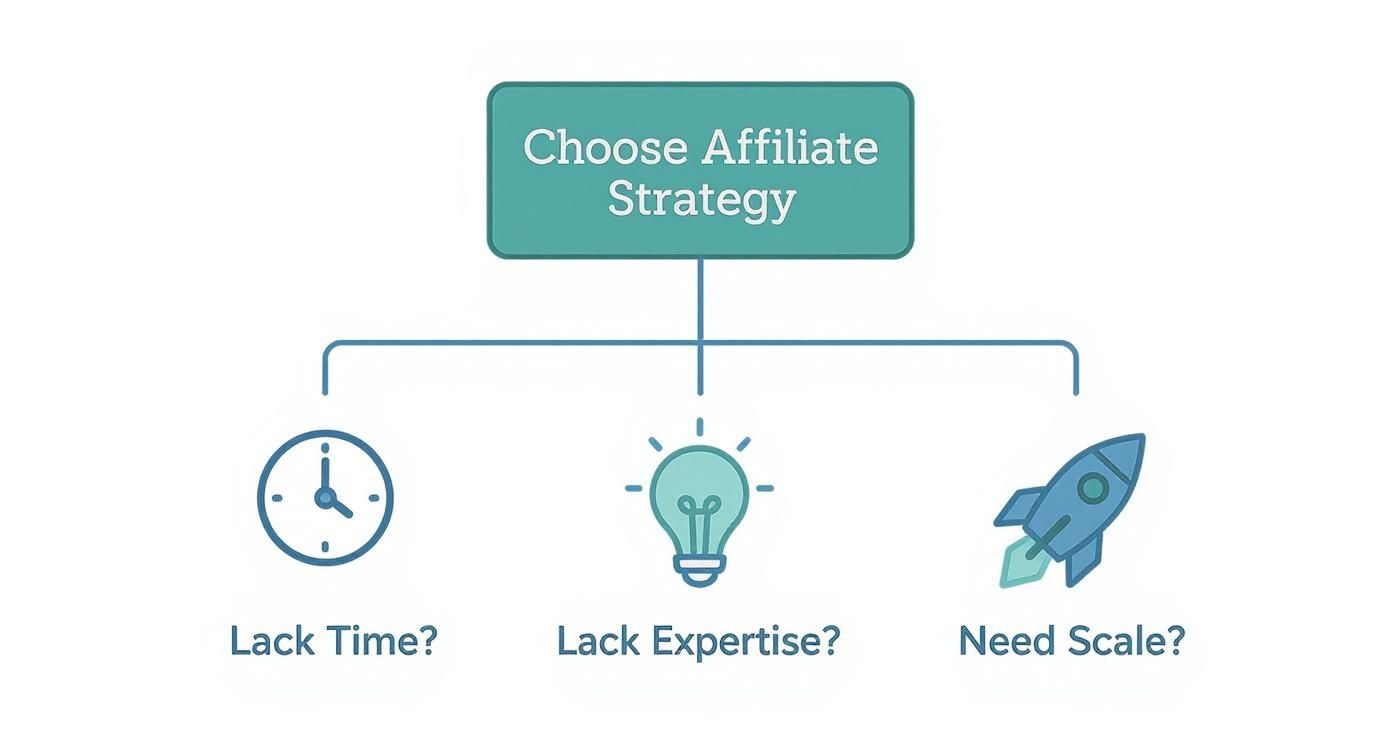
As you can see, while a firm might solve the expertise problem, a technology-first platform often delivers a more scalable and transparent solution. It puts the control right back where it belongs: with you. We'll dig into what that really means.
Understanding the Modern Alternative
The real difference comes down to the core approach. Firms offer managed services; platforms provide enabling technology. Think of it this way: a firm takes over the recruitment and management for you, but they often rely on manual work that’s tough to scale beyond a handful of partners. In contrast, a modern platform like Coral arms you with the tools to manage thousands of affiliates yourself—efficiently—while automating payments and giving you data in real-time.
The right partner shouldn't just run your program for you—they should give you the power to own it and scale it. Tech-driven solutions build the foundation for long-term, sustainable growth that manual management just can’t keep up with.
As you look at different options, it’s smart to understand the fundamentals, like effective blogger outreach strategies, since this is how most firms find new partners. It’s also helpful to get a feel for different payout models. We break down several commission structure examples in our detailed guide. Having this background knowledge makes it much clearer why a platform-based approach often ends up being more transparent, scalable, and cost-effective than a traditional firm.
Affiliate Agencies vs. Firms: What Is the Difference?

Many brands use "agency" and "firm" interchangeably, but in the affiliate world, the differences in their focus, cost, and expertise can make or break your program. Getting this distinction right is the first step to finding a partner who can actually help you grow.
An affiliate marketing agency is usually a jack-of-all-trades. They offer a broad menu of digital marketing services—think SEO, PPC, and social media—and affiliate management is just one slice of the pie.
On the other hand, an affiliate marketing firm is a specialist. These teams live and breathe affiliate and partner marketing. They bring a deeper well of experience, established publisher relationships, and a strategy built entirely around this one channel. To see the difference, you can look into what an SEO agency does and immediately see how different that focus is from a true affiliate specialist.
Evaluating Firm Reputation and Costs
So, how do you spot a good firm? A reputable partner will be an open book, with a clear track record, case studies, and client testimonials you can actually verify. They should be able to explain their strategy in plain English, not hide behind industry jargon.
A major red flag is any affiliate marketing firm that "guarantees" specific revenue figures. Reputable firms focus on a proven process and transparent reporting, not unrealistic promises.
Cost is obviously a huge factor for most brands. While this in-depth guide on choosing the right affiliate marketing agency is a great place to start, it's the hidden fees from traditional firms that often catch people by surprise. Beyond the monthly retainer, you could be on the hook for:
- Platform Fees: Many firms will pass along the hefty subscription costs for third-party affiliate networks.
- Setup Charges: You might see a one-time onboarding fee that can easily run into the thousands.
- Creative Costs: Need new banners, ads, or other assets? That’ll often be an extra charge.
How Coral Outperforms Traditional Firms
This is where the traditional model starts to show its cracks, especially for brands ready to scale. The global affiliate marketing market is on track to hit $31.7 billion by 2031, and that kind of growth requires a modern approach that most firms can’t provide.
Traditional firms are ultimately limited by their headcount and manual processes. It’s nearly impossible for a small team to effectively manage hundreds of partners, which means they inevitably focus on a handful of top performers and let countless long-tail opportunities slip through the cracks.
Coral flips this model on its head. As a platform, it provides the technology to manage thousands of affiliates all at once, automating everything from recruitment and tracking to payments. This approach gives you the infinite scalability that a service-based firm simply cannot match, all while delivering better results at a fraction of the cost.
Comparing Affiliate Firm Pricing and Service Models
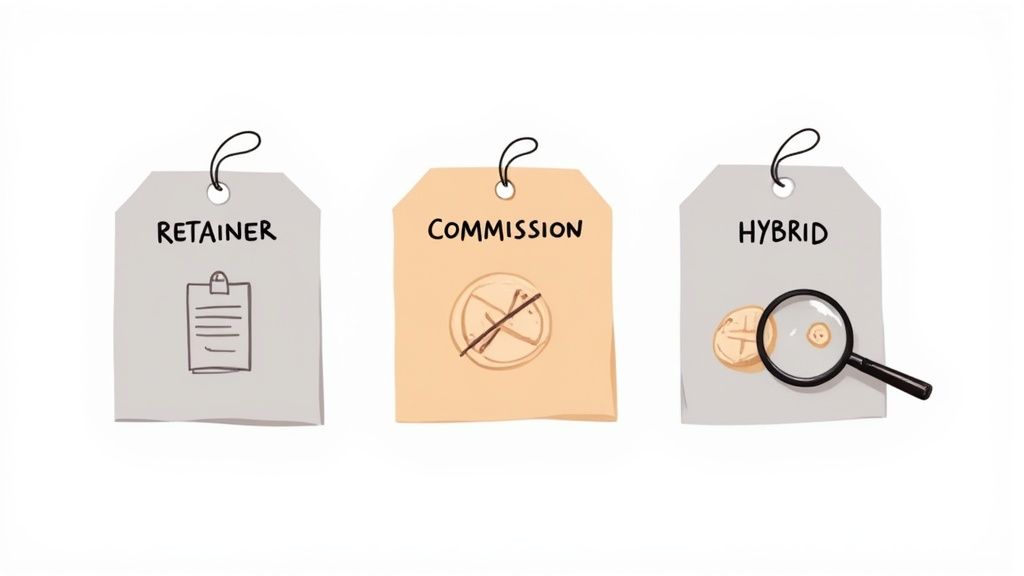
Trying to figure out what an affiliate marketing firm actually costs can be a head-scratcher. It often feels like the pricing is designed to be confusing. To make a smart decision, you have to look past the sticker price and really dig into the different payment models and what they mean for your budget and growth.
Most firms will pitch you a flat monthly retainer, a commission based on performance, or some combination of the two. A fixed retainer seems simple enough—you know what you’re paying each month. But watch out, because that’s rarely the whole story.
Exposing the Hidden Costs of Firms
When you sign with a traditional firm, that monthly retainer is just the starting line. The real costs are often tucked away in the contract details, creating a financial setup that protects the firm’s bottom line, not necessarily yours.
These extra charges can add up fast:
- Setup Fees: A one-time fee, sometimes several thousand dollars, just to get the program off the ground.
- Platform Subscriptions: You might be on the hook for expensive subscriptions to third-party affiliate networks on top of the firm's fee.
- Creative and Asset Charges: Need banners, ad copy, or other marketing materials? That'll be extra.
- Premium Placements: Getting featured by a major publisher often comes with a hefty placement fee, which gets passed straight to you.
This model can create a serious disconnect. The firm collects its retainer whether your program is booming or busting, leaving you holding all the financial risk. It's why so many brands are looking for more transparent partners, often starting with our guide to the best affiliate marketing agencies.
The biggest hidden cost isn't on any invoice—it's the missed opportunity. When a firm’s manual approach limits your program to just a few big-name affiliates, you’re missing out on the long-tail growth that truly successful programs are built on.
Why Modern Platforms Outperform Firms on Cost and Scale
A modern, tech-focused platform like Coral completely flips this old-school model around. Instead of shelling out for a high-retainer service that's limited by how many people are on staff, you invest in a tool designed for unlimited growth. Coral is built on efficiency, automating the time-consuming tasks that drive up a firm's overhead.
This approach leads directly to lower costs and better results. There’s no question that affiliate marketing is a powerful channel— 81.2% of marketers pull in over $20,000 a year from it. To get a piece of that action, you need a solution that can handle hundreds, or even thousands, of partners without your costs skyrocketing.
Here’s a simple table to break down the cost differences you’ll likely see.
Traditional Firm vs. Modern Platform Cost Comparison
| Cost Factor | Traditional Affiliate Firm | Modern Platform (e.g., Coral) |
|---|---|---|
| Primary Cost | Monthly Retainer: $3,000 - $10,000+ | Monthly/Annual Subscription: $500 - $2,000 |
| Setup Fees | Common: $1,000 - $5,000+ (one-time) | Rare to none |
| Commissions | 5% - 20% of affiliate revenue, often on top of retainer | Included in platform cost; you only pay affiliate commissions |
| Software Fees | Often requires separate, expensive network subscriptions | All-in-one; tracking and management are core features |
| Hidden Fees | Charges for creative assets, premium placements, reporting | Transparent pricing; features are included in the plan |
| Scalability | Costs increase significantly as you add more partners | Built to scale; manage thousands of partners for one flat fee |
As you can see, the numbers tell a clear story.
Coral provides that scalability. You get powerful automation for recruiting affiliates, tracking sales, and handling payments. This lets you build a huge, diverse network of partners that a traditional firm just can't manage effectively. With a tech-driven approach, your investment goes directly into growing your program—not just covering someone else's payroll. It delivers a much better ROI and puts you firmly in control.
A Practical Framework for Evaluating Firms

Picking the right affiliate marketing partner is one of the most critical decisions you'll make for your brand's growth. There are a ton of options out there, so you need a straightforward way to cut through the sales pitches and find a team that can deliver real, measurable results. Answering a few key questions will help you separate the true contenders from the pretenders.
First, let's talk language. While people throw around "agency" and "firm" interchangeably, a true affiliate marketing firm should have deep, specialized expertise. Their world should revolve around partner marketing, not a watered-down menu of other digital services. That singular focus is often the first sign of a potentially better partner.
How to Know If a Firm Is Reputable
A solid firm will be transparent and have a portfolio packed with verifiable case studies—complete with clear, specific metrics. Don't settle for vague success stories. Ask for the hard data showing their impact on KPIs like customer acquisition cost (CAC) and return on ad spend (ROAS).
Look for client testimonials on third-party review sites, and always ask for references you can actually speak with. Good firms will also be open about their strategies and how they report on progress. Their team should be able to walk you through their approach to affiliate program management in a way that directly connects to your business goals.
A huge red flag is any firm that "guarantees" specific revenue numbers. Real performance has a lot of variables. A trustworthy partner focuses on a proven process and transparent reporting, not on making unrealistic promises they can't possibly keep.
Uncovering the Hidden Costs
The monthly retainer is just the beginning. The hidden costs of working with a traditional affiliate firm can quickly eat into your budget, which is why you have to ask for a complete breakdown of every potential expense before you sign anything.
Here are some common hidden costs to look out for:
- Initial Setup Fees: Many firms charge a one-time fee, often thousands of dollars, just to get your program off the ground.
- Network Subscriptions: You might be on the hook for expensive subscriptions to affiliate networks like CJ Affiliate or ShareASale.
- Creative Production: Need new banners, ad copy, or other marketing assets? Those charges are rarely included in the retainer.
- Premium Placements: Fees for getting your products featured by top-tier publishers are almost always passed directly on to you.
Getting a handle on these costs is essential, especially when you consider how different markets perform. For example, the retail industry drives 44% of global affiliate commissions. Firms specializing in this space might have very different cost structures than those in other sectors. You can dig into these affiliate marketing revenue trends on eMarketer.com.
How Coral Outperforms Firms on Scalability and Results
This is where the traditional firm model really starts to show its cracks. A firm's capacity is tied directly to its headcount and the manual work they do. It’s nearly impossible for a small team to effectively manage hundreds—let alone thousands—of diverse partners, which is what you need for massive scale.
This is exactly why a technology-first platform like Coral presents a much stronger alternative. Coral is built from the ground up for unlimited growth. It automates all the time-consuming tasks that drive up a firm’s overhead and put a cap on how far they can take you.
Instead of paying a hefty retainer for a service that can only manage a handful of top affiliates, Coral gives you the power to build and manage a massive network of partners yourself. This direct-to-creator model delivers infinite scalability, real-time data, and total control over your program—all at a fraction of the cost. The result is a more efficient, transparent, and powerful way to drive sustainable, long-term growth.
Why Modern Platforms Have the Edge Over Traditional Firms
While a traditional affiliate marketing firm can bring valuable expertise to the table, their service-based model inherently comes with limitations in scale, cost, and transparency. For ambitious Amazon brands looking for serious growth, a modern platform like Coral offers a powerful alternative. It shifts the focus from manual account management to tech-driven empowerment.
The fundamental difference is simple but profound. A firm's capacity is tied to its headcount. A platform's capacity is virtually limitless.
How a Platform Unlocks Unmatched Scale
Think about what it takes to manage relationships with thousands of individual content creators. For a firm, that’s a logistical nightmare. It’s a manual, expensive process that naturally leads them to focus on just a handful of top partners, leaving countless long-tail opportunities on the table.
This is exactly where a technology-first approach changes everything. Platforms like Coral are built from the ground up to handle massive scale by automating the most time-consuming work:
- Effortless Onboarding: You can manage thousands of new affiliate applications through a single, clean system.
- Automated Payments: Say goodbye to manually calculating and sending out commissions.
- Centralized Communication: Engage with your entire partner network at once, not one by one.
A firm might do a great job managing a dozen high-value partners. A platform, on the other hand, gives you the power to manage thousands, unlocking a diverse and resilient revenue stream that firms simply can't build for you.
Exposing Hidden Costs and Murky Reporting
One of the biggest frustrations brands have with agencies is the lack of clarity—both in what they’re paying for and the results they’re getting. The typical retainer model often comes saddled with hidden fees for setup, network access, or premium placements, making it tough to know the true ROI of your investment.
Reporting is another common pain point. Firms often provide static, delayed monthly reports that give you a limited, backward-looking view of performance. This opacity makes it nearly impossible to make quick, data-driven decisions to optimize your campaigns.
In contrast, a platform like Coral provides total transparency. The pricing is straightforward, and you get a real-time dashboard showing every click, conversion, and commission as it happens. You own the data and the relationships, putting you firmly in control of your program's destiny. For a deeper look at the tools that power this, check out our guide on affiliate program software.
How Coral Drives Better Results
By swapping manual labor for powerful automation, Coral helps you get better results at a fraction of the cost. Your investment goes directly into technology that scales your program, not into a firm’s overhead.
This efficiency means you can build a broader, more diverse affiliate network that's more resilient to market changes. Instead of depending on a few "super affiliates," you can cultivate a thriving community of brand advocates, each contributing to your long-term success. The outcome is a more scalable, transparent, and cost-effective affiliate program that consistently outperforms the traditional agency model.
Your Top Questions About Affiliate Firms, Answered
Even when you've done your homework, a few questions always pop up when it's time to make a decision. Let's tackle some of the most common concerns brands have when they're thinking about hiring an affiliate marketing firm.
What's the Difference Between Agencies and Firms?
You'll hear these terms used interchangeably, but there's often a subtle difference. An affiliate marketing agency is usually a jack-of-all-trades, offering a buffet of digital marketing services where affiliate is just one dish. On the other hand, an affiliate marketing firm tends to be a specialist, focusing exclusively on partner and affiliate marketing.
This specialization usually means they have deeper expertise and pre-existing relationships with publishers. The catch? Both models are often stuck in the past, relying on manual work that just doesn't scale. It's why many brands eventually look for a tech-first solution that can handle thousands of partners without the massive overhead.
How Do I Know If a Firm Is Reputable?
A good firm doesn't hide behind smoke and mirrors. They should be completely transparent, showing you a portfolio of case studies with real, verifiable numbers—not just fluffy success stories. Don't be shy about asking for client references and look for reviews on third-party sites.
A huge red flag is any affiliate marketing firm that "guarantees" you'll hit certain revenue numbers. Real performance can fluctuate. A partner you can trust will focus on a proven process and clear reporting, not on making pie-in-the-sky promises.
If they're cagey about their strategies or their reporting feels like a "black box," it’s a good sign to walk away.
What Are the Hidden Costs of Working with Firms?
That monthly retainer you were quoted? It's almost never the final number. Traditional firms have a knack for tacking on extra costs that can make your budget swell. Make sure you ask specifically about these:
- Setup Fees: These are one-time charges for getting you onboarded, and they can easily run into the thousands.
- Platform Subscriptions: You might be on the hook for expensive affiliate network subscriptions in addition to their management fee.
- Creative Production: Need new banners or ad copy? That'll likely be an extra charge.
- Premium Placements: The fees for getting your product featured by a top-tier publisher? They're almost always passed straight on to you.
When you add it all up, the traditional firm model can become a real financial drain, especially when compared to a platform with simple, all-inclusive pricing.
How Does Coral Outperform Traditional Firms in Scalability and Results?
It really boils down to one thing: technology versus manual labor. A traditional affiliate marketing firm is limited by its headcount. An account manager can only juggle so many high-touch relationships before things start slipping. This human element puts a hard ceiling on how much your program can actually grow.
Coral, on the other hand, is a platform built to scale infinitely. It automates all the tedious, time-sucking tasks that bog down firms—think onboarding, tracking, and payments. This frees you up to manage thousands of affiliates at once, from major publications to tiny, niche micro-influencers. You can build a diverse, resilient affiliate program that a firm simply can't replicate.
In the end, this efficiency leads to much better results at a fraction of the cost. With a platform, your money goes directly into technology that fuels your growth, not a firm's payroll and office rent. That means a better ROI and, best of all, you're in the driver's seat.
Ready to take control of your affiliate program with a solution built for scale? Coral provides the tools you need to build, manage, and grow your affiliate network on your own terms. Start your free trial today.