Is a High-Priced Amazon PPC Management Agency Worth It?
Category: Amazon ppc management agency
An Amazon PPC management agency is a team of specialists you hire to run your brand's pay-per-click advertising. They handle everything from high-level strategy to daily campaign tweaks. While the goal is always to get more eyes on your products and drive sales, this partnership comes with a hefty price tag, leaving many brands wondering if there's a more cost-effective way to achieve better results.
The Real Cost of Amazon PPC Management

Let's be honest: navigating Amazon's marketplace is tougher than ever. With over 9.7 million sellers all fighting for the same customer attention, a solid advertising strategy isn't just a nice-to-have; it's a matter of survival. This cutthroat competition is why so many brands turn to an Amazon PPC management agency for help. If you want to dive deeper into this landscape, check out this perspective from Canopy Management.
These agencies offer services designed to help you rise above the noise. At their core, they manage the often-confusing world of Amazon's ad platform to make sure your budget is being spent as effectively as possible.
Core Services of a PPC Agency
A good Amazon PPC management agency will take several critical tasks off your plate to get more traffic and sales. Their day-to-day work usually includes:
- Keyword Research and Targeting: They dig deep to find the exact search terms your ideal customers are typing into Amazon.
- Bid Management and Optimization: This involves constantly adjusting bids on keywords to get you the best ad placement without overspending.
- Campaign Structuring: They organize your ads into smart campaigns (like Sponsored Products or Sponsored Brands) that align with your business objectives.
- Performance Reporting: You get regular reports on key metrics like click-through rates (CTR), conversion rates, and your Advertising Cost of Sale (ACoS).
These services are undoubtedly valuable, but they come at a cost. The way most agencies charge can quickly become a significant financial drain, especially for growing brands trying to stay profitable.
The Problem with Traditional Agency Pricing Models
The biggest headache for many sellers when hiring an agency is the fee structure. It often feels like you're paying for effort, not results, and you're frequently locked into expensive contracts before you've seen a single dollar in return.
Here are the most common pricing models you'll encounter:
- Hefty Monthly Retainers: You pay a flat fee every month, regardless of sales performance. This can easily run from hundreds to thousands of dollars.
- Percentage of Ad Spend: The agency takes a cut of your total advertising budget. This creates a conflict of interest where the agency makes more money when you spend more, not necessarily when you sell more.
This cycle of high spending for uncertain returns is a major pain point. Brands are forced to invest significant capital upfront, hoping the agency's efforts will eventually pay off, which is a risky proposition for any business.
This expensive, high-risk model is exactly why many brands are starting to look for more modern and cost-effective solutions. Instead of paying for promises, smart sellers are moving toward platforms that reward actual results, tying every dollar spent directly to revenue. The fundamentals of PPC on Amazon are shifting, and performance-based affiliate marketing is showing everyone a better way forward.
Getting to Grips with Agency Costs and Performance

Handing over the keys to an Amazon PPC management agency can feel like a smart move for scaling your brand. But before you sign on the dotted line, it's vital to understand the financial and strategic trade-offs. The hidden complexities in how agencies charge and report on results can quickly turn a hopeful partnership into an expensive headache.
The biggest red flag for many brands is the percentage-of-ad-spend pricing model. While it sounds simple enough, this structure can create a serious conflict of interest. When an agency’s income is tied directly to your ad budget, their incentive is to get you to spend more, not necessarily to make you more profitable.
The Challenge of Tracking Agency Performance
One of the most common frustrations for brands working with agencies is how hard it is to track what’s actually working. Reports are often packed with vanity metrics that paint a rosy picture but don't tell the whole story.
- Impressions: A huge impression count just means your ad was shown a lot. It says nothing about whether the right people saw it or if it led to a single sale.
- Clicks: Clicks are a step up from impressions, but they only signal initial interest. A high click-through rate (CTR) is useless if you're just paying for traffic that never converts.
- Opaque Attribution: It can feel impossible to draw a straight line from specific agency actions to real sales growth, leaving you wondering what you're actually paying for.
This focus on top-of-funnel metrics completely misses the point: profitability. Brands get caught in a loop of spending more to chase clicks, all while the real cost of acquiring a customer eats away at their bottom line.
This lack of clarity makes it a nightmare to calculate your true return on investment. If this sounds familiar, our guide on how to measure marketing ROI can give you a solid framework for focusing on what matters. Real performance isn't about ad spend; it's about profitable, sustainable growth.
Coral: The Cost-Effective, Performance-Based Alternative
This is where Coral's affiliate marketing platform flips the script entirely. Instead of locking you into hefty retainers or a percentage of your ad spend, you move to a performance-based model. With Coral, you only pay a commission when an affiliate partner drives an actual sale. It’s that simple.
This model completely realigns everyone's goals. Your partners—whether they're influencers, bloggers, or brand ambassadors—are motivated to promote your products effectively because their income depends on the revenue they generate for you. There's zero upfront risk, and you stop paying for effort that doesn't produce results.
Let’s look at a realistic scenario. An agency charges a $2,000 monthly retainer plus 15% of ad spend. If you spend $10,000 on ads, your total cost for the agency is $3,500. Even if those ads bring in $30,000 in sales (a 33% ACoS), your marketing costs are sky-high before you even account for the cost of your products.
Now, imagine you used Coral and set a 10% affiliate commission. To generate that same $30,000 in sales, you would pay out $3,000 in commissions—with no upfront costs or retainer fees. Every single dollar you spend is directly tied to a confirmed sale, which makes your ROI crystal clear and completely guaranteed.
Comparing Agency Management to Affiliate Marketing
When it comes to scaling your Amazon business, you'll eventually hit a fork in the road. Do you hire a traditional Amazon PPC management agency, or do you explore a more modern, performance-based approach like affiliate marketing? The difference isn't just about what you pay; it’s about risk, motivation, and what you both consider a "win."
Looking closely, a platform like Coral often presents a much more scalable and financially sound path forward.
The biggest contrast is the cost. Most agencies work on a fixed monthly retainer or take a percentage of your ad spend. This means you’re paying them whether your sales are booming or completely flat, creating a pretty significant upfront financial risk. You’re essentially betting on a future return with no guarantees.
An affiliate marketing model completely flips that script. With a platform like Coral, you only pay a commission when a sale is actually made. This pay-per-sale structure means every single marketing dollar is tied directly to revenue. It’s a simple, powerful way to guarantee a positive return on every transaction.
This chart shows some of the key metrics that both agencies and affiliates are trying to optimize, but their financial models for getting there are worlds apart.
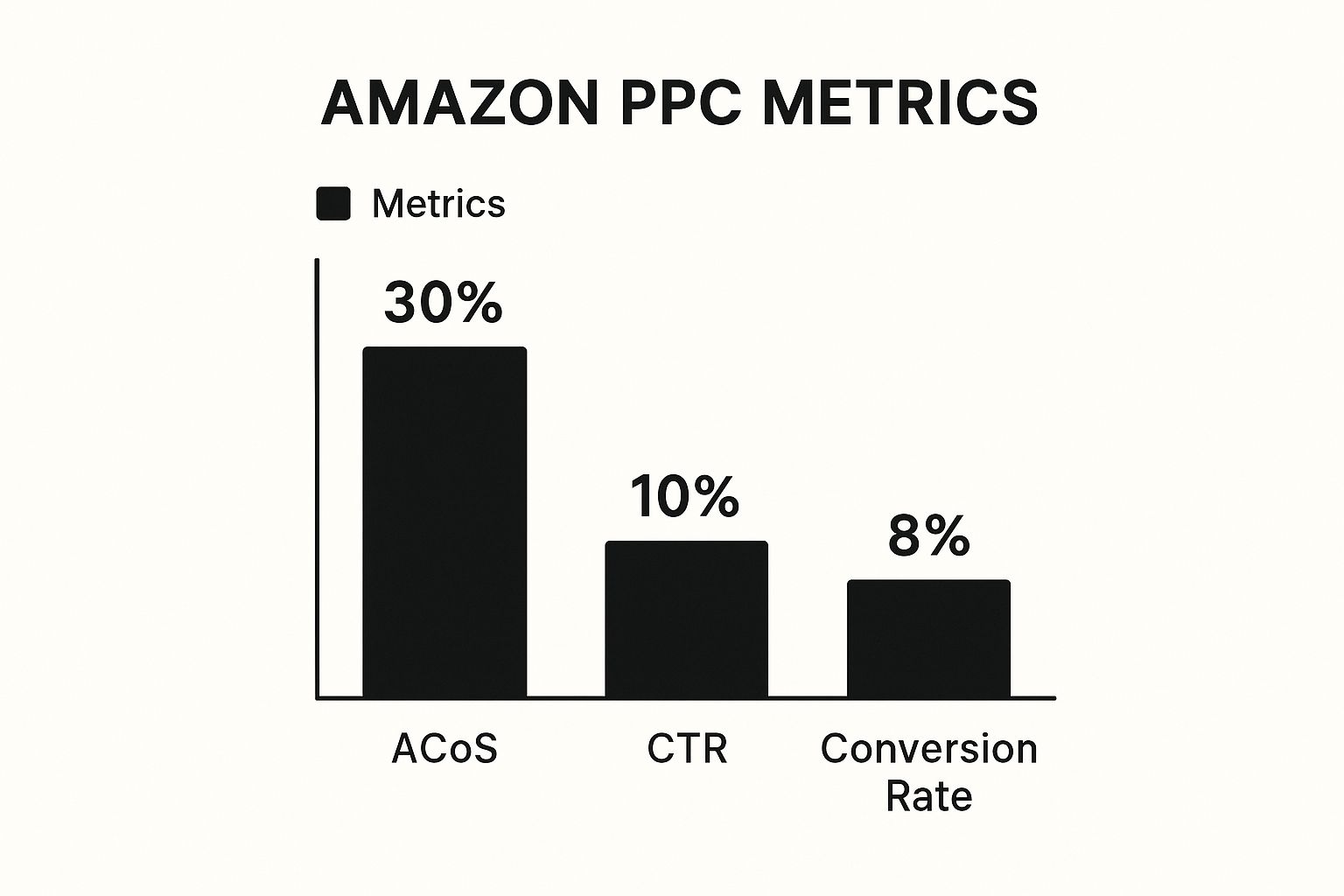
As you can see, you need a solid conversion rate to make the costs associated with ACoS and generating clicks worthwhile.
Aligning Incentives for True Growth
The motivation behind the work is another critical difference. When an agency’s fee is tied to ad spend, their main incentive can easily become encouraging you to spend more. While more ad spend can lead to more sales, it doesn't always lead to more profit. Often, it just leads to a bloated Advertising Cost of Sale (ACoS).
In contrast, an affiliate's goals are perfectly aligned with yours. Affiliates, influencers, and brand ambassadors only make money when they successfully sell your product. This shared objective motivates them to create authentic, engaging content that genuinely convinces people to buy, not just drive empty clicks.
With an affiliate model, you aren't paying for ad spend or effort; you are paying exclusively for results. This shifts the focus from vanity metrics like impressions to the only metric that truly matters—profit.
This setup naturally creates a partnership where your success is their success. For sellers thinking about this route, learning how to master Amazon affiliate marketing on Pinterest is a great example of a direct strategy for promoting products and driving targeted sales—something an agency can't always guarantee.
Performance Tracking: Murky Reports vs. Transparent Attribution
One of the most common frustrations brands have with agencies is murky performance tracking. Reports can be a maze of complex data, making it tough to figure out what specific actions actually led to a sale. This lack of clear attribution often leaves you wondering what you're really getting for your money.
Coral solves this with a transparent attribution system powered by direct Amazon Attribution integration. This provides crystal-clear tracking, letting you see exactly which affiliate partner drove which sale. There's no guesswork. This transparency makes it easy to measure the direct impact of your affiliate program and make smart decisions based on real data.
The average conversion rate for Amazon PPC ads hovers between 10% and 15%, which is why it's such a powerful channel. But with the average cost-per-click (CPC) at $0.91 in the US, those costs can get out of hand fast. An affiliate model bypasses the per-click cost entirely, ensuring you only ever pay for the final conversion.
Amazon PPC Agency vs. Coral's Affiliate Platform: A Head-to-Head Comparison
To see the differences side-by-side, let's break down how these two approaches stack up against each other on the most important criteria.
| Criteria | Traditional Amazon PPC Agency | Coral Affiliate Marketing Platform |
|---|---|---|
| Cost Structure | Fixed monthly retainers or % of ad spend. You pay regardless of sales. | Commission-based. You pay only after a confirmed sale. |
| Financial Risk | High. Significant upfront investment with no guaranteed ROI. | Zero. No cost unless you make a sale, guaranteeing a positive return. |
| Incentive Alignment | Agency is incentivized to increase ad spend, which may not increase profit. | Affiliates are incentivized to drive sales, directly aligning with your goals. |
| Performance Tracking | Can be complex and opaque, making true ROI difficult to measure. | Direct Amazon Attribution integration for clear, transparent, per-sale tracking. |
| Focus | Often on campaign metrics like clicks, impressions, and ACoS. | Solely on the ultimate goal: driving profitable sales. |
Ultimately, choosing a performance-based platform like Coral over a traditional agency offers a more direct, low-risk path to profitable and sustainable growth on Amazon.
Why Affiliate Marketing Just Delivers a Better ROI
While bringing on an Amazon PPC management agency can feel like the right move for growth, real success isn't about getting more clicks—it's about making more profitable sales. This is exactly where many agency relationships stumble. Their complicated fee structures and often cloudy reporting can make it tough to see what your true return on investment (ROI) really is. The conversation needs to change from spending more to earning more.
In sharp contrast, a performance-based affiliate marketing model, like the one we've built at Coral, is designed from the ground up to deliver measurable, positive ROI. The biggest difference is its transparent, pay-per-sale structure. You only pay a commission after a sale is confirmed, which means every single dollar you spend on marketing is directly tied to revenue.
The Power of a Pay-Per-Sale Model
Traditional agency models ask you to pay upfront. You’re on the hook for hefty monthly retainers or a percentage of your ad spend, all with no guarantee of results. You're shouldering all the financial risk, just hoping their campaigns eventually pay off.
A pay-per-sale affiliate model completely flips that script, putting you back in control. Here’s how simple it is:
- You Set the Commission: You decide what percentage of a sale you're willing to pay an affiliate. This keeps your profit margins protected.
- Affiliates Drive Sales: Your network of creators, influencers, and brand fans promote your products to their audiences.
- You Only Pay for Results: When an affiliate drives a successful sale, you pay them the commission you set. If they don't generate sales, you don’t pay a dime.
This direct link between cost and revenue is the key to a superior ROI. You're no longer spending money on clicks or impressions that might not convert. Instead, your budget is tied only to profitable outcomes.
Clear Attribution vs. Murky Reporting
One of the most frustrating parts of working with an agency can be attribution. Trying to figure out which specific agency action led to which sale can feel impossible, leaving you wondering what you’re actually paying for. Reports are often stuffed with vanity metrics that look impressive but don't really impact your bottom line.
Coral solves this by integrating directly with Amazon Attribution. This system gives you a crystal-clear, easy-to-read view of your affiliate performance. You can see exactly which partner drove each sale, giving you undeniable proof of your program's impact on your business. There’s no more guesswork—just clean, actionable data.
As the marketplace gets more crowded, that kind of clarity is non-negotiable. With third-party sellers projected to account for 61-62% of all paid units sold on Amazon in 2025, you need paid visibility that works. The problem is, not every Amazon PPC management agency delivers the transparent results needed to truly win.
A Practical ROI Breakdown
Let's look at a straightforward, hypothetical example to see the difference in action.
Scenario 1: The PPC Agency
An agency charges you a $2,500 monthly retainer. They also manage a $5,000 ad budget for you, which generates $20,000 in sales.
- Your total marketing cost is $7,500 ($2,500 retainer + $5,000 ad spend).
- This gives you an ACoS of 37.5%. While your ROI is positive, those fixed costs are eating into your margins.
Scenario 2: Coral's Affiliate Platform
You decide on a 12% commission rate for your affiliates. To generate that same $20,000 in sales, you would pay out $2,400 in commissions.
- There are no retainers and no upfront ad spend.
- Your marketing cost is a predictable 12% of revenue, protecting your profit on every single sale.
The difference is night and day. The affiliate model gives you predictable costs and guarantees profitability from the start, making it a much more efficient and scalable way to grow. For brands looking to build a sustainable sales channel, launching an affiliate program for ecommerce is a smart move away from high-risk advertising and toward guaranteed returns.
How to Build a Cost-Effective Growth Engine
Moving away from a pricey Amazon PPC management agency isn’t just about saving money. It’s about building a smarter, more sustainable way to grow your brand. Instead of pouring cash into ads and hoping for the best, you can build a powerful sales channel where you only pay for actual, confirmed results. The path forward is surprisingly straightforward and puts you back in the driver's seat.
The first step is a mental shift. Stop renting an audience with ads and start owning a network of genuine brand advocates. An affiliate marketing program lets you partner with creators, influencers, and bloggers who have already earned the trust of your ideal customers. You’re essentially swapping cold, impersonal ad clicks for warm, authentic recommendations.
Launching Your Affiliate Program
You might be surprised how simple it is to get an affiliate program off the ground, especially with a platform like Coral handling the heavy lifting. The whole process is designed to be quick, getting you from zero to new sales in just a few steps.
- Set Your Commission: Figure out a commission rate that’s competitive enough to attract good partners but still protects your profit margins. This percentage is your only cost, and it’s only paid after a sale happens.
- Build a Branded Home Base: Use a tool like Coral to create a professional landing page for your program. This is your recruitment hub where potential partners can learn about your brand and sign up.
- Onboard Your Partners: Start by inviting your existing network—think loyal customers, creators you admire, and brand fans. A modern platform automates the entire sign-up and onboarding flow, making it a breeze for them to join.
- Track Everything with Confidence: Thanks to direct Amazon Attribution integration, you can watch every sale roll in in real-time. There’s no guesswork; you know exactly which partner drove which sale.
This model flips the script, moving you from a high-risk, high-cost ad strategy to a predictable, performance-based one.
The key takeaway is this: A well-managed affiliate program isn't just a replacement for an agency. It's a strategic pivot toward building a scalable and truly profitable new sales channel, all powered by partners who are invested in your success.
Overcoming Common Hurdles with Automation
Two of the biggest headaches that make brands hesitant about affiliate programs are finding good partners and dealing with payouts. Thankfully, today’s platforms are built to solve these exact problems. While Coral doesn’t currently have an affiliate discovery marketplace, it gives you all the tools you need to easily recruit and onboard partners from your own network of brand advocates.
If you’re just getting started, getting the fundamentals right is key. Our guide on affiliate program management offers a complete roadmap for building a successful program from scratch.
What about payments? That used to be a logistical nightmare, but now it’s completely automated. The platform handles all the tracking, commission calculations, and payouts for you. This frees you up to focus on what matters most: building strong relationships with your partners. This kind of efficiency means your program can scale without friction as your affiliate network grows, turning a once-complex task into a simple, automated workflow. The result is a cost-effective growth engine that runs on real partnerships and guaranteed ROI.
Frequently Asked Questions
When you're figuring out how to grow your Amazon brand, you'll likely hit a fork in the road: do you hire a traditional Amazon PPC management agency or try a modern affiliate marketing platform? It's a big decision, so let's walk through the common questions that come up.
Is an Agency or an Affiliate Platform More Cost-Effective?
This is usually the first thing people ask, and the answer really depends on what "cost-effective" means to you. A typical Amazon PPC agency comes with some hefty upfront costs. You're looking at monthly retainers anywhere from $500 to $5,000, or they'll take a cut of your total ad spend. The catch is, you pay these fees whether they make you a single sale or not, which can feel like a high-stakes gamble.
An affiliate platform like Coral flips that model on its head. It’s all performance-based. You only pay a commission after a sale is made and confirmed. This pay-per-sale approach completely removes the upfront financial risk and pretty much guarantees a positive return on every dollar you spend. Think of it this way: an agency asks you to pay for their effort, while an affiliate platform lets you pay only for results.
For any brand keeping a close eye on profitability and predictable costs, a commission-based affiliate model is almost always the smarter financial move. It locks your marketing spend directly to your revenue, protecting your margins on every single sale.
How Does Performance Tracking Differ?
This is a huge point of difference. Many agencies will hand you reports loaded with top-of-funnel metrics—things like clicks and impressions. Sure, big numbers can look good on paper, but they don't always connect directly to sales, making it tough to figure out your true marketing ROI measurement. You can be left scratching your head, wondering what your money actually accomplished.
Coral, on the other hand, gives you a completely transparent look at performance by plugging directly into Amazon Attribution. This means you get crystal-clear, real-time data on every single sale your affiliate partners drive. You can see exactly which creator drove which sale, taking all the guesswork out of the equation. That kind of clarity lets you make sharp, data-backed decisions and see the real impact of your program.
Which Option Offers Better ROI?
Both an agency and an affiliate program want to boost your sales, but how they affect your Return on Investment (ROI) is night and day. An agency's model, with its fixed retainers and ad spend percentages, can quickly inflate your Advertising Cost of Sale (ACoS). So even if sales are climbing, those high overhead costs can chew right through your profits, tanking your overall ROI.
Affiliate marketing, by its very nature, delivers a much stronger ROI because the cost is just a fixed, predictable percentage of your revenue. You set the commission rate, so you're in complete control of your margins from day one. Every sale is profitable by design. There are no retainers or hidden fees to worry about—just a simple cost tied directly to a successful sale, which always leads to a healthier bottom line.
Can an Affiliate Program Replace My PPC Agency?
For a lot of brands, the answer is a firm "yes." While PPC on Amazon has its place, handing it all over to an agency can be an expensive and often inefficient way to go. An affiliate program gives you a more sustainable, scalable, and profitable path to growth.
Instead of just "renting" an audience with ads, you're building a genuine network of brand advocates who have already earned the trust of your ideal customers. Moving from impersonal ads to authentic recommendations from trusted voices usually results in much higher conversion rates and a more loyal customer base. Launching an affiliate program for ecommerce isn't just about swapping out an agency; it’s a fundamental upgrade to your entire marketing strategy.
What if I Have a Small Budget?
If you're working with a tight budget, an affiliate marketing platform is practically a no-brainer. The high upfront costs of an Amazon PPC management agency can be a major barrier for smaller or newer brands. Forking over a few thousand dollars for a monthly retainer before you've even seen a result is a massive financial risk.
With a platform like Coral, there's zero upfront investment. You can start building your affiliate network without spending a cent and only pay when you actually make money. This risk-free approach allows brands of all sizes to build a powerful sales channel that grows right alongside their business. It’s the perfect growth engine when every dollar counts.
Ready to stop paying for effort and start paying for results? With Coral, you can launch your own Amazon affiliate program, team up with creators you trust, and only pay when sales are confirmed. It’s the smarter, more affordable way to scale your brand.