What Is a B2B Influencer Marketing Agency? A Guide for Amazon Brands
Category: B2b influencer marketing agency
A B2B influencer marketing agency is a specialized partner for brands that sell to other businesses. On Amazon, they connect you with credible industry experts and respected thought leaders whose opinions directly influence purchasing decisions.
This isn't about finding influencers with a million followers. It's about building genuine relationships with figures like industry analysts, seasoned practitioners, and niche experts who can build trust in a way that traditional marketing simply can't.
What is a B2B influencer marketing agency?
For an Amazon brand in the business-to-business space, a B2B influencer marketing agency is your strategic connector. Their primary job is to find, vet, and manage relationships with professionals whose endorsements carry real weight with your ideal business customers.
These agencies operate very differently from their B2C counterparts. They focus on an influencer’s credibility, authority in a specific field, and direct relevance to your niche. This is critical because B2B buyers don't make decisions based on flashy endorsements; they rely on deep expertise and trusted analysis. While a typical affiliate marketing agency is laser-focused on generating sales through commissions, a B2B agency's goals are usually much broader.
A great agency understands that B2B sales cycles are long and complex. Their campaigns aren't about quick wins; they're designed to build a foundation of trust that guides buyers through a multi-step decision-making process.
The core difference is the shift from "vanity metrics" to "trust metrics." A whitepaper co-authored with a respected industry analyst will almost always deliver more long-term value than a viral video from a general creator.
Ultimately, these agencies handle everything from initial strategy and influencer outreach to campaign execution and measuring the real ROI. For Amazon brands that need to establish serious credibility in their market, a specialized agency provides the expertise to get it done. Over time, as your program matures, platforms like Coral enable brands to manage B2B influencer relationships directly, reducing agency dependency.
How do B2B agencies differ from B2C agencies?
If you’re an Amazon brand owner who lives and breathes direct-to-consumer strategy, stepping into the world of B2B influencer marketing can feel like a different world. While both B2B and B2C agencies work with influencers, the people they target, the tactics they use, and the timelines they work on are worlds apart.
B2C agencies are all about mass appeal. They partner with lifestyle creators and big personalities who can generate widespread awareness and trigger impulse buys. Their content is usually aspirational, entertaining, and built for instant gratification on platforms like Instagram and TikTok. The goal is straightforward: get in front of as many consumers as possible and turn them into customers, fast.
On the other hand, B2B agencies are built on a foundation of credibility and expertise. They aren't chasing huge follower counts. Instead, they're looking for industry analysts, seasoned practitioners, and niche thought leaders who can sway a much smaller, highly specific group of professional decision-makers.
Core Differences in Approach
The biggest difference comes down to the audience's mindset. A consumer might buy a new gadget after watching a 30-second video, but a procurement manager needs hard data, solid case studies, and a trusted recommendation before signing off on a new business tool. A true B2B influencer marketing agency understands this. They know the buying journey is longer, more complex, and built on trust.
This visual breaks down the three pillars of a B2B agency's work: strategy, connection, and measurement.
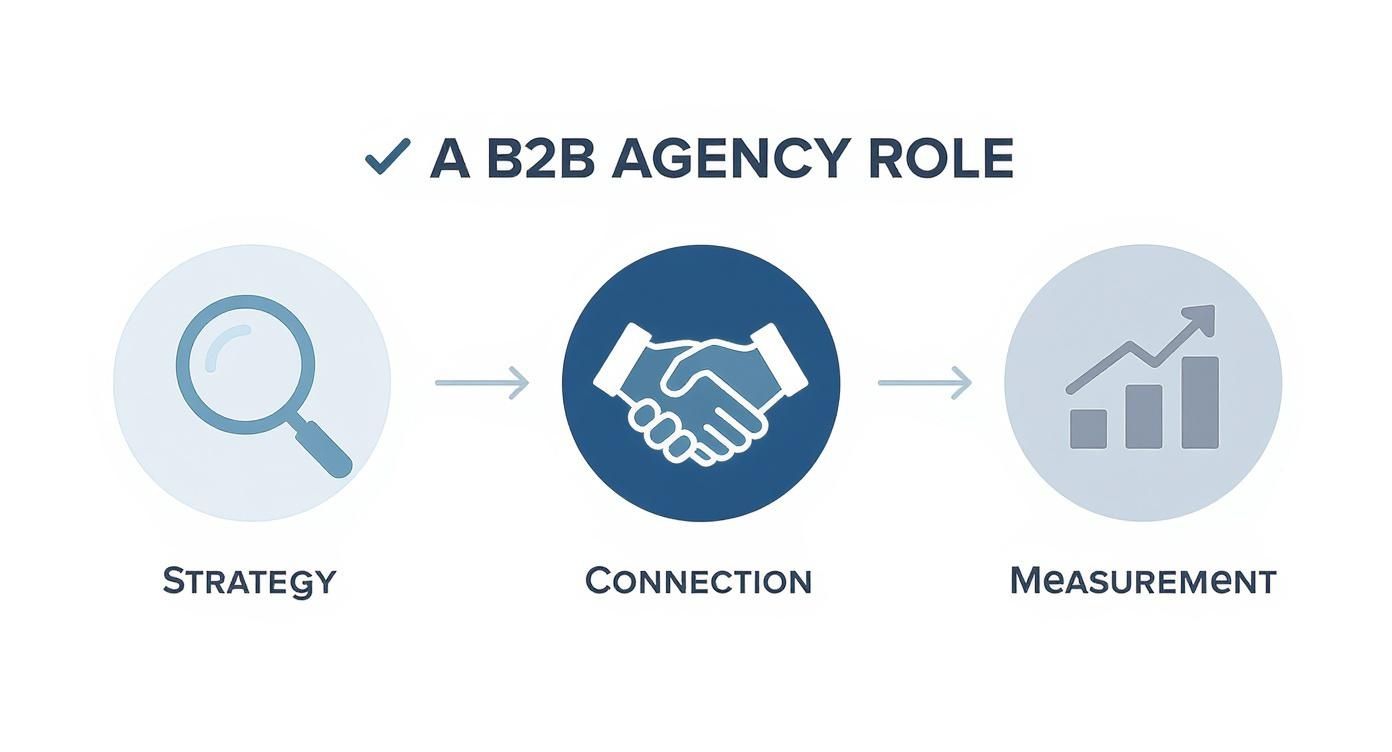
As you can see, a B2B agency's job goes way beyond just finding influencers. It involves deep strategic planning from the start and careful performance tracking at the end.
To make these distinctions crystal clear, here’s a side-by-side look at how these two types of agencies operate.
Core Differences B2B vs B2C Influencer Agencies
This table breaks down the fundamental differences between B2B and B2C influencer marketing to help you choose the right kind of partner.
| Characteristic | B2B Agency Focus | B2C Agency Focus |
|---|---|---|
| Primary Goal | Lead generation, building trust, establishing thought leadership. | Brand awareness, direct sales, driving impulse purchases. |
| Influencer Type | Industry experts, analysts, practitioners, thought leaders. | Celebrities, lifestyle creators, macro-influencers. |
| Key Metric | Quality of leads, audience engagement, content downloads. | Follower count, reach, likes, direct sales conversions. |
| Content Style | Educational, data-driven (whitepapers, webinars, case studies). | Aspirational, entertaining (unboxing videos, lifestyle content). |
| Sales Cycle | Long and complex, involving multiple decision-makers. | Short and simple, often an immediate, emotional decision. |
| Platform Focus | LinkedIn, industry forums, professional blogs, Twitter (X). | Instagram, TikTok, YouTube, Facebook. |
Ultimately, choosing the right agency means matching their expertise to your specific audience and goals. A B2C agency just won't have the right playbook for a professional market.
Campaign Goals and Content Style
While a B2C campaign might chase viral reach and immediate sales, B2B goals are all about building long-term trust and generating highly qualified leads.
The content is a dead giveaway. Instead of a flashy unboxing video, a B2B influencer might co-author a technical whitepaper, host an in-depth webinar, or publish a detailed review that breaks down a product’s features for a specific business use case.
Their audience craves educational, data-driven content that helps them solve a real business problem. These influencers aren’t just promoters; they are often true brand advocates who genuinely believe the product delivers real value. You can get a much deeper look into what are brand advocates in our detailed guide.
This is a critical distinction for any Amazon brand selling to other businesses. If you try to apply a B2C mindset—focusing on vanity metrics and entertainment instead of expertise—you’ll completely miss the mark with a professional audience and see a poor return on your investment. A specialized agency ensures your strategy is built for the methodical, trust-first buying process that defines the B2B world.
What services should you expect from a B2B influencer agency?
When you're evaluating a potential B2B influencer marketing agency, you need to know what a real partnership includes. It’s about more than just finding people with large followings. A top-tier agency brings a full suite of services designed to build real credibility and drive business results for your Amazon brand.
A great agency doesn't just execute tasks; it builds the strategy with you. Their work should begin with a deep dive into your brand, your ideal customer, and your business objectives. From there, they map out the entire campaign, covering everything from the core messaging to how success will be measured.
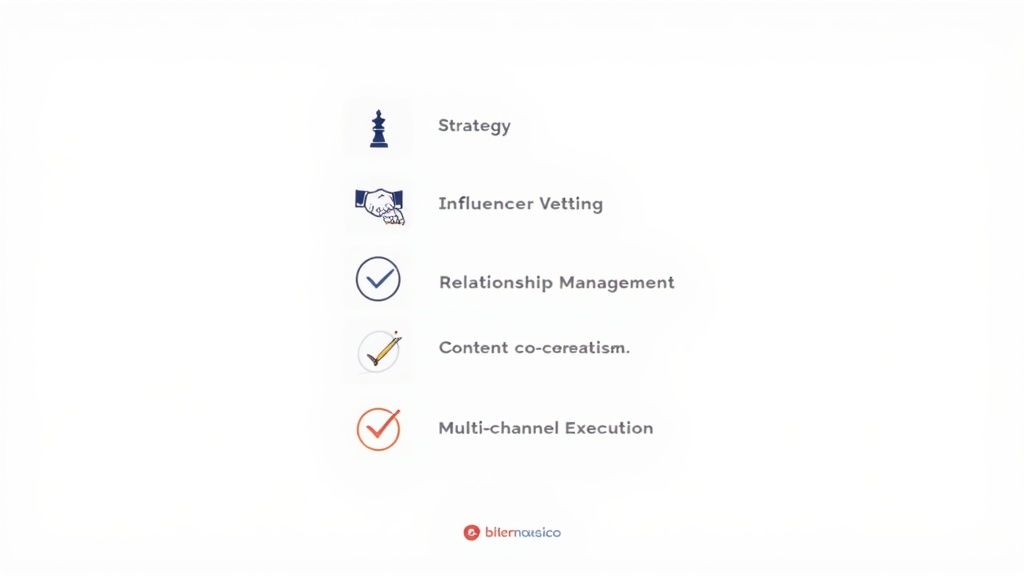
Core Agency Offerings
Any serious agency should have a core set of offerings that are non-negotiable. Think of this as your must-have checklist when you're evaluating potential partners:
- Strategic Planning: The agency should develop a clear plan tied directly to your business goals, whether that’s getting qualified leads, cementing your thought leadership, or sending targeted traffic to your Amazon listings.
- Influencer Discovery and Vetting: This is crucial. The agency needs a rock-solid process for finding and vetting influencers based on their expertise and audience relevance—not just follower counts. They should be able to show you proof of an influencer's authority in your specific niche.
- Relationship Management: They handle all the back-and-forth—communications, negotiations, contracts, and payments. This is a huge time-saver, freeing up your team while the agency keeps the influencer partnerships running smoothly.
- Content Co-Creation and Oversight: They'll work with influencers to create high-value content that resonates with a professional audience, like technical product reviews, webinars, or detailed case studies. This ensures your brand messaging stays on point and effective.
- Campaign Execution and Amplification: From scheduling content to promoting it across LinkedIn, industry blogs, and professional forums, the agency manages the entire lifecycle of the campaign to make sure it gets seen by the right people.
A good B2B agency will also use specialized tools for agencies to analyze social media content in bulk, giving them the data needed to fine-tune the campaign as it runs.
The real value of an agency is its ability to manage the nuanced, long-term relationships required in B2B. These aren't one-off transactional posts; they are strategic partnerships built on mutual respect and credibility.
Ultimately, a strong agency partner manages all these moving parts so you can scale your brand's authority without getting bogged down in the details. Of course, for Amazon brands that want more hands-on control, a platform like Coral lets you manage B2B influencer relationships directly, cutting down on agency reliance and streamlining your influencer review program.
How do you choose the right B2B influencer marketing partner?
Picking a B2B influencer marketing agency is a significant decision. The right partner acts as a seamless extension of your team, driving real strategy and results. The wrong one can be a fast way to burn through your budget. To choose wisely, you need to ask the right questions and evaluate agencies on criteria that truly matter for B2B success.
First, dig into their track record. Don’t just glance at a logo-filled client list. Ask for specific case studies from B2B companies, especially any that have a heavy e-commerce or Amazon focus. You're looking for proof that they genuinely understand the long, complex sales cycles and the need for credibility-driven content that defines the B2B world. Some brands that work with influencers are very transparent about their success stories.
Key Evaluation Criteria
When you start talking to agencies, your focus should be on strategic depth, not just the size of their influencer database. You're hiring a business strategist, not just a rolodex.
Here are a few questions to ask potential partners:
- Industry Experience: Have you worked in our niche or a similarly technical field before? Vague "B2B experience" isn't enough.
- ROI Measurement: How do you prove this works? Can you connect the dots between an influencer campaign and tangible results, like qualified leads or direct traffic to our Amazon storefront using Amazon Attribution?
- Influencer Vetting Process: Walk me through how you find and qualify influencers. How do you confirm their expertise is legitimate and that their audience consists of relevant professionals?
An agency’s real value comes down to one thing: can they demonstrate tangible business results? A great agency will draw a clear line from their influencer campaign to a qualified lead or a measurable move down your sales funnel.
Understanding Agency Pricing Models
Agency fees usually come in three main models. Understanding them helps you find a structure that fits your budget and campaign goals.
- Monthly Retainer: You pay a fixed fee every month for ongoing management. This is ideal for long-term, continuous influencer programs.
- Project-Based Fee: A flat fee for a single campaign with a clear start and end. It’s perfect for testing an agency or for a one-off product launch.
- Performance-Based: The agency’s fee is tied directly to hitting specific goals, like cost-per-lead or number of demos booked. This model aligns your goals with their incentives.
While the agency will handle the outreach, it’s always smart to understand what good communication looks like. You can get a feel for effective tactics with these influencer outreach email templates.
And for brands who want more hands-on control, remember that an agency isn't the only option. Platforms like Coral are built to help you manage these B2B relationships directly, which can significantly cut down on agency costs and dependency as you scale.
Measuring Real Success With Your B2B Agency
In B2B influencer marketing, likes and shares are just noise. For brands selling on Amazon, the real proof of success comes from tracking tangible business outcomes that show your investment is actually working. You have to move past these vanity metrics if you want to justify your partnership with a b2b influencer marketing agency.
The very first step is to sit down with your agency and set clear, measurable goals before a single piece of content goes live. You both need to be on the same page about what a "win" looks like. Is it driving qualified referral traffic to your Amazon listings? Is it generating high-quality leads from a webinar the influencer promoted? Or is it about capturing a larger share of voice in critical industry conversations?
Key Performance Indicators for Amazon Brands
To measure real impact, you have to focus on metrics that plug directly into your sales funnel. Every single activity needs to tie back to the bottom line.
- Amazon Attribution Data: This is non-negotiable for any Amazon brand. It’s the only way to track how many clicks an influencer’s content generated and—more importantly—how many of those clicks turned into actual sales on your product listings.
- Lead Quality: If an influencer is promoting a resource like a whitepaper or webinar, don't just count the sign-ups. Track how many of those leads convert into qualified prospects for your B2B sales team.
- Share of Voice (SOV): Monitor how often your brand is mentioned in relevant industry circles compared to your competitors. A rising SOV is a clear signal that your authority is growing.
This sharp focus on meaningful measurement is becoming the norm, with a staggering 85% of U.S. B2B marketers now using influencer marketing in their playbook. And that number is only going up, which just underscores how vital it is to prove your program works. You can discover more insights about B2B influencer marketing statistics and see how quickly it's being adopted.
When you focus on concrete business metrics, the conversation shifts from "How many people saw it?" to "How did this impact our business?" This is the only way to get a true read on your program's value.
Ultimately, keeping a close watch on these KPIs is essential for understanding what’s working and what isn't. A deep dive into these numbers will help you accurately calculate your influencer marketing ROI and make much smarter bets on future campaigns.
Can You Manage B2B Influencers Without an Agency?
It’s the big question on every growing brand’s mind: do we really need a B2B influencer marketing agency for everything? While agencies bring significant value, especially when you're starting out, managing your program in-house can give you more control and be more cost-effective as you scale. For hands-on brands, it's becoming the go-to strategy.
This is exactly why platforms like Coral exist. They’re built to give brands the tools to find, manage, and track their own B2B influencer and affiliate partnerships in-house. Taking the reins yourself cuts out the middleman, streamlines communication, and lets you build real, long-term relationships with the experts in your industry.
A Hybrid Approach to Growth
But here's the thing: it doesn't have to be an all-or-nothing decision. The smartest brands I've seen don't fire their agency. Instead, they shift how they use them.
You can bring the routine, day-to-day tasks like outreach and payment processing in-house. This move frees up your agency budget to focus on what they do best—high-level strategy, creative campaign ideas, and industry insights that you might miss.
To pull this off, you need the right toolkit. Getting familiar with what’s out there is a critical first step, and a good social media management platform comparison guide can help you sort through your options.
By bringing day-to-day management in-house, you gain direct oversight of your partnerships and performance data, enabling quicker pivots and a more agile program.
This balanced approach creates a scalable path forward. You get the tight control and relationship-building of an in-house program, backed by the strategic firepower of an agency when you need it most.
Alright, let's get into the questions that are probably on your mind. Working with a B2B influencer agency is a different beast, especially if your background is in more traditional Amazon marketing. Let's clear up some of the common uncertainties.
How Much Does a B2B Influencer Agency Cost?
This is the big one, and the honest answer is: it varies wildly. The cost of a B2B influencer marketing agency really depends on what you need. Are you aiming for a complex, multi-layered campaign with top-tier industry experts? Or something more focused?
Most agencies work in one of three ways: a monthly retainer for ongoing management, a fixed project-based fee for a specific campaign, or a performance model tied to goals like lead generation. For a serious B2B campaign, you should probably budget anywhere from a few thousand dollars to upwards of $25,000 a month.
How Long Until We See Results From a B2B Campaign?
Patience is the name of the game here. B2B influencer marketing isn't like a B2C flash sale that drives immediate purchases. This is a long-term play focused on building genuine trust and credibility in your niche.
You'll likely see some early signs of life within the first few months—things like more website traffic or people downloading your content. But the real impact, the kind that moves the needle on a long B2B sales cycle, often takes six months or more to really show up. The goal is to nurture leads over time, not just capture them in an instant.
Can B2B Influencers Drive Direct Amazon Sales?
Yes, they absolutely can, but you have to be smart about it. While the primary goal is often building authority and generating leads, you can definitely design campaigns to push sales directly to your Amazon listings.
The best way to connect an influencer’s work to actual sales is by using a tool like Amazon Attribution. It lets you create unique tracking links for each influencer, so you can see exactly how many clicks and sales their content is driving.
This approach closes the loop, proving the direct sales impact of your partnerships. It transforms what can feel like a fuzzy, top-of-funnel awareness play into a measurable revenue driver for your Amazon business.
Ready to manage your B2B influencer and affiliate relationships directly, with full transparency and control? Coral is an affiliate platform built for Amazon brands, helping you discover partners, track sales with Amazon Attribution, and scale what works—all while reducing agency dependency. Start building more profitable partnerships today at https://coral.ax.