Your Influencer Marketing Dashboard for Amazon ROI
Category: Influencer marketing dashboard
If you're an Amazon brand owner working with creators, you know the drill. Juggling spreadsheets, chasing down links, and trying to figure out which influencer actually drove a sale can feel like a full-time job. This is where an influencer marketing dashboard becomes your command center.
It’s a specialized platform designed to bring all your creator partnerships, campaign tracking, and performance analytics into one clean, organized space. No more chaos.
What is an influencer marketing dashboard?
A generic analytics tool just won't cut it for an Amazon brand. You have very specific questions that need answers: which creators are moving the needle on sales? What's the real ROI on my last campaign after fees and bonuses? How is my new product line really performing with influencer traffic?
A dashboard built for Amazon becomes your single source of truth, solving the headache of piecing together data from a dozen different places.
For any brand selling in the U.S. Amazon marketplace, this kind of precision is non-negotiable. The competition is just too fierce to fly blind. A powerful dashboard like Coral, for example, plugs directly into Amazon Attribution and the Brand Referral Bonus program. It takes that messy, complex data and turns it into clear signals that help you make smarter decisions, like tracking creator performance and attribution with perfect clarity.
What makes a good influencer marketing dashboard?
A truly useful dashboard does more than just show you pretty charts. It’s an analytical partner that brings clarity and gives you direction. For an Amazon brand, this means features have to be tailored to the unique way Amazon's ecosystem works.
A great dashboard should deliver:
- Centralized Creator Management: Forget digging through DMs and email threads. A solid dashboard puts all your partners in one spot where you can track performance, manage communication, and handle payouts without the hassle. If you're still building your roster, our guide on using a content creator marketplace is a great place to start.
- Deep Amazon Integration: This is the big one. Seamless integration with Amazon Attribution is a must-have. It's the only way to accurately track sales, Add to Carts, and other conversion events tied directly to your creators' content.
- Automated Reporting and Analytics: The dashboard should do the heavy lifting for you. It needs to automatically pull in the data and serve it up in a way that’s easy to digest. This saves countless hours of manual work and helps you avoid costly mistakes.
- Financial Clarity: You need to know your numbers, period. The dashboard must accurately track commissions, calculate ROI, and show you exactly what you're earning from the Amazon Brand Referral Bonus. It turns a ridiculously complex calculation into a simple, at-a-glance metric.
If you're curious about the broader design principles that make any dashboard effective, it's worth brushing up on the fundamentals of data visualization and dashboards.
A good dashboard doesn't just show you data; it tells you a story about your business. It highlights your top-performing creators, reveals your most-loved products, and points you toward your next big growth opportunity.
How do you measure influencer campaign ROI?
At the end of the day, measuring your return on investment (ROI) is what it's all about. A dedicated dashboard makes this incredibly simple. Instead of just looking at top-line revenue, you need a tool that accounts for all the variables.
A robust dashboard calculates your true ROI by factoring in:
- Total Attributed Sales: The total revenue generated from an influencer's unique tracking links.
- Creator Commissions and Fees: The actual cost of paying your creator partners for their work.
- Amazon Brand Referral Bonus: The average 10% bonus you earn back from Amazon on qualifying sales, which a specialized dashboard tracks for you automatically.
By pulling all these pieces together, the platform gives you a clear, accurate picture of profitability for every single creator and campaign.
This lets you stop guessing and start making strategic moves based on real financial outcomes. You can confidently double down on the partnerships that deliver real value and cut ties with those that don't. This is the level of insight that separates the brands that crush it with influencer marketing from those that just can't seem to make it work.
What metrics should an influencer marketing dashboard track?
For any Amazon brand, an influencer marketing dashboard cluttered with vanity metrics like likes and shares is just noise. Your success isn't a popularity contest; it’s measured in cold, hard sales and profit. A purpose-built dashboard cuts through that fluff to zero in on the numbers that actually move your bottom line.
Let's dig into the key performance indicators (KPIs) that tell the real story of your influencer campaigns and why they're non-negotiable for any serious Amazon seller.
Moving Beyond Clicks to Conversions
A high click-through rate feels good, but it doesn't pay the bills. The metrics that truly matter are the ones that connect an influencer's post directly to a customer's purchase on Amazon. An effective dashboard has to prioritize these bottom-of-the-funnel KPIs.
- Attributed Sales: This is your north star. It’s the total revenue generated from purchases made through an influencer's unique Amazon Attribution link. This isn't some fuzzy estimate; it's a direct, hard number showing you exactly which creators are driving sales.
- Conversion Rate: This metric tells you how good an influencer is at turning their audience into your customers. A high conversion rate is a clear sign that the creator is sending you highly qualified, ready-to-buy traffic—the hallmark of a perfect audience match.
- Average Order Value (AOV): AOV tracks the average amount a customer spends when they check out through an influencer's link. A strong AOV shows that a creator isn't just driving sales but is also encouraging customers to buy more, which is a massive boost to your revenue per transaction.
A high click-through rate paired with a low conversion rate isn't a win. It’s a clear signal that something is wrong—either the audience isn't the right fit, or your product listing isn't compelling enough to close the deal.
Understanding Creator-Level Performance
Looking at your data in aggregate gives you a bird's-eye view, but the real, actionable insights come from drilling down into individual creator performance. Your dashboard absolutely must let you see who your true top performers are on a granular level.
This detailed view is critical for optimizing your budget. Why would you spread your spend evenly when you can pinpoint the top 20% of creators who are likely driving 80% of your results?
A creator-centric dashboard should clearly show you:
- Revenue Per Creator: This is simply the total attributed sales generated by a single influencer. It’s the quickest way to spot your most valuable partners.
- Product-Level Performance: See which of your products are hitting home with each creator's specific audience. This insight is gold for refining future campaigns and can even give you ideas for your product development roadmap. For a more detailed breakdown, you can explore our complete guide to influencer marketing KPIs.
By tracking these specific metrics, you can confidently shift your budget, scale up your partnerships with high-performing creators, and make data-driven decisions that fuel real growth for your Amazon brand.
Key Dashboard KPIs for Amazon Influencer Marketing
To pull it all together, a great influencer dashboard for Amazon brands has to give you a clear, concise view of the metrics that actually matter. Below is a summary of the non-negotiable KPIs that should always be at your fingertips, showing you exactly how your program is performing at a glance.
| Metric | What It Measures | Why It's Critical for Amazon Brands |
|---|---|---|
| Attributed Sales | The total revenue generated directly from an influencer's tracking links via Amazon Attribution. | Directly proves the financial impact of each creator, making it the most important ROI indicator. |
| Conversion Rate | The percentage of shoppers who make a purchase after clicking an influencer's link. | Reveals the quality of the traffic an influencer sends and the alignment of their audience with your brand. |
| Average Order Value (AOV) | The average amount spent per order made through an influencer's promotion. | Shows if influencers are driving high-value purchases and helps forecast revenue more accurately. |
| Revenue Per Creator | The total sales attributed to a specific influencer, providing a clear view of individual performance. | Allows you to rank your partners by profitability and identify top performers for long-term collaborations. |
| Product-Level Performance | Which specific products are selling best through which influencer channels. | Informs your campaign strategy by showing which product-creator pairings are most effective. |
With these metrics front and center, you’re no longer guessing about your influencer marketing. You're making informed, strategic decisions backed by real sales data.
How do you measure influencer campaign ROI?
For Amazon brands, figuring out your real return on investment is more than just a simple "revenue minus spend" calculation. To get a true handle on profitability, you have to look deeper, factoring in creator fees, your product costs, and one of the most powerful tools you have: the Amazon Brand Referral Bonus.
This bonus, which gives you an average of 10% back on sales driven by external traffic, can completely change the math on your influencer program. A good influencer marketing dashboard does this complex calculation for you, giving you an immediate, clear picture of your actual return.
The True ROI Calculation for Amazon Brands
Let's walk through a real-world scenario to see how this plays out. Imagine you’re launching a new skincare product and you’ve partnered with a creator to get the word out.
Here’s the breakdown:
- Influencer Fee: You pay the creator a flat fee of $500 for a dedicated video review.
- Attributed Sales: Their promotion drives $5,000 in sales, which you can track perfectly using an Amazon Attribution link in their bio.
- Amazon Brand Referral Bonus: Because all that traffic came from outside of Amazon, you earn a 10% bonus. That's $500 back in your pocket ($5,000 x 10%).
In this case, the $500 bonus you earned from Amazon completely paid for the influencer's $500 fee. You just acquired $5,000 in sales for effectively zero cost. This is exactly the kind of powerful insight an integrated influencer marketing dashboard surfaces automatically.
It's no surprise that so many brands are leaning into this channel. In fact, 63% of brands are actively increasing their influencer marketing spend, which shows a clear shift toward channels that you can actually measure.
This flow diagram shows how a dashboard tracks the key metrics that matter, moving from initial sales all the way through to conversion and average order value.
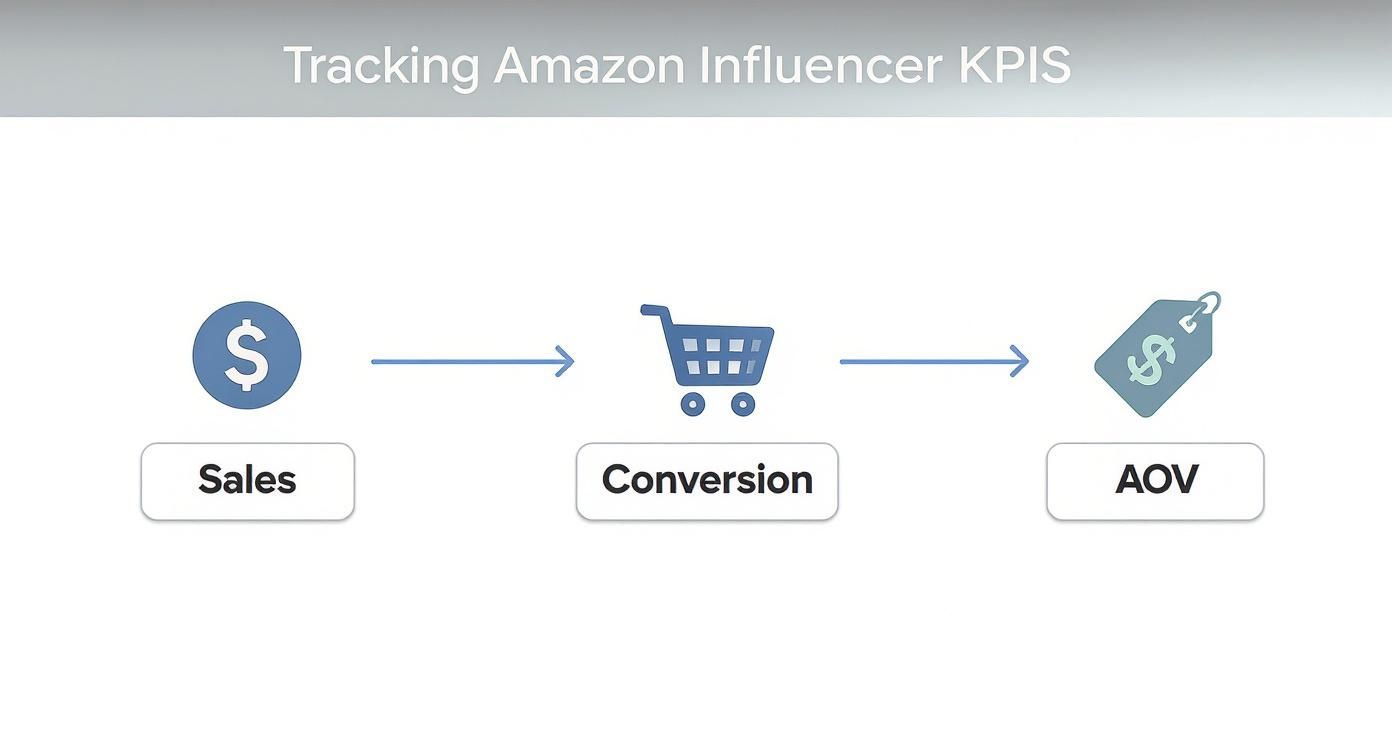
As the visual shows, measuring performance is a process. Each metric gives context to the next, building up to a complete picture of whether a campaign was a success.
Why Per-Creator ROI Is a Game Changer
Looking at your overall program ROI is helpful, but the real magic happens when you can drill down to the individual creator level. A dashboard that gives you per-creator and per-campaign ROI is what lets you stop guessing and start making decisions backed by data.
With this kind of granular view, you can instantly spot your top-performing partners—the ones who consistently deliver a high return. These are the creators you want to build long-term relationships with, invest more in, and feature in your next big campaign.
By focusing on your most profitable partnerships, you can reallocate your budget away from underperforming campaigns and double down on what’s proven to work, maximizing every dollar you spend.
This level of detail is critical for scaling your brand on Amazon. If you want to zoom out and get a broader perspective on calculating overall marketing ROI beyond just influencers, it's worth exploring those strategies as well.
Ultimately, a dashboard turns a pile of complex data into a clear roadmap. It takes away the manual headache of tracking sales and bonuses, giving you the clarity you need to build a profitable, scalable influencer program. For a more detailed look at the formulas and strategies, check out our full guide on how to measure influencer marketing ROI.
What Features Define a Great Influencer Dashboard?
Not all dashboards are created equal, especially when you're playing in the Amazon sandbox. Knowing which features separate a top-tier platform from a basic analytics tool is the key to picking the right partner for your brand. This isn't just about a checklist of capabilities; it's about why those features are make-or-break for an Amazon seller.
The influencer marketing world has absolutely exploded, growing into an estimated $32.55 billion global market. This insane growth is exactly why a purpose-built influencer marketing dashboard is no longer a nice-to-have. For brands serious about tracking, measuring, and actually optimizing their campaigns, it’s a flat-out necessity.
Seamless Amazon Attribution Integration
This one is non-negotiable. If a dashboard doesn't have a deep, reliable integration with Amazon Attribution, you’re flying completely blind. You might see clicks coming in, but you'll have zero clue which creators are actually driving sales, Add to Carts, or—most importantly—new-to-brand customers.
A great dashboard doesn't just show you this data; it makes sense of it. It should automatically pull attribution data for every single creator you work with, killing the need to manually create and track hundreds of individual links. This direct pipeline is the only way to get a true, unbiased look at who's actually moving the needle.
Real-Time Reporting and Granular Insights
Waiting around for weekly or monthly reports is a relic of the past. The Amazon marketplace moves way too fast for that. A top-tier dashboard gives you real-time reporting, letting you see how a creator's post is performing just hours after it goes live.
This speed lets you be agile. If a campaign is a surprise hit, you can double down on it immediately. If it’s a dud, you can pivot your strategy before you waste any more time or money. The dashboard should also offer granular, creator-level insights that let you see:
- Who your top-performing creators are.
- What specific products they sell best.
- Which types of content (like video vs. static images) connect most with their audience.
This is the level of detail where real optimization happens. Once you know who your stars are and want to find more like them, check out our guide on the best influencer outreach tools to build out your roster.
For instance, a clear, visual breakdown of creator performance makes it incredibly easy to spot your top performers at a glance.

When you can instantly see which creators are driving the most clicks, sales, and revenue, you can make fast, data-backed decisions instead of just guessing.
Automated Commissions and Payouts
Honestly, one of the biggest operational headaches for brands running an influencer program is just managing the money. Manually calculating payouts from attribution data, factoring in the Brand Referral Bonus, and then processing individual payments to dozens of creators is a massive time-suck and a recipe for errors.
A great dashboard completely automates this workflow.
It should be your financial command center, accurately calculating what every creator is owed and streamlining the entire payout process. This automation frees up your team to focus on strategy and building relationships, not getting buried in administrative busywork.
Specifically, automated tracking of the Amazon Brand Referral Bonus is a must-have. The platform should calculate the bonus earned from each creator and show you exactly how it offsets their commission. This gives you a crystal-clear view of your net cost per partnership and can turn a collaboration that seems expensive on the surface into a highly profitable one.
By zeroing in on these core features—deep Amazon integration, real-time insights, and financial automation—you can be sure the influencer marketing dashboard you choose will be a powerful growth engine for your brand, not just another piece of software you have to manage.
How to Use Dashboard Insights to Scale Your Brand
An influencer marketing dashboard is so much more than just a reporting tool; it's the engine for your brand's growth. Once you have a steady stream of data flowing in, you can stop guessing and start making smart, profitable decisions backed by hard numbers. This is where you move from passively tracking performance to actively shaping it.

We're going to focus on three core areas where your dashboard insights become immediately actionable: fine-tuning your budget, scaling your best partnerships, and sharpening your creative strategy.
Optimize Your Budget with Precision
The fastest way to scale is to make every single dollar you spend work harder. Your dashboard is the key. It shows you exactly where your money is delivering the highest return, so you can stop spreading your budget thinly across every creator and start making surgical, high-impact investments.
First things first, sort your creators by their ROI. A good dashboard will crunch these numbers for you, factoring in their fees, the sales they've driven, and any Amazon Brand Referral Bonus you've earned. You'll almost certainly see the classic 80/20 rule in action—a small handful of creators will be driving the vast majority of your results.
This clarity is a game-changer. It allows you to:
- Reallocate Your Spend: Confidently shift budget away from the low-ROI creators and double down on your proven winners.
- Negotiate Smarter Deals: Use hard performance data to justify bigger, better collaborations with creators who consistently deliver the goods.
- Test and Learn Efficiently: Set aside a small, controlled part of your budget to test out new creators. You'll know quickly if the partnership has legs and whether you should scale it.
This data-driven approach takes the guesswork out of the equation. It ensures your influencer marketing spend is always working to maximize your bottom line.
Identify and Scale Your Top Partnerships
Once your dashboard has pointed out your star players, it's time to scale those winning relationships. These high-performing creators have proven they have the right audience, authentic credibility, and a content style that truly connects with your brand. Don't treat these as one-off wins; turn them into long-term strategic assets.
For example, your dashboard might show that a micro-influencer in the home decor space is driving an incredible $15 in sales for every $1 you spend on her fee. That’s not just a successful post; it’s a blueprint for a profitable partnership.
With this insight, you can move beyond a single paid post to a more integrated, long-term ambassador relationship. This deepens the creator's connection to your brand, leading to more authentic and consistent promotions that drive sustained growth.
Use your dashboard to build these relationships. Offer performance-based bonuses, give them early access to new products, or bump up their commission rates—all of which can be tracked right inside the platform. Building these strong relationships doesn't just lock in a reliable revenue stream; it also helps to increase customer lifetime value by tapping into their loyal, engaged audience again and again.
Refine Your Creative and Product Strategy
Finally, a great dashboard gives you priceless feedback on what is actually working. The insights go deeper than just which creator is performing well; they give you a direct look at which creative and product combinations are driving sales on Amazon. Use these data points to refine your entire marketing strategy.
Your dashboard can answer the big questions, like:
- Does video outperform static images for this product? If you see that Instagram Reels are driving a 50% higher conversion rate than single-image posts for your new gadget, you know exactly where to focus your creative budget.
- Which of my products are a hit with influencer audiences? If one particular product is a consistent top-seller across multiple creator campaigns, that’s a signal to put more promotional muscle behind it or maybe even bundle it with other items.
- What messaging is actually driving clicks? Look at the calls-to-action and value props in your most successful posts. That language can inform the copy on your Amazon product listings and even your other ad campaigns.
By using your influencer marketing dashboard as your source of truth, you can spot these trends early and adapt fast. This turns your creator program into a powerful testing ground, giving you the real-world data you need to build a smarter, more effective strategy for scaling your brand on Amazon.
Common Questions About Influencer Dashboards
If you're an Amazon brand owner, diving into a new tool always brings up a bunch of practical, real-world questions. Let's cut through the noise and tackle some of the most common ones about influencer marketing dashboards to show you exactly how they fit into your business.
What is an Influencer Marketing Dashboard?
Think of it as your mission control for all things creator-related. An influencer marketing dashboard is a single piece of software that pulls all your campaign management, performance tracking, and payment reporting into one clean, central hub. It’s the end of scattered spreadsheets and trying to stitch together siloed Amazon reports.
For an Amazon seller, this is a game-changer. It means you can see, at a glance, which creators are actually driving sales through Amazon Attribution, how much you’re earning from the Brand Referral Bonus, and what your true ROI is on every single partnership.
What metrics should an influencer marketing dashboard track?
A great dashboard for Amazon brands completely ignores vanity metrics and focuses on what actually puts money in your pocket. You need to see the numbers that draw a straight line from a creator's post to a sale in your Amazon store.
You should be tracking:
- Attributed Sales: The total revenue generated from a creator's unique tracking links. This is your source of truth.
- Conversion Rate: The percentage of clicks that actually turn into paying customers.
- ROI Per Creator: The real profit you're making from each partner after you factor in their fees and any bonuses.
- Brand Referral Bonus Earned: The cash you get back from Amazon, which is absolutely critical for calculating your true profitability.
These are the numbers that tell you the real story. For a deeper dive, you can check out our full guide on the most important influencer marketing KPIs.
How do you measure influencer campaign ROI?
Measuring your real return on investment on Amazon isn't just revenue minus cost—a good dashboard automates the real formula for you. The calculation absolutely has to include the creator's fee, the total sales they generated, and the average 10% Brand Referral Bonus you earn back from Amazon.
For example, let's say you pay an influencer $300, and they generate $3,000 in sales. The $300 bonus you get back from Amazon completely covers their fee, making your true ROI much higher than you'd think. A dashboard does this math for you in real-time. To see more examples, check out our article on influencer marketing ROI.
What makes a good influencer marketing dashboard?
For an Amazon seller, a top-tier dashboard has to be built for Amazon's unique world. The single most important feature is a deep, seamless integration with Amazon Attribution. Without that, you're flying blind and just guessing at your sales data.
Beyond that, you need features like automated commission tracking, streamlined creator payouts, and real-time reporting that shows you what’s happening right now, not last week. It should handle all the messy data and financial tracking so you can spend your time on strategy and building relationships. Any effective affiliate tracking platform worth its salt will have these capabilities baked right in.
Ready to stop guessing and start growing your Amazon brand with data you can actually trust? Coral's dashboard gives you everything you need to track creator performance, automate payouts, and maximize your ROI with built-in Amazon Brand Referral Bonus integration. See how it works at https://coral.ax.