Mastering Customer Acquisition Cost Calculation
Category: Customer acquisition cost calculation
Calculating your customer acquisition cost is pretty straightforward on the surface. You just add up all your sales and marketing expenses over a set period and divide that by the number of new customers you brought in. That one number tells you exactly what you're spending to get each new customer in the door.
Why Your CAC Calculation Is an Essential Business Tool

Let's be real—calculating your Customer Acquisition Cost (CAC) can feel like one more chore on a never-ending to-do list. But with ad costs constantly on the rise, it's probably the most critical health check you can run on your business. It’s what separates guessing about your marketing from knowing its real impact on your bottom line.
I've seen promising startups hit impressive revenue goals only to suddenly run out of cash. The silent killer? A sky-high CAC they weren't paying attention to. Understanding this metric can genuinely be the difference between scaling successfully and burning through your funding with nothing to show for it. It gets right to the heart of whether your business model is actually viable.
Understanding the Rising Costs of Acquisition
The pressure to keep CAC under control is more intense than ever. If it feels like it's getting more expensive to find new customers, you're not wrong. Research shows that acquisition costs have shot up by an eye-watering 222% in the last eight years.
To make matters worse, many e-commerce businesses are now losing around $29 for every new customer they bring on board. Back in 2013, that loss was only $9.
This isn't just a small market dip; it's a massive shift. Companies are spending way more to attract each new customer, which makes knowing your CAC an absolute must-have for survival, let alone growth.
This is exactly why you can't afford to fly blind. A clear picture of your CAC empowers you to make smarter calls on your budget, which channels to double down on, and your overall strategy. It’s the first step toward building a business that’s not just growing, but is also profitable and built to last.
Key Inputs for Your Calculation
Before we get into the math, let's talk about the data you need to pull together. A truly accurate CAC calculation goes way beyond just what you spend on ads. You have to account for every dollar that goes into your customer acquisition machine.
To get started, you'll need to gather a few key things:
- Marketing & Advertising Spend: This is the obvious one. It includes your ad budgets for platforms like Google and Meta, any money spent on content creation, and fees for agencies or freelancers.
- Sales Team Costs: Don't forget the people! You need to include the salaries and commissions for any sales staff directly involved in closing deals.
- Tools & Technology: Every subscription adds up. Factor in the costs for your CRM, marketing automation platforms, and any analytics tools that support your acquisition efforts.
Here’s a quick table to break down the essential components.
Key Components of Your CAC Calculation
This table summarizes the essential inputs needed to accurately calculate your Customer Acquisition Cost.
| Expense Category | What It Includes | Why It's Important |
|---|---|---|
| Marketing & Ad Spend | Paid ads (Google, Meta), content creation, SEO tools, agency/freelancer fees. | This is the most direct cost of reaching potential customers and generating leads. |
| Sales Team Costs | Salaries, commissions, and bonuses for sales reps and managers. | These are the human resources required to convert leads into paying customers. |
| Tools & Technology | CRM subscriptions, marketing automation software, analytics platforms. | These tools are the infrastructure that enables and supports your acquisition process. |
By tracking these inputs, you get a complete picture that connects your spending directly to your results. This clarity is the foundation for improving your numbers and figuring out what actually moves the needle for your business. For a deeper look at how this all ties together, check out our guide on how to measure marketing ROI.
Finding the Right Numbers for an Accurate CAC Formula
An accurate customer acquisition cost calculation is only as good as the data you feed it. The basic formula might seem straightforward, but the real work is in the details—tracking down every single expense that went into winning a new customer. If your inputs are off, your final CAC number will be too, which can lead to some seriously flawed budget decisions.
Most people start by pulling numbers from their ad dashboards, like Google Ads or Meta Ads Manager. That's a good first step, but it’s just one piece of a much larger puzzle. To get the full picture, you need to roll up your sleeves and dig into your accounting software and CRM.
This is all about connecting the dots between your different data sources to get a single, reliable number.
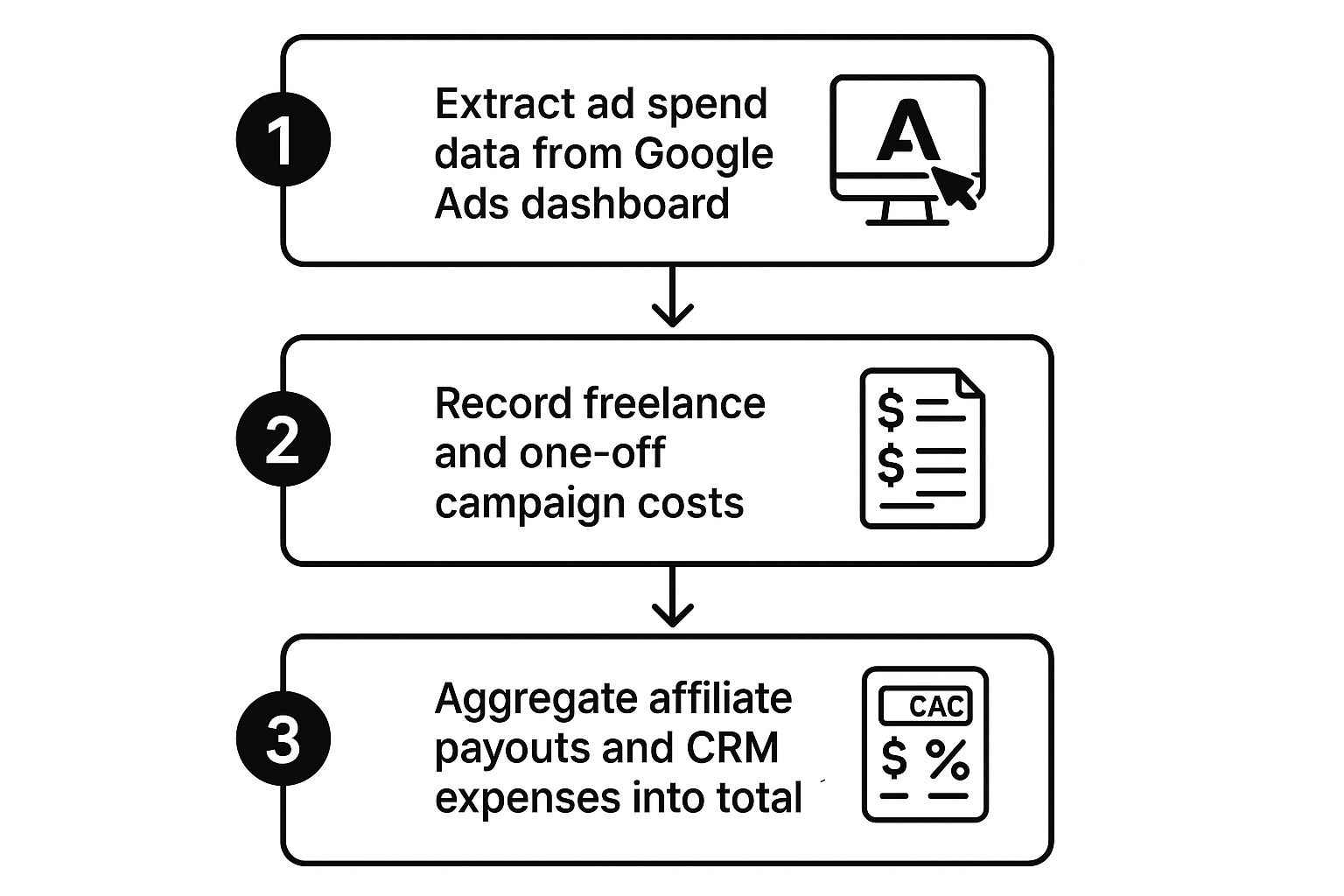
As you can see, a true CAC isn't just about ad spend. It includes everything from freelance invoices and affiliate commissions to the monthly subscription for your CRM.
Uncovering Hidden Acquisition Costs
It's shockingly easy to miss costs that can completely throw off your CAC. These "hidden" expenses often live outside the main marketing budget but are absolutely tied to acquiring new customers. My advice? Set up a system to track these from the get-go. It will save you a world of pain digging through old spreadsheets later.
Think bigger than just your ad spend. Did you bring on a freelance copywriter for a new landing page? That's an acquisition cost. Did you offer a steep 25% discount to entice first-time buyers? The total value of those discounts should be factored in.
To make sure you don't miss anything, run through this checklist:
- Direct Ad Spend: The obvious one—all money spent on platforms like Google, Meta, TikTok, and LinkedIn.
- Content Creation Costs: Fees you paid to freelance writers, designers, or video editors for acquisition-focused content.
- Sales & Marketing Salaries: The portion of salaries for team members directly working on bringing in new business.
- Tech Stack Subscriptions: The monthly or annual costs for your CRM, marketing automation platforms, and analytics tools.
- Affiliate & Influencer Payouts: Any commissions paid out to partners for referring new customers.
The bottom line is this: if an expense helped get a new customer in the door, it belongs in your CAC calculation. Forgetting even one or two of these can make a marketing channel look far more profitable than it really is.
Attribution and Data Accuracy
Okay, so you've gathered all your costs. Now comes the tricky part: tying those costs to the right customers. This is where the concept of attribution modeling becomes crucial. For example, if a customer clicks a Facebook ad, later reads a blog post, and finally converts from an email, which channel gets the credit?
A classic mistake is to give 100% of the credit to the very last touchpoint. This is a problem because it systematically undervalues all the channels that did the hard work of building awareness and trust earlier on. To get a better handle on how to assign value across the entire customer journey, you can dig into different approaches in our guide on what is attribution modeling.
Ultimately, consistency is your best friend. Choose a time frame for your analysis—monthly is a great starting point for most—and stick to it. By tracking the same expenses and applying the same attribution rules every single time, you'll build a set of numbers you can actually trust. That's how you make truly data-driven decisions and grow your business the right way.
Choosing the Right CAC Formula for Your Business
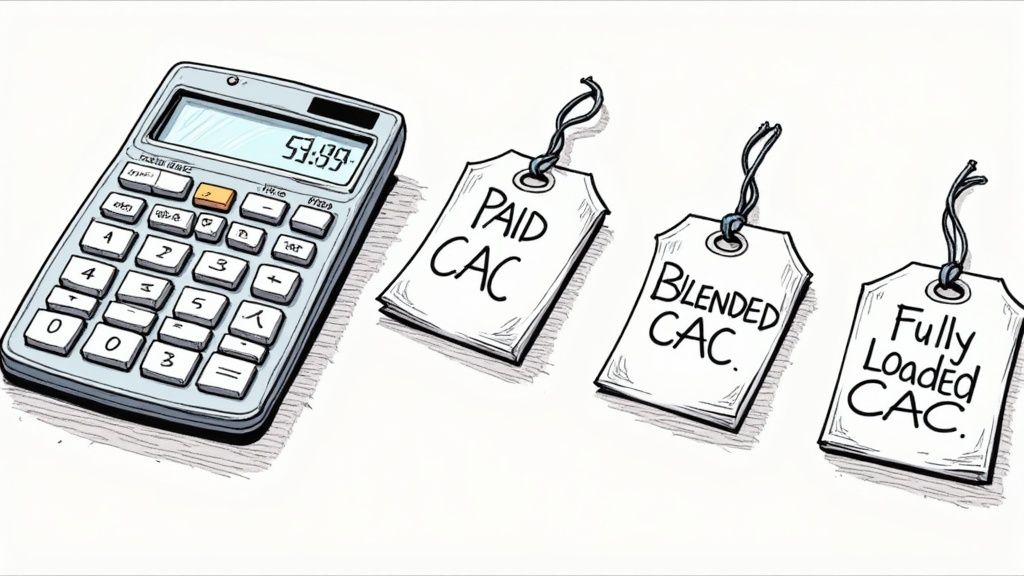
When it comes to calculating customer acquisition cost, there's no one-size-fits-all answer. The formula you use really depends on what you're trying to figure out about your business. While the core idea is always the same—total costs divided by new customers—the specific inputs you choose can paint very different pictures of your company's health.
The most straightforward method is the basic CAC formula. It's the perfect place to start if you just need a quick, high-level snapshot of your acquisition efficiency.
Basic CAC = Total Sales & Marketing Costs / Number of New Customers Acquired
Let's say you run a small online boutique. In a given month, you spend $4,000 on Meta ads and another $1,000 on your email marketing software. That's a total of $5,000. If those efforts bring in 100 new customers, your basic CAC is $50. This simple calculation gives you a solid baseline you can track from month to month.
Blended vs. Paid CAC
The basic formula is handy, but it has one big limitation: it treats all new customers the same. It doesn't care if a customer came from a paid ad or a word-of-mouth referral. This is why it's crucial to distinguish between "blended CAC" and "paid CAC" for a sharper understanding of your marketing engine.
- Blended CAC: This is just another name for the simple formula we just covered. It bundles all marketing costs and divides them by all new customers, regardless of their source.
- Paid CAC: This one is much more specific. It only considers costs from your paid advertising channels (like Google Ads or influencer marketing) and divides that total by the customers acquired directly through those paid efforts.
Imagine you're an e-commerce manager trying to figure out where to allocate your budget. By calculating a paid CAC, you can see that your Instagram ads bring in customers for $30 each, while your Google Ads are costing you $90 per customer. Suddenly, it's crystal clear where you should be doubling down.
The Power of a Fully Loaded CAC
For a truly unvarnished look at your acquisition spending, you need to calculate a "fully loaded" CAC. This is the most honest and comprehensive version because it factors in everything. We're not just talking about ad spend; we're including the salaries of your sales and marketing teams, the cost of your software stack, and any other operational overhead tied to bringing in new customers.
A fully loaded CAC stops you from mistakenly thinking a channel is a goldmine when the hidden human and tech costs are actually destroying your margins. It’s the formula that keeps your business model grounded in reality.
The principle is always the same: add up all your marketing and sales expenses—ads, salaries, software, content, even first-time customer discounts—over a period, then divide by the number of new customers you won in that timeframe. But context is everything. CAC can swing wildly depending on your industry. SaaS companies, for example, often see average CACs anywhere from $200 to over $700. You can dig into what drives these benchmarks in this helpful customer acquisition cost overview.
A SaaS founder pitching to VCs would absolutely use a fully loaded CAC. It shows you have a deep command of your business's real profitability and proves your growth model is sustainable, which makes for a much more compelling investment case.
Connecting CAC to LTV for Sustainable Growth
https://www.youtube.com/embed/KvPhM_-LLP4
Figuring out your customer acquisition cost is a huge milestone. But let’s be honest, that number on its own doesn’t really tell you much. A $50 CAC could be a massive win for one company and a total disaster for another.
So, what’s the missing piece of the puzzle? It’s Customer Lifetime Value (LTV).
LTV is the total revenue you can expect to bring in from a single customer over the entire time they do business with you. When you put your CAC and LTV side-by-side, you get a crystal-clear picture of your company's long-term financial health and whether your growth is actually profitable.
The LTV to CAC Ratio Explained
We look at this relationship through the LTV:CAC ratio. It’s a simple comparison, but it’s probably one of the most important health metrics for a growing business. It answers the one question that really matters: are you spending your acquisition dollars wisely?
A 1:1 ratio is a serious warning sign. It means for every dollar you spend to get a customer, you're only getting that same dollar back. You're essentially just buying revenue, not building a profitable business. There's no margin left to pay your team, keep the lights on, or invest back into the company.
On the flip side, an incredibly high ratio, like 10:1, might seem like a dream come true. But it could actually mean you're being too conservative with your marketing spend and missing out on major growth opportunities.
The Gold Standard: For most SaaS and subscription businesses, the sweet spot for the LTV:CAC ratio is 3:1 or higher. This shows that for every dollar you invest in bringing in a new customer, you're getting at least three dollars in return over their lifetime. That’s a signal of a healthy, scalable, and profitable engine for growth.
Interpreting Your LTV to CAC Ratio
A healthy business model hinges on this ratio. Most experts will tell you to aim for at least a 3:1 LTV to CAC to ensure you’re growing sustainably. If your ratio is lower, it’s a sign that your acquisition spending is eating away at your profits.
This is a critical blind spot for many companies. It’s fascinating that while 44% of businesses focus on acquiring new customers, only 18% prioritize retention—even though keeping an existing customer is almost always cheaper. You can see just how much customer acquisition costs vary by industry in this report.
To make this really practical, let’s break down what your ratio means and what you should do about it.
Interpreting Your LTV to CAC Ratio
A guide to understanding what your LTV:CAC ratio means for your business strategy.
| LTV:CAC Ratio | What It Means | Recommended Action |
|---|---|---|
| Below 1:1 | You're Losing Money | Immediately halt or completely rethink your current acquisition strategy. This model is unsustainable. |
| 1:1 | Breaking Even | You're not making any profit from new customers. It's time to focus on increasing LTV or lowering your CAC. |
| 3:1 | Healthy & Scalable | Your business model is solid. You’ve struck a good balance, signaling you have a strong foundation for growth. |
| 4:1+ | High Growth Potential | You have an excellent, efficient model. It’s time to double down and invest more aggressively in your proven channels. |
Of course, context matters. A brand-new startup trying to grab market share might stomach a lower ratio for a short period. But for any established business, that 3:1 benchmark is key.
Once you start looking at both sides of this equation, you stop seeing CAC as just a "cost." Instead, it becomes a strategic "investment." One of the most effective ways to improve your ratio is by focusing on the value side of the equation; for some great ideas, check out our guide on how to increase customer lifetime value.
Proven Strategies to Lower Your Acquisition Costs
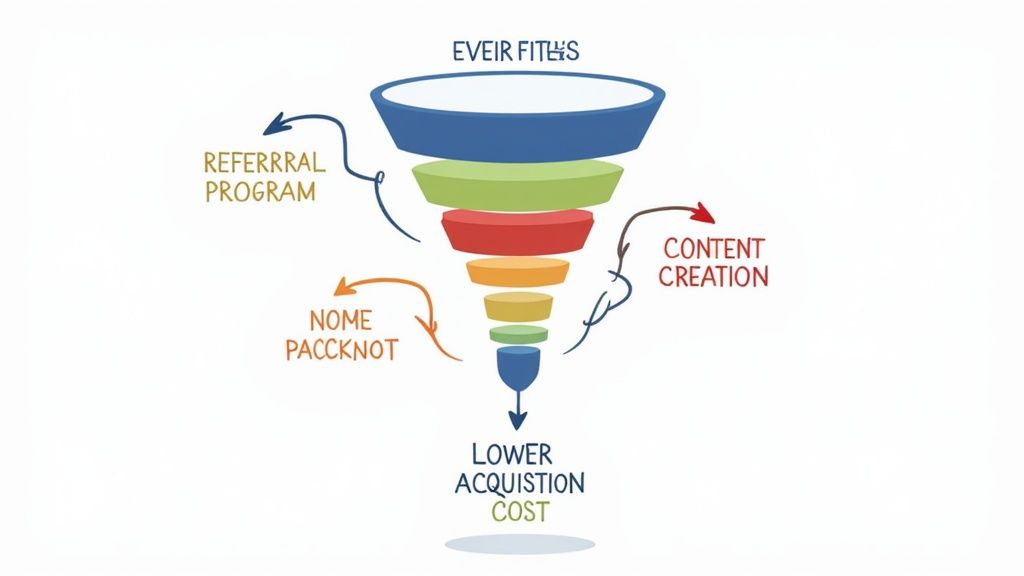
So you've nailed down your customer acquisition cost calculation. Now the real fun begins: getting that number as low as possible.
Lowering your CAC isn’t about blindly slashing your marketing budget. It’s about being smarter with your spending, making targeted investments that actually pay off. You want to double down on what works and cut the dead weight.
Let's get into some practical strategies that have a real impact on your bottom line.
Reallocate Your Ad Budget Wisely
One of the fastest ways to bring down your CAC is to stop wasting money. It sounds obvious, I know, but you’d be surprised how many businesses spread their ad spend too thin without really knowing which channels are pulling their weight.
You need to calculate a "Paid CAC" for each and every ad channel you use—Google Ads, Meta, TikTok, you name it. You might find that your overall blended CAC is $75, but Google is bringing in customers for $40 while LinkedIn is costing you a whopping $150.
Once you see the numbers laid out like that, the path forward becomes crystal clear:
- Drastically cut or pause spending on the expensive, high-CAC channels.
- Funnel that freed-up budget directly into your top performers.
This one move alone can make a huge dent in your average acquisition cost without spending a single extra cent.
I see a lot of founders chase scale on every platform. That's a mistake. It’s far better to dominate the one or two channels where you can acquire customers profitably. Profitability beats presence every single time.
Launch a Simple Customer Referral Program
Your happiest customers can be your most effective (and cheapest) marketers. A solid referral or affiliate program can turn your customer base into a growth engine. Think about it: a recommendation from a friend is infinitely more trustworthy than an ad.
For instance, an e-commerce shop could offer a $20 store credit to both the person referring and their friend who makes a purchase. Just like that, your acquisition cost for that new customer is a predictable $20—almost certainly less than you'd pay for them through a cold ad campaign.
If you need a starting point, there are some great guides on setting up an affiliate program for ecommerce that walk you through the process.
Improve Onboarding and Retention
Finally, don't forget that a healthy CAC is only half the picture. The real goal is to increase the value of the customers you acquire. A customer who sticks around for the long haul makes that upfront acquisition cost much more palatable.
Your onboarding process is your golden opportunity to show a new user they made the right choice. Guide them to that "aha!" moment as quickly as you can, and you'll dramatically increase the chances they become a loyal, long-term advocate. This boosts your LTV and, in turn, improves your crucial LTV:CAC ratio.
Acquisition is just the start. Implementing effective customer retention strategies is what truly builds a sustainable business.
Got Questions About CAC? Let's Get Them Answered
Once you start digging into your customer acquisition cost, you'll inevitably run into some tricky "what if" scenarios. These are the practical questions that can make a simple formula feel a lot more complex. Let's walk through some of the most common ones I hear so you can feel confident in your numbers.
Monthly vs. Quarterly CAC: Which is Better?
One of the first things people ask is about the right time frame. Should you be looking at your CAC every month or every quarter?
Calculating it monthly is great for businesses with short sales cycles, like most e-commerce brands. It lets you spot trends and react quickly if your costs suddenly jump.
On the other hand, a quarterly calculation gives you a more stable, big-picture view. It smooths out the inevitable peaks and valleys—like a fluke viral post one month or a holiday slowdown the next. This is especially helpful for B2B companies where the journey from first contact to a signed deal can take a while.
What Do We Do with Free Trial Users?
This is a huge one for any SaaS business. You've got all these users signing up for a free trial, but they aren't paying you yet. How do they fit into the CAC formula?
It's tempting to count them as new customers, but don't. Including them would make your CAC look artificially low and give you a dangerously misleading picture of your marketing efficiency.
The rule of thumb is simple: a user only becomes a "customer" the moment they start paying. All the marketing and sales costs that went into acquiring that group of free users should be tied to the period when they actually convert, not when they first signed up.
This method keeps your customer acquisition cost calculation honest and directly links your spending to real, incoming revenue.
How Should We Handle Multi-Touch Attribution?
Attribution is another classic headache. A customer sees a Facebook ad, later reads a blog post from a Google search, and finally clicks a link in your newsletter to make a purchase. Which channel gets the credit?
Giving 100% of the credit to that last click is the easiest way to do it, but it's almost always wrong. This "last-touch" model completely ignores the work your other channels did to build awareness and trust along the way.
A far better approach is to adopt a multi-touch attribution model that gives partial credit to each touchpoint. It takes more sophisticated tracking, for sure, but it gives you a much more accurate view of what’s truly driving conversions. For instance, you might want to understand how influencers create that initial spark. You can dig deeper into measuring the impact of those campaigns by learning how to track influencer marketing ROI.
Ready to turn happy customers into your most powerful acquisition channel? With Coral, you can build, manage, and scale a high-performing affiliate program right on Amazon. Start for free today.